
Game review
Mount and Blade: Warband
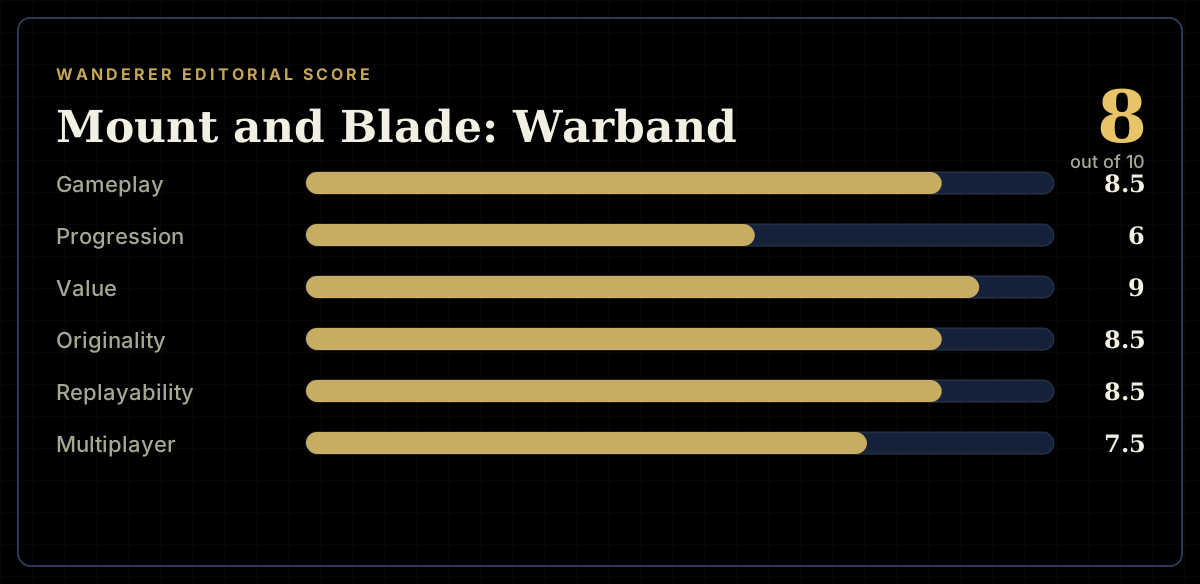
8 / 10
- Developer
- TaleWorlds Entertainment
- Publisher
- TaleWorlds Entertainment
- Released
- 31 March 2010
- Platforms
- Windows, macOS, Linux
- Genre
- Action RPG
- Monetisation
- Paid, one-time purchase, plus two official paid DLC (Napoleonic Wars, Viking Conquest Reforged Edition). No in-app purchases or ongoing live-service monetisation.
- Players
- Full multiplayer support for up to 64 players across Deathmatch, Team Deathmatch, Capture the Flag, Conquest, Battle and Siege modes, alongside a complete single-player campaign.
The short version
Mount and Blade: Warband is fifteen years old, looks it in places, and still sits at Overwhelmingly Positive across more than 135,000 reviews — a rare combination that says more about how little else has fully copied its skill-based mounted combat and open, faction-driven sandbox than about nostalgia alone. It's also a game whose most consistent criticism has never really gone away: campaigns that start with real narrative momentum — recruit farmers, fight bandits, build a company — routinely stall into a repetitive mid-and-late-game grind against lords who can't be permanently removed from play, an issue reviewers were raising in 2014 and are still raising in reviews dated 2025.
Biggest strengths
- A mounted and melee combat system built on directional attacks, blocking and momentum that few other games have matched, let alone quinceañera-old ones.
- A genuinely open, emergent campaign — join or betray factions, marry into nobility, build a mercenary company or found your own kingdom, with no fixed critical path.
- Full 64-player multiplayer across six distinct modes, including large-scale Siege and Conquest battles built around the same skill-based combat as the campaign.
Biggest weaknesses
- A specific, long-standing structural complaint recurs across reviews from 2014 through 2025: enemy lords cannot be permanently defeated, only captured and inevitably released or escaped, which undercuts the satisfaction of prolonged campaign warfare.
- Troop AI and order-following issues are reported as ongoing problems by reviewers as recently as December 2025, not just a legacy complaint from the early Steam years.
- The Linux port has drawn specific stability complaints in the review sample, and Steam Deck control mapping for the game's directional-attack system is criticised in at least one 2025 review.
Who it's for: Fans of sandbox RPGs, medieval combat and emergent strategic warfare who don't need hand-holding or modern production values, and who are prepared to lean on the mod scene once the base campaign's structural repetition sets in.
Our recommendation: An easy recommendation at its price, but go in expecting the campaign's back half to demand real patience, and treat the extensive mod scene as part of the intended experience rather than an optional extra.
8 / 10
A combat system nothing else fully copied
Mount and Blade: Warband's reputation rests first on its combat, and the review sample is remarkably consistent about why. Melee attacks are directional — swing from the left, right, above or thrust, block along the same four directions, and manage horseback momentum, weapon reach and shield coverage as live, moment-to-moment variables rather than a stat check resolved by a dice roll. It's a system genre fans have spent fifteen years pointing to as still largely unmatched, and the store page's own feature list backs up the seriousness behind it: motion-captured combat animations, a physics-aware system where "your shield will still stop arrows even if you are not actively defending," and the ability to pick up any battlefield projectile to reuse. Official screenshots show what that looks like in practice — mounted cavalry charging through snow with raised swords and full kit, infantry lines advancing across open grassland under faction banners — and while the fifteen-year-old character models and textures are plainly of their era, the sense of a real, physically simulated battlefield comes through even in a still image.
Layered on top of that combat is a genuinely open campaign structure. The player starts as nobody in particular in the fictional realm of Calradia and can become a wandering mercenary captain, a vassal lord, a rebel building an independent kingdom, or a married noble consolidating power through political ties rather than the sword — the store page specifically highlights the ability to "marry a lady of the realm for romance or cold political gain" and to win her over "through poetry or bravery," a detail that signals real breadth of approach rather than a single win condition. One long, detailed 2017 review calls it a game where the player "can aspire to become a noble lord, powerful king (or even emperor)" and means it literally — there is no scripted endgame forcing any one of those outcomes.
The complaint that's stayed exactly the same for over a decade
What's most striking about reading Warband's negative reviews in chronological order isn't that they're harsh — most aren't, and several open by praising the same combat system covered above — it's how little the central complaint has changed since Steam reviews for this game began. A 2014 review calls it "a very frustrating game" specifically because it "merges a roleplay game with a strategy game while at the same time implementing them so weakly." A 2022 review, going deliberately against a hundred thousand positive votes, describes the campaign as becoming "a frustrating wrangle with the computer-controlled factions and lords" once the early game's momentum runs out. A January 2025 review is the most specific about the actual mechanical cause: "Deathless lords who can escape from any prison? Cringe. The lack of a 'kill lords' option feels nonsensical" after enjoying the first 10-20 hours enormously. That's not three isolated complaints — it's the same structural issue, independently identified across an eight-year span, by reviewers who otherwise land on different sides of recommending the game.
A second, more technical thread runs alongside it: troop and army AI. A December 2025 review — as recent as the review sample gets — describes the game as "utterly broken is so many ways. Between troops ignoring orders, separate invisible barriers for you and for your troops leading to confusion, missions being broken, crashing." That a fifteen-year-old, extensively patched game is still drawing bug reports this specific and this recent suggests these aren't teething problems from launch but persistent, unresolved rough edges the sandbox scale of the game has never fully smoothed out. Platform-specific complaints round out the technical picture: a Linux port criticised for buggy performance and driver crashes in an older review, and a December 2025 review flagging directional attack and parry controls as poorly suited to Steam Deck's control scheme.
Multiplayer, mods, and why the base game was never meant to be the whole story
Warband's multiplayer is a full, separate pillar rather than an afterthought — up to 64 players across Deathmatch, Team Deathmatch, Capture the Flag, Conquest, Battle and Siege, running on the same skill-based combat as the campaign, with an in-match equipment economy the store page describes as "carefully balanced" to reward skill over pure grinding. That multiplayer backbone is also what the game's two official DLC expansions build on most directly: Napoleonic Wars reskins the combat system into large-scale musket-and-bayonet line battles, and Viking Conquest Reforged Edition adds a full alternate campaign and setting. Steam Workshop support opens the door further, and the sheer volume of community tag engagement — over 1,400 votes for "Moddable" alone — confirms a game whose own player base treats modification as a core, expected part of owning it rather than a niche sideline. None of that erases the base campaign's structural repetition problem covered above, but it does mean a player who bounces off the vanilla mid-game loop has real, well-trodden alternatives within the same purchase rather than needing to buy something else entirely.
Final verdict
Mount and Blade: Warband earns its stature honestly: a combat system that still holds up against much newer competition, a genuinely open sandbox campaign with real strategic and political freedom, a substantial multiplayer mode built on the same mechanical foundation, and one of PC gaming's most enduring mod scenes backing all of it up. It also carries a real, specific structural flaw that reviewers have been naming consistently for over a decade — an endless-war campaign loop with no way to permanently remove rival lords from the board — plus AI and stability rough edges that recent reviews confirm are still present in 2025, not just old complaints inherited from a worse-optimised launch build. At its price, and against everything else it offers, that's a trade worth making for the audience it's built for; it's not a game that's aged into flawlessness just because it's aged into a classic.
Pros and cons
Pros
- A mounted and melee combat system built on directional attacks, blocking and momentum that few other games have matched, let alone quinceañera-old ones.
- A genuinely open, emergent campaign — join or betray factions, marry into nobility, build a mercenary company or found your own kingdom, with no fixed critical path.
- Full 64-player multiplayer across six distinct modes, including large-scale Siege and Conquest battles built around the same skill-based combat as the campaign.
- Steam Workshop support plus a long-running independent modding community, backed by two substantial official DLC expansions (Napoleonic Wars, Viking Conquest).
- Exceptional value at its price point given the sheer number of hours reviewers across a decade and a half report getting out of it.
Cons
- A specific, long-standing structural complaint recurs across reviews from 2014 through 2025: enemy lords cannot be permanently defeated, only captured and inevitably released or escaped, which undercuts the satisfaction of prolonged campaign warfare.
- Troop AI and order-following issues are reported as ongoing problems by reviewers as recently as December 2025, not just a legacy complaint from the early Steam years.
- The Linux port has drawn specific stability complaints in the review sample, and Steam Deck control mapping for the game's directional-attack system is criticised in at least one 2025 review.
- Fifteen-year-old visuals and animation will be a real barrier for players used to modern production values, even accounting for the game's own charm.
Screenshots
-

Mount & Blade: WarbandImage: TaleWorlds Entertainment via Steam -

Mount & Blade: WarbandImage: TaleWorlds Entertainment via Steam -

Mount & Blade: WarbandImage: TaleWorlds Entertainment via Steam -
How the review scores each part of the gameWanderer Editorial -
The short versionWanderer Editorial