Game review
V Rising
8 / 10
- Developer
- Stunlock Studios
- Publisher
- Stunlock Studios
- Released
- 17 May 2022
- Platforms
- Windows, PlayStation 5
- Genre
- Survival action-RPG
- Monetisation
- Premium, one-off purchase. All post-launch DLC is cosmetic — armor sets and a licensed Castlevania crossover pack — none of it affects PvP or PvE power on a shared server
- Players
- Dedicated PvP and PvE servers up to 40+ players depending on host settings, plus private solo or duo worlds; full-loot base raiding on public PvP servers
The short version
V Rising solves survival-crafting's oldest problem — the moment progression turns into an undirected grind — by replacing the tech tree with a hit list. Every real unlock comes from killing a named V Blood boss, and the combat asked of you to do it is genuinely action-RPG quality: dodges, cooldowns, boss patterns worth learning. The catch is that the game's core identity is full-loot PvP raiding, and a large share of its actual audience plays on private or PvE servers specifically to avoid that identity, which makes recommending it depend heavily on which server you intend to join.
Biggest strengths
- The V Blood boss hunt turns progression into a curated sequence of fights instead of an open-ended crafting checklist, so there's always a specific, named next goal
- Combat has real action-RPG mechanics — dodge-cancels, cooldown-based abilities, weapon-specific combos — and boss fights are built around patterns worth learning rather than stat checks
- Sunlight is a genuine traversal constraint, not flavour text, and forces route-planning that most survival games never bother to attach to their day-night cycle
Biggest weaknesses
- The gear grind past roughly item level 85 shifts from boss hunting into rolling secondary stats on gems and legendaries, and the game stops introducing anything new while it asks for this
- Full-loot PvP raiding is the system the whole game is balanced around, but a large share of the player base plays PvE or solo specifically to avoid it, leaving that identity underused by its own audience
- A dry castle heart on a live multiplayer server keeps decaying while you're logged off, so a week away from a PvP world can mean coming back to a weaker base than you left
Who it's for: Players who want survival-crafting with real combat depth and don't mind a curated progression path; small groups willing to commit to a server type before they start rather than after. Solo PvE players will have a good time for thirty or forty hours before the endgame starts assuming a clan.
Our recommendation: Buy it if you're choosing your server type on purpose — PvE or a private world for the boss hunt and castle building, a populated PvP server only if raiding other players' castles is actually the game you want. Skip it if "vampire survival game" was the whole pitch; the vampire parts are the least demanding half of what you'll actually be doing.
8 / 10
Most survival-crafting games hand you a tech tree and let you get lost in it. V Rising hands you a kill list. Every meaningful unlock — new abilities, new recipes, new castle pieces — comes from tracking down and killing a specific, named boss called a V Blood carrier, and that single design choice is doing more work than the vampire theming to make this one of the more focused games in its genre. It's also, two years after leaving Early Access, a game whose real audience doesn't quite match the game it's built around: this is a PvP raiding game at its foundations, and a noticeable share of the people playing it are on private or PvE servers specifically to opt out of that foundation.
The boss hunt is the progression system
Strip away the gothic dressing and V Rising's structure is straightforward: you wake up as a freshly-revived vampire with almost nothing, and the game's map is dotted with V Blood bosses — named NPCs, usually humans or other creatures with a distinct fighting style, ranked roughly by difficulty. Killing one doesn't just drop loot. It permanently unlocks a specific ability, recipe, or structure tied to that boss, visible on a tracker before you ever fight them. Want the ranged spell that lets you kite effectively? There's a boss for that. Want the crafting station that unlocks refined leatherworking? Same deal.
This solves a problem survival-crafting games rarely solve well: the moment, usually somewhere around hour fifteen, where the tech tree runs out of obvious next steps and the game starts asking you to grind resources toward a goal you chose for yourself rather than one the game gave you. V Rising never really has that moment in its first two-thirds, because the next V Blood is always on the map, always named, and always tied to a specific reward you can see before you commit to the fight. It's progression as a curated hit list rather than an open-ended checklist, and it gives the game a sense of forward motion that Valheim's biome gates aim at from a different angle — Valheim resets your competence with each new zone, forcing you to relearn threats from scratch, while V Rising hands you a specific next target and tells you exactly what killing it buys before you commit to the fight. Neither approach is strictly better; V Rising's is more legible, Valheim's produces a stronger sense of dread.
Where it strains is after that two-thirds mark. Once the main V Blood roster is cleared, out around gear level 85 by most players' accounts, the game's remaining content shifts from "kill this named thing" into rolling random secondary stats on gems and legendary weapons through repeatable rift content — the exact undirected grind the boss list spent forty hours avoiding. It's not a small seam. It's the point where V Rising stops being distinctive and starts being any other loot game asking you to pull the same lever repeatedly for a better roll.
Combat that actually earns the ARPG label
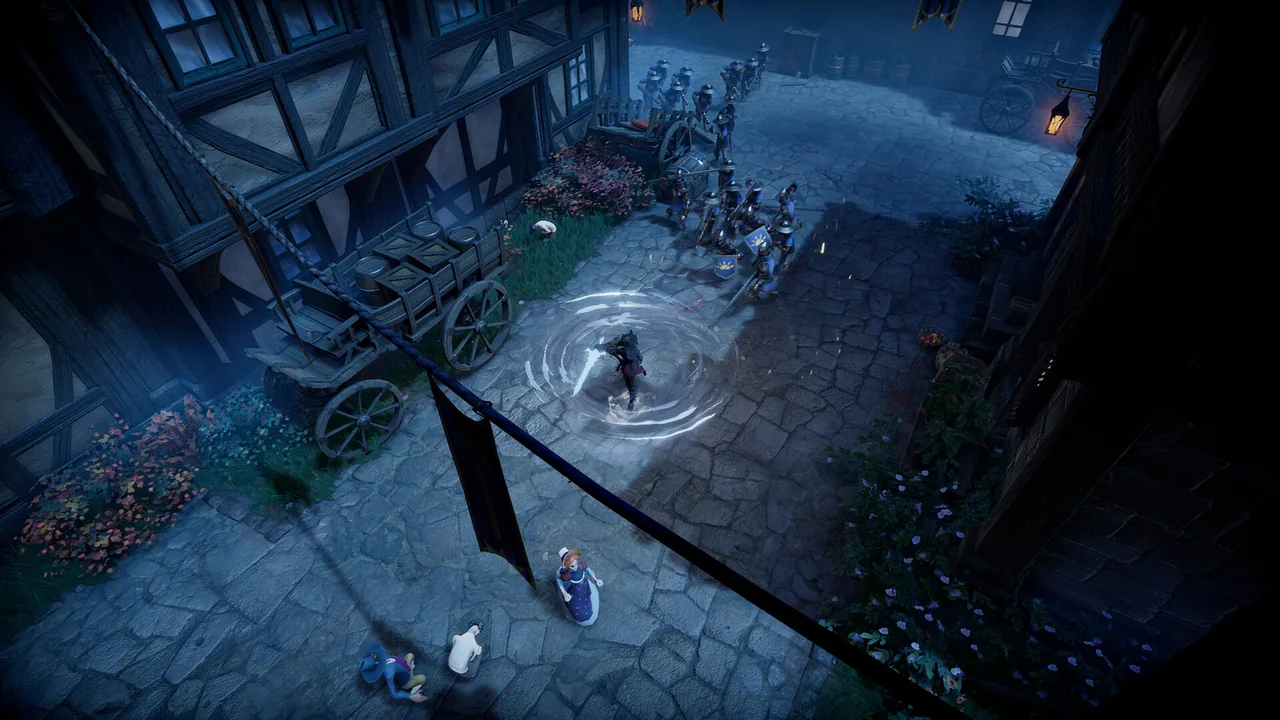
Here's the part that separates V Rising from most of its genre neighbours: the combat is good in a way survival games almost never manage. You've got a dodge with real invincibility frames, a handful of weapon types that each carry distinct combo strings, and a bar of spell slots pulled from an unlock pool that lets you build a loadout around specific matchups rather than one fixed kit. Boss fights are built around actual patterns — tells worth reading, phases that change the fight's shape, punish windows that reward patience over button-mashing — rather than the stat-check encounters that pad out most crafting games' combat.
The reason this works mechanically is that Stunlock Studios came out of making Battlerite, a top-down arena brawler, and it shows: ability cooldowns are tuned tightly enough that fights have real rhythm, and the game commits to making positioning and dodge timing matter more than gear level for a much longer stretch than survival games usually allow. A geared player who dodges badly loses to a worse-geared player who reads the fight correctly, at least until the gap gets wide enough to overwhelm skill entirely. That's an ARPG design principle, not a survival-game one, and it's the single best reason to recommend V Rising to someone who bounced off the genre's usual combat floor.
The criticism worth taking seriously, and one that shows up constantly in player feedback, is that this same combat system gets noticeably less fun on the hardest PvE difficulty. Brutal mode was tuned with PvP matchups in mind — long defensive cooldowns designed to stop one player from permanently stunlocking another — and against AI, which doesn't share those cooldown constraints, those same long windows just mean more time getting hit before you can respond. It's a real design tension: the system that makes duels feel fair against another player makes solo boss fights feel unfair against the computer, and Stunlock hasn't fully closed that gap.
The vampire mechanics are systems, not costume
It would be easy for a game called V Rising to treat vampirism as flavour text over a generic survival loop. It mostly doesn't. Three mechanics in particular function as real systems rather than theming:
Sunlight is an actual traversal constraint. Step into direct daylight without shade, shadow cloak or a stone coffin nearby and you take real, escalating damage — which means route planning through the overworld is genuinely shaped by where the shadows fall, not just where the monsters are. It's one of the few survival games where the day-night cycle changes what you can physically do rather than just what spawns.
Blood types turn feeding into an economy rather than a health bar top-up. Every NPC you drain carries a blood type — Worker, Warrior, Rogue, Scholar and so on — and each type grants a different temporary buff at different percentages depending on the individual you fed on. Hunting down a 95% Warrior blood carrier for a big physical damage buff before a boss fight, or a high-quality Scholar for spell power, makes feeding a genuine tactical decision rather than a chore, and it's a smart way to make the game's human NPC population matter beyond being scenery.
Castle heart decay is the one that matters most to anyone weighing this game against something like Wanderer's own always-ticking world. Your castle's heart holds a reserve of blood essence, and once that reserve runs dry, the castle begins decaying — walls losing structural integrity, the base becoming easier to break into — and on a live multiplayer server, that clock keeps running whether you're logged in or not. A higher-level heart buys a longer buffer before the decay starts, and server hosts can set the decay rate to zero for casual groups, but on a populated PvP server running default settings, a week away from the game is a week your castle spent getting weaker for someone else to walk into. Private and solo worlds don't tick while nobody's connected, so the punishment is specific to shared servers rather than universal — but it's real, and it's the kind of design decision that should be part of anyone's decision about which server type to join, not a detail discovered after building a base you're proud of.
PvE and PvP are effectively two different games
This is the thing to get right before buying: V Rising was designed around full-loot PvP raiding, where a rival clan can siege your castle, break in, and take what they find. That system shapes combat balance, castle placement, resource pressure, and the entire social layer of the game. It's also not what a large share of the actual playerbase is doing. PvE servers strip out player-versus- player combat and raiding entirely, private and solo worlds let you set every rule yourself, and plenty of players — solo reviewers among them — report finishing the whole V Blood roster without ever fighting another person.
Both are legitimate ways to play, but they produce genuinely different games. On a PvP server, the threat of losing your base to a better-organised clan gives every hour of progress real weight, and the siege and raid tools — Siege Golems, explosives, the weekly PvP windows server hosts configure — are built with real depth. On a PvE or private server, you get the boss hunt, the castle building and the blood economy without any of that risk, which is a genuinely good time for thirty or forty hours, but it also means you're playing past the game's actual design centre of gravity rather than through it. Neither choice is wrong. What's worth avoiding is joining a public PvP server without understanding that your castle is a target the moment you place its heart, or joining expecting PvP and discovering a server population that's mostly there to avoid you.
Castle building: expressive, but load-bearing
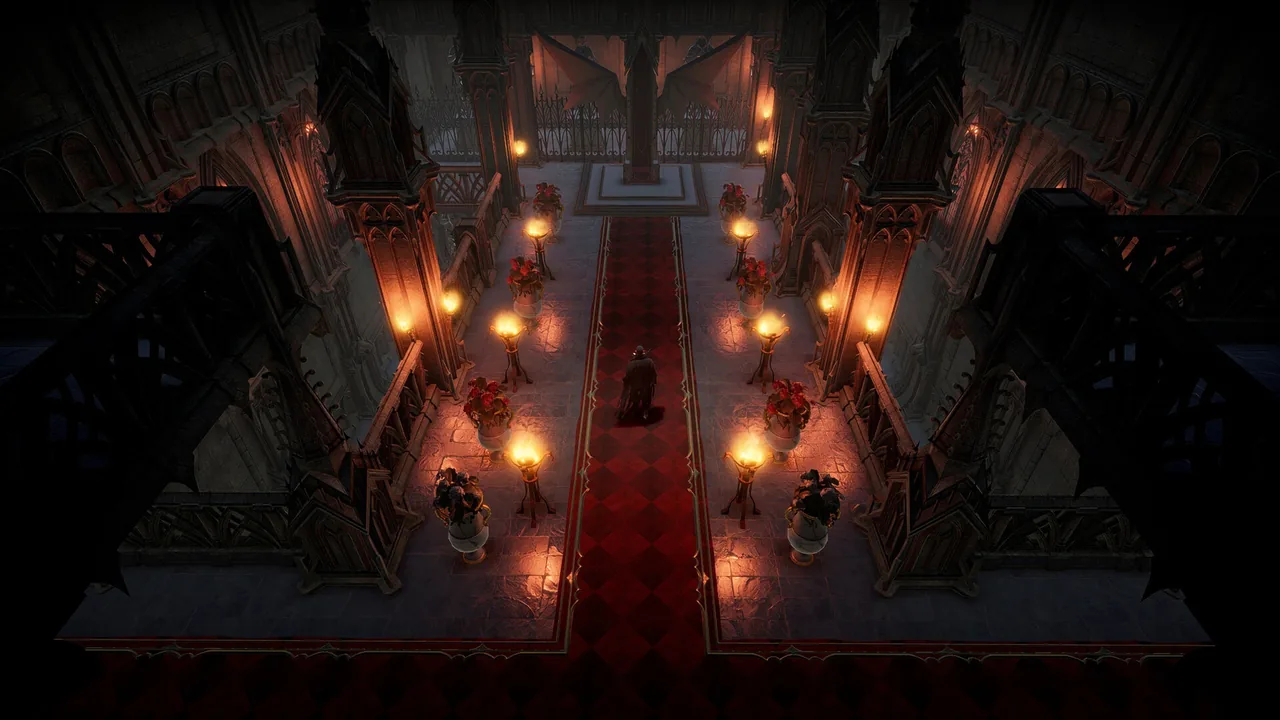
Building in V Rising splits cleanly into two halves, and both matter. The mandatory half is functional: floor tiles need a connected foundation, workstations need to sit in specific rooms to function at full efficiency, and your castle heart's level gates how large a territory you can claim. The expressive half is genuinely deep for a survival game — wall types, roof shapes, staircases and multiple floor levels let you build something that looks like an actual gothic castle rather than a box with a door, and the shape of your build has real tactical consequences on a PvP server, where a maze-like layout can slow down raiders as effectively as thicker walls.
It's a stronger building system than most of its genre peers offer, closer to what a dedicated builder wants than what Enshrouded or Valheim provide, without going as far into pure sandbox territory as something like Core Keeper's more contained base loop.
Presentation and performance
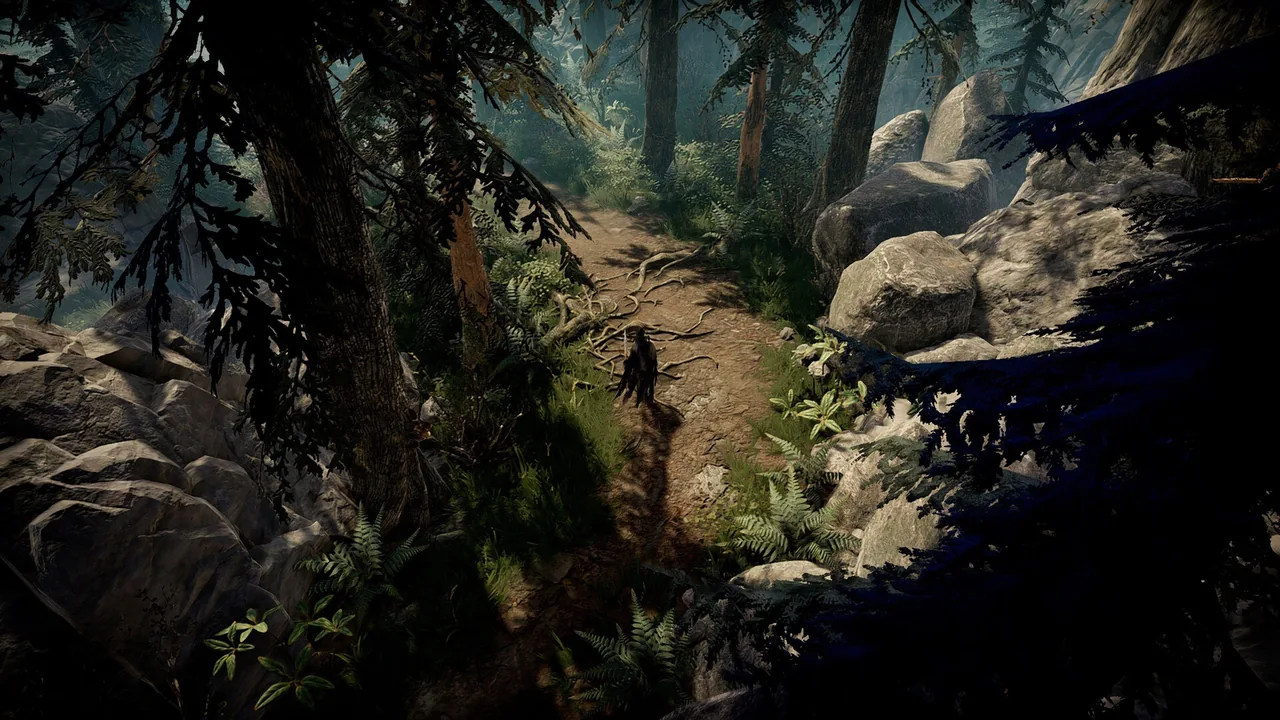
The isometric-adjacent camera and painterly gothic art direction do a lot of work to make V Rising feel distinct from its top-down survival-game contemporaries — Gloomrot's industrial decay and the Farbane Woods' overgrown ruins both look genuinely considered rather than generated. The sound design leans competent rather than exceptional: combat has good weight to its hits, but the ambient and menu music doesn't leave much of an impression next to the genre's stronger scores.
Performance is generally solid on the stated system requirements, with the more common complaints in player feedback centring on server-side issues — rubber-banding and desync on busier public servers — rather than client-side frame rate. Anyone hosting or joining a self-managed dedicated server should expect the usual survival-game caveat that a well-run private server plays better than a crowded public one.
Monetisation and value
V Rising is a straight premium purchase at NZ$49.99, with every piece of post-launch content sold as cosmetic DLC — outfit packs, and a genuinely well-executed collaboration with Konami that lets you dress as Alucard from Castlevania. None of it affects combat power on a shared server, which matters more here than in most games given how central PvP raiding is to the base design: nobody is buying an advantage in a siege. At the price of a couple of takeaway dinners for a game that realistically offers thirty to sixty hours before the endgame grind sets in, the value case holds up regardless of which server type you choose.
Where it costs you
The honest weak points, beyond the mid-game grind already covered: population decline is a real concern for anyone joining a public server today rather than at launch, and Stunlock's March 2026 announcement that the game is now content-complete — while they build a new, separately-branded vampire game in the same universe — means there's no new zone coming to draw players back in the way Invaders of Oakveil did in April 2025. The game you're buying today is essentially the final version of itself, still being hot-fixed and balance-patched as recently as June 2026, but not growing. And solo play, while genuinely viable for the boss-hunt portion, starts to show its seams once content assumes you've got a coordinated group backing you up for sieges and the toughest late-game fights.
Players who like a world that keeps making quiet, structural demands on their time even when they're not actively playing it — a system with its own clock rather than a static save file — may also find something familiar in Wanderer's approach to progression that continues whether or not you're logged in.
Verdict
Eight out of ten. V Rising's central idea — replace the survival-crafting tech tree with a curated list of named boss fights — is genuinely smart design, and the combat built to support it is better than almost anything else in the genre. That's enough to recommend it strongly for the thirty or forty hours it takes to clear the main boss roster, on whichever server type actually matches what you want from it. The drop-off after that point is real: a mid-game grind that abandons the game's own best idea, a PvP identity that a large slice of its players don't actually engage with, and a content pipeline that's now officially closed. None of that erases what the front two-thirds of the game gets right. It just means going in with your eyes open about which V Rising you're signing up for.
Price and platform details checked 1 August 2026.
Pros and cons
Pros
- The V Blood boss hunt turns progression into a curated sequence of fights instead of an open-ended crafting checklist, so there's always a specific, named next goal
- Combat has real action-RPG mechanics — dodge-cancels, cooldown-based abilities, weapon-specific combos — and boss fights are built around patterns worth learning rather than stat checks
- Sunlight is a genuine traversal constraint, not flavour text, and forces route-planning that most survival games never bother to attach to their day-night cycle
- Blood types create an actual buff economy where hunting the right NPC matters as much as hunting the strongest one
- Castle building has real structural rules and enough shape variety that a base is a design decision, not a box with a door
- All post-launch DLC is cosmetic, including a genuinely well-made Castlevania crossover pack, and none of it touches PvP or PvE power
Cons
- The gear grind past roughly item level 85 shifts from boss hunting into rolling secondary stats on gems and legendaries, and the game stops introducing anything new while it asks for this
- Full-loot PvP raiding is the system the whole game is balanced around, but a large share of the player base plays PvE or solo specifically to avoid it, leaving that identity underused by its own audience
- A dry castle heart on a live multiplayer server keeps decaying while you're logged off, so a week away from a PvP world can mean coming back to a weaker base than you left
- Solo and small-group play holds up for the early and mid game but starts to strain once content assumes a coordinated clan, particularly around sieges and later bosses
- Windows and PlayStation 5 only, with no Xbox or Switch version and no announced plans for one
- Population on public servers thins out well before the boss list runs out, and Stunlock's March 2026 content-complete announcement means no new zones are coming to refill them
Screenshots
-
V RisingImage: Stunlock Studios via Steam -
V RisingImage: Stunlock Studios via Steam -
V RisingImage: Stunlock Studios via Steam -
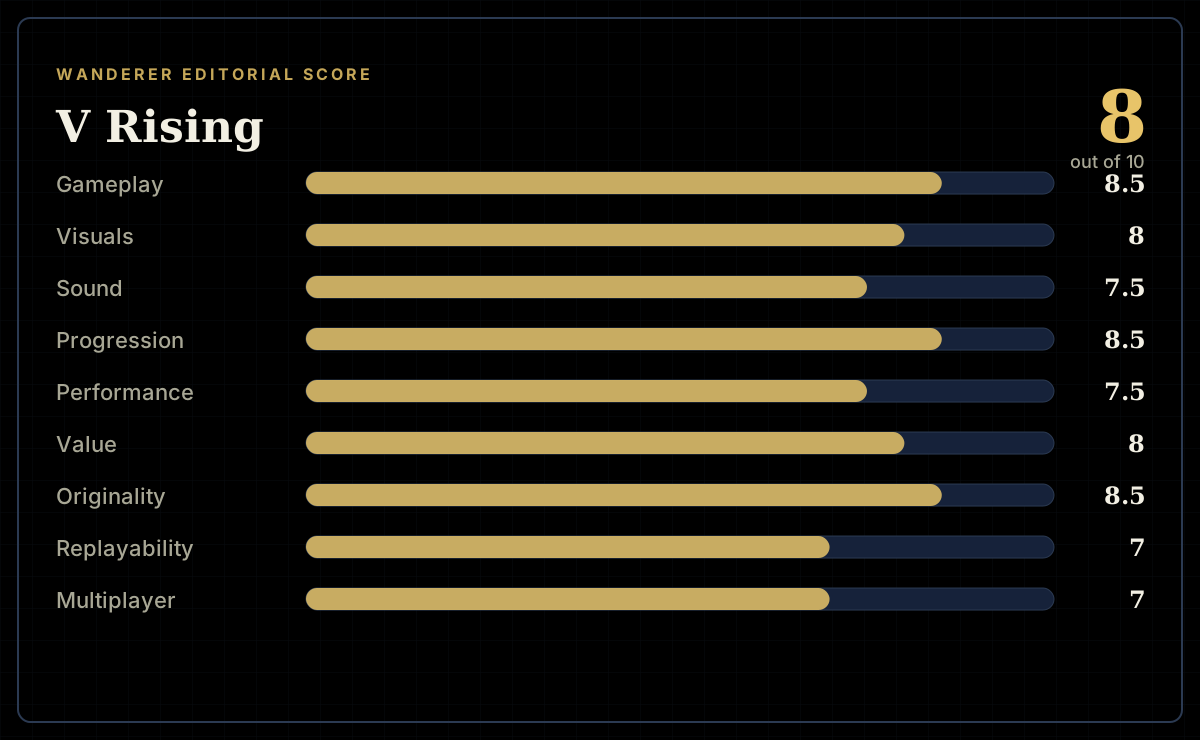
How the review scores each part of the gameWanderer Editorial -
The short versionWanderer Editorial