Game review
Wartales
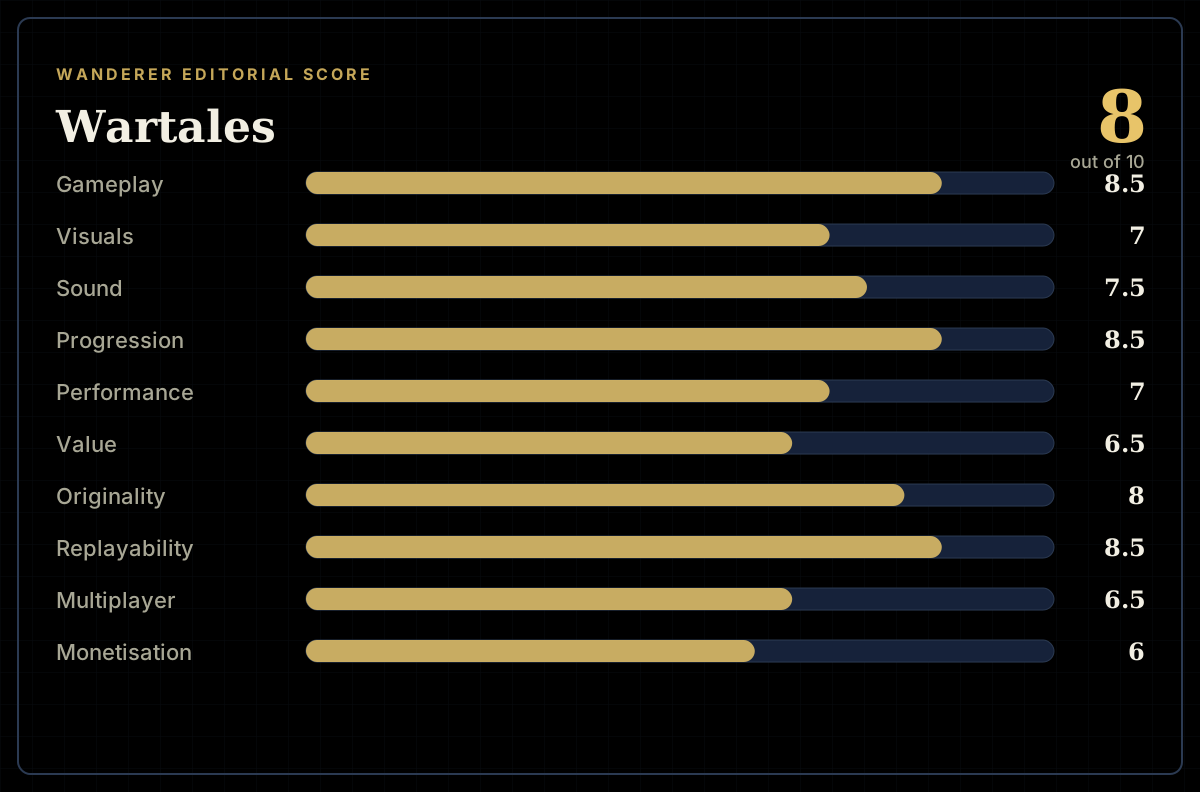
8 / 10
- Developer
- Shiro Games
- Publisher
- Shiro Games (self-published)
- Released
- 12 April 2023
- Platforms
- Windows, Nintendo Switch, Xbox Series X|S
- Genre
- Tactical RPG
- Monetisation
- Premium, one-off purchase — three paid story expansions, five smaller paid "Contract" content packs and an optional soundtrack DLC; no microtransactions, energy systems or loot boxes, but the base game does advertise its own DLC from inside menus and NPC dialogue
- Players
- Up to 4-player online co-op, one shared company and one shared wage bill
The short version
Wartales asks a question most party RPGs never bother with: what does it actually cost to keep ten armed strangers fed, paid, healed and loyal? The answer is the whole game. Contracts, bounties and tomb-robbing exist to fund a payroll, and the tactical combat, while genuinely good, is best understood as the release valve for a company that's been running the numbers wrong.
It's a superb premise let down in the same three places most long sandbox RPGs stumble — a mid-campaign stretch that repeats its own lessons, presentation that's tasteful rather than striking, and a post-launch DLC lineup aggressive enough that the base game now nags you about it from the inside.
Biggest strengths
- Wages, food and gear upkeep turn every contract into a financial decision, not just busywork
- Prisoners can be ransomed, sold, put to work or recruited, giving captures real strategic weight beyond loot
- Skill trees let one mercenary cross into a second profession, so a company reads as overlapping specialists rather than five fixed classes
Biggest weaknesses
- The game advertises its own paid DLC from inside menus and NPC dialogue, which cheapens what is otherwise a fair premium purchase
- Eight paid add-ons released since 2023 push the true cost of "the whole game" well past the base price
- Co-op sessions carry a real risk of stability problems that solo play doesn't share
Who it's for: Players who'd rather manage a payroll than a hero's destiny — Battle Brothers and Mount & Blade veterans, RimWorld and Darkest Dungeon fans who want more tactics and less attrition-for-its-own-sake, and anyone who finds "can we afford this fight" a more interesting question than "can we win it."
Our recommendation: Buy the base game — three-plus years on it's still one of the better mercenary sandboxes on PC. Treat the expansions as a later purchase and go in expecting the DLC prompts, which are a real and recurring irritation rather than a minor one.
8 / 10
A century after a plague ended an empire, the roads of the Edoran wastes are full of ex-soldiers, ex-farmers and ex-nobles who've all arrived at the same conclusion: banditry, bounty-hunting and grave-robbing pay better than whatever they used to do. Wartales puts you in charge of one such company, and it is scrupulously uninterested in whether any of them are heroes. What it cares about is whether you can make payroll on Tuesday.
That's the whole pitch, and Shiro Games commits to it more thoroughly than almost any other party-based RPG on the market. This isn't a game about a chosen band saving a kingdom with a combat system attached. It's a small-business simulator wearing a hex map and a skill tree, where the business happens to be violence, and the tactical fighting — which is very good — exists because the books occasionally, inevitably, don't balance.
The ledger is the actual game
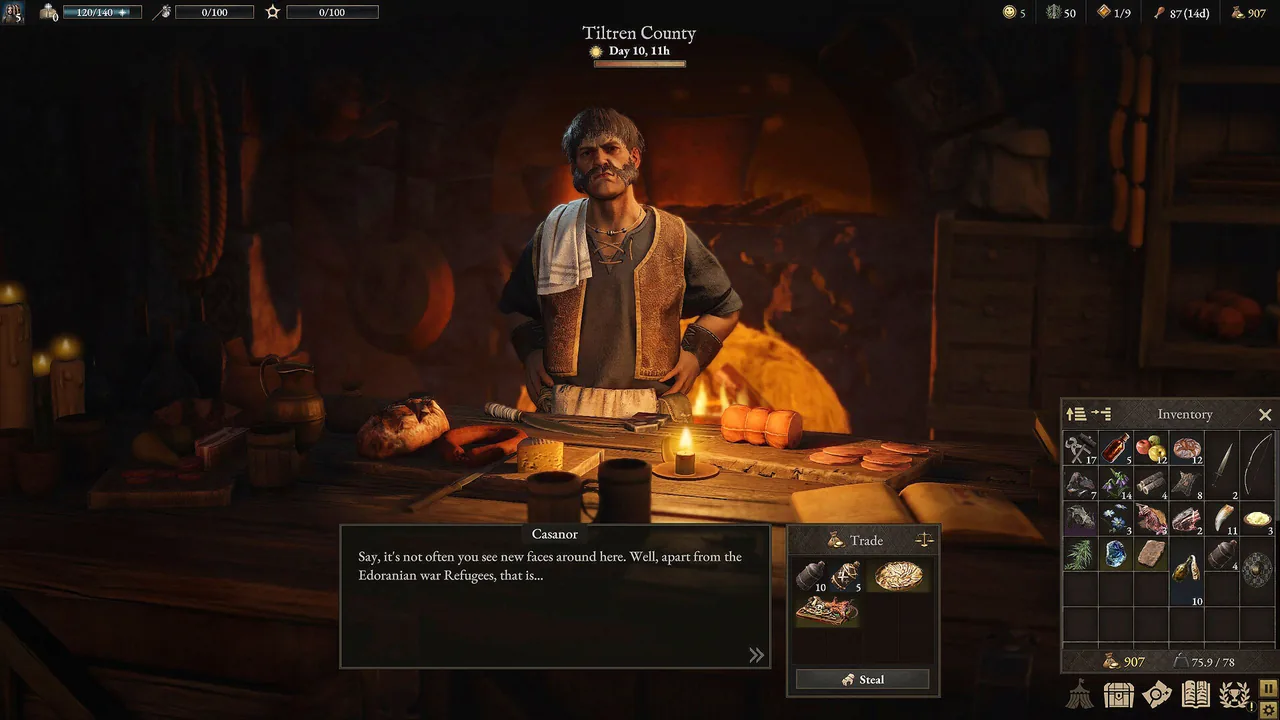
Every mercenary in your company eats, and every mercenary gets paid. Neither of those facts is decorative. Camp each night and your company shares out food from its stores; run dry and companions start to desert rather than starve alongside you. Recruit a tenth sellsword and your weekly wage bill grows with them, which means the fifteenth contract you take isn't chosen for its story beats — it's chosen because the smithing supplies are running low and somebody's armour needs replacing before the next fight it can't survive. Equipment degrades with use and has to be repaired or replaced with crafted or purchased gear, which means combat losses are never just a tactical setback. They're a line item.
This is where Wartales earns the comparison to RimWorld and Dwarf Fortress that's followed it since Early Access, and it's a fair one in spirit even though the genre is completely different: the appeal isn't winning individual encounters, it's keeping a fragile system solvent over dozens of hours while it keeps finding new ways to bleed you. Reviewers and players alike consistently describe the tension of "affording everybody's wages" as the thing that actually hooks them, more than any single fight — and that tracks, because the game is built to make you feel every gold piece leave your hands. A contract that pays 300 gold isn't an abstract reward. It's roughly what ten mercenaries eat in a week, and you know that number because you've done the arithmetic yourself, at camp, more than once.
Prisoners push the system further than most party RPGs bother to. Win a fight against bandits and you can take survivors captive rather than kill them — then ransom them back to their own faction, sell them, put them to forced labour in your camp, or eventually let them earn a place in your own roster. Even wild animals can be captured rather than butchered. None of those options is free of consequence: a camp full of prisoners needs guarding and feeding same as everyone else, and the faction you're ransoming to remembers who's doing the extorting. It's a small system, but it's one most tactics games leave completely on the table, and it does more to make the world feel like it's tracking your choices than any dialogue tree does.
Where the economic pressure occasionally tips from "meaningful" into "bookkeeping" is in the sheer number of things it asks you to track at once — food, wages, gear condition, prisoner upkeep, and the relationship meters between companions who bicker in camp. None of it is individually heavy. Stacked together across a session, it's the kind of maintenance a player has to actively enjoy running rather than merely tolerate, and the camp conversations meant to build "unbreakable bonds" between companions offer surprisingly little real control over their outcome for the amount of attention the game asks you to give them.
Professions instead of a class list
Wartales never hands you a class screen. Recruits arrive with a background, a starting specialisation and a personality, and from there their skill trees are yours to shape — a character built primarily as a swordsman can still pick up smithing, cooking or a second combat tree, so the company you end up with is a roster of overlapping specialists rather than five archetypes wearing different armour. Camp itself runs on the same idea: whoever you've built as your blacksmith forges gear, whoever you've built as a cook turns raw food into meals that matter, and whoever's been picking locks and appraising relics on the road is doing so because you decided that's who they'd become, not because the game assigned them the job at creation.
It's a looser, more organic take on party-building than most tactics RPGs attempt, and it pays off specifically because the economy gives every specialisation a job to do — a cook isn't a flavour choice, they're the difference between a camp that eats well and one that doesn't. The trade-off is that this looseness takes time to pay dividends. Early hours mean playing the mercenaries the world hands you, in roughly the shape it hands them to you, before the tree investment starts producing a company that feels genuinely yours rather than generically competent.
Combat is what happens when the plan fails
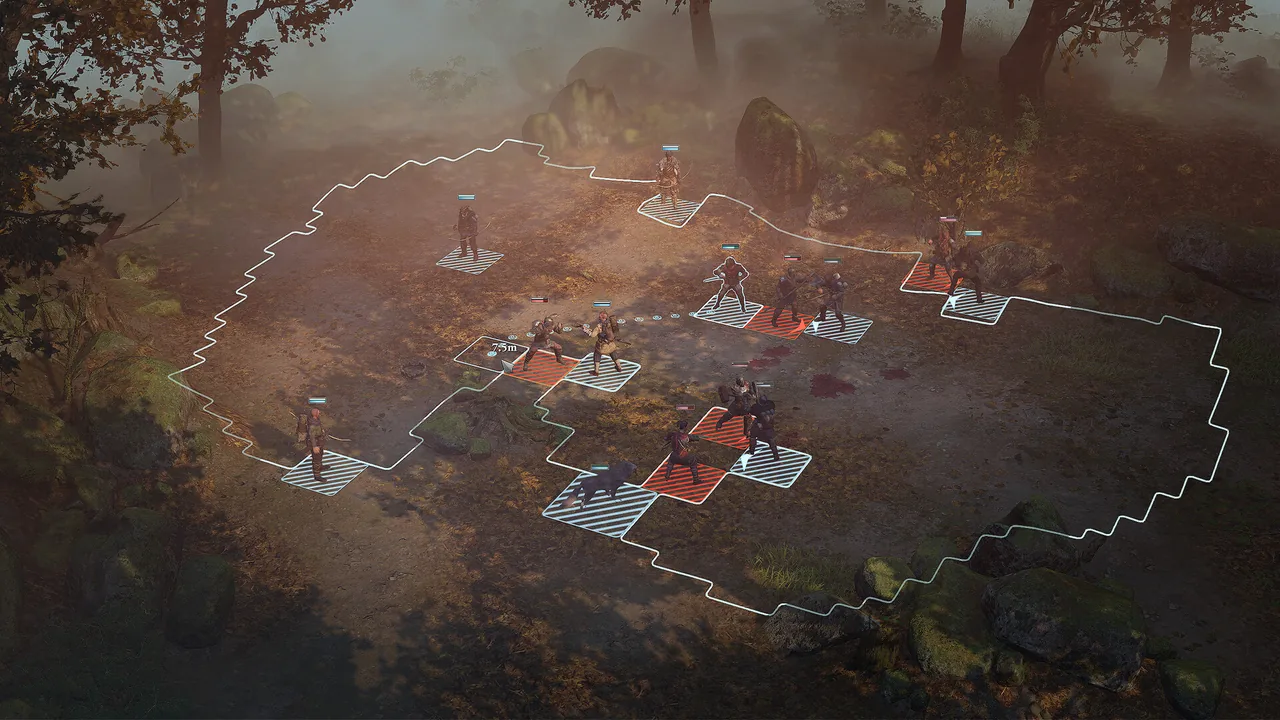
The turn-based tactical layer, fought on grid-based maps against everything from bandit camps to wandering monster packs, is legitimately strong on its own terms — positioning, armour values and target priority all matter, and a company built around one aggressive combo can fall apart against an encounter that punishes exactly that combo. But it reads best in context: a fight in Wartales is rarely the point, it's the cost of a decision made two screens earlier. You took the contract because you needed the gold. You're outnumbered because you couldn't afford to hire a fourth scout. You're fighting exhausted because you didn't budget time to rest before the deadline. When a fight goes badly, the honest post-mortem usually starts at the ledger, not the battlefield, and that's a genuinely different feeling from most party RPGs, where combat is the reward loop and everything else is overhead. Here it's closer to the other way around.
Player sentiment across a large sample of reviews backs this up: praise for combat consistently frames it as "commanding an actual mercenary company" rather than piloting individual heroes, and the moments people remember tend to be economic and emergent — losing a companion of eighty-plus hours to one bad encounter, watching a camp feud spill into a fight nobody planned for — rather than any single scripted set-piece.
The long middle
Wartales is not a short game. Player accounts of finished or ongoing campaigns commonly run into the hundreds of hours, spread across regions of steadily rising difficulty (or flat difficulty, if you switch on the optional level-scaling toggle aimed at players who'd rather explore freely than be walled out of areas by their level). That length is a real selling point for the audience it's built for, and it's also where the design shows its seams. The economic loop that makes the opening ten hours so absorbing — contracts fund wages, wages keep the company alive, the company grows and needs more contracts — doesn't meaningfully evolve once you've internalised it. New regions add new monsters and new points of interest to loot, but the actual decisions you're making by hour sixty are recognisably the same ones you were making by hour fifteen, just with bigger numbers attached. Combat's tactical ceiling is real, but its variety plateaus once a company's core loadout and tactics are settled, and settled tends to happen well before a 100-hour campaign is finished.
None of that erases the earlier hours, and a game this openly built for a marathon playstyle was never going to avoid some repetition entirely. But it's worth saying plainly: the middle of a long Wartales campaign sags, and the systems that made the opening so sharp aren't doing much new work by then.
Three years of paid content, and a nag built into the base game
Wartales left Early Access in April 2023 with a complete, sellable game, and Shiro has kept adding to it steadily since: three story expansions — Pirates of Belerion (December 2023), The Skelmar Invasion (December 2024) and The Curse of Rigel (December 2025, which adds a Thaumaturge class built around alchemy) — plus five smaller "Contract" packs built around single questlines or side-systems, the most recent of which, Fires in the Capital, shipped as recently as April 2026. That's a genuinely healthy content cadence for a game past its third birthday, and none of it is live-service filler; each release is conventional, self-contained premium DLC.
The problem isn't the content, it's the delivery. A significant and recurring thread in current player feedback isn't about any individual expansion's quality — it's about the base game actively promoting purchases to players who already own it, through menu prompts and in-fiction NPC dialogue that surfaces DLC by name during ordinary play. Buying the base game and then being marketed to inside it is a different experience from browsing a storefront, and it's earned Wartales a consistent stream of otherwise-positive reviews that dock it specifically for this. Stack the base price against three expansions and five Contract packs and the full collection comfortably clears US$150 — nobody needs all of it to have a complete game, but the in-game reminders that it exists are a genuine and avoidable irritation on top of a game that didn't need one.
Co-op carries its own tax. Wartales supports up to four players sharing one company, splitting the same wages and stores, and when it works it's a genuinely good way to divide the workload of running a sandbox this dense. Player reports also describe it as the least stable part of the game, with session and synchronisation problems that solo play simply doesn't encounter — worth knowing before you build a co-op session around it rather than discovering it mid-campaign.
Who this actually suits
If your idea of a party RPG is a small cast of named heroes with individual arcs, Wartales will feel oddly cold — companions have personalities and can be lost permanently, but the game's sympathies are with the company as an institution, not any one member of it. That's by design, and it's the same design choice that makes the economic pressure land: you're not managing five protagonists, you're managing a business with a headcount, and the game wants you to feel that distinction every time someone dies and the wage bill quietly gets smaller.
Wanderer's own players, used to progression that keeps ticking whether or not they're actively managing it, will find Wartales asks for the opposite kind of attention — every hour spent away from the ledger is an hour the ledger doesn't balance itself. That's a fair trade for players who want their upkeep to matter. It's a poor fit for anyone who'd rather their systems ran quietly in the background.
Verdict
Eight out of ten. Wartales commits harder to its central idea than almost any other party RPG does to its own — running a mercenary company is genuinely a business here, and the tactical combat is smarter for existing in service of that economy rather than as the whole point of the game. The profession-based skill system rewards patience with a company that feels assembled rather than generic, and the prisoner and reputation systems give real weight to choices most tactics games treat as flavour text.
It doesn't reach higher because a hundred-hour campaign built around one core loop was always going to show wear by its second half, because the presentation is tasteful rather than memorable, and because a genuinely good base game keeps interrupting itself to sell you the next one. None of that undoes what the design gets right. It just means going in with clear eyes about both the length of the commitment and the DLC prompts that come with it.
Price, DLC lineup and the Steam review summary checked 30 July 2026.
Pros and cons
Pros
- Wages, food and gear upkeep turn every contract into a financial decision, not just busywork
- Prisoners can be ransomed, sold, put to work or recruited, giving captures real strategic weight beyond loot
- Skill trees let one mercenary cross into a second profession, so a company reads as overlapping specialists rather than five fixed classes
- Losing a veteran of dozens of hours to one bad fight stings in a way scripted companion deaths rarely manage
- Level scaling is optional, so players who want the world to genuinely punish travelling too far east can turn the safety net off
- Up to four players can run one company together, splitting the same wage bill and the same food stores
Cons
- The game advertises its own paid DLC from inside menus and NPC dialogue, which cheapens what is otherwise a fair premium purchase
- Eight paid add-ons released since 2023 push the true cost of "the whole game" well past the base price
- Co-op sessions carry a real risk of stability problems that solo play doesn't share
- Mid-campaign contracts keep repeating their structure long after the economic lessons they teach have landed
- Relationship conversations in camp offer little real control over the outcome despite the time spent managing them
- Encounter variety plateaus once a company's core loadout and tactics are settled, well before the credits
Screenshots
-
WartalesImage: Shiro Games via Steam -
WartalesImage: Shiro Games via Steam -
WartalesImage: Shiro Games via Steam -
How the review scores each part of the gameWanderer Editorial -
The short versionWanderer Editorial