
Game review
Salt and Sanctuary
6.5 / 10
- Developer
- Ska Studios
- Publisher
- Ska Studios
- Released
- 17 May 2016
- Platforms
- Windows, macOS, Linux
- Genre
- 2D Soulslike RPG
- Monetisation
- Paid, one-time purchase. No in-app purchases; a spiritual sequel, Salt and Sacrifice, is sold separately.
- Players
- Optional online co-op and PvP invasions, layered on top of a primarily single-player experience.
The short version
Salt and Sanctuary's fusion of Dark Souls-style stamina combat, a deep skill-and-class RPG system, and Metroidvania-style interconnected exploration remains a genuinely well-regarded combination, reflected in a Very Positive rating across more than 20,000 reviews. What keeps a large share of players from fully embracing it is a specific, dominant and entirely fair complaint: the game provides no in-game map for a hand-drawn world explicitly built around backtracking and interconnection, a gap reviewers have been raising since launch. More recently, an August 2024 update made the game meaningfully harder eight years after release — attributed by press coverage to the original developer, though at least one detailed review describes it differently, as the work of an unrelated party who took over the project.
Biggest strengths
- A genuinely deep RPG system layered onto Dark Souls-style 2D combat, with real build variety across classes and skill trees.
- A distinctive, hand-drawn dark-fantasy art style from Ska Studios that gives the game real visual identity within a crowded genre.
- An interconnected, Metroidvania-style world that rewards exploration and backtracking once a player has built a mental map of it.
Biggest weaknesses
- No in-game map exists for a world explicitly designed around interconnected backtracking, a specific and dominant complaint raised consistently since launch.
- A 2021 review describes a specific boss's attack telegraph as indistinguishable for colorblind players, a real and specific accessibility gap.
- An August 2024 update made the game significantly harder; who actually made that change is disputed between press coverage crediting the original developer and at least one detailed review describing an unrelated party taking over the project.
Who it's for: Soulslike and Metroidvania fans who want the genre's combat depth in hand-drawn 2D, and who are willing to either mentally map the world themselves or lean on external resources given the lack of an in-game one.
Our recommendation: A strong soulslike worth playing for the combat and world design, with the clear caveat that navigating it without an in-game map is a real, common source of frustration.
6.5 / 10
Dark Souls' combat, folded into a hand-drawn Metroidvania
Salt and Sanctuary's core achievement is translating Dark Souls' stamina-managed, punishing combat into two dimensions without losing what makes that combat work, then wrapping it in a genuinely interconnected Metroidvania world rather than the more linear structure most soulslikes use. The store page's own framing captures the tone directly: "explore a haunting, punishing island... in a cursed realm of forgotten cities, blood-soaked dungeons, and desecrated monuments." The official screenshot backs up the visual identity that framing implies — a lone, hooded figure swinging a massive axe in a burst of hand-inked light rays, silhouetted ruins framing the scene on both sides. Ska Studios' distinctive art direction, carried over from their earlier work, gives the game a look genuinely unlike the more realistic or pixel-art approaches most of the genre takes, and reviewers across the board credit the class and skill-tree system with real build depth beneath that presentation.
A missing map, and why it's not a minor complaint
Set against that praise is a remarkably dominant, single-issue complaint: this game, built explicitly around exploration and backtracking through an interconnected world, ships with no in-game map at all. Checking a broad sample of negative reviews, nearly half raise this specific gap. "NO MAP. NO. I don't even care if the art style is good, I don't even care if the skill tree is too limited, I don't even care if the bosses are fun. After 5 hours of game play, I can't stand the no map," reads one particularly direct 2022 review. Another calls it "Metroidvania with no map," treating the omission as disqualifying on its own regardless of anything else the game does well. This isn't a subjective taste complaint the way genre difficulty debates often are — a Metroidvania's entire design premise depends on a player being able to remember or reference where they've been relative to where they need to go, and the absence of any in-game tool to support that is a concrete, practical gap that a meaningful share of the audience finds genuinely disqualifying rather than a minor inconvenience.
A harder game, eight years later — but whose decision was it?
The most unusual finding in this game's review history concerns a real, documented August 2024 update that meaningfully increased difficulty nearly a decade after launch. Syndicated press coverage posted directly to the game's own Steam news feed states plainly: "Eight years since it first arrived, Salt and Sanctuary is suddenly a lot harder thanks to a transformative update from developer Ska Studios," tying the change to patch 1.0.2.0. A January 2024 review, however, describes the same period differently: "Long long after the developer finished the game, someone else (a former modder) got their hands on it and have forced horrible ch[anges]... Completely ruined and unplayable now." This review cannot fully reconcile these two accounts — the press coverage explicitly credits the original studio, while the reviewer describes a different party entirely taking control of the project. Both are reported here rather than resolved in either direction, because a reader deciding whether to buy the current, patched version of this game deserves to know both what changed and that there's a genuine discrepancy in the public record about who made that call, not a confidently asserted single narrative this review can't actually verify beyond what's publicly stated.
Smaller but real gaps
Two more specific issues round out the picture. A 2021 review raises a concrete accessibility concern: as a colorblind player, they found a particular boss's telegraphed attack pattern indistinguishable from its safe state, a gap with no adjustment offered in settings. A 2022 review reports something more serious on the technical side: the game "causes my PC to hard crash, either requiring a reboot or just turns the PC straight off," happening roughly six times in under five hours before the reviewer gave up — an isolated report in the sample, but a serious one given the severity described.
What "wanted to like it" adds to the map complaint
A smaller but related pattern is worth connecting to the missing-map issue rather than treating as separate. Several reviews open with the same "I really, really wanted to like this game" framing this outlet has now seen recur across more than one soulslike and action RPG in this coverage, and in this specific case, the follow-up complaint is disproportionately about navigation and disorientation rather than combat difficulty. One 2018 review says outright that the game "tried to translate" Dark Souls' interconnected world design "without the tools to actually navigate it," a complaint that reads as the map issue expressed as a design philosophy critique rather than a simple missing-feature gripe. That reframing matters: it suggests the map's absence isn't merely an inconvenience some players push through, but for a meaningful subset, a genuine barrier between liking the combat and being willing to keep playing long enough to experience the rest of what the game offers.
Final verdict
Salt and Sanctuary's combination of Dark Souls-calibre combat and Metroidvania structure remains a genuinely well-executed, distinctive achievement in its genre, and its continued post-launch support years after release is a real point in its favour. The missing in-game map is this review's central reservation — a specific, dominant, entirely reasonable complaint rather than a matter of taste — and the unresolved question of who actually reshaped the game's difficulty in 2024 is worth knowing about even though this review can't settle it definitively. Buyers who can accept navigating by memory, or are willing to reference outside resources, will find a genuinely strong soulslike underneath those concerns.
Pros and cons
Pros
- A genuinely deep RPG system layered onto Dark Souls-style 2D combat, with real build variety across classes and skill trees.
- A distinctive, hand-drawn dark-fantasy art style from Ska Studios that gives the game real visual identity within a crowded genre.
- An interconnected, Metroidvania-style world that rewards exploration and backtracking once a player has built a mental map of it.
- Continued, genuine post-launch support, including Steam Deck optimisation, cloud saves and a substantive balance overhaul years after release.
Cons
- No in-game map exists for a world explicitly designed around interconnected backtracking, a specific and dominant complaint raised consistently since launch.
- A 2021 review describes a specific boss's attack telegraph as indistinguishable for colorblind players, a real and specific accessibility gap.
- An August 2024 update made the game significantly harder; who actually made that change is disputed between press coverage crediting the original developer and at least one detailed review describing an unrelated party taking over the project.
- An isolated but serious 2022 report describes the game causing full PC hard-crashes, requiring a manual reboot.
Screenshots
-

Salt and SanctuaryImage: Ska Studios via Steam -

Salt and SanctuaryImage: Ska Studios via Steam -

Salt and SanctuaryImage: Ska Studios via Steam -
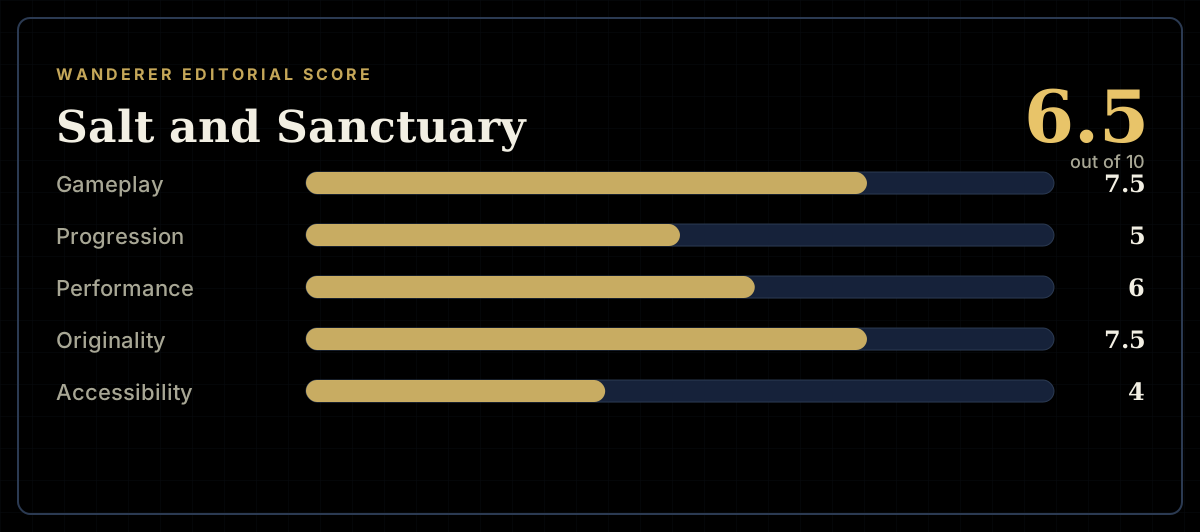
How the review scores each part of the gameWanderer Editorial -
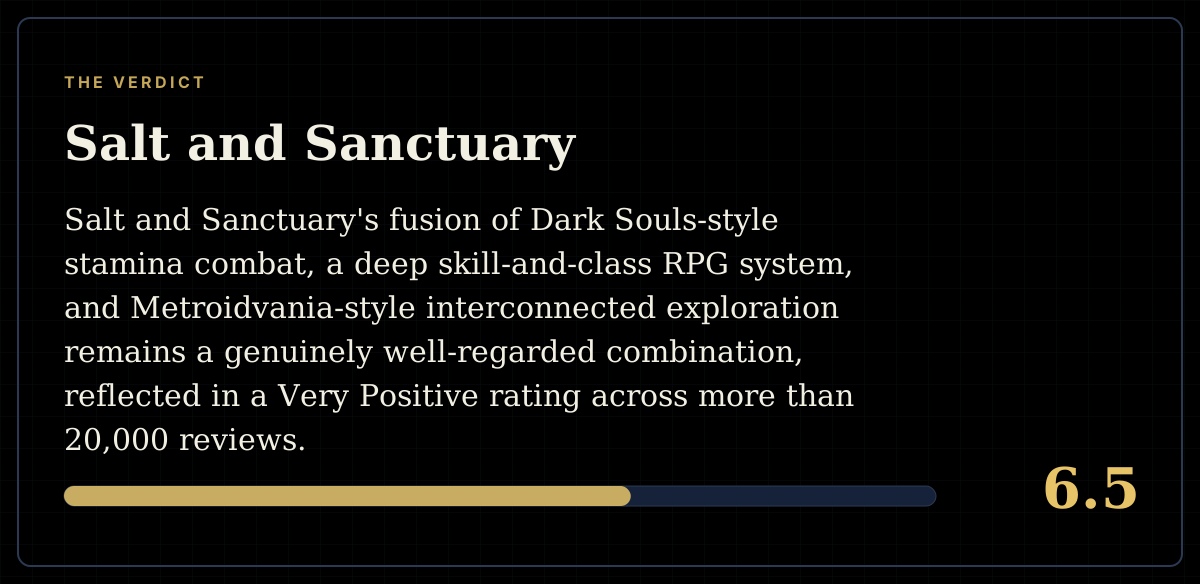
The short versionWanderer Editorial