
Game review
Dust: An Elysian Tail
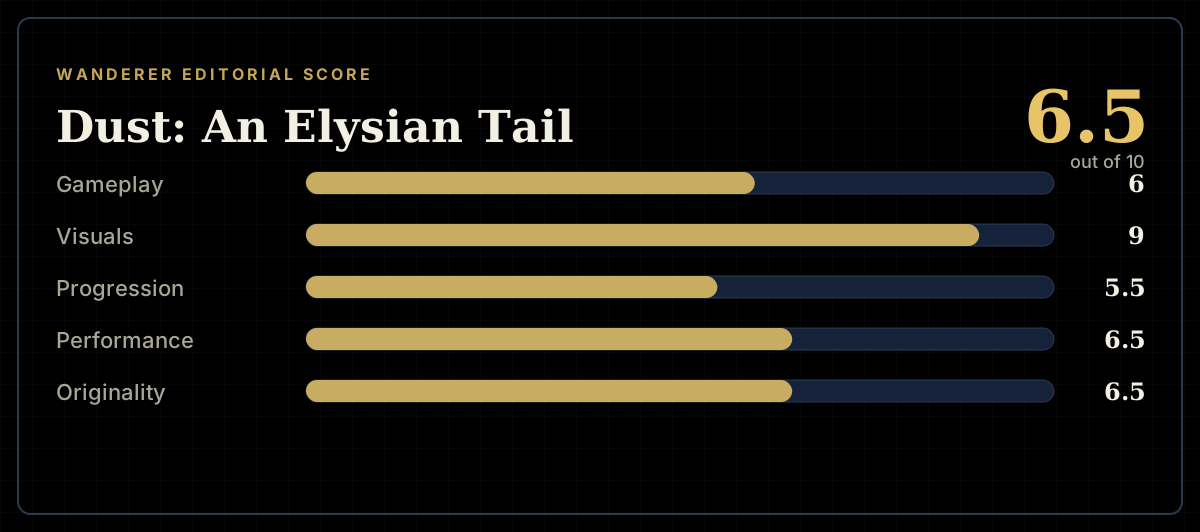
6.5 / 10
- Developer
- Humble Hearts LLC
- Publisher
- Xbox Game Studios
- Released
- 24 May 2013
- Platforms
- Windows, macOS, Linux
- Genre
- Action RPG
- Monetisation
- Paid, one-time purchase. No in-app purchases or DLC.
- Players
- Single-player only.
The short version
Dust: An Elysian Tail's hand-painted art, composed and animated almost entirely by a single developer, remains a genuine achievement more than a decade later, and it's the reason more than 14,000 reviews still rate the game Overwhelmingly Positive. What a large and remarkably consistent thread of criticism has argued since launch is that the game underneath that art doesn't grow to match it — combat that leans on a small set of moves without meaningfully expanding, and a narrative delivery that interrupts action with frequent, lengthy dialogue scenes often enough that more than one reviewer questions whether the game knows if it wants to be an action title or a visual novel.
Biggest strengths
- Genuinely exceptional hand-painted art and animation, remarkable in particular for having been produced almost entirely by one person.
- A distinctive musical score and voice work that reviewers consistently single out as punching well above the game's budget.
- An earnest, heartfelt narrative and cast of anthropomorphic characters that clearly resonate strongly with a large share of the game's audience.
Biggest weaknesses
- A consistent, decade-plus complaint describes combat as simplistic and repetitive, built around a small set of moves that don't meaningfully expand as the game progresses.
- Frequent, lengthy dialogue scenes repeatedly draw criticism for interrupting the flow of action, with multiple reviewers questioning the game's basic genre identity as a result.
- Several reviewers describe the Metroidvania structure and skill-tiering as barebones relative to genre peers.
Who it's for: Players drawn primarily to presentation, character writing and a heartfelt solo-developer passion project, with realistic expectations that the combat and pacing won't match the ambition of the art around them.
Our recommendation: Worth playing for the visuals, music and earnest storytelling; go in with modest expectations for combat depth and be ready for dialogue-heavy pacing.
6.5 / 10
A one-person achievement that still shows in every frame
Dust: An Elysian Tail's most remarkable fact doesn't change no matter how a given player feels about its mechanics: nearly all of its hand-painted art, animation and level design was produced by a single developer, Dean Dodrill, over several years of solo work. The store page's framing — "immerse yourself in a gorgeous hand-painted world on a search for your true identity" — undersells just how far that solo effort extends. The official screenshot shows exactly the quality that reputation rests on: a fox-tailed swordsman mid-motion through a sun-dappled forest glade, deer and butterflies rendered with the kind of painterly detail more associated with a small animation studio than a single artist working alone. Reviewers across the game's entire history, including many otherwise critical of its mechanics, consistently exempt the visuals and score from criticism — one 2020 review that goes on to raise real concerns about pacing still opens by conceding "the controls work well, the game is smooth, the music and art range from 'not bad' to 'very good.'" For a game built by one person, that level of consistent craft is a genuine achievement worth recognising on its own terms.
The complaint that's followed the game since 2013
What tempers the presentation's near-universal praise is a specific, consistent critique that's followed the game from its earliest Steam reviews to some of its most recent ones. "Combat system is too simplistic. You will use the same moves over and over," reads a 2015 review, a complaint echoed almost verbatim by a 2021 review describing the game as "mind-numbingly boring and grin[dy]" despite genre familiarity from the reviewer. A 2023 review is more specific about where the ceiling sits: "the barebones execution on the Metroidvania concepts, the limited tiering for skilling, and overall very boring nature of combat" keep the game from matching its reputation for the reviewer personally, even while acknowledging why others enjoy it. A second, related thread concerns pacing: a 2023 review states the tension directly — "it's hard to tell whether this game wants to be an action adventure or a visual novel. The flow of exploration is interrupted constantly by dialogue scenes." That's not a complaint about the writing's quality, which multiple reviewers praise separately, but about its placement — dialogue arriving frequently enough to repeatedly break the momentum an action RPG is normally built to sustain.
A fair, split reception rather than a hidden flaw
It's worth noting how many reviewers in the negative sample explicitly frame their criticism as a matter of personal fit rather than an objective flaw, which suggests the game's actual audience split is a genuine, reasonable disagreement rather than one side simply being wrong. "I can see where people like this game... HOWEVER," begins one 2023 review before detailing specific complaints. "I didn't hate Dust... I can see why others like it," reads a 2021 review. This pattern — acknowledging the game's appeal while still declining to recommend it personally — recurs often enough in the sample that it reads as an honest, consistent split in taste rather than one side missing something obvious. A returning player from adolescence captures this shift directly in a 2022 review, describing loving the game as a teenager and finding the return "a lot more skeptical" as an adult, suggesting at least part of the divide may track with how much a player values earnest, character-driven pacing over combat density specifically.
A recent, specific bug worth flagging
Separate from the design debate, a February 2026 review reports a concrete and current technical problem: "the interaction functions keep breaking for me and making the game unplayable," describing enjoying the story and gameplay right up until the bug halted progress entirely. This is a single, recent report rather than a widespread pattern in this review's research, but it's worth naming plainly as a live risk for anyone installing the game today.
Weighing a solo project against genre-standard expectations
It's worth being explicit about a tension this review's score has to hold rather than resolve away: judging Dust purely against combat-focused Metroidvania peers built by full studio teams risks underrating what a single developer working largely alone was realistically able to achieve across every discipline simultaneously — art, animation, writing, level design, systems programming and music direction. Held to that standard, the combat's relative simplicity reads less as a design failure and more as a reasonable trade-off given where the bulk of the labour clearly went. At the same time, this outlet's job is to describe what a buyer will actually experience regardless of how sympathetically that experience should be read given its production context, and reviewers across a decade have been consistent that the combat specifically doesn't hold up next to games built by larger teams with more specialised combat design attention. Both things are true at once: a genuinely remarkable solo achievement, and combat that a fair share of players correctly identify as its weakest, least ambitious component relative to everything else on display.
Final verdict
Dust: An Elysian Tail's presentation remains a genuine solo-developer achievement, and its heartfelt writing and character work clearly land for a large share of its audience — that's not in serious dispute across more than a decade of reviews. Where this score reflects real caution is a remarkably consistent, specific complaint about combat depth and dialogue-heavy pacing that's followed the game since launch, raised fairly and non-dismissively by reviewers who mostly acknowledge the game's appeal even while declining to personally recommend it. This is a strong pick for players who value presentation and heart over combat density, and a fair skip for players who don't.
Pros and cons
Pros
- Genuinely exceptional hand-painted art and animation, remarkable in particular for having been produced almost entirely by one person.
- A distinctive musical score and voice work that reviewers consistently single out as punching well above the game's budget.
- An earnest, heartfelt narrative and cast of anthropomorphic characters that clearly resonate strongly with a large share of the game's audience.
- A genuinely impressive achievement for a solo-developer project, spanning a full Metroidvania-scale world, RPG progression and voiced dialogue.
Cons
- A consistent, decade-plus complaint describes combat as simplistic and repetitive, built around a small set of moves that don't meaningfully expand as the game progresses.
- Frequent, lengthy dialogue scenes repeatedly draw criticism for interrupting the flow of action, with multiple reviewers questioning the game's basic genre identity as a result.
- Several reviewers describe the Metroidvania structure and skill-tiering as barebones relative to genre peers.
- A February 2026 review reports a specific, current bug where interaction prompts stop functioning partway through a playthrough, making progress impossible.
Screenshots
-

Dust: An Elysian TailImage: Xbox Game Studios via Steam -

Dust: An Elysian TailImage: Xbox Game Studios via Steam -

Dust: An Elysian TailImage: Xbox Game Studios via Steam -
How the review scores each part of the gameWanderer Editorial -
The short versionWanderer Editorial