
Game review
Pathogenic
8.5 / 10
- Developer
- Aberrant Labs
- Publisher
- Slug Disco
- Released
- 16 July 2026
- Platforms
- Windows, macOS, Linux
- Genre
- Roguelike / Twin-stick Shooter
- Monetisation
- One-time purchase with no in-game spending. The only extra is a supporter pack bundling the soundtracks and an artbook. Steam Workshop mod support is free and built in. Listed at NZ$15.75 — checked 4 August 2026, after the 20% launch discount ended on 30 July.
- Players
- Local shared-screen co-op only, and not the kind most buyers expect — both players control two permanently joined halves of a single pathogen
The short version
You are the disease. You start as one cell with almost nothing attached to you, and you end a good run as a lopsided horror of stolen organelles that one-shots a white blood cell the size of a minivan. The build system is the real thing — you rip parts off enemies, bolt them to specific points on your body, and live with the geometry of your own decisions. Where it stumbles is consistency: a dodge that fires you across the screen, hurtboxes you can't reliably read, and loot rolls that decide more of a run than most players want. Ten dollars, a hundred thousand copies in a week, and a studio shipping real fixes fortnightly.
Biggest strengths
- Grafting organelles onto a body with real positions and connection points turns build-crafting into a spatial problem, not a menu — where a part goes matters as much as what it does
- The soft-body physics give every cell, projectile and boss a wobble and weight that makes the whole microscopic world feel alive rather than drawn
- The difficulty ramp is exceptionally well judged, with clear-rates falling smoothly from 94% on the first level to 26% on the sixth rather than hitting a wall
Biggest weaknesses
- "Shared/Split Screen Co-op" oversells what's there — two players pilot halves of one attached organism, and several buyers say plainly they'd have skipped the purchase had they known
- A single dodge charge with enormous travel distance makes precise evasion difficult in exactly the cramped rooms that demand it
- Item drops can't be rerolled while mutations can, so a bad early roll can quietly decide a run
Who it's for: Twin-stick and roguelite players who want a build system with actual physical constraints rather than a list of percentages, and anyone who has ever wanted to play the cell stage of Spore with guns. Not for players who need a run's outcome to rest on execution alone.
Our recommendation: Buy it — at this price it's the easiest recommendation in the genre this year. Two caveats worth knowing first. If you're buying it for local co-op, don't: both players are stuck to the same organism, which is a deliberate design rather than a bug, but it isn't couch co-op in the way the store label implies. And if bad loot rolls ruin your evening, know that item drops can't be rerolled even though mutations can.
8.5 / 10
A hundred thousand copies in under a week. Six thousand people playing at once. Steam Deck Verified inside five days. For a twin-stick roguelite from a studio nobody had heard of a month ago, priced at about ten dollars, that is not a normal launch — and having read every English-language complaint filed against it, the enthusiasm is largely earned.
The pitch is the reason. You are the disease. Not a doctor, not an immune cell, not a scientist in a lab coat — a single parasite dropped into a human body, hunted by its immune system, working its way through the lungs and the heart and the brain. Aberrant Labs built it and Slug Disco published it, and if that second name means anything to you it's probably because of ant colonies, which tells you something about the kind of biology-obsessed game this outfit is drawn to.
Build-crafting with a body
The reason Pathogenic sticks is that its progression is physical.
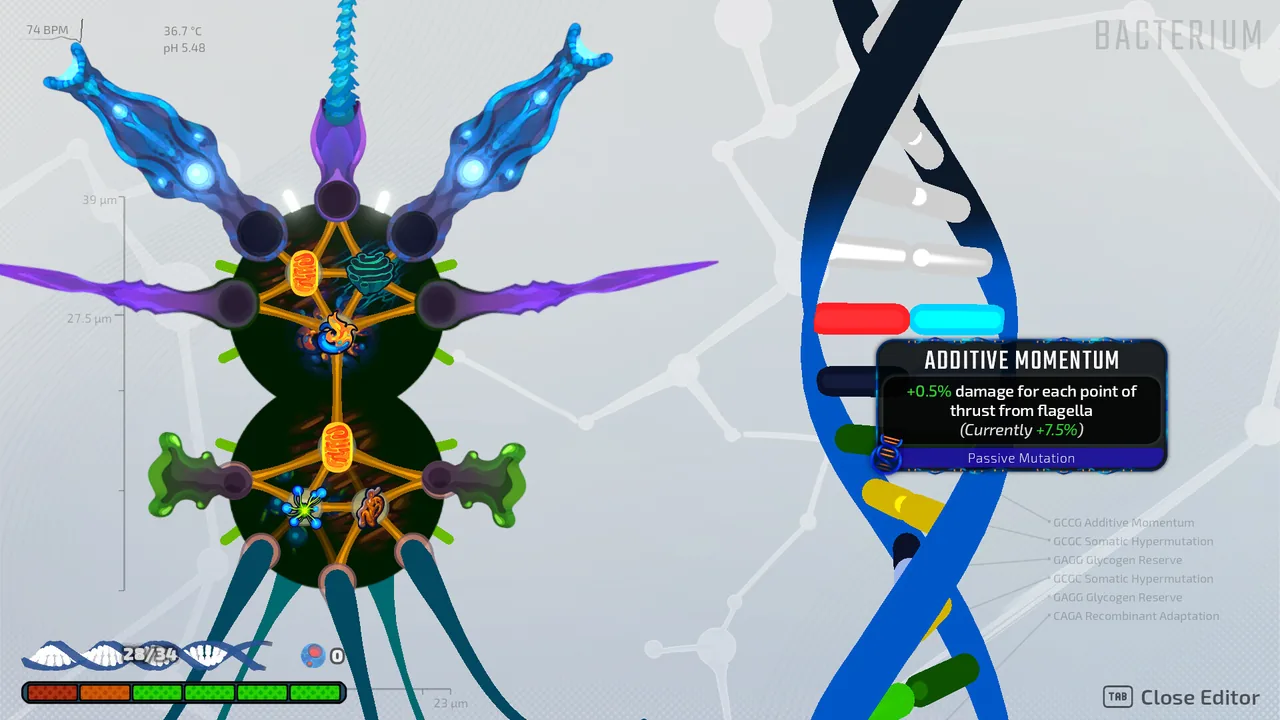
You kill an immune cell, you rip out its organelles, and you graft them onto yourself. Flagella for movement. Mitochondria for power. Secretors that shoot. Spikes that stab. But they don't go into a list — they attach to points on your body, and a weapon bolted to your back or your flank is a weapon that spends most of the fight pointing at nothing.
That single constraint does an enormous amount of work. Most roguelite builds are additive: you collect modifiers, the numbers go up, the shape of the character never changes. Here the shape is the build. You end up making genuinely awkward decisions — a superb organelle you can't fit facing forward, a mediocre one that slots exactly where you need it, an evolution that offers you more space in entirely the wrong place. One player described the result as a horrifying blob of questionable evolutionary decisions, which is about right, and is the game working as intended.
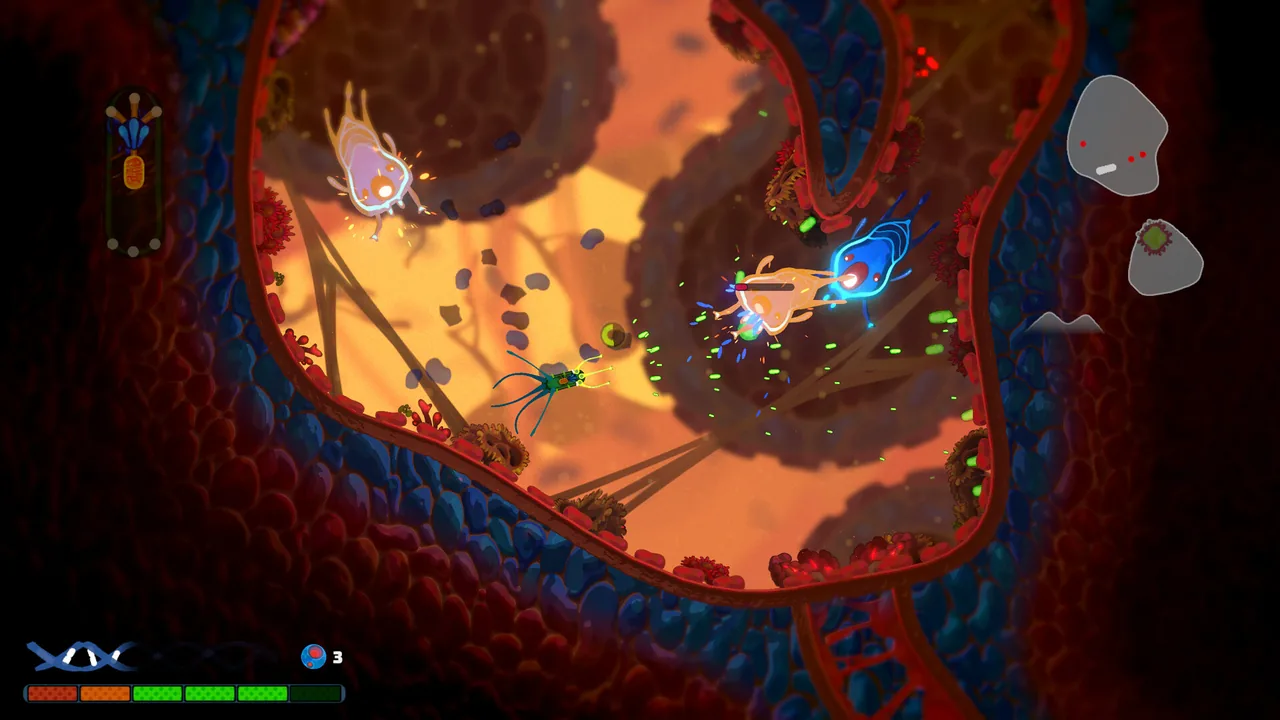
The soft-body physics sell it. Everything wobbles — you, the enemies, the projectiles, the walls of the organ you're standing in. It's the difference between a game about cells and a game that feels cellular, and it's why comparisons keep reaching past the current genre back to old Flash-era games like Bubble Tanks rather than to Brotato or Risk of Rain 2.
Underneath sits a plasmid tree for permanent upgrades, separate per parasite, plus alternate pathogens to unlock, stacking antibiotic difficulty modifiers, challenge runs with modifiers like melee-only, Workshop mod support and leaderboards. For ten dollars that is a genuinely absurd amount of structure.
The curve, and where it holds
Compare the achievement data to the last survivors-like I looked at. Hell Maiden clears its first area for 86% of players and its second for 14% — a wall. Pathogenic runs 94%, 83%, 68%, 52%, 38%, 26% across its first six levels.
That's what a well-tuned difficulty ramp looks like in numbers. Every level sheds players, none of them slams a door, and a quarter of everyone who bought it has reached the sixth. The seventh drops to 4.4%, which is a real gate — but by then you're in secret-level, unlocked-parasite, stacked antibiotics territory, and a hard ceiling there is the point of a ceiling.
The alternate parasites reinforce it. Roughly six per cent of players have cleared level six with each of the worm, the nanobot, the strafer, the amoeba — small numbers individually, but they add up to a meaningful population of people playing this well past the credits.
The argument about luck
The most substantial criticism, and it comes from players with hundreds of hours rather than refund-window drive-bys, is that runs are decided by drops more than by play.
The mechanics support the complaint. Mutations can be rerolled; item drops cannot. So the offensive core of your run is dealt to you, and if what you're dealt is weak, the game doesn't offer a lever to fix it — it offers a longer fight. That interacts badly with the way enemy health scales after the second zone, and produces the bimodal experience several reviewers describe: you are either deleting entire rooms in one shot or grinding a boss for five minutes while it chips you down.
The counter-argument is real too. This is a game about adaptation, and being handed a poor hand and forced to make something of it is thematically exactly right — you are a parasite, not a gunslinger. Plenty of players with a thousand-plus minutes logged say the improvisation is the appeal.
Where I come down: the theme justifies the randomness, but not the absence of a reroll on the one category that matters most. Give item drops the same reroll that mutations have and the argument mostly evaporates without touching the design's intent. The developers have already moved in that direction on the related complaint — the 3 August update made boss armour activate at lower damage thresholds but scale more slowly, specifically so that huge-damage builds stop hitting a brick wall. That's a well-aimed fix.
Read this before you buy it for couch co-op
The store page lists Shared/Split Screen Co-op. What that means in practice: both players control two halves of the same pathogen, permanently attached, constantly dragging each other around.
There is no mode where two people each pilot their own parasite.
As a design it's a legitimately interesting idea — a two-player creature that has to negotiate its own movement is a decent premise for a couch game, and the players who like it, like it a lot. As a store listing it's misleading, and multiple buyers have said outright that they'd have passed had they understood. When the developers responded to that feedback in the 23 July update, what they added was a way for one person to control both halves solo. That's a tell: the two-headed pathogen is the design they believe in, not a compromise they intend to replace.
So treat the co-op label as describing an unusual local curiosity rather than a couch co-op mode. If that's your reason for buying, this isn't the game.
Friction
The dodge is the other consistent complaint, and it's a real one. You get one charge, and it hurls you a long way — which in the tight rooms where evasion matters most tends to deposit you in a different set of bullets or straight into a hazard. Bullet-hell design demands small precise adjustments; this dodge only does large imprecise ones.
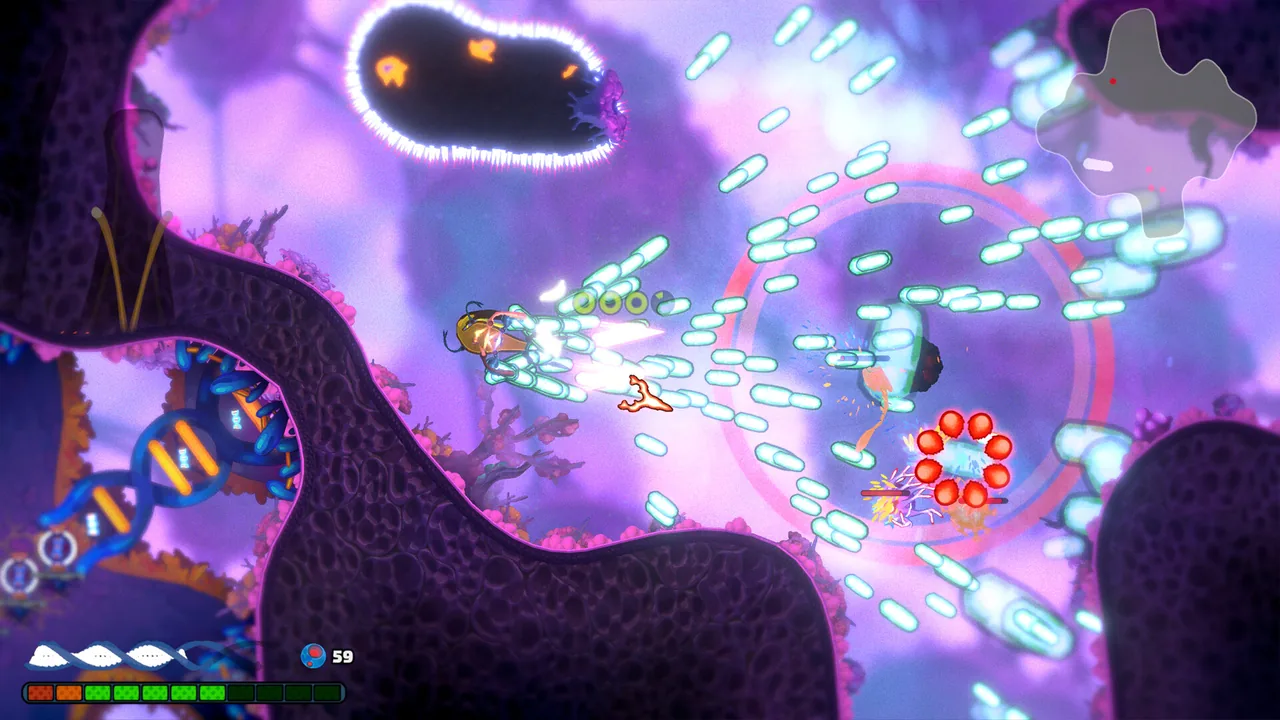
Readability is uneven too. Some enemies deal contact damage always, some only when they flash red, some only on visible spikes, and nothing teaches you which is which. Layer your own glowing effects over that and the screen gets busy fast — turning down bloom and screen shake helps, and the fact that experienced players are recommending that to each other says the default presentation is fighting the combat.
And the balance is wide. Some organelles and perks are strong enough that passing them up is a mistake, which quietly narrows a build system that is otherwise the game's best feature.
Technically it launched in reasonable shape and has improved fast: crash fixes across music, cutscenes, run starts and level transitions, better performance at the lowest graphics settings, and a switch of the Mac renderer from Vulkan to Metal after Mac players reported stuttering at every setting. If you're on a Mac and bounced off it in the first fortnight, it's worth another look.
Worth your ten dollars
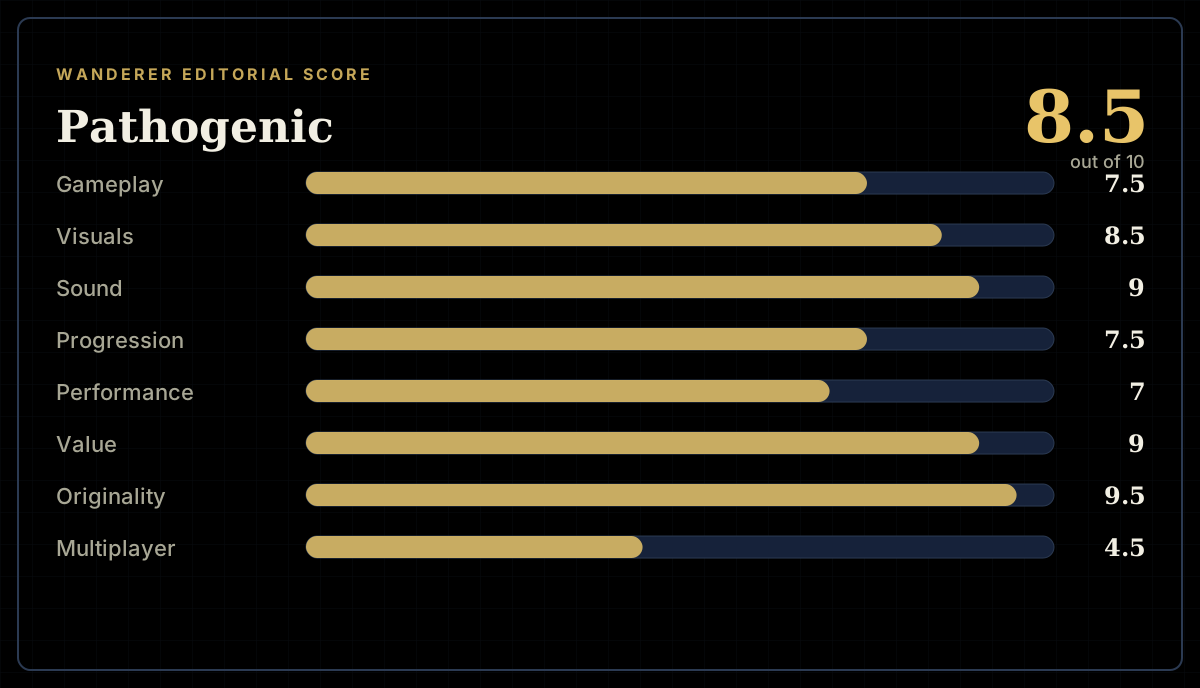
8.5 out of 10. Rated 8.5 out of 10.
Pathogenic is the most inventive thing this genre has produced in a while, and the inventiveness isn't skin-deep — the organelle grafting changes how you think about a run in a way that the hundredth "pick one of three upgrades" screen never will. The price is close to indefensible in the customer's favour, the support is fast and specific, and the difficulty curve is a model of how to pace a roguelite.
It isn't a 9. The dodge undercuts the combat it's attached to, the loot system decides more than it should, and the co-op line on the store page is the kind of thing that ends up in a refund request rather than a review. Fix the reroll asymmetry and tighten the dodge and this becomes one of the best roguelites on Steam rather than one of the most interesting.
Buy it anyway. If you've enjoyed Everything is Crab's cheerful weirdness or spent a hundred hours in Brotato working out which twenty items multiply each other, this is the same instinct pointed somewhere nobody else has bothered to look — and it's the rare roguelite where growing stronger genuinely changes what you are, not just what your numbers say.
Pros and cons
Pros
- Grafting organelles onto a body with real positions and connection points turns build-crafting into a spatial problem, not a menu — where a part goes matters as much as what it does
- The soft-body physics give every cell, projectile and boss a wobble and weight that makes the whole microscopic world feel alive rather than drawn
- The difficulty ramp is exceptionally well judged, with clear-rates falling smoothly from 94% on the first level to 26% on the sixth rather than hitting a wall
- Enormous amount of game for the money — 41 achievements, alternate parasites, stacking difficulty modifiers, challenge runs, Steam Workshop mods and leaderboards
- The soundtrack is repeatedly singled out even by players leaving negative reviews
- Support has been fast and specific, including a Mac renderer switch to Metal and a boss-armour rework aimed squarely at the complaints in the launch reviews
Cons
- "Shared/Split Screen Co-op" oversells what's there — two players pilot halves of one attached organism, and several buyers say plainly they'd have skipped the purchase had they known
- A single dodge charge with enormous travel distance makes precise evasion difficult in exactly the cramped rooms that demand it
- Item drops can't be rerolled while mutations can, so a bad early roll can quietly decide a run
- Damage tends to be all-or-nothing — you either delete rooms instantly or chip at a boss for five minutes, with little in between
- Screen readability suffers once your own effects are on screen, and contact damage rules differ between enemies without a consistent visual language
- Several organelles and perks are strong enough to be automatic picks, which narrows builds faster than the variety on offer should allow
Screenshots
-
PathogenicImage: Slug Disco via Steam -
PathogenicImage: Slug Disco via Steam -
PathogenicImage: Slug Disco via Steam -
How the review scores each part of the gameWanderer Editorial -
The short versionWanderer Editorial