Game review
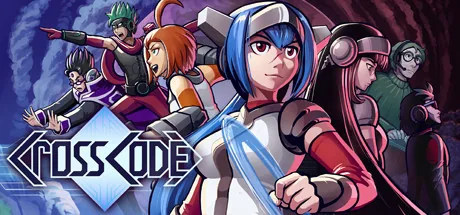
CrossCode
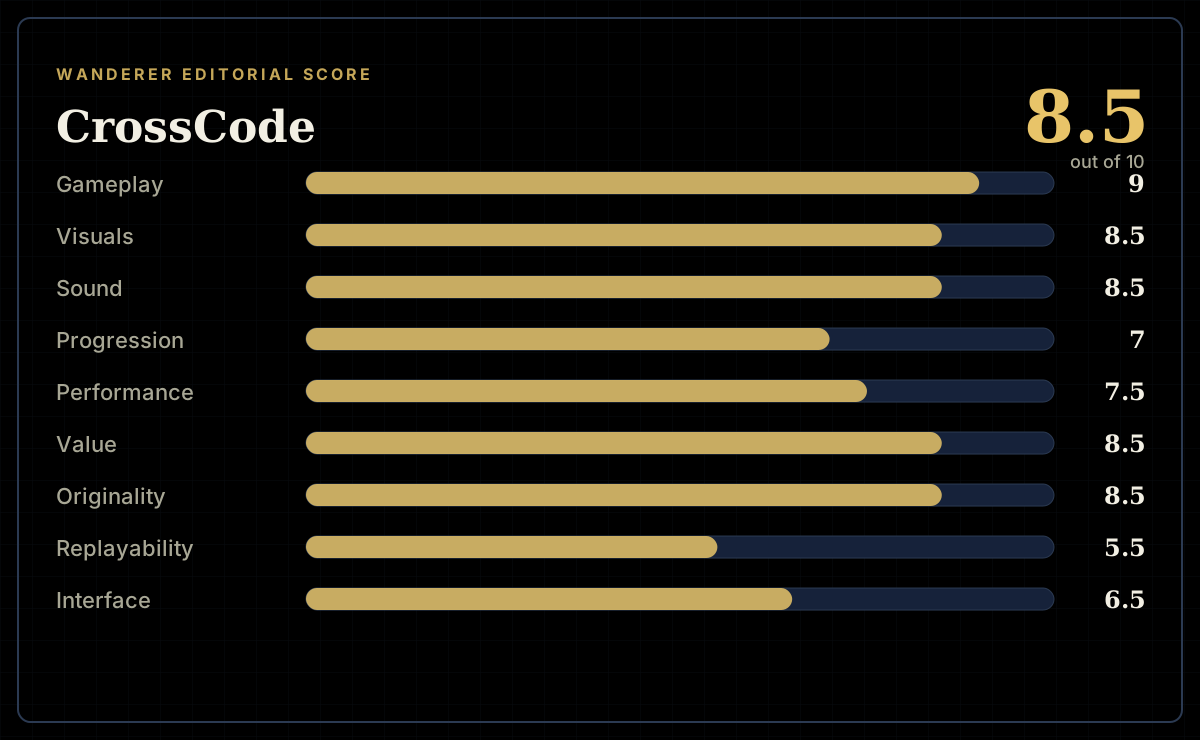
8.5 / 10
- Developer
- Radical Fish Games
- Publisher
- Deck13
- Released
- 20 September 2018
- Platforms
- Windows, macOS, Linux, Nintendo Switch, PlayStation 4, PlayStation 5, Xbox One, Xbox Series X|S
- Genre
- Action RPG
- Monetisation
- Premium, one-off purchase; one paid story expansion (A New Home) plus optional cosmetic skin DLC, no other in-game purchases
- Players
- Single-player only
The short version
CrossCode's whole design rests on one idea: the ball Lea throws to fight enemies is the exact same object she throws to solve every dungeon puzzle in the game. That unification is the reason this action RPG is worth taking seriously — it isn't a combat game with puzzle rooms bolted on, it's a single physics toy pointed at two different problems, and both problems get genuinely harder as the game teaches you more of what the ball can do.
It's also a long game that asks a lot of patience for that idea to keep paying off. The middle third loses momentum, some puzzle rooms repeat their own logic past the point of interest, and the fictional MMO framing that justifies the mute protagonist and the quest markers is a clever trick that occasionally shows its seams over a sixty-hour runtime.
Biggest strengths
- The ball-throw mechanic is identical in combat and puzzles, so every new elemental mode or bounce trick you learn fighting enemies immediately unlocks new solutions in dungeons
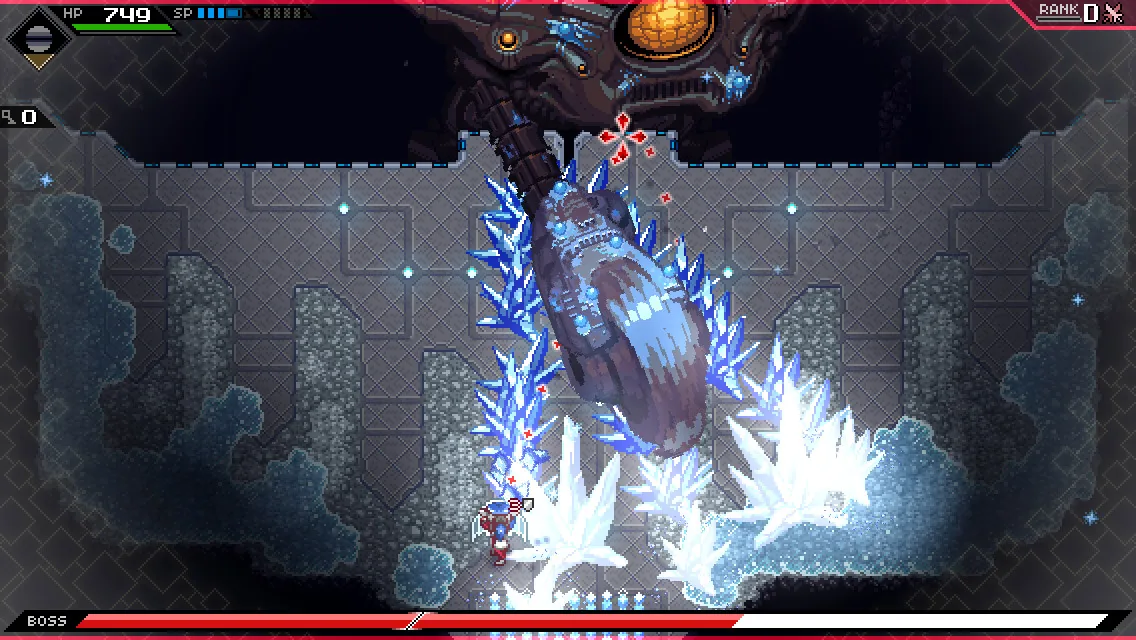
- Boss fights read enemy patterns and punish careless positioning rather than relying on raw stat checks, with a stagger system that rewards aggressive, accurate play
- Dungeon puzzle design reaches a scale and intricacy closer to a Zelda temple than anything else in the action RPG space, with multi-room mechanics that build on each other
Biggest weaknesses
- Story momentum barely exists for the opening stretch of the game and stalls again through a lengthy middle section that a consistent share of Steam's negative reviews single out by name
- Several late dungeons reuse the same two or three puzzle ideas across many rooms in a row, turning a mechanic that was interesting the first time into a checklist by the tenth
- The isometric camera makes platform height genuinely hard to read in places, and misjudging a ledge is a repeat source of player frustration rather than an occasional one
Who it's for: Players who want their action RPG combat and their dungeon puzzles to be the same skill rather than two separate games sharing a save file, and who don't mind a long, dense campaign that expects them to sit with a hard puzzle room rather than skip it.
Our recommendation: A confident buy at NZ$23.99 for a campaign most players finish somewhere in the 40-to-60-hour range, with a cheap, substantial expansion waiting once the main story wraps. Go in for the ball, stay for the dungeons, and expect the middle chapters to test your patience before the game earns its ending.
8.5 / 10
Most games that borrow MMO trappings for a single-player campaign treat them as set dressing — quest markers, a skill bar, a companion who occasionally logs off, none of it examined too closely because examining it would break the illusion. CrossCode doesn't just borrow those trappings, it builds its entire premise around explaining them. You're playing Lea, a player character inside a fictional MMO called CrossWorlds, and the game uses that fiction to justify almost everything a normal action RPG asks you to accept without question. It's the rare game whose premise and its mechanics are the same joke told seriously, made by a studio that clearly loves both the genre it's parodying and the one it's building.
That framing would be a cute gimmick on its own. What makes CrossCode worth a real look is that the joke has teeth: the ball Lea throws to fight monsters is the exact same object, governed by the exact same physics, that solves every dungeon puzzle in the game. There's no separate puzzle toolkit sitting next to the combat kit. It's one verb, pointed at two different kinds of room.
The ball is the whole language
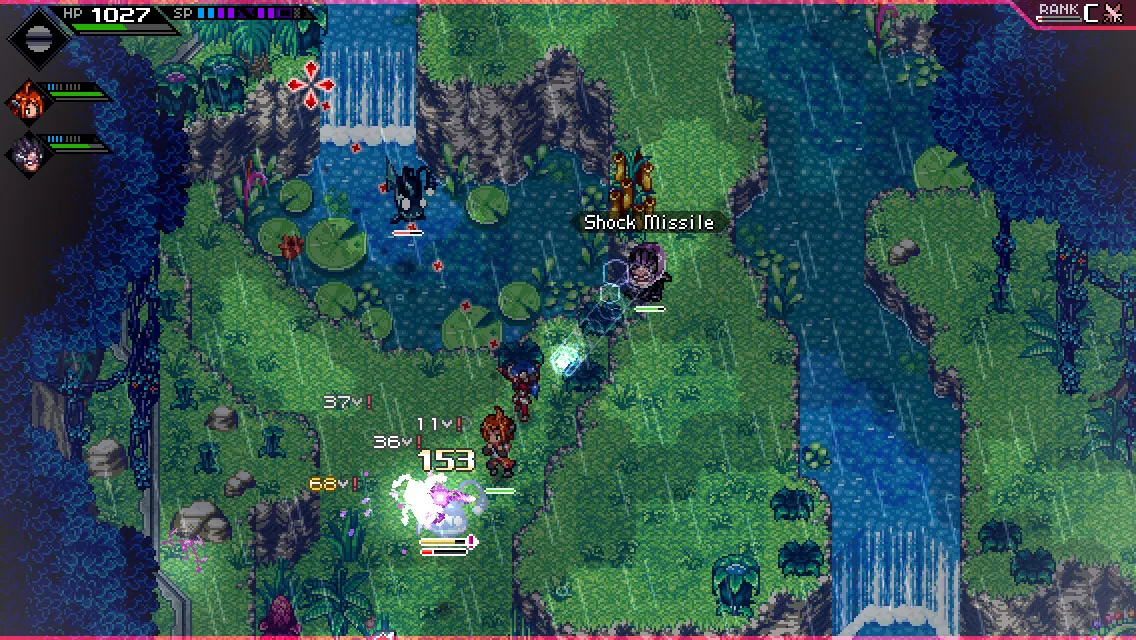
Lea's basic attack is a charged energy ball, thrown in a straight line, that bounces off walls and enemies at a clean, predictable angle. In combat that's a ranged option with real spacing consequences — bad throws waste the charge time and leave you exposed, good ones ricochet through a cluster of enemies or come back around a shield from an angle the enemy didn't block. Unlocking elemental modes later on adds heat, cold, shock and wave variants, each with a different rock- paper-scissors relationship to enemy resistances, so the choice of which ball to throw becomes as important as when to throw it.
The trick is that every one of those properties is also a puzzle tool. A shock ball that stuns an enemy on contact also completes an electrical circuit on a switch panel. A ball that bounces at a clean angle off a wall in combat bounces at that same clean angle off a mirror in a dungeon, which means the entire skillset a fight demands — timing a throw, reading an angle, tracking where a bounced ball will end up — is the literal skillset the game's puzzle rooms are built to test. Most action RPGs that include environmental puzzles treat them as a pause button on the real game; CrossCode never really changes games at all. You're doing the same thing in a boss arena and a switch room, just against a different kind of resistance.
It isn't a flawless unification. Combat rewards fast, aggressive positioning and punishes hesitation; puzzle rooms often want you to slow down and plan several bounces ahead before committing. The switch between those two mental modes, sometimes room to room, is a real adjustment the game never quite smooths over, and a handful of Steam's negative reviews describe exactly that friction — being pulled out of a puzzle-solving headspace by a sudden fight, or vice versa. It's a minor cost next to what the shared mechanic buys, but it's real.
The dungeons: the best content and the hardest sell
CrossCode's dungeons are where the design pays off hardest, and where the game asks the most of a player's patience in return. These aren't linear corridors with the occasional switch to flip — they're large, interlocking spaces where a mechanic introduced in the first room is still being combined with new ideas ten rooms later, closer in shape and ambition to a Zelda temple than to anything the action RPG genre usually attempts. Multi-stage elemental puzzles, timing-based chains across several screens and boss encounters that fold the dungeon's own puzzle logic into the fight itself are the norm, not the exception.
That's also exactly where the game loses some of its audience. Player feedback consistently separates into two camps on dungeon difficulty: players who find the escalation genuinely satisfying, and players who describe specific late-game rooms as reusing the same two or three ideas so many times in a row that a mechanic that felt clever the first time becomes a checklist by the tenth. Both readings are fair, and which one you land on says more about your tolerance for sustained puzzle difficulty than it does about the game's execution. What's harder to defend is the isometric camera's habit of making platform height genuinely ambiguous — misjudging whether a ledge is one step up or two is a recurring, avoidable source of frustration that has nothing to do with the puzzle logic itself and everything to do with how the perspective renders elevation.
If you bounce off CrossCode, it's very likely to happen in a dungeon, and it's worth knowing that going in: this is a puzzle game wearing an action RPG's skin as much as the reverse, and the puzzle difficulty doesn't ease up to accommodate players who came for the combat alone.
A mute hero in someone else's MMO
Lea can't talk. Within CrossCode's fiction, that's not a stylistic choice on the writers' part — it's an in-game bug, a known glitch in the CrossWorlds MMO that other player characters comment on and that the story eventually investigates as a real plot thread rather than quietly forgetting about. That's a genuinely clever piece of design: it takes the silent-protagonist trope, which most RPGs use without ever justifying it, and turns it into diegetic content. The same goes for quest markers (in-game UI elements Lea's character is using), NPC party members who "log off" mid- adventure, and item drops that behave like loot tables because, narratively, they are loot tables. Nothing in CrossCode's world needs an unspoken pact with the player to accept normal RPG conventions — the game just explains them.
The device holds up well for most of the campaign, helped enormously by expressive, readable character animation doing the emotional work Lea's dialogue can't. It wears thinner in the opening hours, where her silence sits next to a talkative AI companion and a heavier-than-necessary run of tutorial interruptions, and a fair number of player complaints about early friction point at that combination specifically rather than at the mute-protagonist idea itself. It's a smart structural choice more than a perfect one — closer in spirit to how Bitburner builds its entire interface out of the fiction that you're inside a real computer system, another game where the framing device isn't decoration, it's the reason the mechanics don't need an excuse.
The mid-game problem
Ask CrossCode's own player base where the game struggles and the answer is consistent: the middle third. The opening hours spend real time establishing systems before the plot moves anywhere, and a sizeable share of negative Steam reviews describe the story stalling out again after the early Vermillion Wasteland chapters, well before the back half picks momentum back up. That's a structural problem more than a content problem — the puzzle and combat design don't get worse in the mid-game, but the narrative reasons to keep pushing forward thin out at exactly the point where the campaign still has a long way left to go.
It compounds an issue that shows up in the negative reviews independently of pacing: this is a long game, and more than a few players argue directly that cutting it down would have made it stronger rather than weaker. There's a real case for that. CrossCode rarely runs out of new mechanical ideas, but it does occasionally run out of new things to do with the ideas it already has, and the mid-game is where that repetition is most exposed.
The console version, then and now
CrossCode launched on PC first, in September 2018, and didn't reach Switch, PlayStation 4 and Xbox One until July 2020 — a genuinely difficult port, given that the original game runs on a JavaScript-based engine that Deck13 had to translate into native code rather than simply recompile. The Switch release in particular had a rocky first impression: noticeable framerate drops during busy scenes were a common complaint at launch, and several patches went out during and after certification specifically to address it.
That reputation is largely a launch-era one at this point. The heaviest technical patching happened in the year or so after the console versions shipped, and Radical Fish Games' more recent update history — including a seventh-anniversary hotfix as late as August 2025 — shows a game still being maintained rather than one that shipped broken and was abandoned. The studio has since moved its primary development attention to a newer project, Alabaster Dawn, but CrossCode continues to receive periodic patches and crossover content rather than sitting entirely still. Buyers going in today on Switch shouldn't expect the same rough edges that defined the July 2020 launch window, even without a specific benchmark to point to.
A New Home and what your money buys
CrossCode's base price sits at NZ$23.99, which is genuinely competitive for a campaign that a consistent pattern of player feedback puts somewhere in the 40-to-60-hour range depending on how much side content and how many post-game challenge dungeons you chase. The paid expansion, A New Home, adds NZ$11.39 for a new residential area, additional dungeons and a proper narrative epilogue to the base story — not a skin pack or a difficulty remix, but new content built to the same standard as the campaign it extends. There's no subscription, no premium currency and no loot-box layer anywhere in the game; the only other paid add-ons are a couple of cosmetic skin DLCs priced under NZ$3 each, which change nothing about how the game plays.
Compared to Chained Echoes, another Deck13-published indie RPG built by a small team around one core mechanical idea, CrossCode asks for a similar up-front commitment and delivers a similarly complete package with no ongoing monetisation to worry about. Where Chained Echoes bets everything on a single combat system, CrossCode splits its bet between combat and puzzle design and, for the most part, cashes both.
Verdict
CrossCode earns its reputation the hard way — not through nostalgia, and not through a single standout system, but through genuine mechanical unity. The ball you throw in a boss fight and the ball you throw at a dungeon switch panel are the same object obeying the same rules, and that choice makes the game's two halves reinforce each other instead of competing for attention. Add a setting that justifies its own genre conventions instead of hiding them, and you have one of the more thoughtfully constructed action RPGs in the pixel-art revival.
It settles at 8.5 rather than higher because the length works against it as often as it works for it. The mid-game loses narrative momentum for long stretches, several late dungeons lean too hard on ideas that were already fully explored earlier, and the camera's handling of elevation is an avoidable irritant in a game that otherwise asks for real precision. None of that undoes what the core mechanic accomplishes — it just means a sixty-hour commitment doesn't sustain its best ideas for the entire runtime.
If you liked how Sea of Stars or Octopath Traveler II rebuilt older genre conventions around one strong idea, CrossCode is worth the same kind of attention, aimed at a different genre entirely. Go in expecting a puzzle game as much as an action RPG, and budget the patience a sixty-hour campaign actually needs.
Price and Steam review data checked 2 August 2026.
Pros and cons
Pros
- The ball-throw mechanic is identical in combat and puzzles, so every new elemental mode or bounce trick you learn fighting enemies immediately unlocks new solutions in dungeons
- Boss fights read enemy patterns and punish careless positioning rather than relying on raw stat checks, with a stagger system that rewards aggressive, accurate play
- Dungeon puzzle design reaches a scale and intricacy closer to a Zelda temple than anything else in the action RPG space, with multi-room mechanics that build on each other
- The fictional CrossWorlds MMO setting gives the game a diegetic excuse for quest markers, NPC party members logging off mid-story and other genre conventions other RPGs use without explaining
- A dense, colourful 16-bit-style world with a well-liked soundtrack that sustains long exploration and backtracking sessions without becoming grating
- A New Home adds a real new area, additional dungeons and a proper narrative epilogue for NZ$11.39, rather than reusing existing content behind a paywall
Cons
- Story momentum barely exists for the opening stretch of the game and stalls again through a lengthy middle section that a consistent share of Steam's negative reviews single out by name
- Several late dungeons reuse the same two or three puzzle ideas across many rooms in a row, turning a mechanic that was interesting the first time into a checklist by the tenth
- The isometric camera makes platform height genuinely hard to read in places, and misjudging a ledge is a repeat source of player frustration rather than an occasional one
- Boss fights lean on a break-then-stagger rhythm that some players find becomes the one correct approach once it's learned, flattening fights that initially read as tactical
- Lea's silence is a deliberate story choice, but paired with a talkative AI companion and frequent menu interruptions it creates real friction in the opening hours before the combat-puzzle loop takes over
- The Nintendo Switch version had a genuinely rough launch, with noticeable framerate drops during busy scenes that took multiple post-launch patches to bring in line with the other console releases
Screenshots
-
CrossCodeImage: Deck13 via Steam -
CrossCodeImage: Deck13 via Steam -
CrossCodeImage: Deck13 via Steam -
How the review scores each part of the gameWanderer Editorial -
The short versionWanderer Editorial