Game review
Backpack Dungeon Review
6.7 / 10
- Developer
- 夜喵
- Publisher
- Shuffle Play Games
- Released
- 14 July 2026
- Platforms
- ["Windows", "Mac"]
- Genre
- Roguelike
- Monetisation
- Paid
- Players
- Single-player
The short version
Backpack Dungeon is a sharp, affordable take on the backpack-management roguelike that earns real strategic depth from a simple premise, even if its AI art and grindy long tail keep it from standing alongside the genre's best.
Biggest strengths
- The route-based backpack system, where item placement and activation order matter as much as raw stats, is a genuinely engaging puzzle
- Multiple heroes, randomized relics, and twenty escalating difficulty tiers give runs real variety for a long time
- Extremely cheap for the amount of content and depth on offer, with Steam Workshop support extending it further
Biggest weaknesses
- Visibly AI-generated art has drawn heavy criticism and undercuts the game's otherwise distinct identity
- A handful of enemies, especially a damage-type-immune final boss, hard-counter entire build archetypes with little warning
- Meta-progression is a long grind for comparatively thin rewards, and the tutorial and UI have reported bugs
Who it's for: Roguelike and inventory-puzzle fans who don't mind AI-assisted visuals and want a cheap, deep time-sink.
Our recommendation: Recommended, especially at its low price point, provided the AI-generated art style isn't a dealbreaker.
6.7 / 10
A Simple Idea, Built Out With Real Care
Backpack Dungeon belongs to a small but increasingly crowded genre popularized by games like Backpack Battles and Backpack Hero, where the inventory grid isn't just a place to store equipment but the entire combat engine. Here, developer 夜喵 takes that premise and commits to it fully. Items placed in your backpack activate in sequence as a small ball travels a route through the grid, triggering weapons, potions, and passive effects along the way. Where you place something, and what you place next to it, matters as much as how strong that item is on its own. It is a small twist on a familiar formula, but it gives Backpack Dungeon its own identity rather than feeling like a straight clone of its more famous forebears.
Expanding the backpack grants more room for gear, but it also lengthens the route the trigger ball has to travel, meaning a bigger bag isn't automatically a better one. That trade-off sits at the center of nearly every decision in a run, and it is consistently the part of the game reviewers single out as its strongest idea. A tightly packed, efficient loadout can outperform a sprawling one stuffed with rare loot, and figuring out exactly where that balance point sits for a given build is the kind of puzzle that keeps players coming back run after run.
Deep Systems for a Very Small Price
For a game asking under four dollars at launch, Backpack Dungeon's scope is genuinely surprising. Multiple playable heroes each unlock their own spin-off variant after being taken far enough into a run, doubling the effective character roster and giving long-term players fresh builds to chase long after the early hours. Twenty escalating difficulty levels provide a steady curve from an approachable introduction to genuinely demanding late-game challenges, and a wide item pool, relic combinations, and status-based strategies mean that no two runs play out quite the same way. Steam Workshop support adds custom monsters, items, and events on top of that, which several long-time players have specifically praised as extending the game's life well past what the base content alone would offer.
Combat itself resolves largely automatically once a fight begins, which puts nearly all of the tension into the preparation phase rather than moment-to-moment execution. That design won't appeal to players looking for reflex-driven action, but for the puzzle-and-optimization crowd it is exactly the point: watching a carefully assembled build execute cleanly feels earned, because every piece of it was a deliberate choice made beforehand. Between dungeon floors, an auction-house style vendor lets players bank gold and pre-purchase items for future runs, a system several longtime players specifically call out as one of the game's smarter quality-of-life touches, even as they ask for it to be expanded with more investment and speculation options down the line.
Battle speed can also be freely adjusted, from a slowed-down pace for parsing exactly why a build succeeded or failed to a fast-forward option for steamrolling through fights whose outcome is already obvious. It's a small touch, but it matters a lot in a genre where a single run can span dozens of floors, and it keeps the preparation-heavy loop from feeling padded out by combat that has already been effectively decided before it starts.
Where the Balance Breaks Down
The trade-off for that depth is a game that leans hard on players finding a small number of genuinely powerful item combinations, and several detailed reviews describe a run of the mill where the vast majority of the item pool ends up feeling irrelevant next to a handful of standout picks. Enemies compound this: outside of a few specific encounters, most fights offer little meaningful variation, and the final boss in particular hard-counters entire damage types and build archetypes, which can leave players who invested heavily in a poison- or status-based strategy with no viable path to victory short of restructuring their whole approach. That kind of late, unsignposted wall sits awkwardly next to a game that otherwise rewards experimentation.
Meta-progression between runs is present but has drawn consistent criticism as slow and comparatively thin for the amount of time it demands, unlocking mostly minor stat bonuses and starting relics rather than the kind of build-altering options that would justify a long grind. Performance in extended endless-mode sessions has also been flagged by multiple players as laggy, and a handful of users reported a buggy tutorial sequence and, in one case, a post-hotfix Windows trust warning that briefly prevented the game from launching at all.
The AI Art Question
No discussion of Backpack Dungeon is complete without addressing its visuals, and player feedback on this point is loud and consistent. A large share of the game's art assets are AI-generated, and it is not a subtle use of the technology; many reviewers describe it as immediately recognizable and, for a game marketed around a "unique pixel-art" identity, somewhat at odds with that pitch. Opinions split sharply along this line: a meaningful number of players say it's simply not a dealbreaker at this price point and that the mechanics carry the experience regardless, while others describe the art as actively distracting or "soulless," and a few report the developer understated how much of the asset pipeline relied on it. This isn't a minor aesthetic quibble in the review landscape around the game; it's arguably the single most polarizing aspect of the whole package, and it's worth going in with eyes open regardless of how strongly it will or won't bother you personally.
Verdict
Backpack Dungeon takes a genre that already has strong competition and finds a real point of differentiation in its route-based backpack mechanic, wrapping it in enough heroes, relics, and difficulty tiers to justify a very long play session for a very small asking price. It stumbles in the places that matter for long-term staying power: a grindy meta-progression loop, a handful of unfairly hard-countering encounters, and a divisive reliance on AI-generated art that a significant portion of its audience simply can't get past. None of that erases what works here, and for players willing to look past the visuals, there's a genuinely clever, budget-priced roguelike underneath.
Pros and cons
Pros
- The route-based backpack system, where item placement and activation order matter as much as raw stats, is a genuinely engaging puzzle
- Multiple heroes, randomized relics, and twenty escalating difficulty tiers give runs real variety for a long time
- Extremely cheap for the amount of content and depth on offer, with Steam Workshop support extending it further
Cons
- Visibly AI-generated art has drawn heavy criticism and undercuts the game's otherwise distinct identity
- A handful of enemies, especially a damage-type-immune final boss, hard-counter entire build archetypes with little warning
- Meta-progression is a long grind for comparatively thin rewards, and the tutorial and UI have reported bugs
Screenshots
-
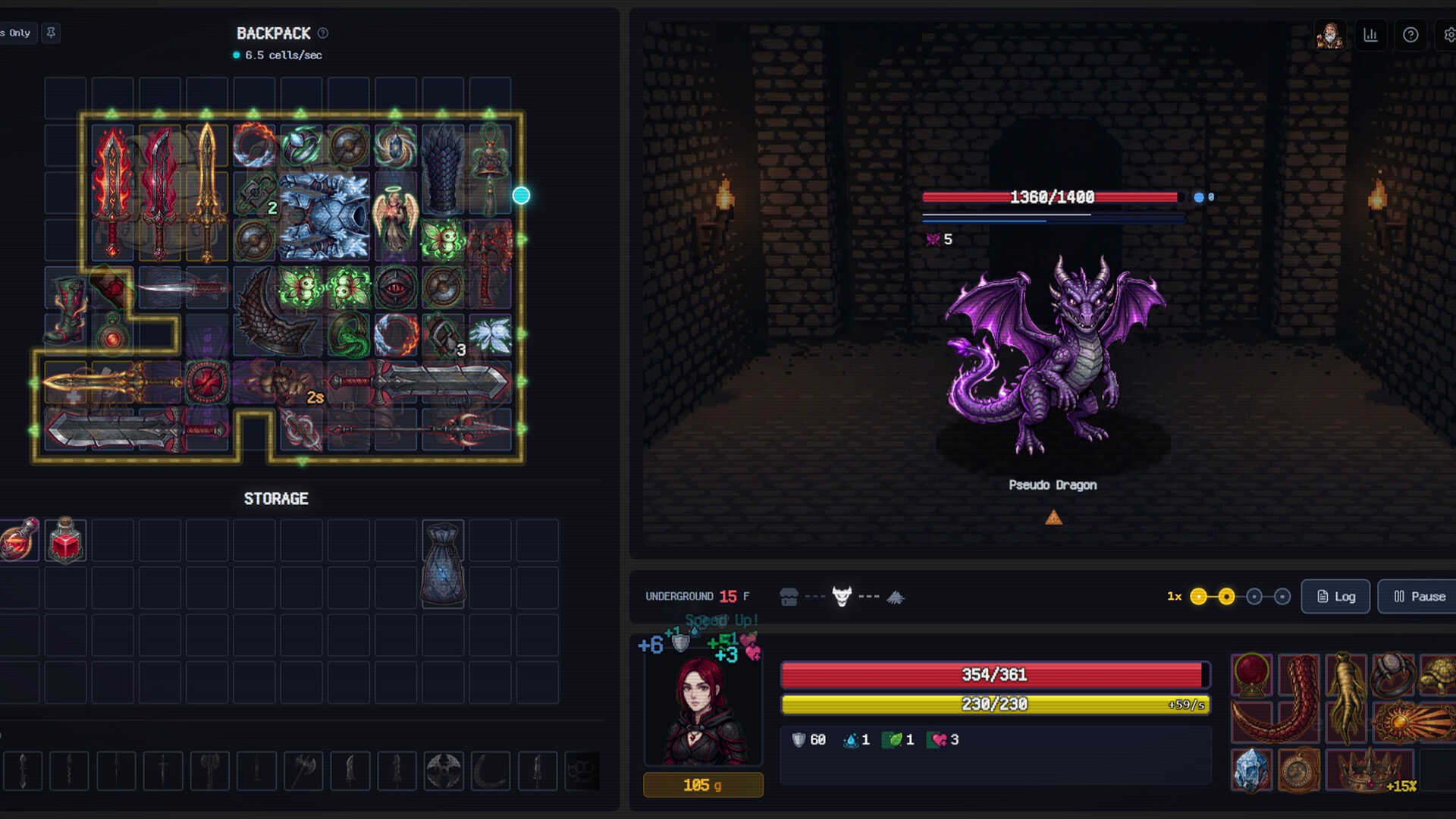
The backpack grid sits beside the fight it powersImage: 夜喵 -
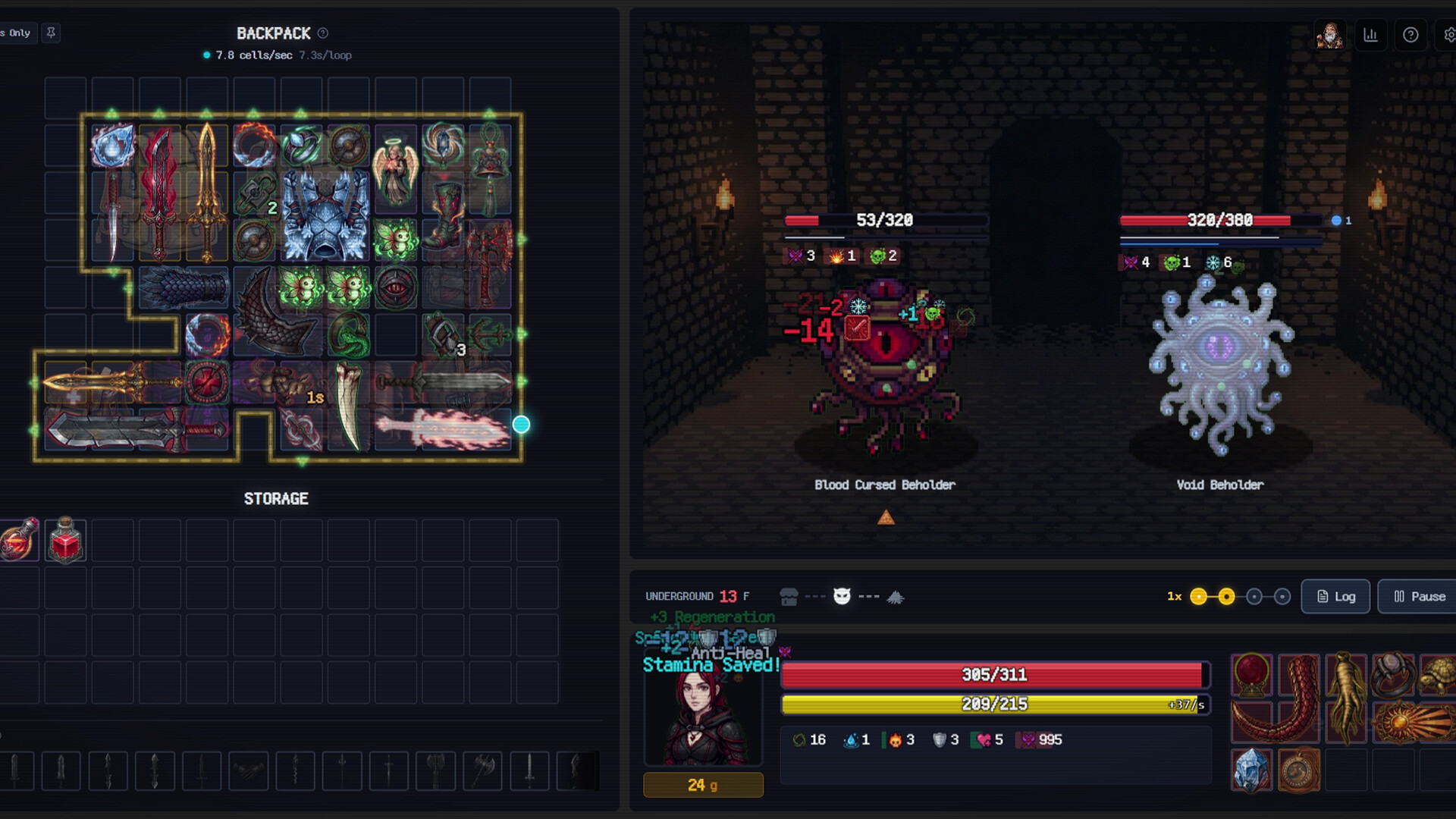
A packed backpack facing down a pair of BeholdersImage: 夜喵 -
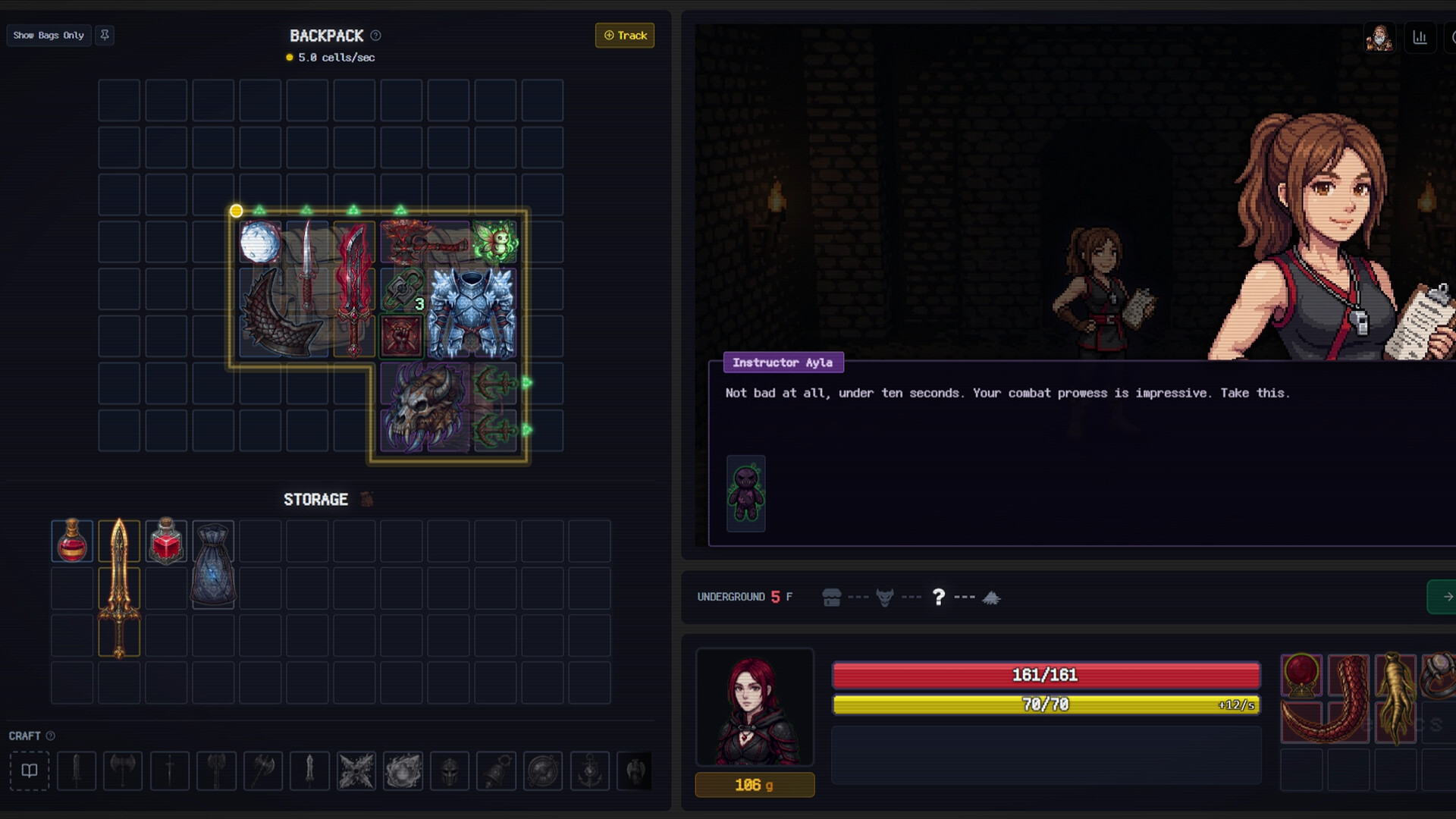
The tutorial introduces mechanics through Instructor AylaImage: 夜喵 -
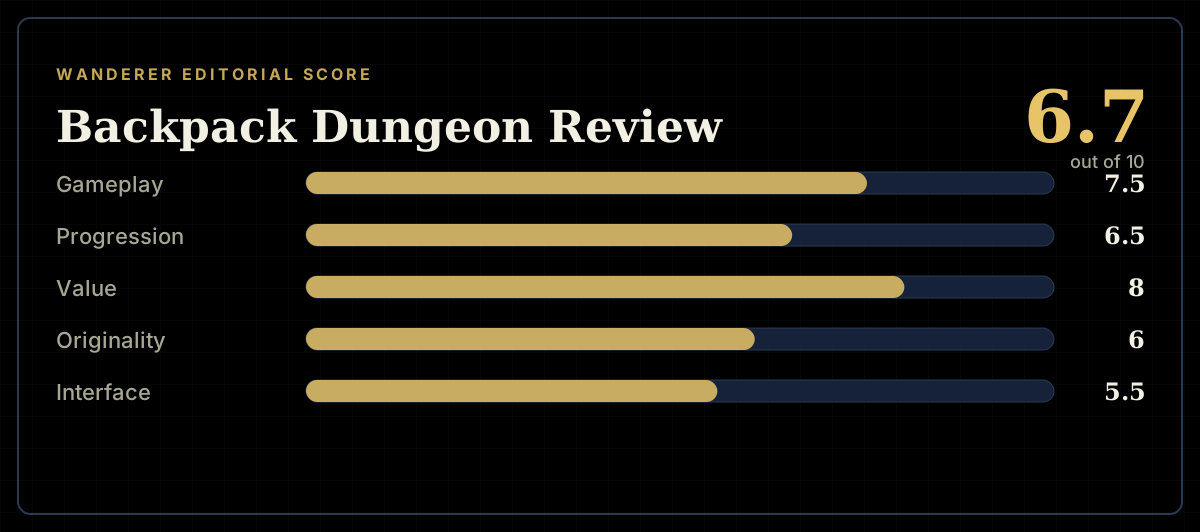
How the review scores each part of the gameWanderer Editorial -
The short versionWanderer Editorial