
Game review
Agent 64: Spies Never Die Review
6.4 / 10
- Developer
- Replicant D6
- Publisher
- Replicant D6
- Released
- 11 August 2026
- Platforms
- ["Windows"]
- Genre
- Action
The short version
Biggest strengths
- A faithful, exceptionally well-tuned recreation of GoldenEye 007 and Perfect Dark's N64-era shooting, movement, and level design, built almost entirely by one developer
- A genuinely large amount of single-player content: a fourteen-mission campaign playable on three difficulties, a dedicated Challenge mode against bots, and a customizable Arena
- Full online and split-screen local co-op and multiplayer, running smoothly even on Steam Deck
Biggest weaknesses
- The Cypher progression system locks later story acts behind replaying earlier missions on harder difficulties or completing separate challenges, the single most repeated complaint across the game's review base
- Missing several quality-of-life features found even in its 25-to-30-year-old inspirations: no crouch, no blood effects, no weapon wheel, no voice acting, and no dual-wielding
- A thin weapon roster of roughly five guns and largely one-note enemy AI limit variety across the campaign's missions
6.4 / 10
A Love Letter to the N64 Spy Shooter, Written by One Person
Agent 64: Spies Never Die wears its influences on its sleeve so openly that the title itself is barely a disguise: this is a GoldenEye 007 and Perfect Dark tribute act, right down to a secret agent named John Walter running through nightclubs, ski resorts, and marble-floored mansions to stop a recurring nemesis named Dominic Pulp. What makes it remarkable is the scale of the undertaking behind it. The game was built almost entirely by a single French developer working under the handle Replicant D6, with a second person credited solely for the soundtrack, and reviewers consistently call out how absurd it is that a two-person effort captures the specific, hard-to-articulate feel of those Rare-developed N64 classics as precisely as it does. Blocky, low-resolution character models with static face scans, chunky environmental geometry, a total absence of voice acting in favor of on-screen text banners, and loose, crosshair-optional aiming that has you catching up to the camera rather than snapping to it, all of it is recreated with obvious care rather than as a cost-cutting shortcut. Long-time fans of the genre describe missions that directly evoke specific rooms and set pieces from the Facility, the G5 Building, and dataDyne Central without ever outright copying a level, calling the homages tasteful rather than shameless. For anyone who spent hundreds of hours with a Rareware cartridge as a kid, that specificity is the game's entire pitch, and by most accounts it delivers.
Fourteen Missions, Three Difficulties, and a Cypher System Everyone Complains About
The campaign spans fourteen individually playable missions across roughly ten environments, from penthouses and snowy outdoor bunkers to a well-regarded castle level, each completable on three difficulty tiers (Agent, Special Agent, and the hardest, 64 Agent) that add secondary objectives, tougher enemies, and previously blocked-off areas as you climb. There are no lives, checkpoints, or health kits, just armor pickups to buffer damage, so a mission gone wrong means a full manual restart, a deliberately old-school choice that reviewers find tense in short bursts but occasionally punishing on longer levels. Where the design turns genuinely divisive is the Cypher system: completing a mission earns Cypher Points based on the difficulty played, and a set number of Cyphers is required to unlock each subsequent act of the four-act story. In practice, that means finishing every mission on the easiest setting isn't enough to reach the end, players have to replay levels on harder difficulties or hunt down hidden masks to unlock bonus challenges, just to keep the story moving. It's by a wide margin the most repeated criticism in the game's review base, with players calling it an artificial roadblock that turns story progression into a chore, stalls momentum at the end of every act, and in a number of cases, prompted refund requests outright. A vocal minority argue the replay incentive works in the game's favor, pointing out that the multiple victory conditions across difficulties effectively turn fourteen levels into dozens of distinct challenges worth mastering, but even sympathetic reviewers tend to agree the point requirements are set uncomfortably high.
Missing Just Enough to Feel Like a Step Backward
Where Agent 64 draws its sharpest criticism is in comparison to the very games it's imitating, several of which are now nearly three decades old and still, reviewers point out, offer things this one doesn't. There's no crouch function, no blood effects on hit character models (something GoldenEye itself had), no weapon wheel, no dual-wielding, and no voice acting even in cutscenes, all delivered instead through text banners that are awkward to read mid-firefight. The weapon roster is similarly thin, around five gun types with only one entry per category outside a late-game standout, and the sniper rifle in particular draws consistent complaints for feeling unresponsive regardless of input device. Enemy AI swings between two extremes: often oblivious to nearby gunfire and easy to funnel into ambushes, but noticeably sharper and more aggressive on the hardest difficulty, where accuracy and damage spike sharply enough that several reviewers call the jump between tiers uneven rather than a smooth curve. A handful of players also reported more concrete technical issues at launch, stuttering tied to the game's optional anti-cheat, a recurring weapon-twitch graphics bug, and desyncs or crashes in online co-op, though these appear to affect a minority and the developer has continued shipping hotfixes on a near-daily cadence since release. None of this erases what the game gets right, but it does mean the shortlist of things GoldenEye and Perfect Dark did that Agent 64 doesn't is long enough to bother reviewers who came in expecting a strict step forward rather than a careful recreation with a few steps back.
A Genuine Multiplayer Suite and a Lot of Content to Chase
Where the game earns some of its strongest praise is in the sheer amount packed around the campaign. Split-screen and online co-op let two players tackle the story together, complete with shared armor pickups and the ability to revive a downed partner, and reviewers repeatedly single out a late-night couch co-op session as one of the best parts of their time with the game. Beyond the story, a Challenge mode pits players against bots in preset scenarios modeled on Perfect Dark's combat trials, and a fully customizable Arena supports Deathmatch, Capture the Flag-style Briefcase matches, and dozens of joke-y "Paradox" modifiers (slow-motion bullets, big-head mode, and similar classic cheats) across local or online play with up to eight participants. Chasing par times to unlock those cheats and cosmetic extras adds a genuine skill ceiling for players willing to grind, though several reviewers note the stricter par times are achievable only by a small fraction of the player base and would benefit from more forgiving tiers for casual returning fans. The soundtrack draws a mixed but generally positive reception, several reviewers say it grew on them over dozens of hours despite an unremarkable first impression, while a few call it a flat imitation of the genre's iconic scores. Combined with Steam Deck support that reviewers describe as working well out of the box, the overall package is a lot more substantial than its short campaign length alone would suggest, even if getting the most out of it requires patience with the Cypher grind and a willingness to replay the same maps repeatedly.
Verdict
Agent 64: Spies Never Die succeeds at the one thing it absolutely had to get right: it feels like a GoldenEye 007 and Perfect Dark game, built by people who understood exactly what made those originals click, right down to the loose aiming, the destructible desk props, and the tuxedo-clad goons who forget you exist the moment they lose sight of you. That's a genuinely impressive achievement for what's essentially a two-person team, and it's more than enough to make this a recommended pickup for anyone who grew up with an N64 controller in hand. Where it comes up short is in the gap between homage and evolution: quality-of-life features that even its decades-old inspirations had, crouching, blood effects, voice acting, a bigger weapon pool, are conspicuously absent, and the Cypher progression system turns what should be a satisfying difficulty curve into a genuine sticking point for a large share of players. It's an easy recommendation for retro shooter fans willing to meet it on its own terms and grind through the rough edges, less so for anyone hoping for a game that pushes the format forward rather than lovingly rebuilding it brick by brick.
Pros and cons
Pros
- A faithful, exceptionally well-tuned recreation of GoldenEye 007 and Perfect Dark's N64-era shooting, movement, and level design, built almost entirely by one developer
- A genuinely large amount of single-player content: a fourteen-mission campaign playable on three difficulties, a dedicated Challenge mode against bots, and a customizable Arena
- Full online and split-screen local co-op and multiplayer, running smoothly even on Steam Deck
- Detailed, era-appropriate presentation, from low-poly character models and destructible office props to a soundtrack that ramps with the action
Cons
- The Cypher progression system locks later story acts behind replaying earlier missions on harder difficulties or completing separate challenges, the single most repeated complaint across the game's review base
- Missing several quality-of-life features found even in its 25-to-30-year-old inspirations: no crouch, no blood effects, no weapon wheel, no voice acting, and no dual-wielding
- A thin weapon roster of roughly five guns and largely one-note enemy AI limit variety across the campaign's missions
- A short core campaign, somewhere between two and five hours depending on skill, that some reviewers feel doesn't justify the asking price on its own
Screenshots
-
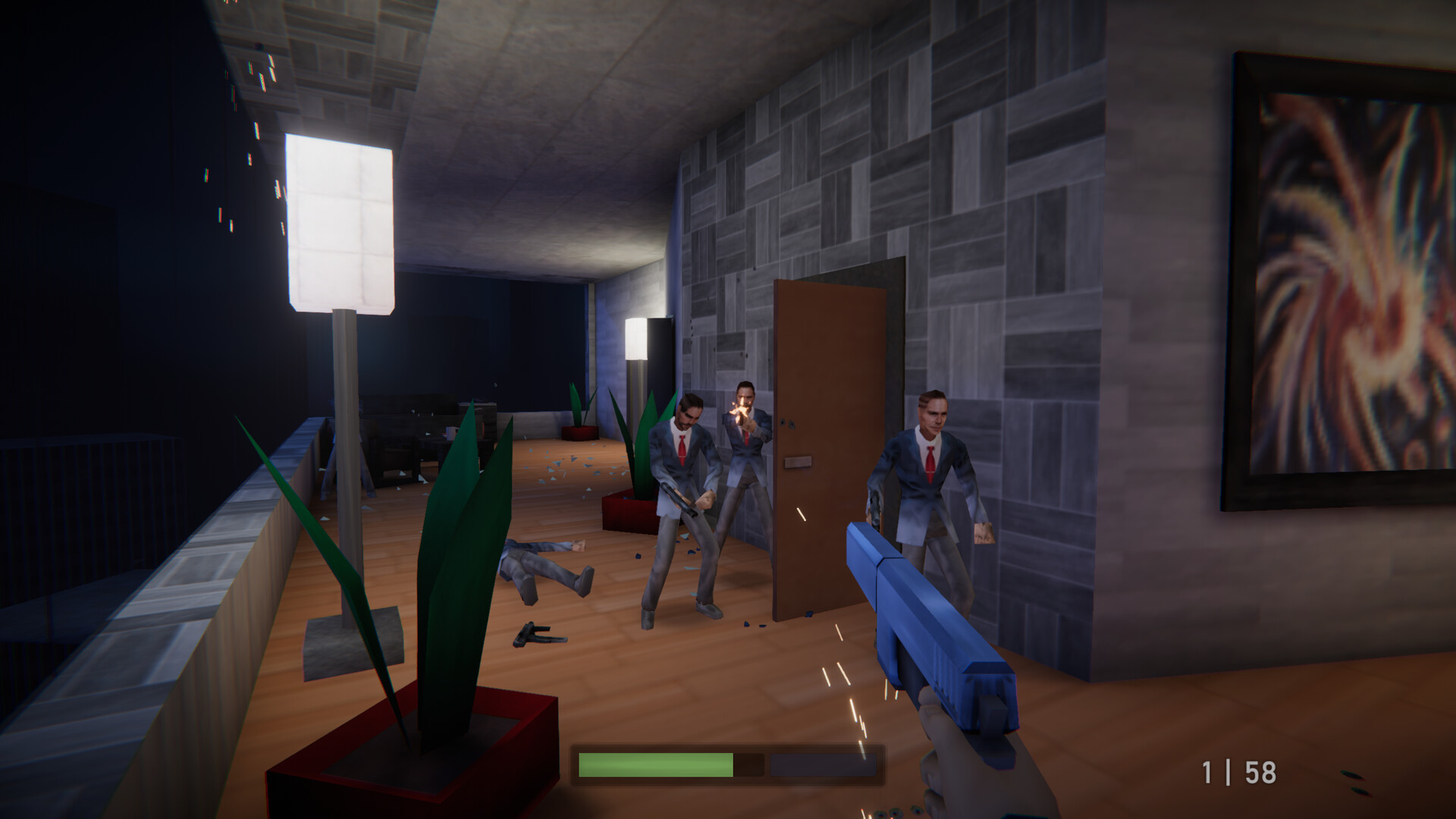
Low-poly guards, destructible props, and N64-style aiming recreate the feel of GoldenEye and Perfect DarkImage: Replicant D6 -
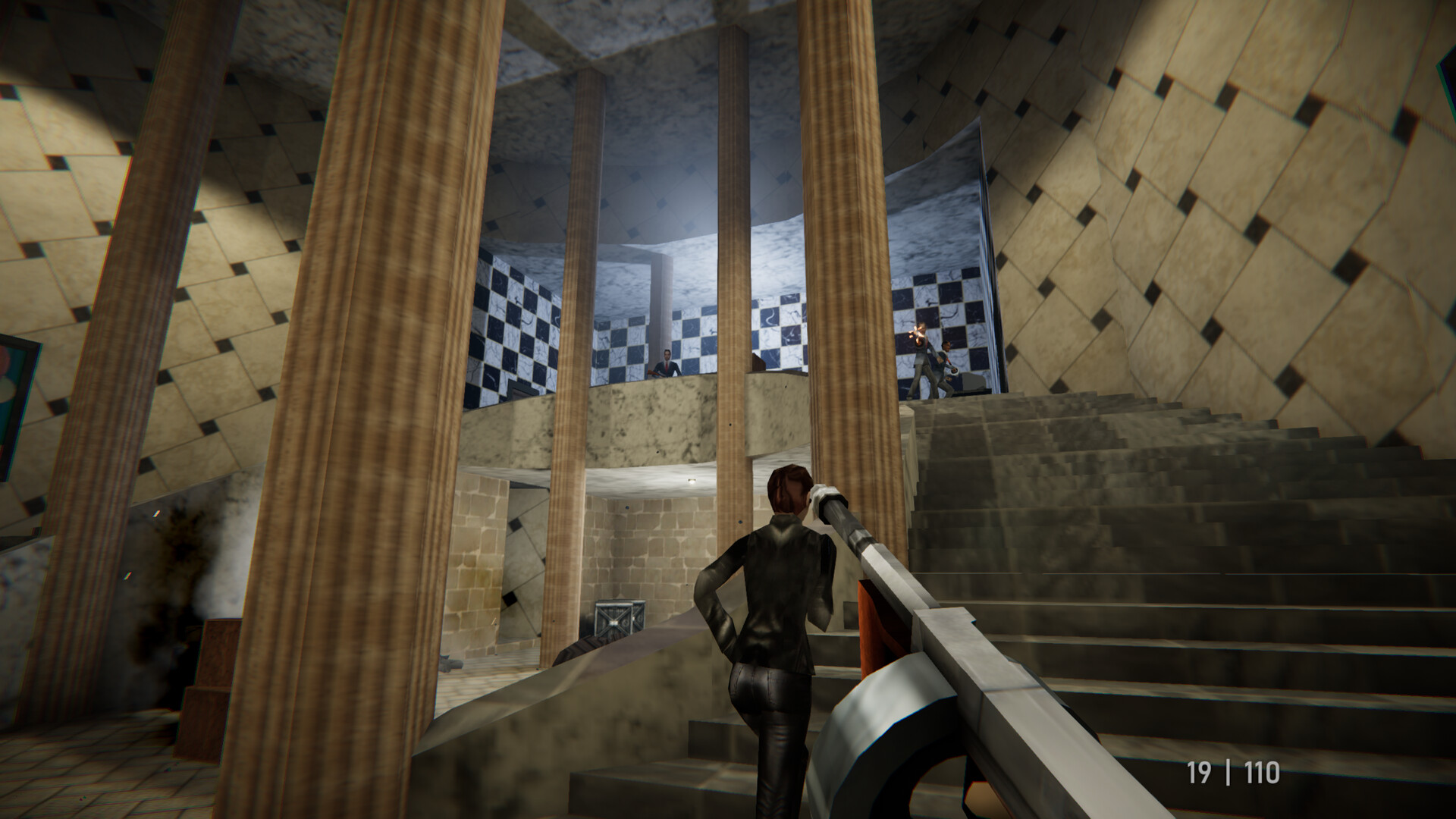
Co-op partner Dana joins missions in a columned, checkerboard-tiled mansion levelImage: Replicant D6 -
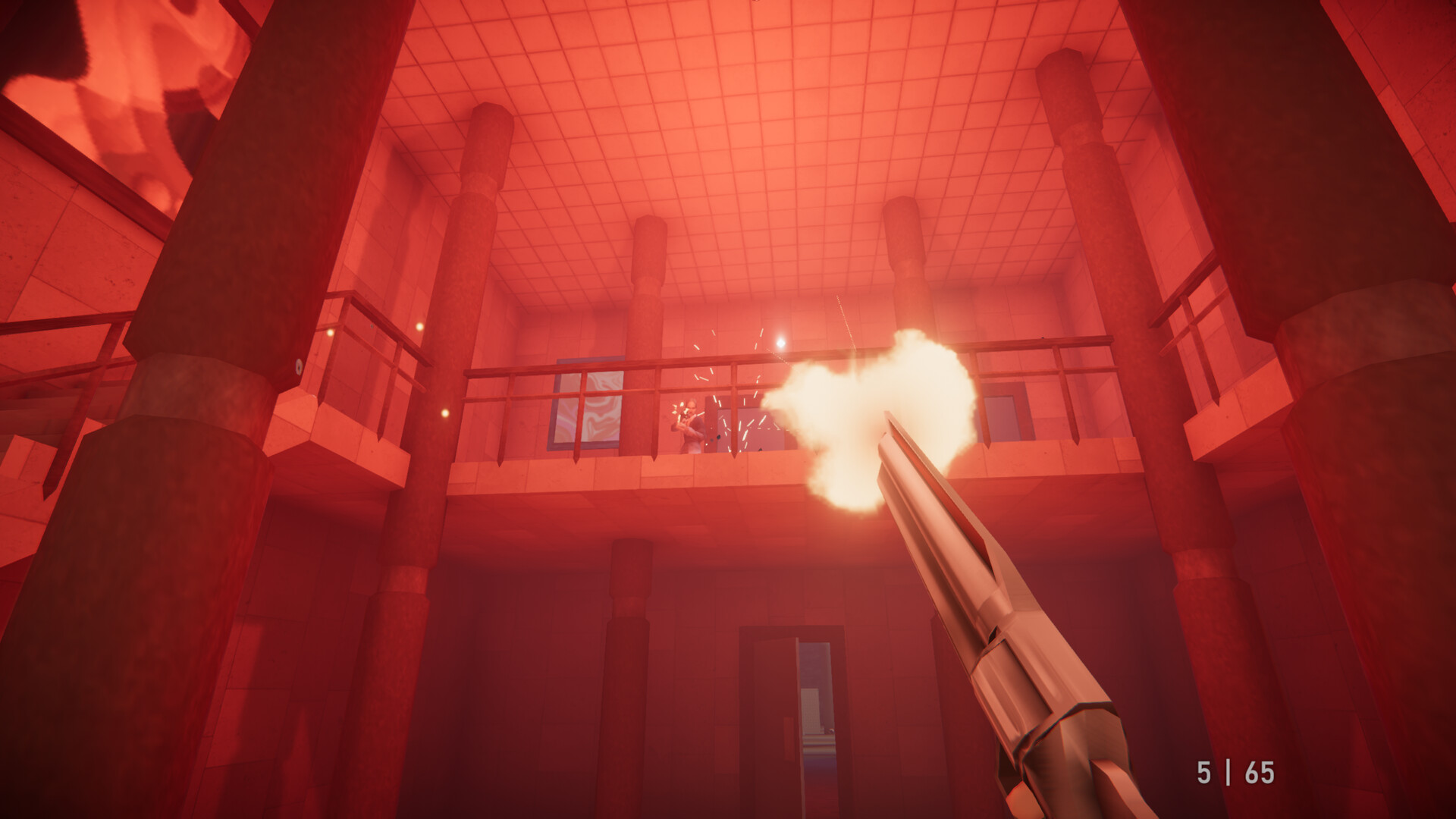
Triggering an alarm bathes levels in red and puts nearby guards on high alertImage: Replicant D6 -
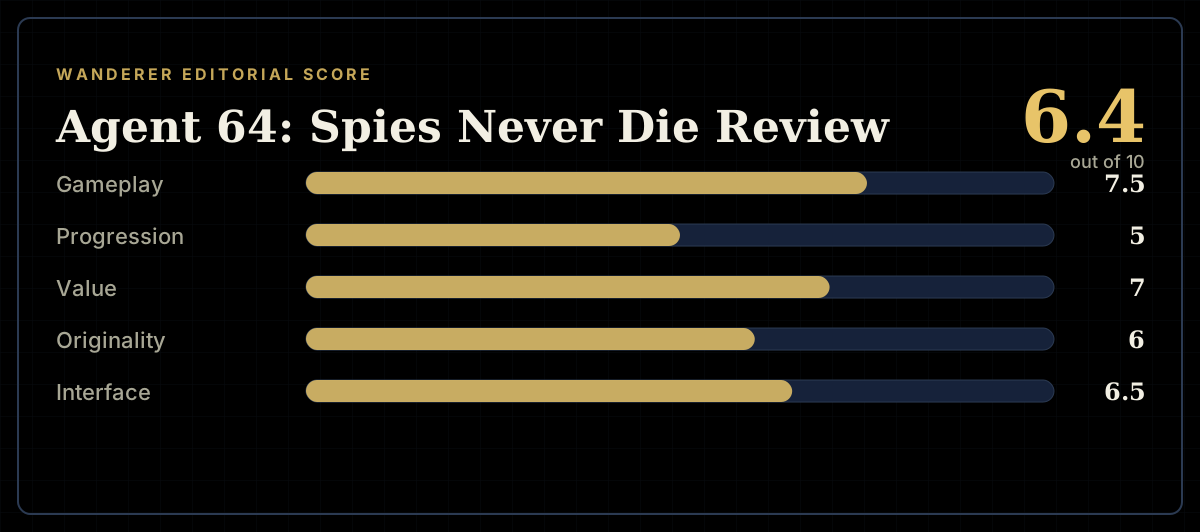
How the review scores each part of the gameWanderer Editorial -
The short versionWanderer Editorial