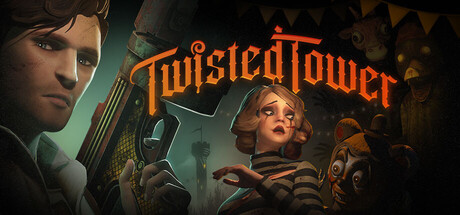
Game review
Twisted Tower
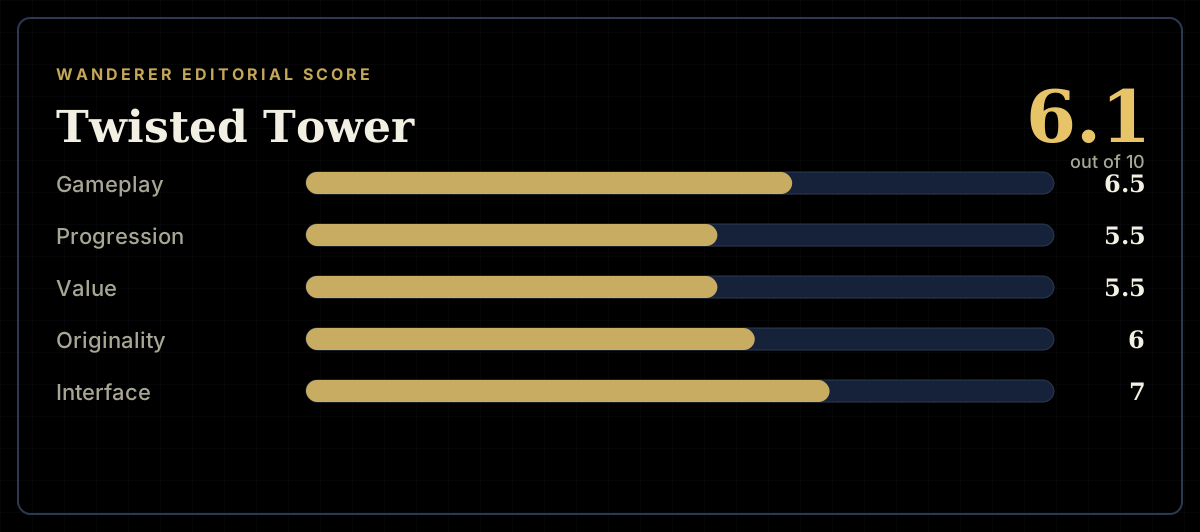
6.1 / 10
- Developer
- Atmos Games
- Publisher
- 3D Realms
- Released
- 18 August 2026
- Platforms
- ["Windows"]
- Genre
- Action
- Monetisation
- Paid
- Players
- Single-player
The short version
Twisted Tower's toy-themed weapons and richly corrupted theme-park atmosphere make a strong first impression, but shallow enemy AI, a bloated arsenal, and a widely panned story keep it from earning the Bioshock comparisons it so openly invites.
Biggest strengths
- A distinctive toy-weapon arsenal, from a whack-a-mole mallet to a bubblegum-firing chaingun, paired with strong voice acting that most reviewers single out as genuinely creative and fun to use
- A striking, richly detailed corrupted-theme-park atmosphere spanning a hotel, waterpark, clown casino, carnival forest, and space station, with art direction and music nearly every reviewer, critical or not, calls the game's strongest asset
- Official Steam Deck Verified support and a tightly-paced 3-to-6-hour campaign that several reviewers describe as a satisfying single-session shooter when taken on its own terms
Biggest weaknesses
- Widely reported shallow and cheesable combat, with basic enemy pathing, easily-exploited cover tactics, and repetitive encounters that many reviewers say fail to live up to the Bioshock comparisons the game invites
- A narrative delivered mostly through stop-and-listen audio logs and letters that a large share of reviewers call incoherent, undercooked, or actively unpleasant by its climactic twist
- A short campaign for its price with 10 largely redundant weapons, gated movement abilities that arrive too late to shape level design, and little incentive to replay its alternate paths
Who it's for: Players drawn to Bioshock's atmosphere-first arena-shooter formula who want a short, style-heavy action horror romp and are willing to forgive thin combat and a rough story for striking art direction and creative weapon design.
Our recommendation: Worth a look on sale for the atmosphere, weapon design, and a focused few hours of shooting, but manage expectations around its combat depth, story coherence, and length before paying full price.
6.1 / 10
Climbing a Corrupted Theme Park, Bioshock in Hand
Twisted Tower is developed by Atmos Games, the studio led by indie developer Thomas Brush, and published by 3D Realms, and it wears its central inspiration on its sleeve from the opening minutes: a first-person arena shooter set inside an abandoned, corrupted amusement park, built around resource management, audio-log storytelling, and weapon upgrade stations that any Bioshock player will recognize instantly. Players control Vincent, who chases his kidnapped fiancée Charlotte into the tower belonging to washed-up filmmaker and theme-park mogul V.C. Twister, fighting through five very different environments, a hotel, a waterpark, a clown casino, a carnival forest, and a space station, on the way to the top. At the time of writing, 1,702 English-language Steam reviews sit at roughly 93% positive, a strong headline number that hides a genuinely split conversation: many reviewers explicitly say they wish Steam allowed a "mixed" rating rather than a binary thumbs up or down, since their actual experience with the game lands somewhere in between.
The game had a long and public development, having gone through at least one full reboot from an earlier concept called "Father," and several long-time followers of Brush's YouTube channel describe watching its evolution over years before release. That history matters to how the review base reads the final product: reviewers who came in expecting a full realization of the Bioshock formula tend to walk away disappointed by what they see as underbaked systems, while those treating it as a shorter, style-first action-horror romp are considerably more forgiving.
Where Twisted Tower earns its most consistent praise, across both positive and negative reviews, is its central conceit: every weapon and traversal tool is themed around a twisted version of a childhood amusement park toy. A whack-a-mole mallet serves as the starting melee weapon, joined over time by a rubber-band pistol, a dart-firing Tommy gun nicknamed the Misfire, a shotgun that fires a joke-branded gas cloud, a bubblegum-themed chaingun, a marble-firing magnum, and a sniper-style sling-shot, among others. Reviewers repeatedly call this arsenal creative and genuinely funny, and several specifically praise the satisfying sound design and reload animations that accompany each one. Traversal gets a similar treatment: fairy wings, spring-loaded shoes, a grappling hook, and a jetpack are unlocked gradually and let players combine dashing, double jumps, and grapples once all four are acquired, though a common complaint is that these tools arrive too late, clustering in the final quarter of the game, to meaningfully shape earlier level design.
The five main areas are singled out repeatedly for their visual variety, moving from art-deco hotel corridors to a garish clown casino and an unexpected space station, and the corrupted fairy-tale mascots, from a giraffe with a machine gun to living telephones that startled more than one reviewer, are broadly well received as creature designs even by critics of the wider combat systems. Several detailed reviews frame this as the game's clearest success: a Willy Wonka-meets-Disneyland theme executed with real visual imagination, wrapped around gruesome, bloody combat that plays the contrast for both horror and dark comedy.
Combat That Doesn't Hold Up to the Comparison It Invites
The most consistent and detailed criticism, showing up across the large majority of negative reviews and inside many positive ones, targets the actual moment-to-moment combat. Reviewers repeatedly describe enemy AI as extremely basic, walking in straight lines toward the player with no meaningful use of cover, flanking, or varied attack timing, which lets fights be trivialized by simply standing behind cover and letting enemies flinch-lock into death, or by dodging ranged attacks with simple, predictable side-stepping. One especially detailed negative review lays out this "cheese" strategy in depth, noting it works on roughly 95% of the game's enemy roster, with only two enemy types, explosive bombers and flight-capable propellers introduced late in the campaign, meaningfully resisting it. Several reviewers who otherwise enjoyed the game concede the same point in milder terms, describing combat as "okay" or "servicable" rather than genuinely tense, and noting that even the hardest of the game's three difficulty settings rarely produced a real threat.
Enemy variety compounds this: most reviewers count somewhere between 14 and 18 distinct enemy types across the campaign, introduced gradually as new areas unlock, but several note that once an enemy's pattern is learned there's little reason to treat it differently on a second encounter, and that the game reuses the same handful of types heavily rather than escalating meaningfully. The weapon count draws a related complaint from an unusually large number of reviewers: ten guns is described repeatedly as too many for a three-to-six-hour campaign, with multiple pairs functioning nearly identically to one another, uneven damage scaling that makes a couple of weapons (the marble magnum and sling-shot come up often) dramatically stronger than the rest, and clip sizes reviewers call too small relative to how quickly ammo depletes in group encounters. The single boss fight at the very end of the game, against Mr. Twister himself, draws almost universal disappointment, described across both positive and negative reviews as anticlimactic, mechanically simple, and a letdown after the buildup that precedes it.
A Story the Review Base Overwhelmingly Calls the Weakest Link
If there's one point of broad agreement across the review base, positive or negative, it's that Twisted Tower's narrative is its least successful element. The story is delivered mainly through audio recordings, letters, and newspaper clippings scattered through each level, most of which force the player to stand still while they play out, a design choice several reviewers call actively disruptive to pacing. A number of detailed reviews note that the story appears to have changed substantially between the public demo and the final release, with an original tragic "ex-fiancée" framing replaced by the current setup, and speculate this points to a late rewrite that left inconsistencies in its wake. One especially thorough negative review catalogs a long list of period-accuracy errors after the game's central timeframe is revealed mid-story to be 1944 England rather than the 1950s theme suggested by its marketing, from drive-in cinemas that didn't exist there at the time to wartime rationing never once acknowledged.
The climactic twist draws the sharpest reaction of all. Without spoiling specifics, multiple reviewers describe the final revelation as tonally jarring, poorly foreshadowed despite being widely predicted well before it arrives, and, for a meaningful number of reviewers, actively uncomfortable in a way that soured their overall impression of the game regardless of how they felt about everything preceding it. Even reviewers who otherwise gave the game a thumbs up frequently single out the ending specifically as a letdown, several noting they would have rated the game notably higher had it landed better. It's worth noting the story doesn't drag every review down equally; a portion of positive reviewers describe themselves as story-agnostic players primarily there for the shooting, for whom this criticism matters less.
Presentation, Length, and Whether It's Worth the Price
Where Twisted Tower recovers ground is presentation. The art direction, sound design, and voice acting draw consistent praise even from the game's harshest critics, several of whom explicitly separate their disappointment with the writing from their appreciation of how the world looks and sounds. The game is officially Steam Deck Verified, runs well on modest hardware by most accounts, though a handful of reviewers report frame-rate drops specifically on Steam Deck during larger encounters, and its controller support is well regarded. Length is the other major sticking point: most reviewers finish the campaign in three to seven hours, with speedrunners already clearing it in under thirty minutes, and a meaningful share of the review base, including many who ultimately recommend the game, argue that its roughly twenty-seven-New-Zealand-dollar price sits high for what amounts to a single afternoon's entertainment. An "Adventure Plus" replay mode offers alternate routes through select levels for a second playthrough, but several reviewers who tried it describe the changes as too minor to justify revisiting rather than a meaningfully different experience.
Verdict
Twisted Tower has real strengths: a genuinely inventive toy-weapon arsenal, a richly detailed and consistently well-realized corrupted theme-park setting, and presentation values, art, sound, and voice acting, that punch well above what a three-to-six-hour indie shooter usually delivers. Where it falls short of the Bioshock comparisons it so openly courts is in the systems underneath that presentation: enemy AI that a large share of the review base calls trivially exploitable, a story that even many of its recommenders single out as the game's clear weak point, and a runtime that leaves its asking price feeling steep to a meaningful portion of players. It's an easy recommendation for anyone chasing the aesthetic and weapon-design side of the pitch who's willing to treat the combat and story as secondary, but players expecting a genuine successor to its clearest inspiration should go in with expectations calibrated accordingly, and price-sensitive shoppers may be better served waiting for a sale.
Pros and cons
Pros
- A distinctive toy-weapon arsenal, from a whack-a-mole mallet to a bubblegum-firing chaingun, paired with strong voice acting that most reviewers single out as genuinely creative and fun to use
- A striking, richly detailed corrupted-theme-park atmosphere spanning a hotel, waterpark, clown casino, carnival forest, and space station, with art direction and music nearly every reviewer, critical or not, calls the game's strongest asset
- Official Steam Deck Verified support and a tightly-paced 3-to-6-hour campaign that several reviewers describe as a satisfying single-session shooter when taken on its own terms
Cons
- Widely reported shallow and cheesable combat, with basic enemy pathing, easily-exploited cover tactics, and repetitive encounters that many reviewers say fail to live up to the Bioshock comparisons the game invites
- A narrative delivered mostly through stop-and-listen audio logs and letters that a large share of reviewers call incoherent, undercooked, or actively unpleasant by its climactic twist
- A short campaign for its price with 10 largely redundant weapons, gated movement abilities that arrive too late to shape level design, and little incentive to replay its alternate paths
Screenshots
-
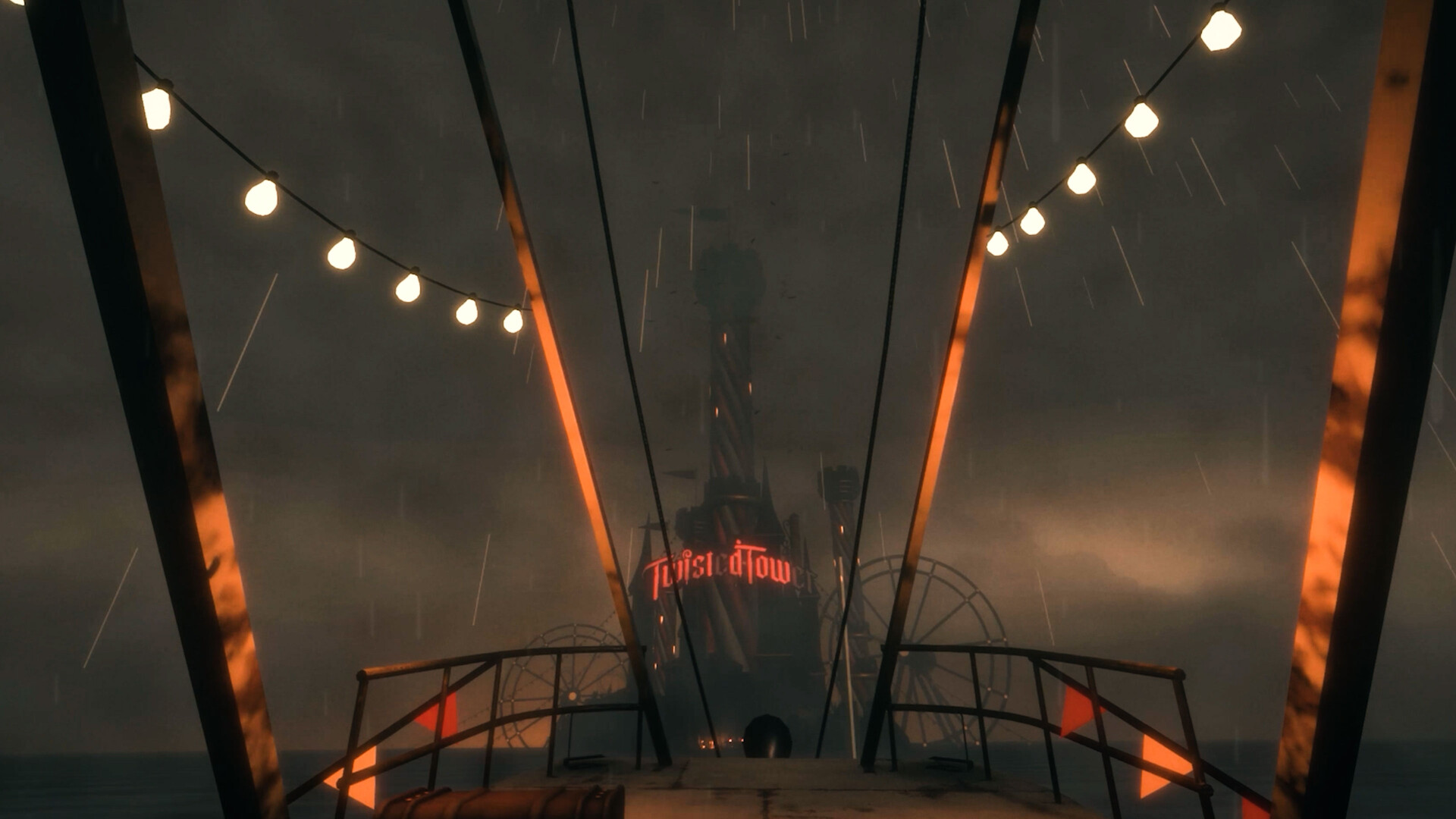
The approach to the corrupted resort, lit by string lights and a neon sign through the rain3D Realms -
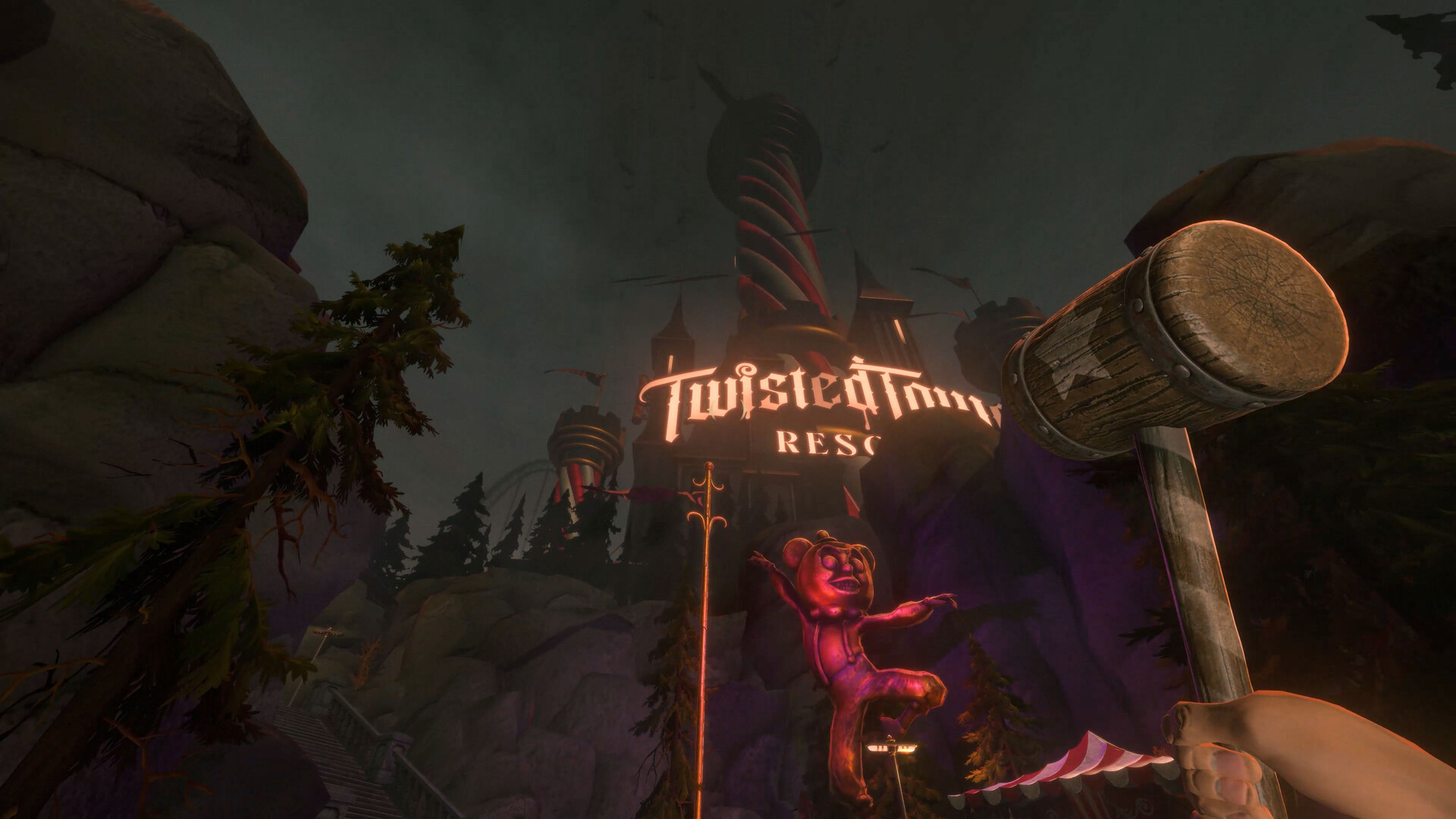
Nearing the resort entrance, mallet in hand, beneath a leering mascot statue3D Realms -
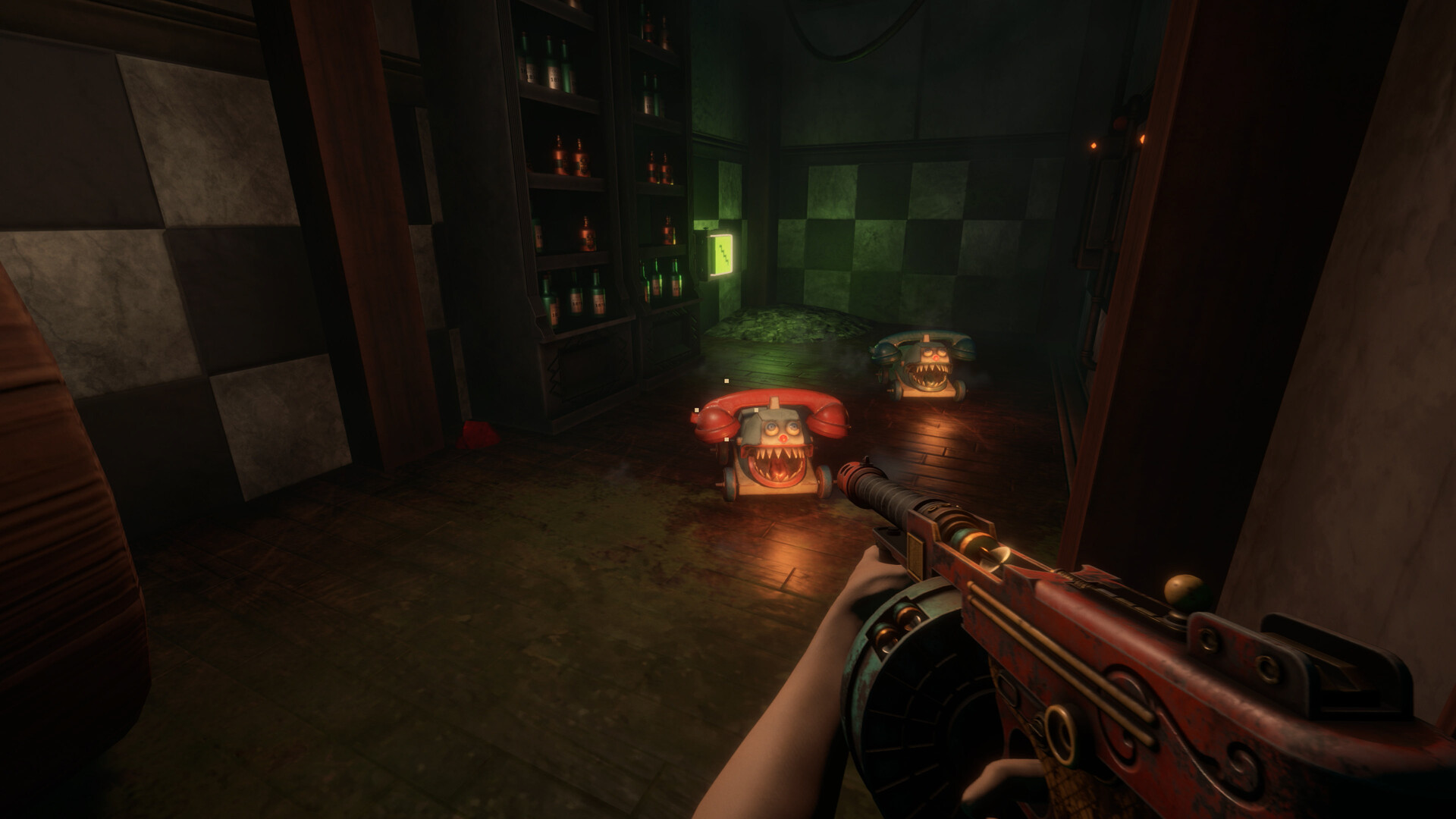
Facing down a pair of corrupted telephone mascots in one of the resort's checkerboard hallways3D Realms -
How the review scores each part of the gameWanderer Editorial -
The short versionWanderer Editorial