
Game review
Exark
5.5 / 10
- Developer
- Robot Cat Limited
- Publisher
- Goblinz Publishing
- Released
- 18 August 2026
- Platforms
- ["Windows"]
- Genre
- Strategy
- Monetisation
- Paid
- Players
- Single-player
The short version
Exark's central idea, an ark-ship you build, staff, and defend as its own production line doubles as its health bar, is a genuinely clever twist on the backpack-battler formula, but a thin meta-game, short runs that end just as builds get interesting, and a rough launch full of bugs and missing polish leave it feeling closer to a strong demo than a finished 1.0.
Biggest strengths
- A genuinely fresh premise, an ark-ship fleeing a dying sun, where production output doubles as your health bar, forcing real trade-offs between growing your economy and defending it
- Four distinct starting Houses with their own ships, buildings, and crew, with strong replayability once players start mixing pieces from different Houses together
- Charming pixel art and a well-regarded soundtrack that reviewers single out as standout even among those otherwise critical of the game
Biggest weaknesses
- Runs are short enough that many players hit the credits just as their build finally comes together, with no additional worlds or settlements to extend a strong run
- Meta-progression is thin: the Star Atlas mostly unlocks optional difficulty modifiers rather than meaningful player power, giving little reason to keep grinding between runs
- A rough technical launch, including buildings reportedly deleted on entering a settlement, crashes on close or at run's end, and severe frame-rate drops once a build gets large
Who it's for: Fans of backpack-battler and building-synergy roguelites like Backpack Battles or The Bazaar who want a fresh premise and don't mind a game still finding its feet post-launch.
Our recommendation: Worth trying the free demo first, since it reportedly covers nearly the entire game; buy on sale rather than at full price until the developer has had time to add content and fix the reported bugs.
5.5 / 10
An Ark-Ship Built From Borrowed Parts
Exark, developed by Robot Cat Limited and published by Goblinz Publishing, released on August 18, 2026 after a run through demo events including Tiny Teams and Steam Next Fest earlier in the year. Its premise is a clever twist on a familiar formula: you command a colossal ark-ship fleeing a star that has turned lethal, placing buildings on a grid, recruiting crew with unique skills, and sailing between destinations that trigger auto-resolved battles against enemy ships. Reviewers consistently draw comparisons to backpack-battler hits like Backpack Battles and The Bazaar, but reframed as a two-dimensional ship-management sim rather than an item-inventory puzzle, and several specifically praise how fresh that reframing feels within an increasingly crowded genre.
The idea that ties it together, and the one nearly every reviewer calls out as the game's best trick, is that your ship's production output functions as its health bar. Losing morale, which is replenished by generating resources and defeating enemies, ends the run, which means every decision about how aggressively to invest in military strength versus economic growth carries real weight. One reviewer calls it "really cool and refreshing," and it's the mechanical hook that keeps even Exark's harshest critics coming back to acknowledge the game has something genuine at its core.
Food, Production, Inspiration, and Four Rival Houses
Beneath that central hook sits a fairly dense resource-management layer. Food powers buildings directly, Production accumulates toward a periodic choice of new buildings, and Inspiration determines which specialized crew members become available to recruit and slot into synergy chains. A dockside market lets players buy buildings and hire crew outright for players flush with gold, though reviewers note that approach alone rarely carries a run past the midgame; the real satisfaction, several say, comes from watching a self-reinforcing production chain click into place.
That structure is doubled by a House system: four playable factions, each with its own starting ship layout, signature buildings, and crew pool, encouraging noticeably different opening strategies. One detailed review contrasts a build-efficiency-focused House built around engineers and craftsmen with a resource-heavy House that starts with rare mineral deposits built into its ship, and reviewers who've spent real time with the game describe genuine excitement about mixing pieces from multiple Houses together once that option unlocks, since it multiplies the number of viable strategies well beyond what any single starting loadout offers. A Star Atlas and a "hazard meter" round out the run-to-run structure, letting experienced players opt into harder starting conditions or equip relic-like bonuses between attempts.
A Strong Idea, Stretched Thin
Where the reviews turn sharply is on how much game actually surrounds that central hook. The most common specific complaint, raised across reviews with dozens of upvotes, is that runs simply end too soon: several players describe reaching the final flight just as their synergies finally came together, only for the game to end without a next world or settlement to carry that momentum forward. The advertised endless mode doesn't fully solve this either, with one reviewer reporting it cuts off entirely after roughly five minutes regardless of how strong a build has become. Difficulty balance compounds the issue in the other direction: multiple reviewers describe cruising through early runs, cranking difficulty to maximum out of boredom, and still winning on a second attempt once they'd identified a strong build, leaving little of the "brain-teaser" tension the genre usually promises.
Meta-progression fares worse still. The Star Atlas, the game's only carryover system between runs beyond unlocking new starting loadouts, mostly grants optional difficulty modifiers rather than lasting player power, and reviewers describe its impact as noticeable only in a run's opening fights before fading into irrelevance. Combined with a widely echoed sentiment, several reviewers use nearly identical language to say the 1.0 release "should have been early access," this leaves the meta-layer feeling more like a placeholder than a finished system.
A Rough Landing at Launch
The most damaging complaints concern outright technical rough edges rather than design choices. Multiple reviewers report buildings being deleted without explanation upon arriving at a settlement, crashes when closing the game or finishing a run, and severe frame-rate drops once a build accumulates enough active synergies, with one describing the endgame as "a chore of watching a slide" on hardware otherwise sufficient for similar indie titles. Quality-of-life gaps add friction on top of that: there's no keybind support for common actions like speeding up or pausing time, forcing repetitive mouse clicks across every run (the developer has reportedly committed to adding hotkeys in an upcoming patch), no functioning ultrawide support despite an option that claims to enable it, and no in-game compendium to reference which crew and buildings belong to which House, a gap several reviewers call out as a real usability problem given how much the game leans on faction-specific synergies. A handful of reviewers who'd played the pre-release demo extensively describe disappointment that the full release added little beyond what the demo already offered, with one noting the demo ended just one fight short of the entire available game.
Verdict
Exark has one of the more interesting hooks to appear in the backpack-battler space this year: an ark-ship whose economy is its life total, forcing real tension between growth and survival with every decision. Reviewers who click with its four Houses and their synergy chains describe genuine excitement about experimenting with hybrid builds, and the pixel art and soundtrack earn praise even from the game's detractors. But a thin meta-progression system, runs that end just as they get interesting, and a launch marred by deleted buildings, crashes, and severe late-game slowdown all point to a game that needed more time in the oven. Play the demo first, since by most accounts it's a fair preview of nearly everything on offer, and consider waiting for a sale and a few patch cycles before committing to the full price.
Pros and cons
Pros
- A genuinely fresh premise, an ark-ship fleeing a dying sun, where production output doubles as your health bar, forcing real trade-offs between growing your economy and defending it
- Four distinct starting Houses with their own ships, buildings, and crew, with strong replayability once players start mixing pieces from different Houses together
- Charming pixel art and a well-regarded soundtrack that reviewers single out as standout even among those otherwise critical of the game
Cons
- Runs are short enough that many players hit the credits just as their build finally comes together, with no additional worlds or settlements to extend a strong run
- Meta-progression is thin: the Star Atlas mostly unlocks optional difficulty modifiers rather than meaningful player power, giving little reason to keep grinding between runs
- A rough technical launch, including buildings reportedly deleted on entering a settlement, crashes on close or at run's end, and severe frame-rate drops once a build gets large
Screenshots
-
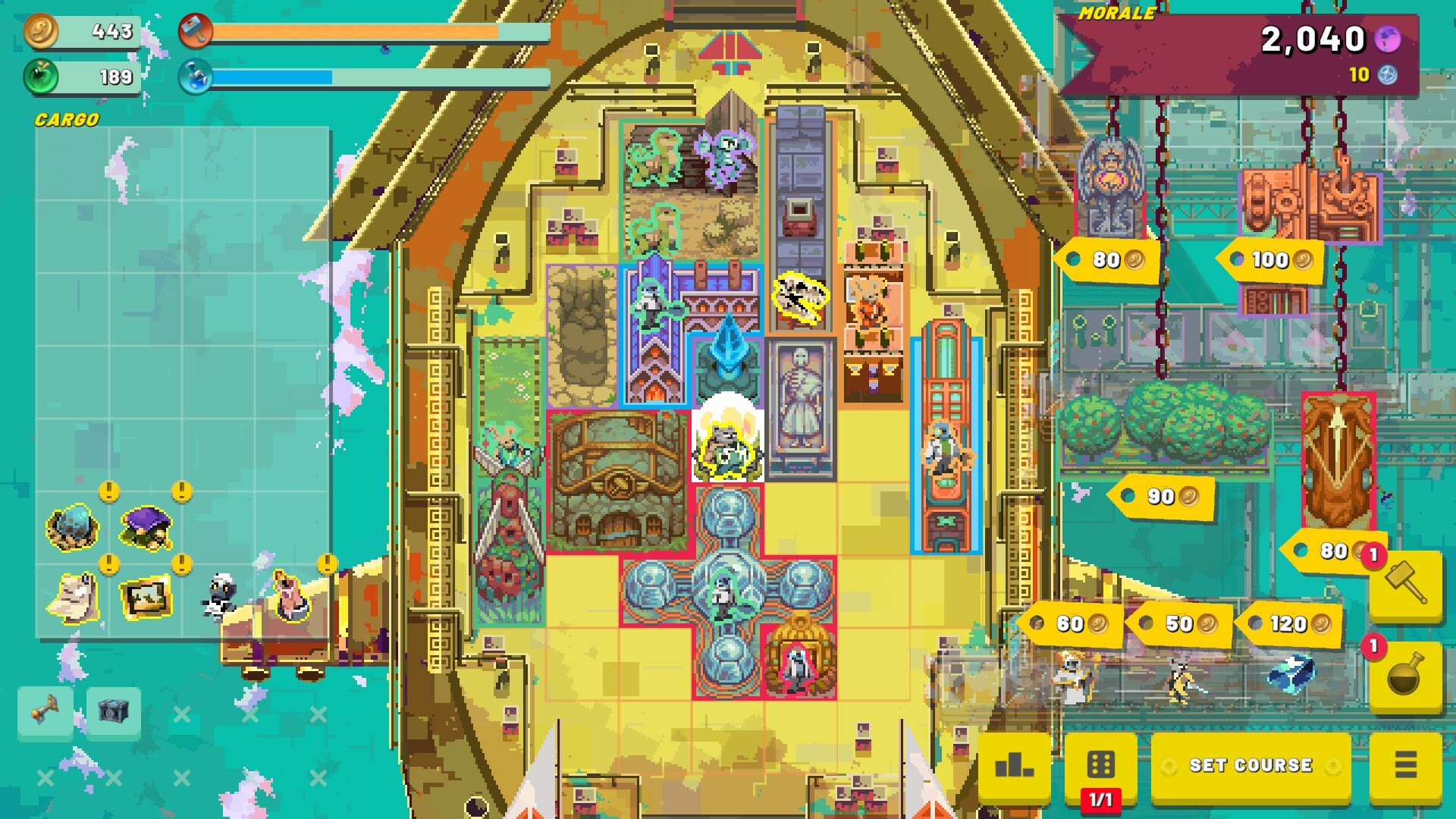
Slotting buildings and crew onto the ship's grid while a dockside market offers more to buyRobot Cat Limited -
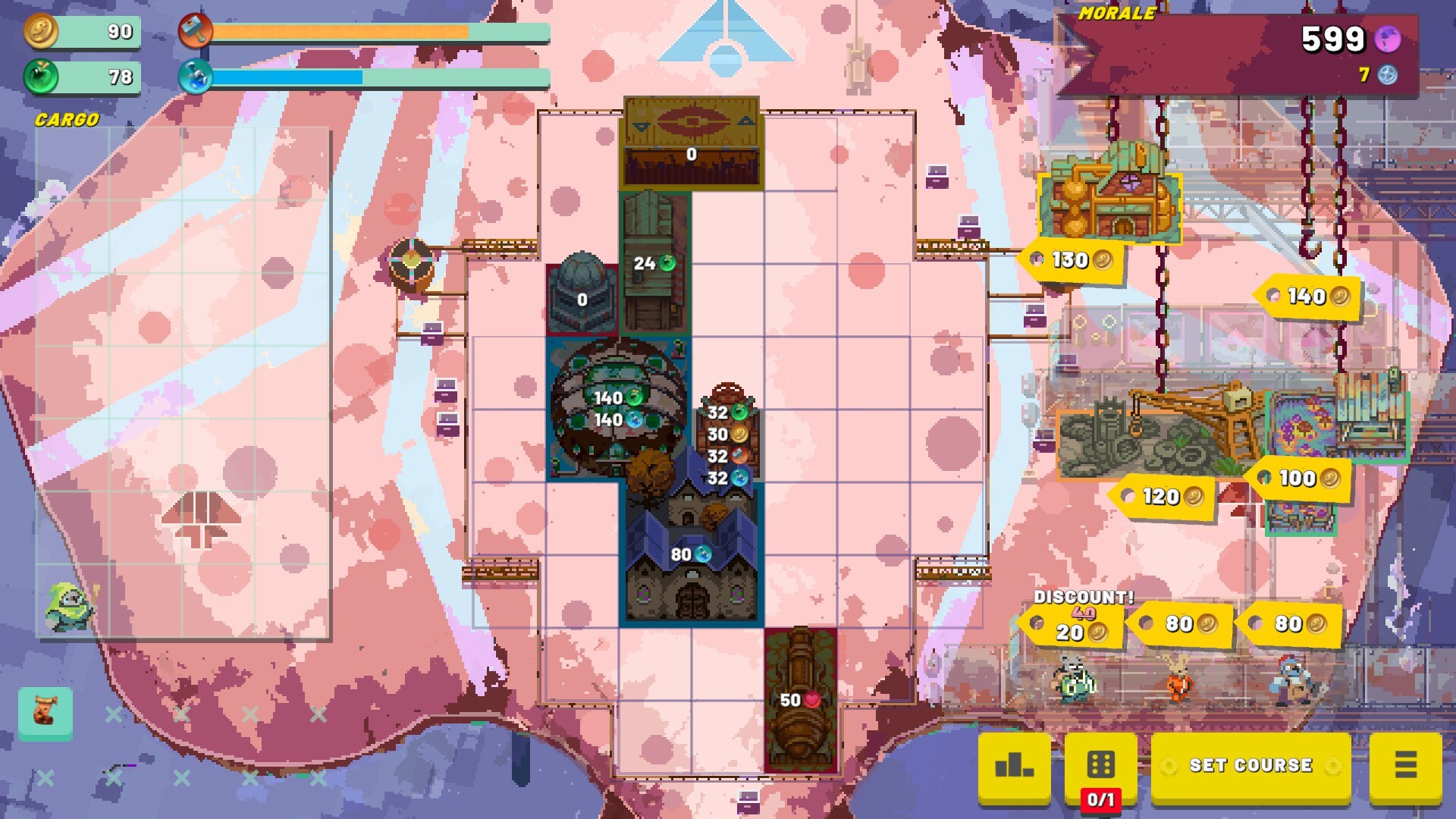
A House's ship laid out with resource totals tracked above each buildingRobot Cat Limited -
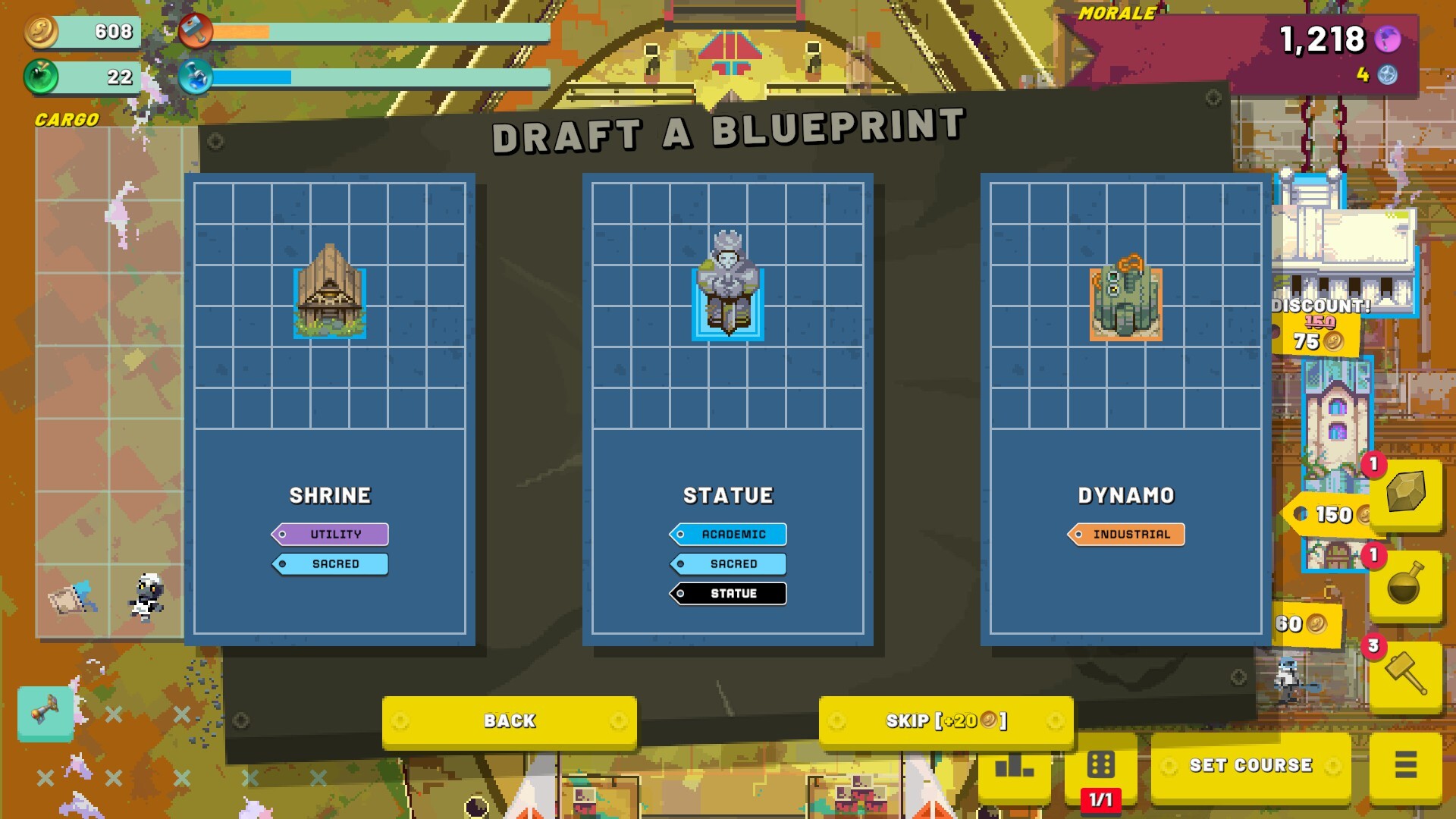
Drafting a new blueprint from a choice of three buildings between runsRobot Cat Limited -
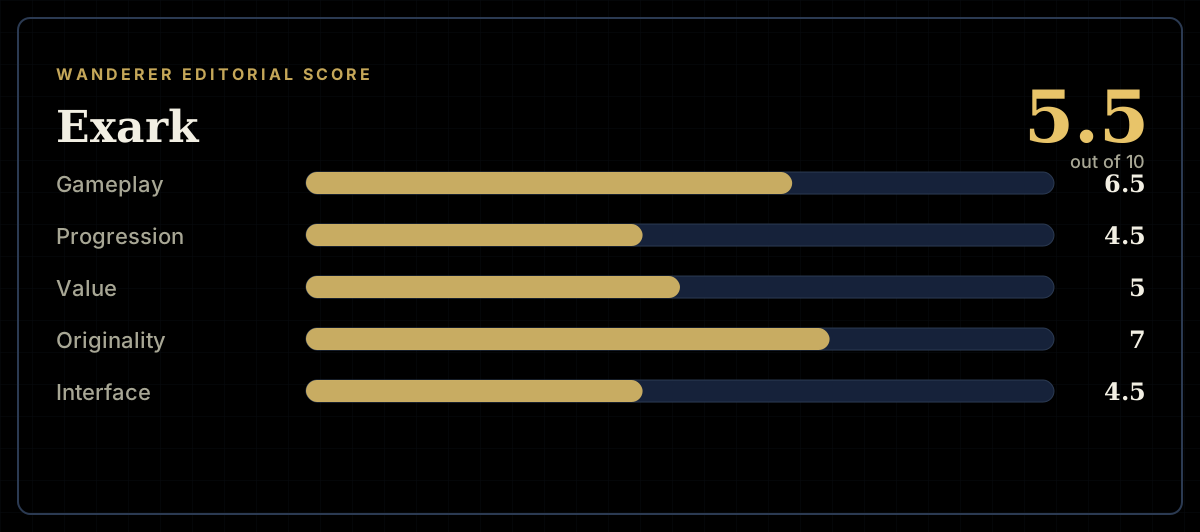
How the review scores each part of the gameWanderer Editorial -
The short versionWanderer Editorial