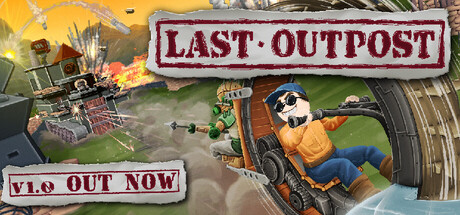
Game review
Last Outpost Review: A Familiar Formula, Less Polished
4.8 / 10
- Developer
- Troyd Games
- Publisher
- Troyd Games
- Released
- 6 February 2025
- Platforms
- ["PC"]
- Genre
- Strategy / Base Defense
- Monetisation
- Paid
- Players
- false
The short version
Last Outpost asks players to fortify a small base by day and survive waves of the undead by night, and it does so in a mould reviewers recognise instantly and mention constantly: Thronefall. Some reviewers are happy to take a cheaper, rougher version of that formula in a post-apocalyptic skin; others find the comparison unflattering, pointing to specific gaps in unit AI, build variety, and combat balance that the game it's compared to doesn't have.
Biggest strengths
- Multiple reviewers, including one with over 200 hours logged, describe it as well balanced and worth the price despite its rough presentation
- The day/night rhythm of building up defenses and then surviving a wave is praised for clear, readable feedback about what's happening and why a base falls when it does
- Consistently cited as cheap and good value, with several reviewers specifically calling it worth it in the $4-6 range
Biggest weaknesses
- Repeatedly and directly compared to Thronefall, with several reviewers describing it as a 'reskin' or 'ripoff' offering a similar structure with noticeably less polish
- A detailed early review reports units can't hold position and return to their starting spot after each night, forcing players to manually replace them every round, alongside an upgrade system that only allows generic power increases rather than distinct build paths
- A separate detailed review describes specific enemy-AI and balance issues, including enemies that ignore player-controlled units to rush the base directly, and multiple identical units all targeting the same low-health enemy
Who it's for: Fans of minimalist day/night base-defense strategy games looking for a cheap, shorter take on the Thronefall formula, rather than players expecting deep RTS systems.
Our recommendation: Solid value at its low price for genre fans who don't mind rough edges, but go in expecting a smaller, less refined take on a formula you may already know well.
4.8 / 10
Last Outpost, a post-apocalyptic base-defense strategy game from Troyd Games, sits at 72% positive across 65 Steam reviews. A sample of 18 English-language reviews spanning its Early Access debut through more recent full-release feedback shows a small but genuine fanbase alongside a consistent, specific set of complaints -- most of which trace back to one comparison that comes up again and again.
The Thronefall Comparison Is Unavoidable
Reviewers reach for the same reference point independently and repeatedly. One writes bluntly: "I played Thronefall first (and absolutely loved it) and thought this game would be similar so I gave it a shot. Immediately, it felt more like a Thronefall ripoff than anything else." Another, more favourably, calls it "a reskinned Thronefall but with less polish... after beating Thronefall though I was looking for something similar and this fit the bill." A third simply describes it as "Thronefall meets the apocalypse." Even one of the sample's harshest reviews opens by naming it directly: "a low quality copy of Thronefall." This isn't a single reviewer's pet comparison -- it's the framing nearly every review in the sample reaches for, positive or negative, which makes it the single most useful piece of context for anyone deciding whether to buy.
Where the Comparison Turns Critical
The sample's most detailed negative review, posted during the game's Early Access period, lays out specific ways it falls short of that reference point: "no option for units to maintain their position -- they return back after each night, so you have to repeatedly place them back again," and an upgrade system where "you have to just level up everything you can and that's all," rather than allowing distinct build paths. A second detailed critical review adds further specifics on the combat side: enemies largely "ignore" player-controlled units and rush straight for the base, deployable turret-hero abilities take roughly ten seconds to come online (long enough that "enemies has already rush to your face" by the time they do), and multiple identical units will target "one single enemy with low HP" rather than spreading out. Neither review is vague -- both describe concrete, checkable mechanical behaviour, which is worth weighing seriously even from a smaller sample.
Genuine Fans Exist, Too
Set against that, a meaningful slice of the sample is enthusiastic. One reviewer with 219 hours logged calls it a game with "a lot of strategy and choices but still simple enough to keep it fun," adding "I loved the balance for a minimalist game like this... totally worth the price." Another calls it "super fun mini RTS," comparing it to the NES classic Jackal, while a third with nearly 16 hours logged says "it is well balanced and loved the beating challenges with my own strategy... cool to have that much variety in a small game like this." These reviews directly contradict some of the balance criticism above -- a genuine split rather than a one-sided consensus, and worth reporting as such rather than resolving in either direction.
Readable Feedback, Rougher Controls
One longer, structured review specifically praises the game's clarity: "information is presented clearly, with intuitive visual cues that make it easy to understand what is happening on the battlefield at a glance," adding that "failure feels fair and educational" because it's usually clear why a base fell. That praise for readability isn't contradicted elsewhere in the sample. Controls are a separate matter -- more than one reviewer specifically asks for controller support or mouse-driven movement, with one noting "controls are a little clunky" and preferring "mouse click to move rather than keyboard only."
Developer Responsiveness
Notably, at least two of the sample's more detailed critical reviews carry a "developer has responded to this review" tag, suggesting the studio is actively engaging with feedback rather than ignoring it. Nothing in the sample confirms whether the specific issues raised (unit positioning, upgrade variety, AI targeting) have since been addressed, but the pattern of engagement is a reasonable, if inconclusive, positive signal for future support.
Content and Pacing Concerns
A more recent review raises a different kind of complaint: unused or underdeveloped systems. It describes not using "half of buildings and units because they are not balanced to fit their function," a vehicle that "never really do[es] as much as it could," and "a big red upgrade saying 'coming soon,'" despite newer content already existing elsewhere. Another recent review echoes a milder version, asking for "more maps" and "an endless mode" -- both read as a game whose core systems work but whose content breadth hasn't fully caught up. A shorter review adds a different angle on the same theme, saying it expected more from the building side and found the construction mechanics closer to a mobile-style tycoon game than the RTS-adjacent tag on the store page implies -- another sign that the gap between what's advertised and what's delivered is a recurring friction point across the sample, not a one-off complaint.
Final Verdict
Last Outpost delivers a recognisable, functional take on the day/night base-defense formula at a genuinely low price, and it has real fans who find it well balanced and worth their time. But it invites its own toughest comparison by wearing its inspiration so openly, and the reviewers who take that comparison seriously back it up with specific, credible complaints about unit AI, build variety, and combat balance. For genre fans on a budget who don't already own the game it's most often compared to, it's a reasonable, if rough, way to spend a few hours.
Pros and cons
Pros
- Multiple reviewers, including one with over 200 hours logged, describe it as well balanced and worth the price despite its rough presentation
- The day/night rhythm of building up defenses and then surviving a wave is praised for clear, readable feedback about what's happening and why a base falls when it does
- Consistently cited as cheap and good value, with several reviewers specifically calling it worth it in the $4-6 range
Cons
- Repeatedly and directly compared to Thronefall, with several reviewers describing it as a 'reskin' or 'ripoff' offering a similar structure with noticeably less polish
- A detailed early review reports units can't hold position and return to their starting spot after each night, forcing players to manually replace them every round, alongside an upgrade system that only allows generic power increases rather than distinct build paths
- A separate detailed review describes specific enemy-AI and balance issues, including enemies that ignore player-controlled units to rush the base directly, and multiple identical units all targeting the same low-health enemy
Screenshots
-
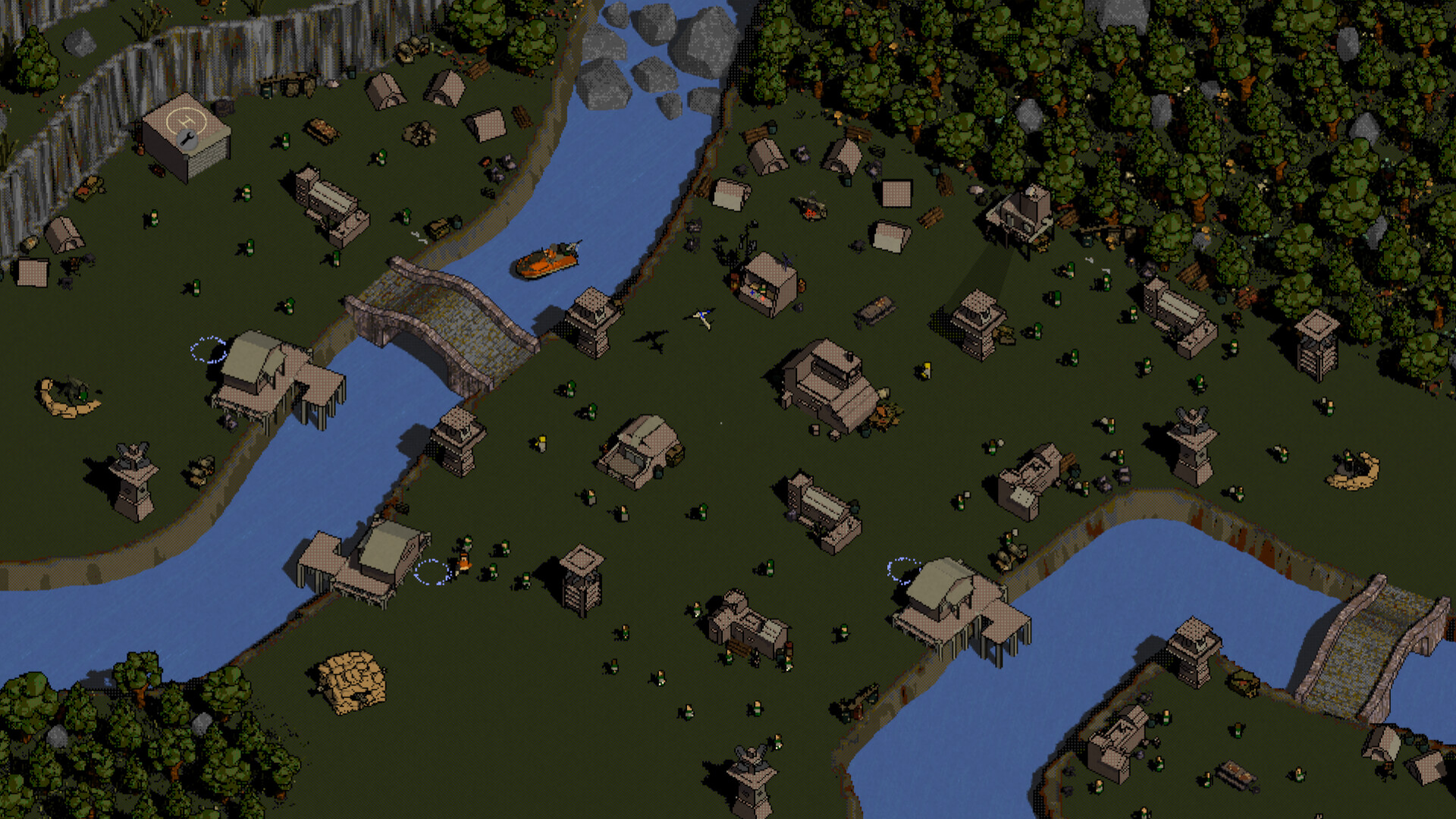
A daytime overview of a river-crossing map, with scavenged structures and watchtowers spread across both banksTroyd Games -
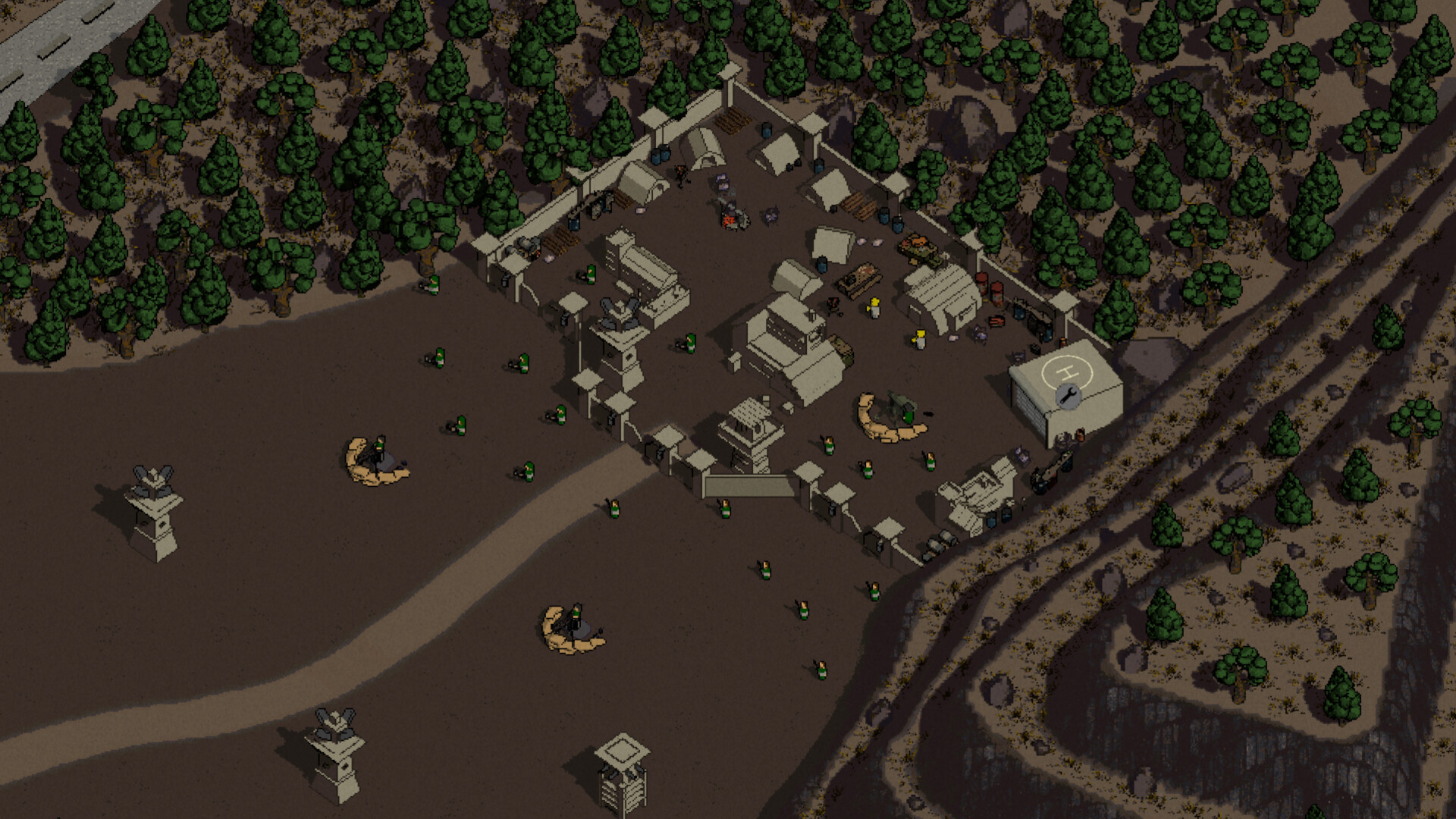
A fortified outpost compound, walled in against the surrounding wasteland ahead of nightfallTroyd Games -
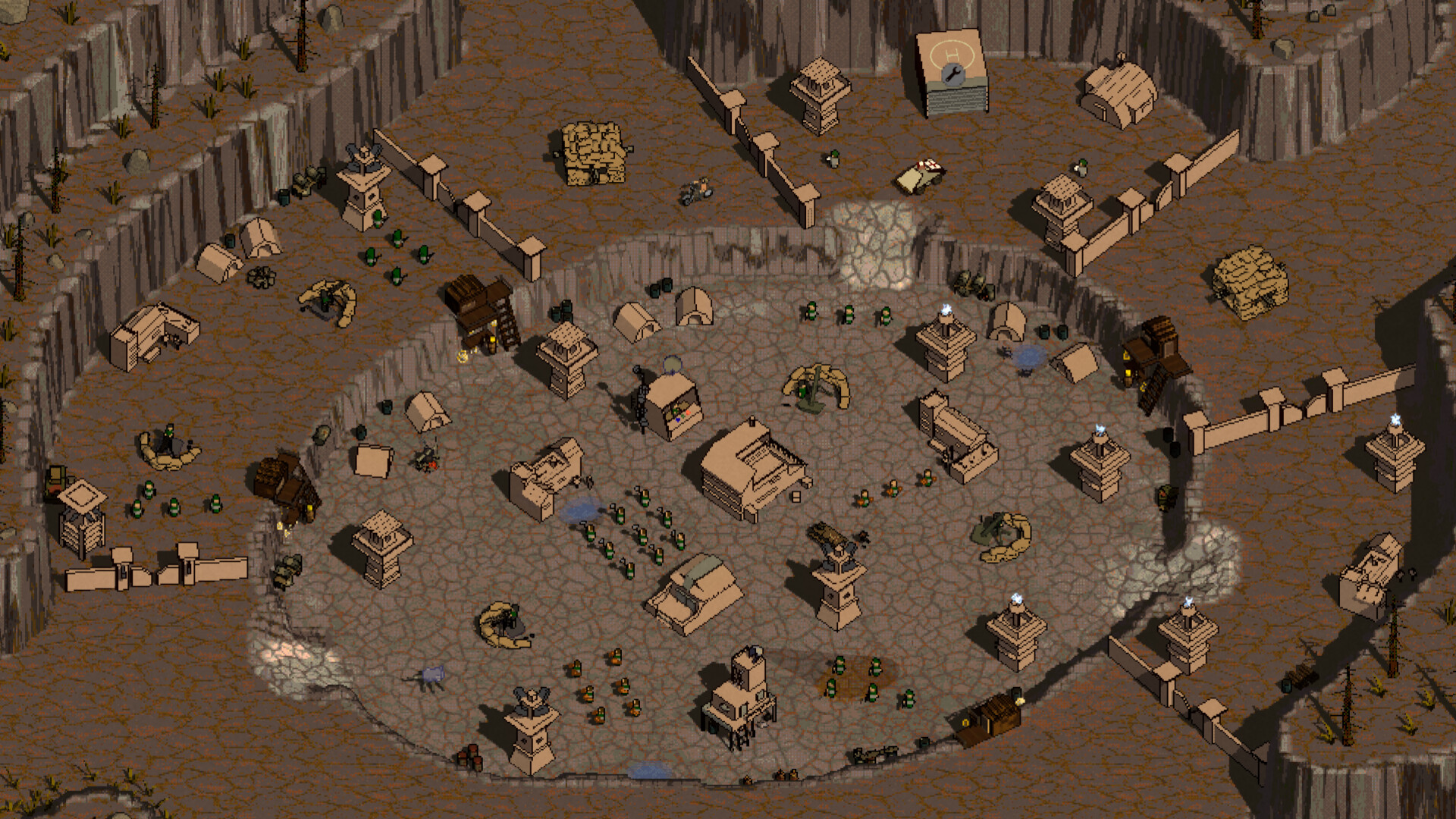
A canyon-walled outpost bristling with watchtowers, one of several distinct base layouts in the gameTroyd Games -
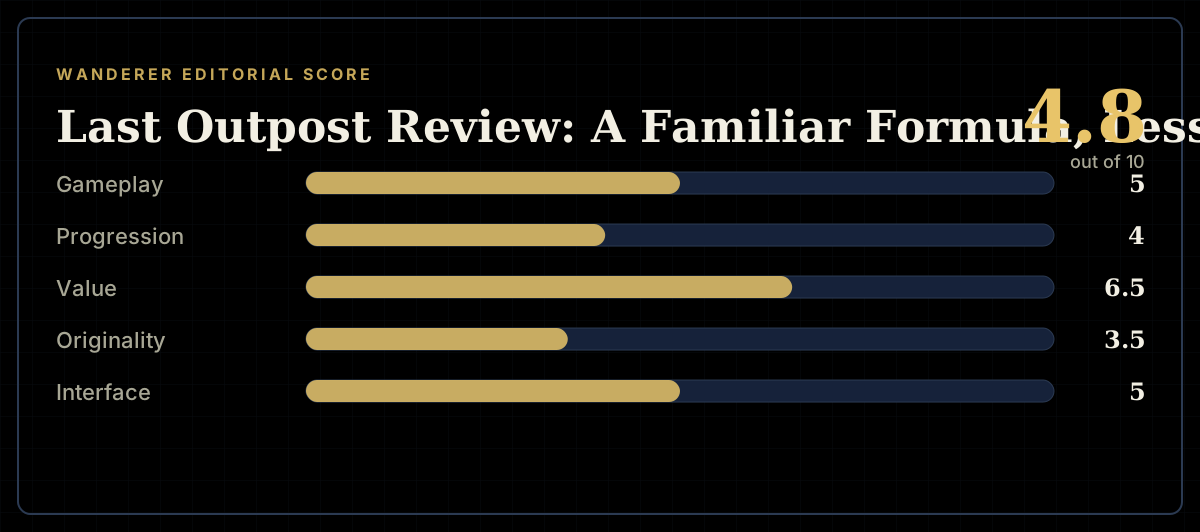
How the review scores each part of the gameWanderer Editorial -
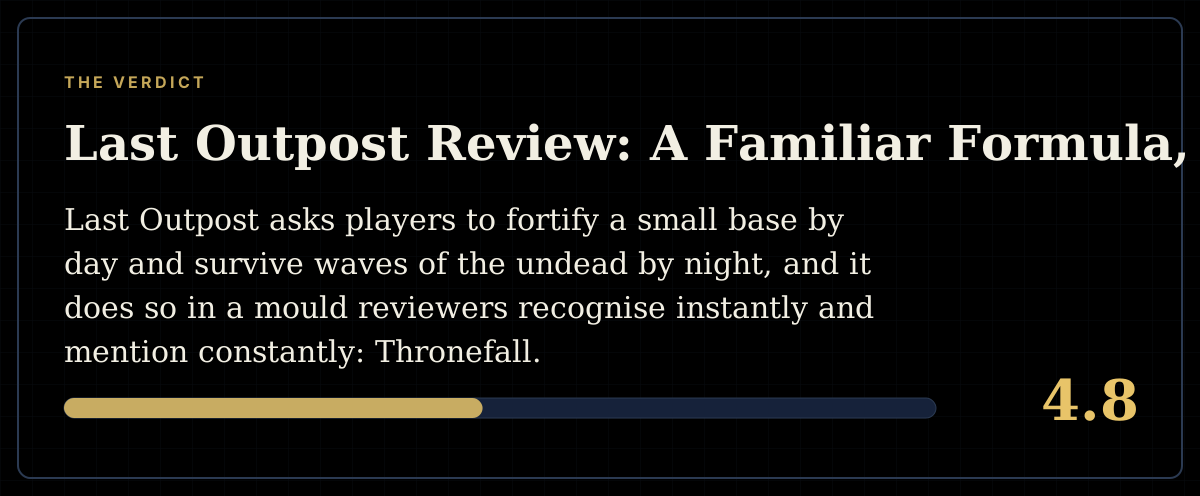
The short versionWanderer Editorial