Game review
Magic Forge Tycoon Review: A Clever Arms-Dealer Premise That Runs Out of Runs
5.9 / 10
- Developer
- Clever Trickster Studio
- Publisher
- Clever Trickster Productions
- Released
- 13 January 2026
- Platforms
- ["PC"]
- Genre
- Simulation
- Monetisation
- Paid
- Players
- false
The short version
Magic Forge Tycoon has a genuinely clever hook at its centre: you're not really running a weapons shop, you're an arms dealer quietly engineering wars that never end, because a world at war pays better than a world at peace. Reviewers consistently praise that idea and the sliders-and-hints crafting system built around it, but just as consistently report that a single 2-to-5-hour run teaches you everything the game has to offer, leaving little reason to return once its handful of recipes and political tricks are learned.
Biggest strengths
- Reviewers repeatedly single out the game's central idea, arming warring kingdoms and deliberately keeping conflicts unresolved for maximum profit, as clever, morally interesting and unlike most tycoon games
- The weapon-crafting system, built around nine sliders and contextual hints, is praised by several reviewers as satisfying to master, particularly the trial-and-feedback loop of dialing in a new recipe
- Runs are compact at roughly 2 to 5 hours, making it an easy game to pick up and finish in a single sitting for players who don't want a long-term commitment
Biggest weaknesses
- Multiple reviewers report that once a weapon's ideal slider settings are learned, every future run repeats the identical solution, turning a promising puzzle into rote repetition
- Several reviews describe the alchemy and enchantment systems as underdeveloped relative to how they're presented, affecting sales politics rather than meaningfully changing weapons themselves
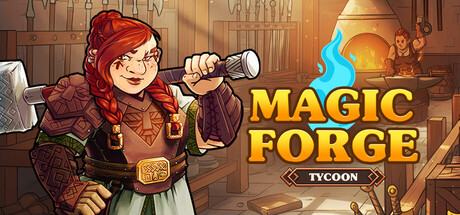
- One detailed reviewer specifically flags apparent AI-generated art that wasn't fully cleaned up, pointing to weapons in the store banner that visibly float without support
Who it's for: Fans of light management sims in the Game Dev Tycoon mould who want a short, novel premise rather than a deep, long-term management game.
Our recommendation: Worth a look at a discount for the political-economy hook alone; go in expecting a short, largely single-playthrough experience rather than a deep tycoon sim.
5.9 / 10
Magic Forge Tycoon casts the player as the owner of an astral forge, crafting enchanted weapons and selling them to rival fantasy kingdoms across roughly fifteen in-game years. Developed and published by Clever Trickster Studio, the game launched in January 2026 to a mixed 69% positive rating across 82 Steam reviews. The 17-review English-language sample pulled for this piece, drawn from both the most-praised and most-recent reviews in that pool, splits fairly evenly between reviewers charmed by the game's central idea and reviewers who found that idea didn't have enough game built around it to sustain repeat play.
An Arms Dealer's Dilemma, Dressed Up as a Tycoon Sim
What distinguishes Magic Forge Tycoon from the crowded field of shopkeeper-management games it superficially resembles, several reviewers compare it to Game Dev Story, Game Dev Tycoon, and the fantasy-shop niche carved out by Swords & Potions, is its political layer. The world contains up to nine warring realms, each willing to buy weapons from the player. Fulfilling contracts for a given faction raises reputation with them and unlocks valuable bonuses, but keeping those bonuses depends on that faction surviving its wars. The twist reviewers find genuinely compelling is that realms at war pay far more than realms at peace, which means, as one reviewer puts it bluntly, the ideal state to aim for is one where "every realm loves you, every realm wants to fight its neighbors, and no one ever wins these wars. You're an arms dealer; you want wars, not victors." Another reviewer frames a similar realisation as unexpectedly reflective, writing that the game "even becomes a little bit of a philosophical reflexion on society" once its systems click into place. This isn't a minor flavour detail bolted onto a generic economy sim; it's consistently the thing reviewers cite as the game's most memorable and best-executed idea.
Crafting: A Satisfying Puzzle That Solves Itself
The core crafting loop revolves around nine sliders per weapon, representing trade-offs between function and style, six with identifiable "sweet spots" and three that simply need pushing in whichever direction a given contract demands. Reviewers describe genuine satisfaction in the process of dialing in a new weapon type for the first time, with one reviewer writing they "love the gameplay loop of trying to make a perfect weapon and getting hints after each attempt." Enchantments layer on top of this system and are generally well received, with reviewers describing them as intuitive rather than arbitrary once a player has a feel for elemental associations.
The trouble, according to a detailed and heavily cited critical review in the sample, is what happens after that first discovery process is complete. Since a weapon's ideal slider configuration is fixed once learned, that same reviewer notes "you've unlocked that recipe and it's going to be the exact same every single run," turning what felt like a puzzle on the first attempt into rote repetition on every subsequent one. That reviewer goes further, describing the game's alchemy system, pitched as a way to meaningfully modify weapons, as a disappointment relative to expectations: rather than changing a weapon's properties, alchemy effects only influence buyer behaviour, such as making a kingdom more likely to go to war. "We should be able to do better than 'combine two ingredients with the effect of X to make X potion' by now," they write, arguing the crafting system's creative premise ultimately wasn't used to build meaningful gameplay around it.
A Short Loop That Mostly Solves Itself
Length and replayability form the sample's most consistent thread of criticism, appearing across multiple otherwise-unrelated reviews. Typical completed runs are reported at somewhere between one and five hours, covering the full fifteen in-game years, and several reviewers explicitly frame the game as a two-playthrough experience at most: one run to learn the systems, a second to apply that knowledge efficiently, and then diminishing returns after that. "This is two-plays-game. First time you learn. Second - you play... I see no reason to play for the 3rd time," reads one representative Not Recommended review, which goes on to compare the experience unfavourably to the reviewer's much longer history with Game Dev Tycoon and its mod scene. A more positive account reaches a similar conclusion about replay incentives from the other direction, noting a built-in leaderboard and achievement-hunting hooks exist for players who want them, but adding "I didn't find much purpose in replaying" beyond that. Not every reviewer treats the shortness as purely negative; some frame it as appropriate for a "short and sweet" casual game rather than a flaw, and one reviewer specifically praises the game's replayability, though that view is a minority position in the sample relative to the repeated complaints about repetitive middle stretches and rapidly diminishing novelty.
Quality-of-Life Gaps
A second, smaller but recurring complaint concerns the game's interface and workflow. One reviewer who otherwise enjoyed the political systems specifically calls out the absence of a keyboard shortcut to switch between the forge and the market, given how frequently the player needs to buy materials, and wishes for automation options such as auto-buying materials below a price threshold. Other reviewers echo related frustrations, describing constant interruptions from tension and war notifications as tedious over a longer session, and one reviewer admits several of the game's systems, including a "city support" mechanic and something referred to as "the Explicer part," never became clear to them even after a full run, suggesting the game's information design could do more to explain its own systems.
An AI-Art Complaint Worth Flagging
One detailed critical review in the sample raises a specific concern about the game's presentation that's worth reporting on its own terms: the reviewer states that although the Steam store page claims AI-generated assets were "tweaked" by the developers, the results still show clear signs of unedited AI generation, pointing specifically to weapons displayed in the store banner art that appear to float without any visible means of support, with blades rendered flat and physically inconsistent. That reviewer refunded the game after roughly twenty minutes of play, citing this alongside a lack of engagement with the forge and geopolitics mechanics as their reason for bouncing off it entirely. It's a single account rather than a sample-wide pattern, but since it concerns a specific, checkable claim about the developer's own asset pipeline and disclosure, it's included here as a genuine data point for prospective buyers who care about that distinction, rather than omitted as incidental commentary.
Value and Final Verdict
At NZ$17.49 for what most reviewers describe as a two-to-five-hour experience with limited reason to return, Magic Forge Tycoon sits in an awkward spot on value, and the sample's 69% positive score reflects that tension more than it reflects any single dealbreaking flaw. The game's central idea, an arms dealer quietly stoking eternal, unwinnable wars for profit, is smart, distinctive, and genuinely well-realised in its systems, and the crafting loop that supports it is satisfying at least once. What it doesn't offer, according to the weight of this review sample, is much reason to keep playing after that idea has been fully explored, which makes it easiest to recommend to players drawn specifically to its premise and willing to accept a short, largely one-and-done experience rather than players hoping for a tycoon game with long-term depth.
Pros and cons
Pros
- Reviewers repeatedly single out the game's central idea, arming warring kingdoms and deliberately keeping conflicts unresolved for maximum profit, as clever, morally interesting and unlike most tycoon games
- The weapon-crafting system, built around nine sliders and contextual hints, is praised by several reviewers as satisfying to master, particularly the trial-and-feedback loop of dialing in a new recipe
- Runs are compact at roughly 2 to 5 hours, making it an easy game to pick up and finish in a single sitting for players who don't want a long-term commitment
Cons
- Multiple reviewers report that once a weapon's ideal slider settings are learned, every future run repeats the identical solution, turning a promising puzzle into rote repetition
- Several reviews describe the alchemy and enchantment systems as underdeveloped relative to how they're presented, affecting sales politics rather than meaningfully changing weapons themselves
- One detailed reviewer specifically flags apparent AI-generated art that wasn't fully cleaned up, pointing to weapons in the store banner that visibly float without support
Screenshots
-
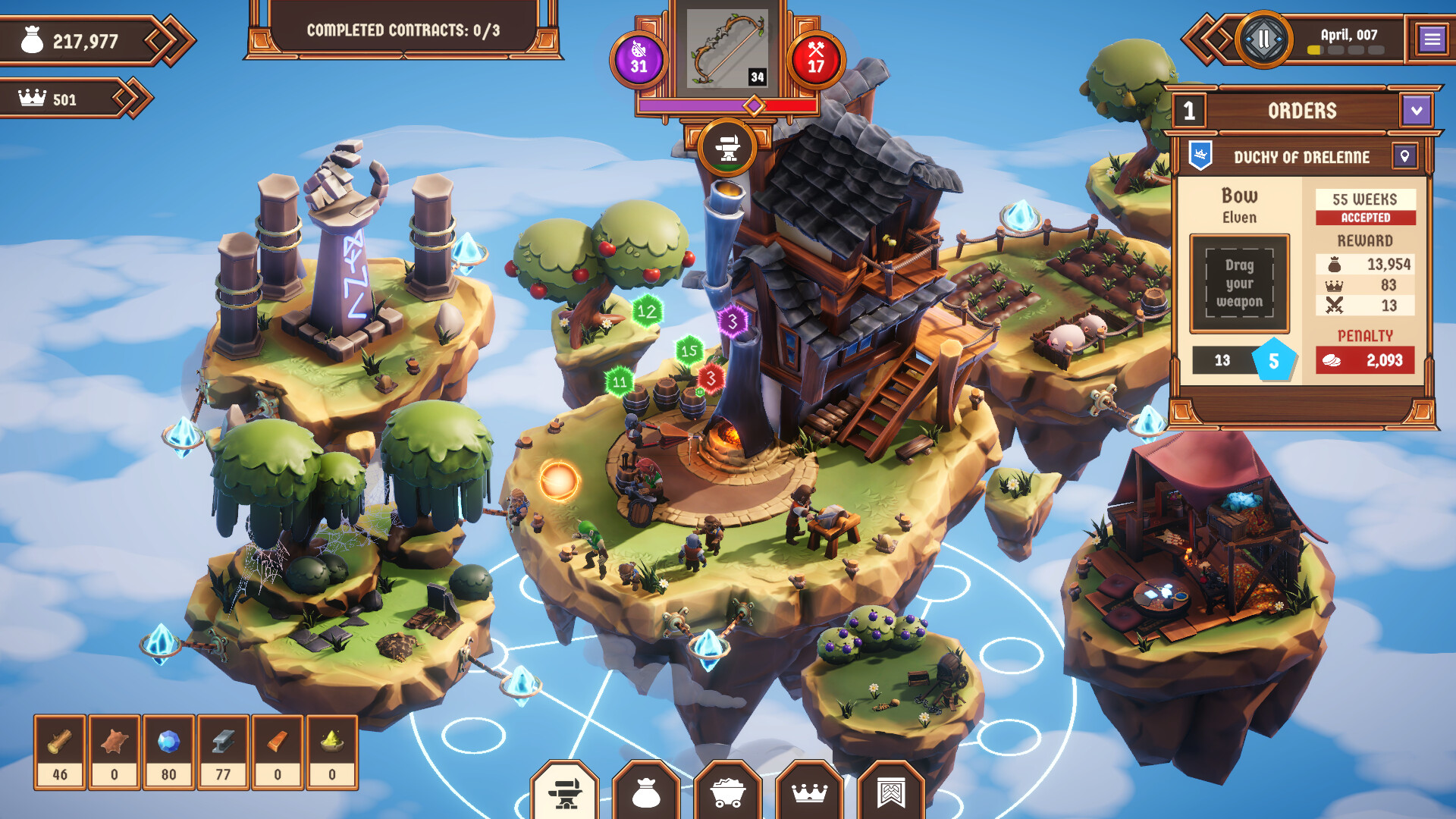
The forge island, where resources are gathered and weapon contracts are trackedClever Trickster Productions -
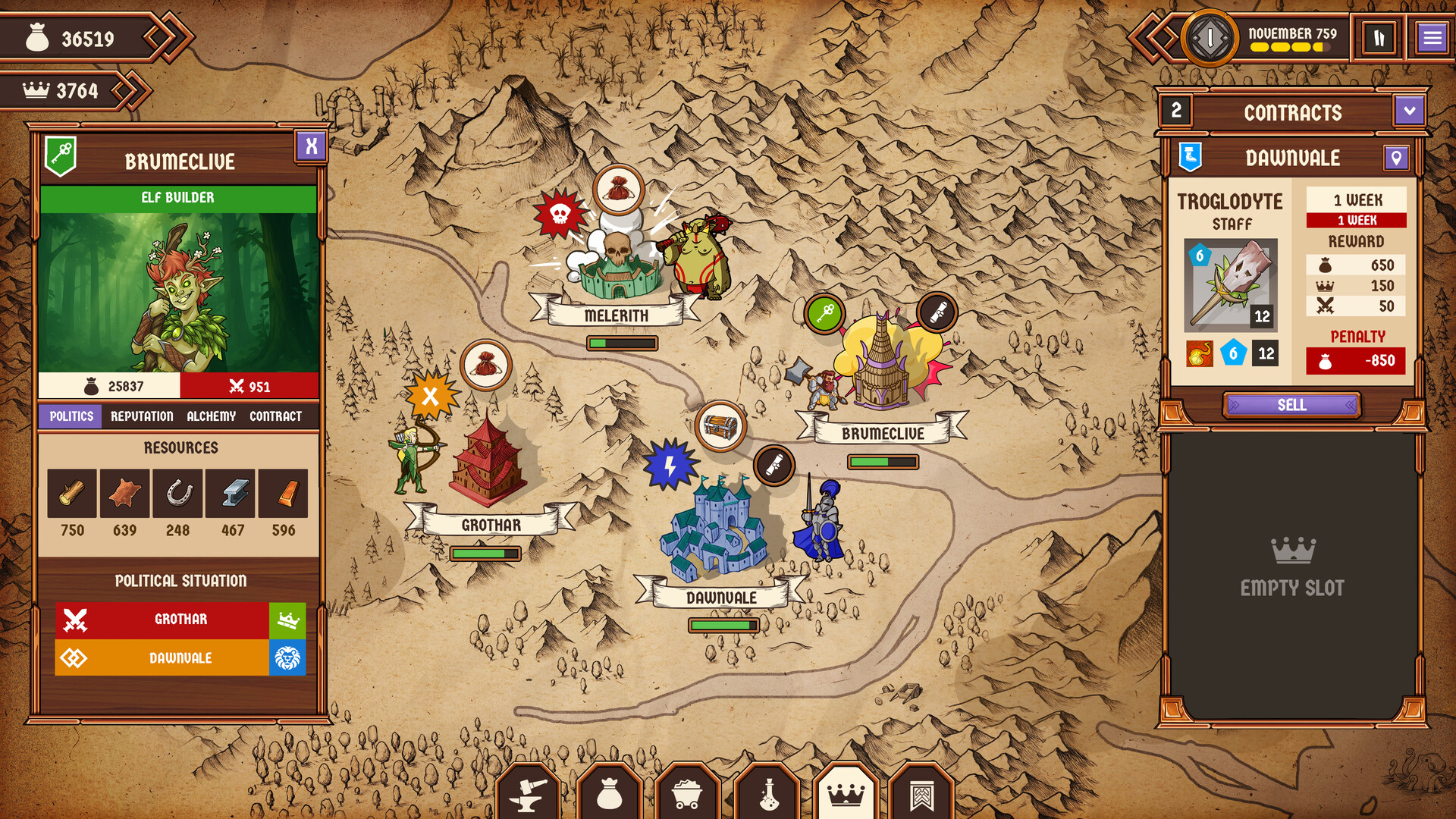
The political map, tracking reputation and conflict between the game's warring realmsClever Trickster Productions -
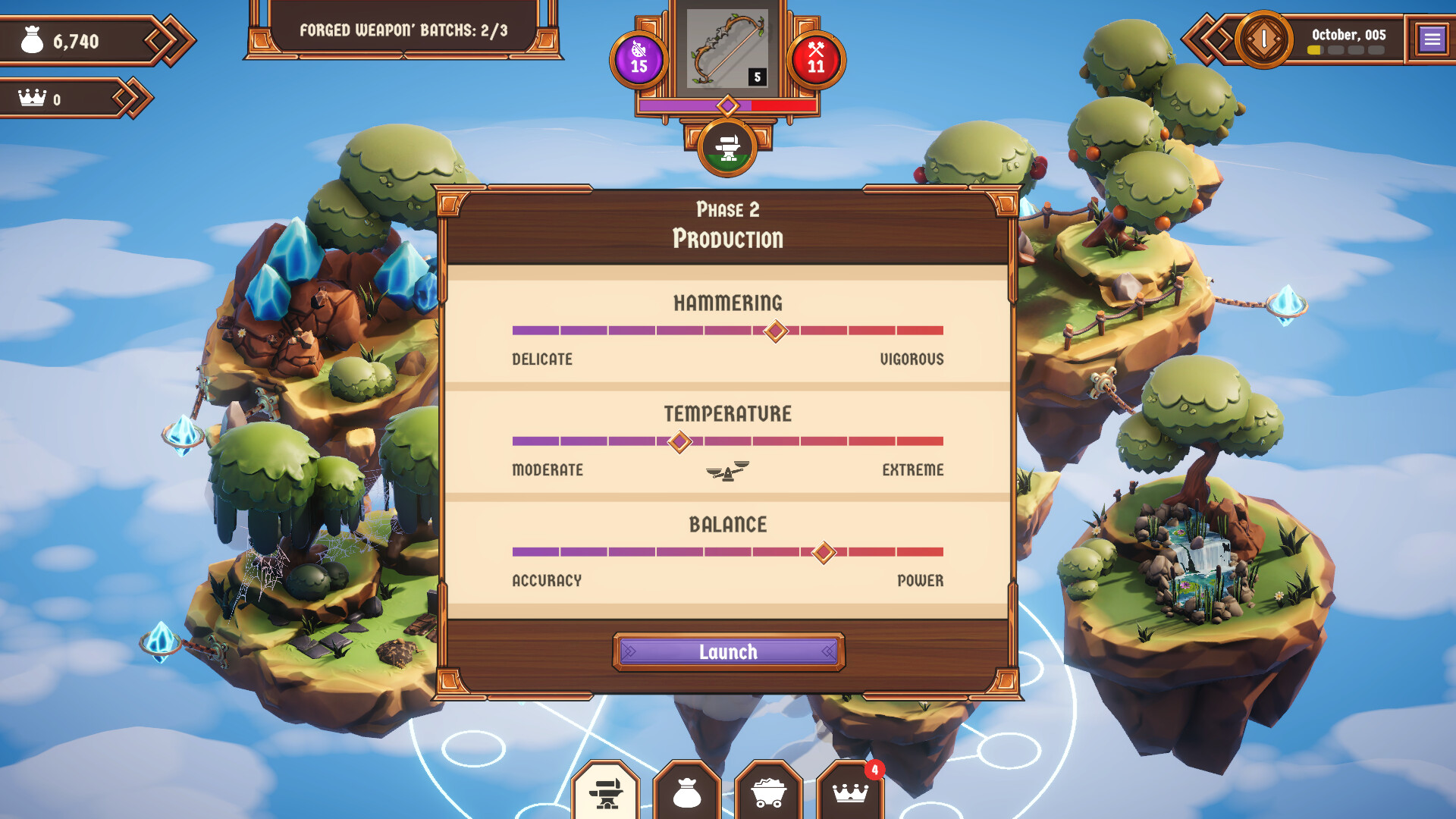
The crafting sliders players use to dial in a weapon's hammering, temperature and balance during forgingClever Trickster Productions -
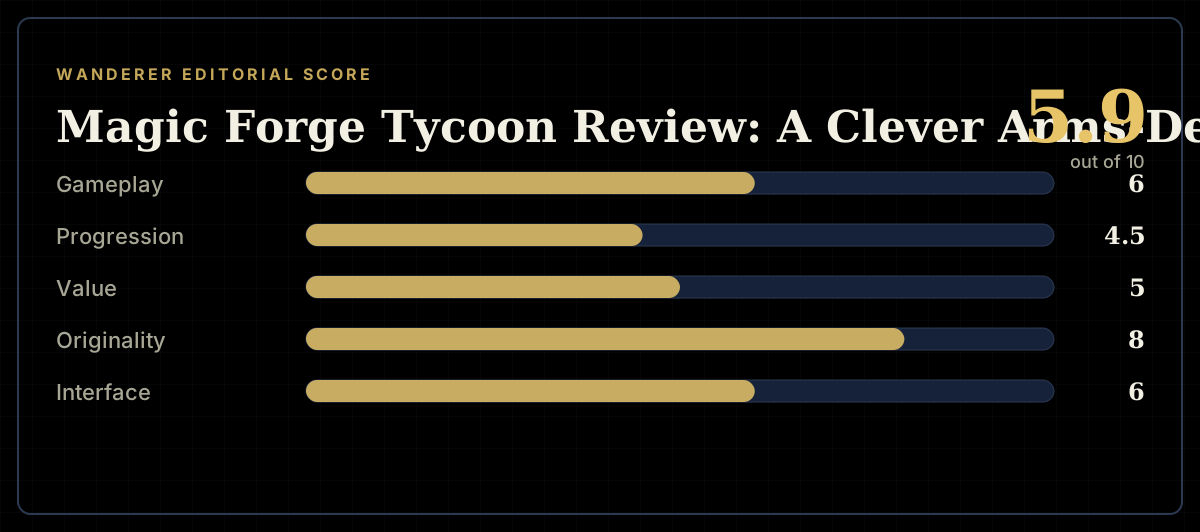
How the review scores each part of the gameWanderer Editorial -
The short versionWanderer Editorial