Game review
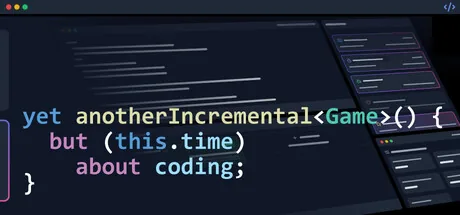
Yet Another Incremental Game (but this time about coding)
6 / 10
- Developer
- Raclette Games
- Publisher
- Raclette Games
- Released
- 14 July 2026
- Platforms
- Windows, macOS, Linux, Steam Deck, Browser
- Genre
- Incremental clicker
- Monetisation
- One-off purchase. No ads, no in-app purchases, no premium currency
- Players
- Single-player
The short version
The best joke premise in the genre this year, because it isn't really a joke. An incremental about hiring things to type for you is an incremental about automation, which is what these games have always been about — so the theme and the mechanics pull in the same direction instead of the art being wallpaper over a spreadsheet.
What stops it is the ladder. The first few tiers are paced well and then the numbers stop cooperating, projects stall, and a chunk of the achievement list sits somewhere no save can reach. It's cheap, it's clean, and it's a fortnight into a six-to-twelve month build.
Biggest strengths
- The automation fantasy and the genre fantasy are the same fantasy here, so every unlock lands thematically as well as numerically
- Six specialist agents that generate, debug and train each other give the mid-game an actual shape rather than one long multiplier
- Language specialisation carries permanent bonuses across the whole save, which makes prestige runs feel like they compound rather than reset
Biggest weaknesses
- Progression stalls hard around the project tier, where tasks stop advancing and the curve stops explaining itself
- The achievement list ballooned from 100 to over five thousand in one update, and the developer's own notes admit some of them are still unreachable
- Code Review, one of the advertised pillars, was replaced wholesale thirteen days after launch — the design is not settled
Who it's for: Incremental veterans who like a theme with a bit of bite, and anyone who has ever watched a build log and felt something.
Our recommendation: Play the free browser build or the Steam demo first. If you're still typing after the second prestige, eight dollars for cloud saves and the desktop version is easy money. If you hit the project wall and stop, you've lost nothing.
6 / 10
The title is a shrug and a sales pitch in the same breath, and both halves are accurate. There really are a lot of these. This one really is about coding. What the title doesn't tell you is that Raclette Games has stumbled onto the most naturally suited theme the incremental genre has been handed in years — and then shipped it onto a progression curve that gives way about a third of the way up.
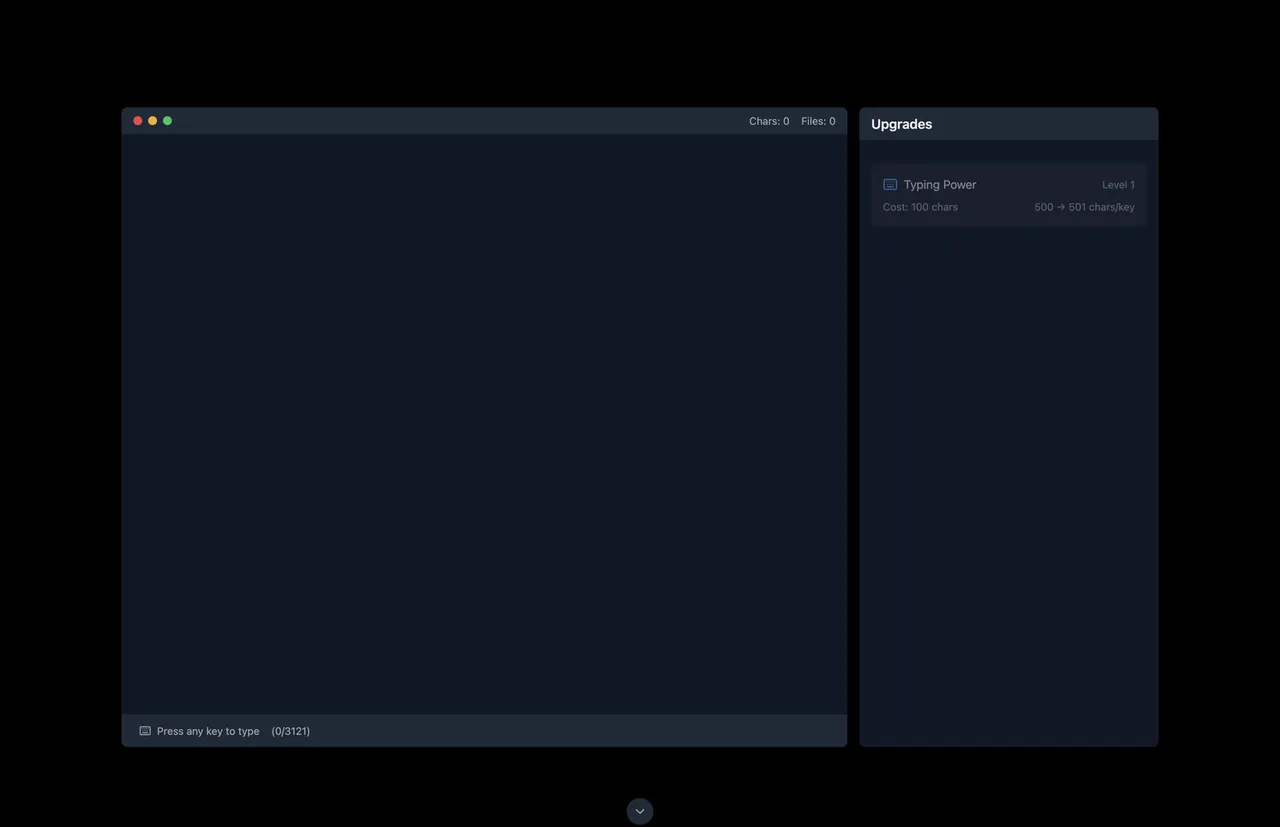
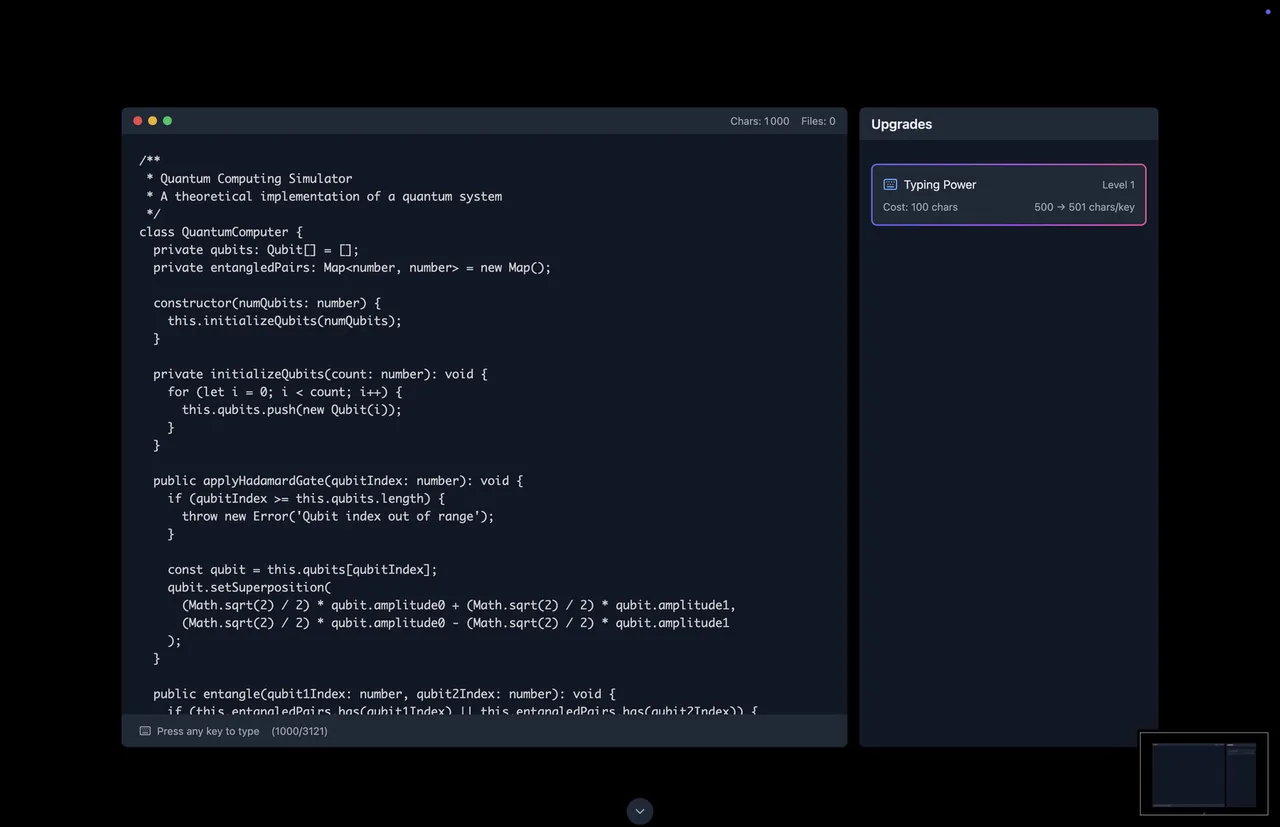
Start it and you're mashing keys. Any keys. Face-rolling counts, which is the first sign the game knows what it is. Characters become files, files become upgrades, upgrades become agents that type for you, and from there you're never touching the keyboard for output again — only for the small pleasure of remembering that you used to have to.
Why the theme actually works
Most themed idlers are a skin. You could swap the cookies for ore or the ore for souls and nothing about the maths would notice. This one is different in a way that's worth pulling apart, because the premise and the genre are describing the same activity.
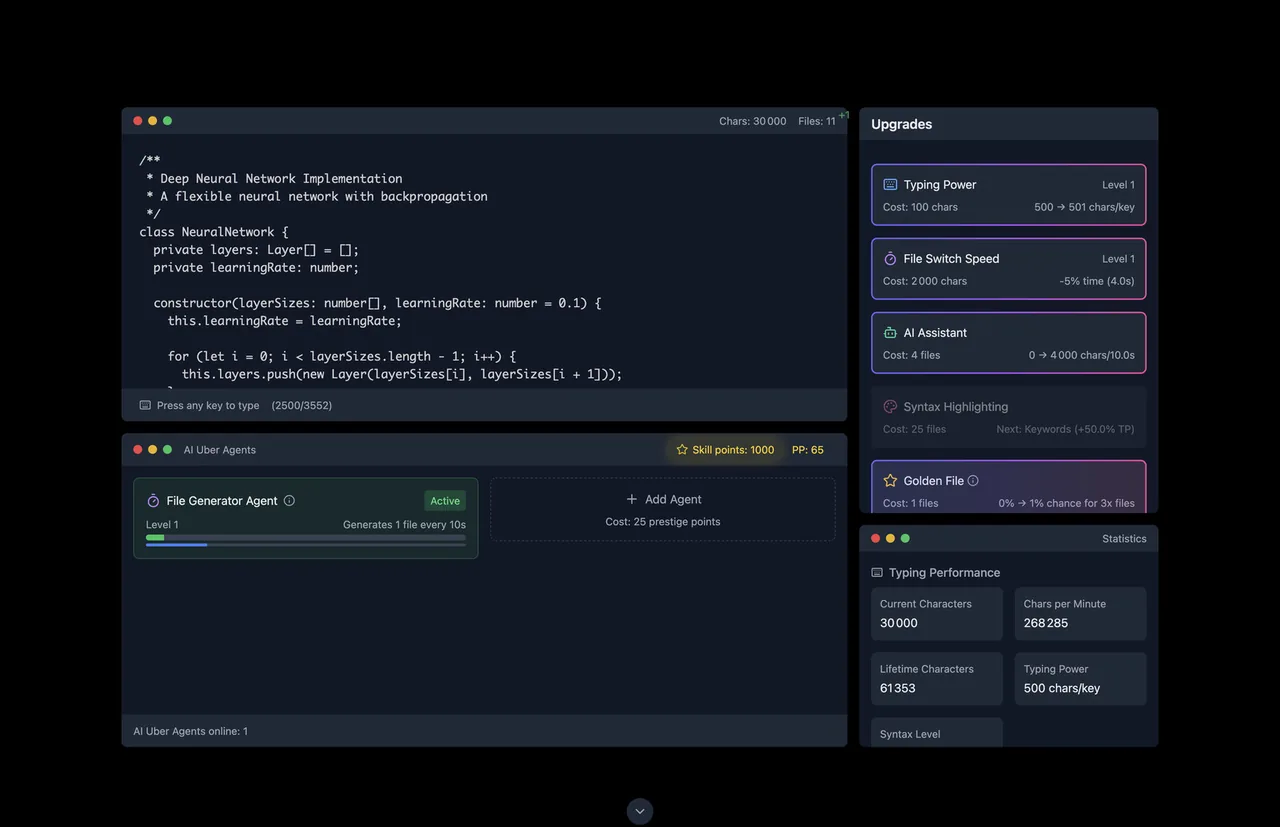
An incremental game is a story about replacing your own labour with machinery. So is software development, as told by anyone who has ever written a script to avoid a chore. When you unlock the first agent here and it starts producing files while you sit there, the game isn't dressing up a multiplier — it's showing you the exact thing the genre has always been about, with the correct noun attached. Six of them eventually run in parallel: one generating, one hunting bugs, one training the others, all of them overclockable for double output at a cost. The fiction and the spreadsheet agree, and that agreement does a lot of quiet work in the first few hours.
The supporting systems are sensibly chosen too. Projects hand you 200-file codebases across eleven languages, bugs included, and you point your workforce at them. Specialising in a language pays a permanent bonus that survives prestige, which is the right kind of long-term hook — it turns the reset from a wipe into a deposit. The skill tree runs to dozens of nodes and several have no level cap at all. Prestige resets the run for a permanent multiplier. Agents keep working while the game is closed. None of that is novel on its own, but it's assembled competently, and the theme keeps giving each layer a name that means something.
Where the ladder gives way
Then you reach the projects tier and the game stops holding up its end.
This is the most consistent complaint from the people playing it, and it's a design problem rather than a taste one: tasks stop advancing, the numbers required stop bearing an understandable relationship to the numbers you can produce, and the game offers no read on which of your four production systems is supposed to be the answer. A good incremental always has a next lever. When a wall arrives here, the honest response is often to check whether it's a wall or a bug — and in this build, it might be either.
The achievement list makes the scaling problem visible from outside. It went from 100 entries to over five thousand in a single late-July update, and the patch notes themselves warn that some are still broken and that others need balancing. That's not a small admission. Five thousand achievements is a retention lever, not content, and hanging it off a curve that already stalls means a large fraction of that list describes states no save can currently reach. Uncapped skill nodes have the same shape of problem: uncapped is generous right up to the moment scaling becomes the thing standing between you and the next tier, at which point "no cap" just means the ceiling moved somewhere you can't see it.
The Machine — a grid where you place power supplies, crawlers, RAM and databases and chain them into production lines — is the endgame the whole ladder points at, and it's the least finished thing in the build. Its own currency and upgrade tree are on the roadmap rather than in the game. That's a defensible Early Access decision, but it does mean the destination is currently a sketch.
Thirteen days, one demolished pillar
The patch history is worth reading before you buy, because it tells you more about the game's state than the store page does.
It launched on 14 July and was patched twice the same day — a crash tied to agent experience, a windowed-mode fix, a tooltip. Two days later came interface scaling and bulk-buy previews that show the cumulative effect of a batch, which is exactly the quality-of-life work this genre lives on. On 19 July, machine unlock rebalancing and a fix for a Linux and Steam Deck crash. On 27 July, version 1.1.0, followed by a hotfix for project difficulty within a couple of hours.
That cadence is a good sign. A solo developer shipping eight updates in a fortnight and fixing platform-specific breakage inside days is doing the job. But 1.1.0 also took Code Review — one of the five pillars the store page sells — and replaced it outright with Merge Queue Defense, a tower-defence mode where suspicious pull requests come down a conveyor belt and you shoot them, complete with seven milestones, its own shop and a run-local currency. Thirteen days after launch.
Judge that however you like, but be clear about what it means: the loop you pay for today is not necessarily the loop that exists in three months. Some of the harsher user reviews are aimed less at how the game plays than at how it was built and how that was communicated, which is a separate argument from the one this review is having. On the build itself, the fair reading is that the foundation is genuine and the shape above it is still moving.
What the eight dollars buys
US$7.99, NZ$12.49 in New Zealand, checked on 29 July 2026. One purchase. No ads, no premium currency, no energy meter, no timer nagging you back, nothing sold to skip the grind. In a genre that regularly charges for the privilege of progressing while the app is closed, that restraint deserves saying out loud.
The wrinkle is that there's a free HTML5 build of the same game in your browser, and a free demo on Steam. What the paid version adds, by the developer's own accounting, is cloud saves, native Steam achievements and a desktop application. Whether that's worth eight dollars depends entirely on how much you play — and the useful part is that you get to find out before paying, which is more than most games at this price offer.
The current Steam standing is Mostly Positive at 70% of 34 reviews, which is a small sample and about right. This is a game people enjoy for several hours and then argue with.
Verdict
There's a genuinely good incremental in here, and the thing it does best is something almost none of its competitors manage: the theme and the maths are telling the same story. Watching your typing speed become a hiring problem become a logistics problem is a satisfying arc, the language specialisations give prestige real weight, and the pricing is clean in a category where clean pricing is rare.
It scores a 6 because the ladder isn't finished. Progression stalls where the game should be opening up, the achievement list has been inflated past the point the curve can support, the endgame system is a placeholder, and an advertised pillar was demolished and rebuilt inside two weeks. Those are Early Access problems and a determined developer is clearly working on them — but a score is a verdict on the thing that exists today, and today this is a strong first act attached to an unreliable second one.
Buy it if the premise makes you grin and you're comfortable funding a build that will change under you. Play the free version first if you're not. Come back in six months either way, because if the scaling gets the attention the interface already has, this could be a much better game than the one currently on sale.
Prices, monetisation and the Steam review summary checked 29 July 2026.
For a more finished take on skill-web idling, Idle Iktah is the sturdier recommendation, and Dwarf Eats Mountain is worth a look if you want an incremental with a firmer endgame. If you'd rather your automation happened somewhere with a road and a sky, that's the job Wanderer took on.
Pros and cons
Pros
- The automation fantasy and the genre fantasy are the same fantasy here, so every unlock lands thematically as well as numerically
- Six specialist agents that generate, debug and train each other give the mid-game an actual shape rather than one long multiplier
- Language specialisation carries permanent bonuses across the whole save, which makes prestige runs feel like they compound rather than reset
- Prices honestly — one purchase, no ads, no premium currency, no energy meter, and a free version to test the hook first
- Post-launch patch cadence is genuinely fast, with crashes and platform-specific breakage addressed within days
Cons
- Progression stalls hard around the project tier, where tasks stop advancing and the curve stops explaining itself
- The achievement list ballooned from 100 to over five thousand in one update, and the developer's own notes admit some of them are still unreachable
- Code Review, one of the advertised pillars, was replaced wholesale thirteen days after launch — the design is not settled
- Crash and save-corruption reports are still common enough to be a pattern rather than bad luck
- The endgame machine grid is the least finished system in the build, and it's the one the whole ladder points at
Screenshots
-
Yet Another Incremental Game (but this time about coding)Image: Raclette Games via Steam -
Yet Another Incremental Game (but this time about coding)Image: Raclette Games via Steam -
Yet Another Incremental Game (but this time about coding)Image: Raclette Games via Steam -
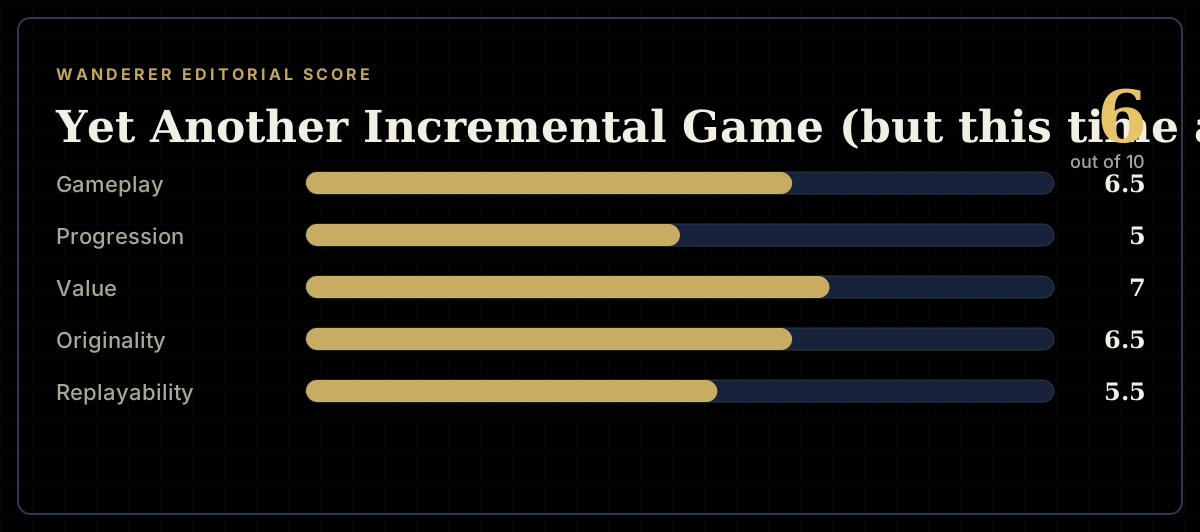
How the review scores each part of the gameWanderer Editorial -
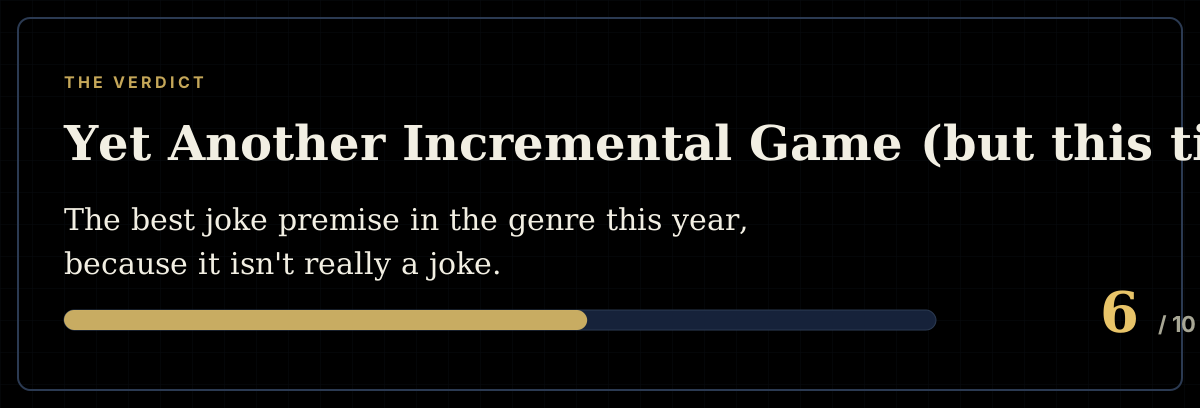
The short versionWanderer Editorial