
Game review
Revolution Idle
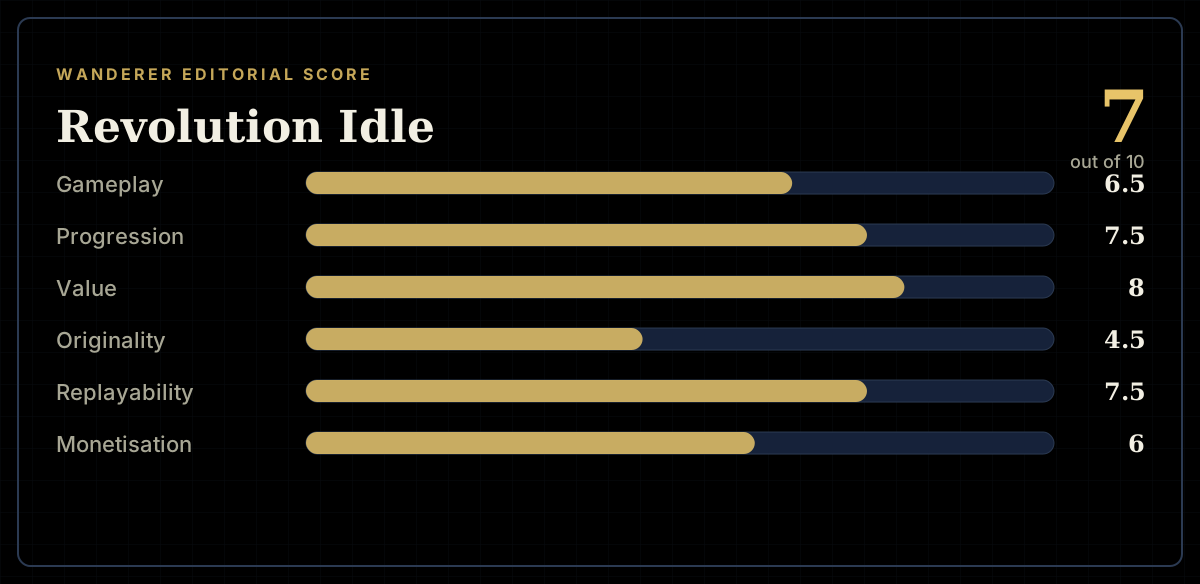
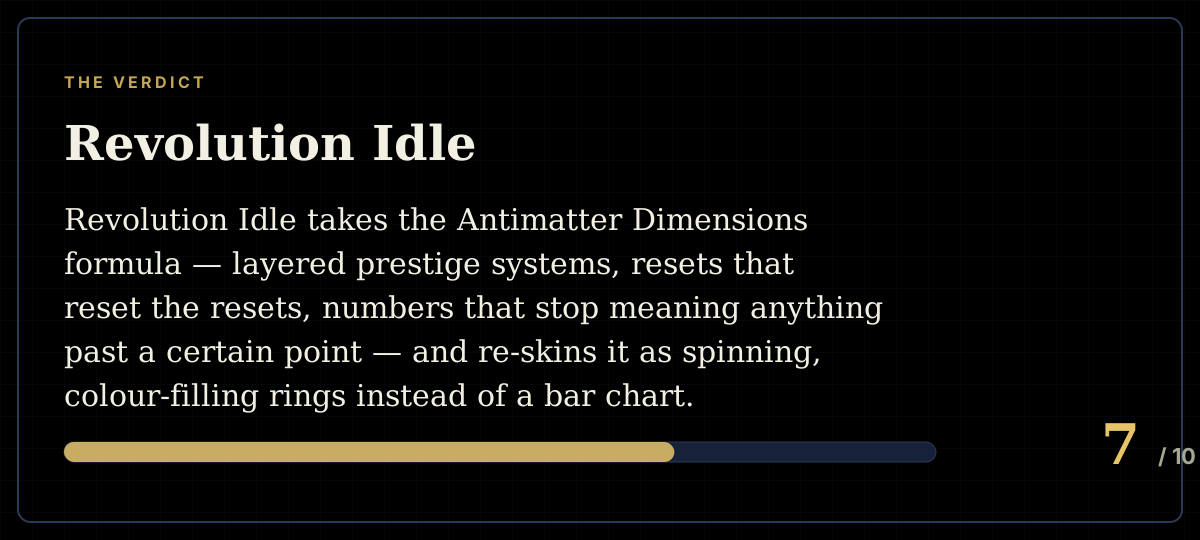
7 / 10
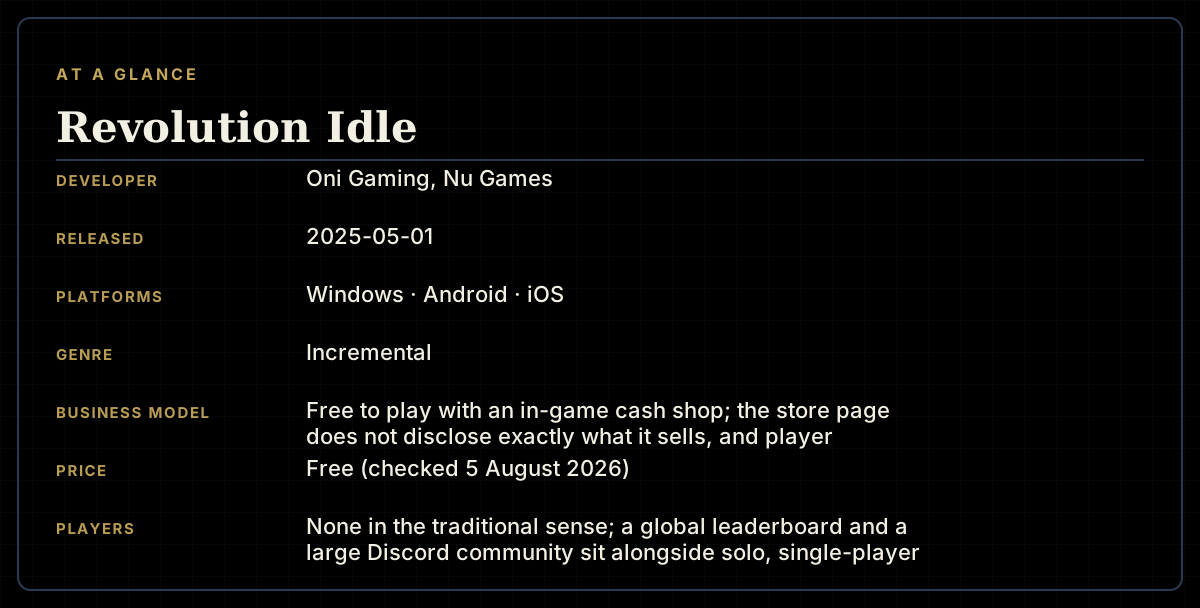
- Developer
- Oni Gaming, Nu Games
- Publisher
- Oni Gaming
- Released
- 1 May 2025
- Platforms
- Windows, Android, iOS
- Genre
- Incremental
- Monetisation
- Free to play with an in-game cash shop; the store page does not disclose exactly what it sells, and player feedback is split between calling it skippable and describing the later game as a choice between paying and waiting
- Players
- None in the traditional sense; a global leaderboard and a large Discord community sit alongside solo, single-player progression
The short version
Revolution Idle takes the Antimatter Dimensions formula — layered prestige systems, resets that reset the resets, numbers that stop meaning anything past a certain point — and re-skins it as spinning, colour-filling rings instead of a bar chart. It's not shy about the debt; a chunk of its own player base isn't shy about pointing it out either.
What it does with that structure is genuinely substantial: 670-plus achievements that grant real bonuses rather than just badges, a macro builder for players who want to script their own automation, cross-platform saves between PC, Android and iOS, and updates that were still landing in July 2026, nine months after full release. It's derivative by design rather than by accident, and for the audience that already loves this specific style of incremental, that's closer to a selling point than a flaw.
Biggest strengths
- 670-plus achievements grant real progression bonuses rather than sitting as cosmetic badges, giving completionists an actual reason to chase the long tail
- The macro builder lets advanced players script their own automation instead of relying on whatever the developers hard-coded, a rare degree of player-side control for the genre
- Cross-platform saves keep PC, Android and iOS progress in sync, so the idle promise of checking in from anywhere actually holds up
Biggest weaknesses
- The core loop, visual language and prestige-inside-a-prestige structure track closely enough to Antimatter Dimensions that a share of its own reviewers call it out directly as derivative
- Several long-time players describe needing the Discord and community wiki just to make sense of systems the game itself explains poorly
- The in-game cash shop's exact contents aren't disclosed on the store page, and player sentiment is split on whether the late game leans on it more than it should
Who it's for: Fans of layered prestige incrementals — Antimatter Dimensions, NGU Idle, that entire family — who don't mind that Revolution Idle wears its influences on its sleeve, and who want a free game that keeps adding systems rather than settling into a fixed shape.
Our recommendation: Install it if concentric rings, exponents and prestige-inside-a-prestige already sound appealing; skip it if you've played the games it's drawing from and want something that reinvents rather than reskins the format.
7 / 10
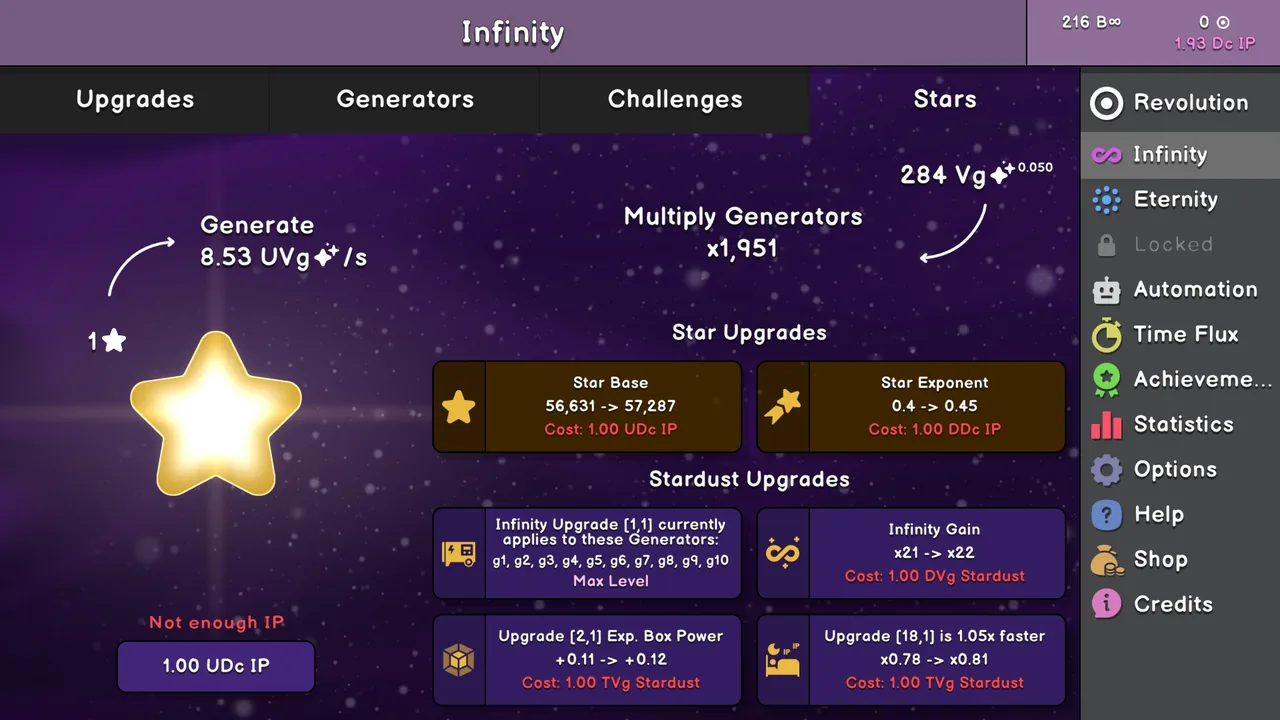
Every incremental game eventually asks the same question: what happens once the number gets too big to mean anything? Revolution Idle's answer is to keep adding layers on top of that question rather than answering it — Prestige feeds Infinity, Infinity feeds Eternity, Eternity feeds Time Flux, and each layer exists specifically to make the layer beneath it worth resetting again. If that structure sounds familiar, it should. Revolution Idle is built in the direct lineage of Antimatter Dimensions and the dimension-and-prestige incrementals that followed it, right down to players in its own review section pointing out the resemblance. What it adds isn't a new idea — it's scale, polish, and a visual identity distinct enough to stand on its own.
Rings instead of rows
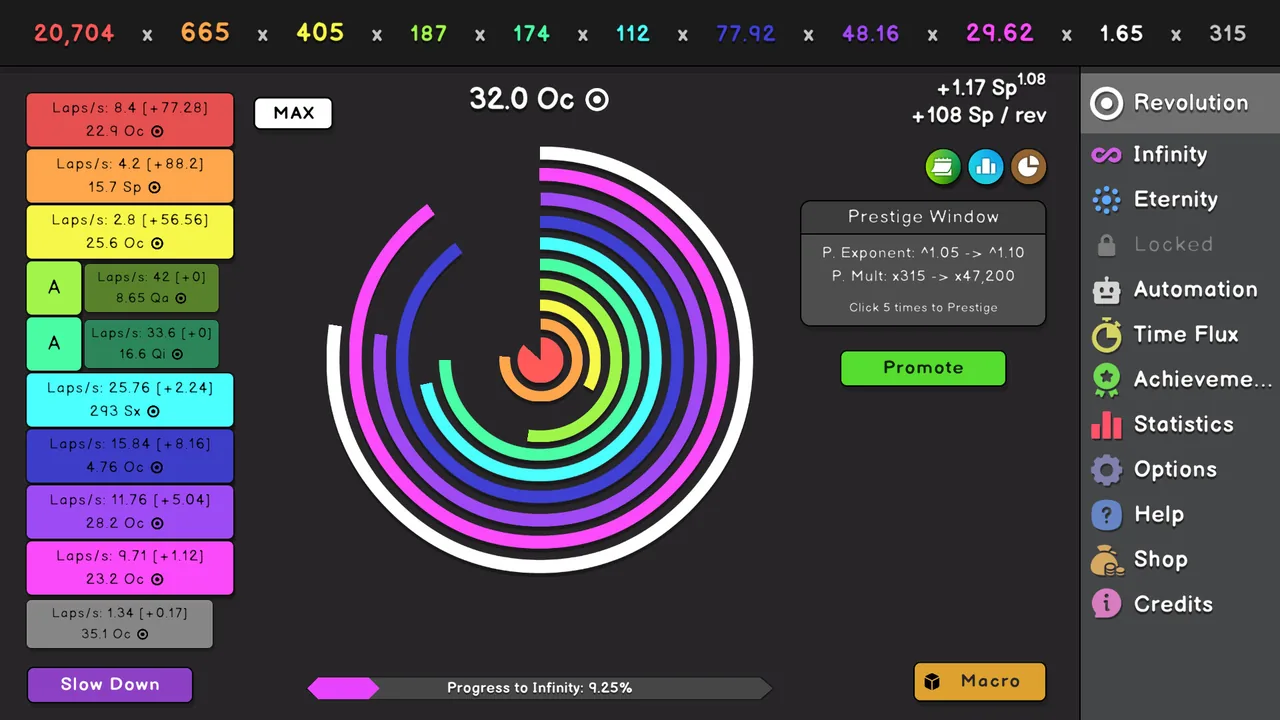
Where most incrementals stack their resources in a vertical list of buy buttons, Revolution Idle wraps its progression around a spinning wheel of concentric, colour-coded rings, each one filling up at its own rate measured in "laps per second." It's a genuinely effective piece of UI design — watching eight or nine rings spin and fill at wildly different speeds communicates the shape of your build at a glance in a way a column of numbers doesn't. The sidebar underneath it reads like a table of contents for the genre: Revolution, Infinity, Eternity, Automation, Time Flux, Achievements, Statistics, Shop, and a dedicated Macro tool, unlocking roughly in that order as a run progresses.
The moment-to-moment loop is exactly what genre veterans expect: buy the next multiplier, watch laps per second climb, hit a wall, prestige to reset the ring speeds in exchange for a permanent exponent bump, repeat at a higher tier. Where it earns real credit is the automation layer. Advanced players can build their own macros to handle repetitive purchase and prestige decisions instead of being stuck with whatever automation the developers hard-coded — a level of player-side control that most incrementals, even good ones, don't offer.
Six hundred and seventy reasons to keep playing
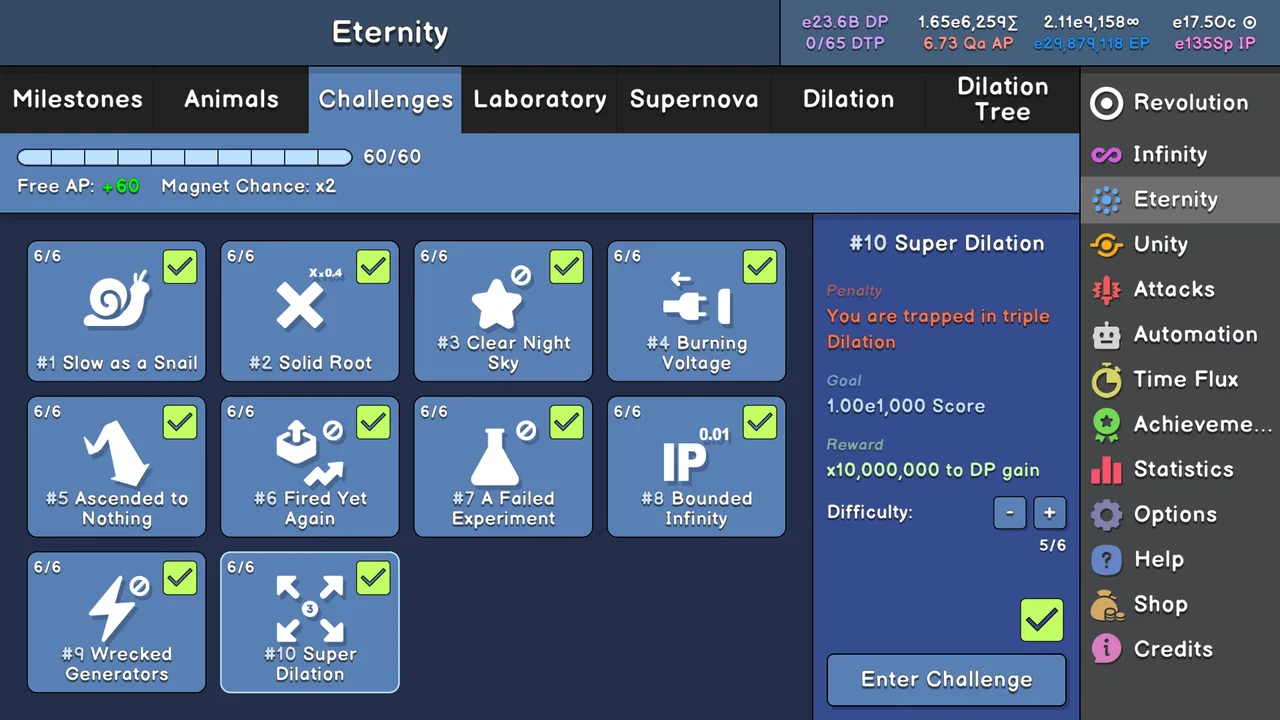
Revolution Idle's achievement list runs past 670 entries, and — according to the store page and borne out by Steam's own global achievement data — a meaningful number of them grant real progression bonuses rather than sitting as decoration. Global completion rates make the shape of that tail visible: the easiest achievements sit at 80-88% completion, the kind everyone clears in their first session, while hundreds near the bottom of the list sit under 2%, chased only by players who've put in serious hours. That's a steep curve, but it's the honest shape of an exponent-driven incremental rather than a sign the game is abandoning players early — the content genuinely runs that deep, and the July 2026 "Plague & Singularity" update, landing well over a year after full release, is evidence the developers are still building toward the far end of it.
Cross-platform saves are the other quiet strength here. Progress syncs between Windows, Android and iOS, which matters more for an idle game than almost any other genre — the entire pitch is that the game keeps working when you're not looking at it, and being able to check in from a phone rather than being tied to one PC actually delivers on that.
The debt it doesn't hide, and the one it should explain better
Ask Revolution Idle's own player base what it reminds them of and Antimatter Dimensions comes up unprompted, sometimes admiringly, sometimes as a direct accusation of copying. Both reactions are reasonable responses to the same fact: the prestige-inside-a-prestige structure, the exponent math, the escalating tiers of reset are not new ideas here, they're a very close read of a format other games established first. Revolution Idle's own contribution is presentation, scale and active support rather than mechanical invention, and whether that's a problem depends entirely on whether you're coming to it fresh or arriving from the games it's drawing on.
More concerning is a smaller but consistent thread in negative reviews: players who say they needed the game's Discord and community wiki to understand systems the game itself explains poorly. For a title that leads with "a built-in tutorial gets you started fast," a recurring complaint about needing an external wiki to progress past the early game suggests that tutorial stops covering ground well before the systems do. A related complaint shows up often enough to flag rather than dismiss: several reviewers report that offline progress only counts if the game can briefly reach the internet to register it, which — if accurate for a given player's setup — quietly undercuts the away-from-keyboard promise that's supposed to be the entire point of an idle game.
Monetisation, without a clear answer
Revolution Idle carries an in-game cash shop, confirmed by its Steam category tags, but the store page itself doesn't spell out what it sells. Reading through player feedback doesn't settle it cleanly either — plenty of reviewers call it a free game in every sense that matters, while others describe the late game as a choice between paying and waiting considerably longer than the early hours suggest. Without a public price list or a developer statement on exactly what the shop offers, the honest position is to flag the split rather than adjudicate it: go in expecting a free-to-play economy with a real shop behind it, and judge for yourself once you've seen it rather than trusting either side of that argument on faith.
Final verdict
Judge Revolution Idle purely as an idea and it's hard to get excited about a game that borrows this much of its structure from elsewhere. Judge it as an execution of that structure — the ring visualisation, the achievement depth, the macro tooling, the cross-platform saves, the fact that it's still being meaningfully updated well past its first birthday — and it's a genuinely strong entry in a crowded genre, currently sitting at 86% positive across its recent English reviews for reasons that hold up under inspection. The onboarding friction and the unclear shop are real marks against it, not dealbreakers.
If you already know you like this specific style of incremental, Revolution Idle is one of the more actively supported, content-dense ways to play it for free. If you're coming from Antimatter Dimensions or NGU Idle looking for the format reinvented rather than redecorated, this isn't where you'll find it.
Players who'd rather their number-go-up progression happen inside a persistent world with other people in it, rather than a solo ring of exponents, may also want to look at Wanderer.
Pros and cons
Pros
- 670-plus achievements grant real progression bonuses rather than sitting as cosmetic badges, giving completionists an actual reason to chase the long tail
- The macro builder lets advanced players script their own automation instead of relying on whatever the developers hard-coded, a rare degree of player-side control for the genre
- Cross-platform saves keep PC, Android and iOS progress in sync, so the idle promise of checking in from anywhere actually holds up
- Still receiving substantial content updates as of July 2026, more than a year after its Early Access launch, including a major "Plague & Singularity" patch
- A confirmed 2 million-plus player base and a 130,000-member Discord mean help, guides and a working economy of shared knowledge are never far away
Cons
- The core loop, visual language and prestige-inside-a-prestige structure track closely enough to Antimatter Dimensions that a share of its own reviewers call it out directly as derivative
- Several long-time players describe needing the Discord and community wiki just to make sense of systems the game itself explains poorly
- The in-game cash shop's exact contents aren't disclosed on the store page, and player sentiment is split on whether the late game leans on it more than it should
- A vocal minority of negative reviews report that offline time only counts if the game can reach the internet to register it, undercutting the away-from-keyboard promise for anyone without a reliable connection
- With 670 achievements and an exponent-driven curve, the tail of the game is enormous by design — rewarding for genre veterans, potentially exhausting for anyone else
Screenshots
-
Revolution IdleImage: Oni Gaming via Steam -
Revolution IdleImage: Oni Gaming via Steam -
Revolution IdleImage: Oni Gaming via Steam -
How the review scores each part of the gameWanderer Editorial -
The game at a glanceWanderer Editorial -
The short versionWanderer Editorial