
Game review
Your Chronicle
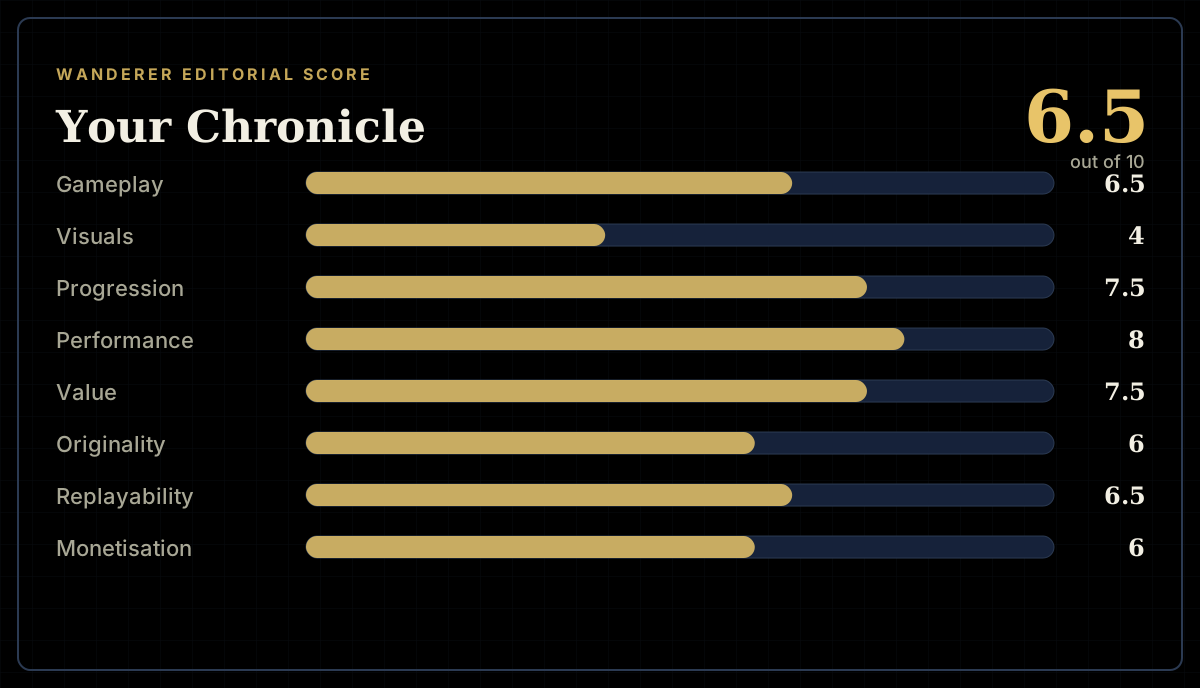
6.5 / 10
- Developer
- Samurai Games
- Publisher
- Samurai Games
- Released
- 4 April 2021
- Platforms
- Windows, macOS, Linux, Android, iOS, browser
- Genre
- RPG, Incremental
- Monetisation
- Free-to-play with an optional Ruby premium currency. Rubies buy consumables, permanent upgrades and a handful of Ruby-exclusive automation unlocks such as Auto Sacred Ritual, but they also drop from Guardian kills, chests, achievements and Reincarnation rewards, so nothing in the shop is locked behind real money specifically. A separate Artwork Addition DLC adds story-completion illustrations only, with no effect on pacing or power.
- Players
- Single-player
The short version
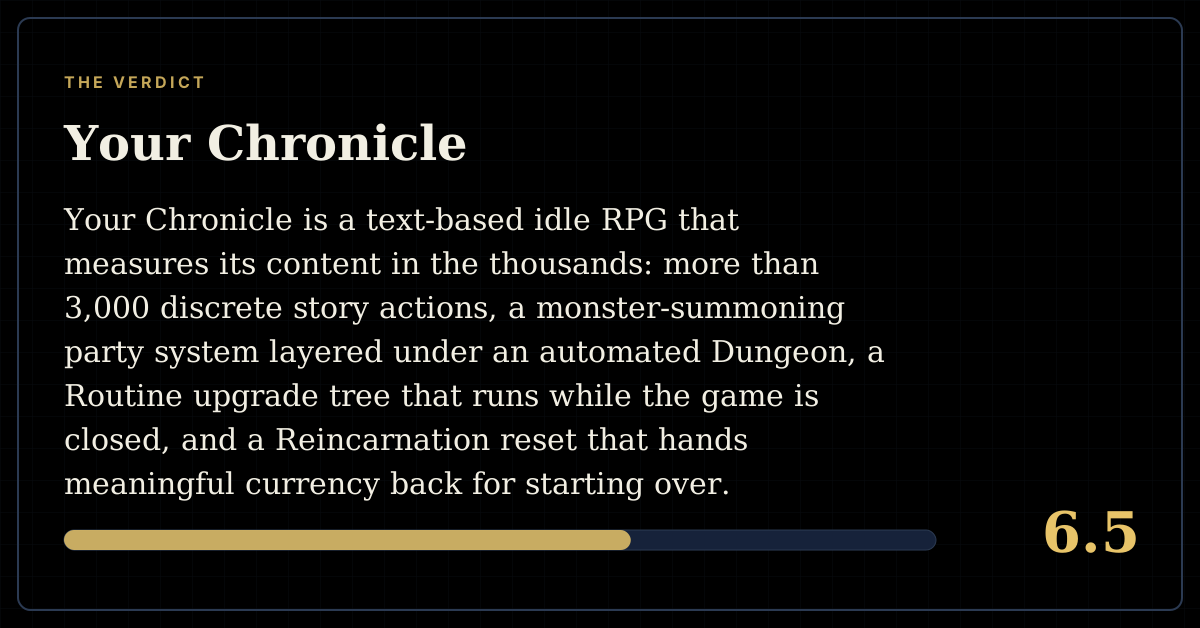
Your Chronicle is a text-based idle RPG that measures its content in the thousands: more than 3,000 discrete story actions, a monster-summoning party system layered under an automated Dungeon, a Routine upgrade tree that runs while the game is closed, and a Reincarnation reset that hands meaningful currency back for starting over. Samurai Games has kept shipping numbered updates for more than five years, right through to version 2.7.13 in July 2026 — this is not a stalled Early Access project coasting on an old pitch, it's a live one still adding systems.
What it doesn't do is explain any of that. The opening hours drop a beginner into a dense grid of tabs — Action, Routine, Party, Dungeon, Shop — with a thin in-game guide and two separate community-run wikis that exist largely to cover what the tutorial doesn't. Players who push through find a genuinely deep, generous, actively maintained free game underneath. Most won't push through, and the game does very little to change that.
Biggest strengths
- Free access to the entire base game with more than 3,000 branching story actions and no paywall blocking core content
- Automation unlocks for Dungeon battles and the Routine upgrade tree turn a click-heavy opener into something that mostly runs itself within the first several hours
- Rubies, the premium currency, drop from Guardian kills, chests, achievements and Reincarnation rewards, so the shop's automation unlocks stay earnable without spending
Biggest weaknesses
- The opening hours hand new players a dense grid of Action, Routine, Party and Dungeon tabs with only a thin in-game beginners guide, and two separate community wikis exist largely to cover the gap
- Reincarnation resets the run, and the currency and unlocks already spent make the decision to trigger it difficult to walk back once it's underway
- Visual presentation stays almost entirely text and icon based, so the DLC illustrations are the only real art most players will see without paying extra
Who it's for: Idle-RPG veterans who already read wikis before they read tutorials, and who want raw systems depth and a story with an actual multi-ending structure over a curated introduction.
Our recommendation: Try it free on Steam, mobile or in a browser before deciding whether it's worth your time — there's no purchase gate to weigh, only a time investment. Open the in-game beginners guide immediately and expect to lean on the community wiki within the first hour; treat that as normal rather than a sign something's broken.
6.5 / 10
Some idle RPGs hide their depth behind a slow, generous drip feed, unlocking one new system at a time until the whole machine reveals itself over dozens of hours. Your Chronicle doesn't bother with the drip feed. It opens the tap. Within the first sitting, a new player is looking at Action buttons, a Routine upgrade tree, a monster-summoning Party screen and an automated Dungeon, with a Shop selling a premium currency sitting one tab over from all of it. Samurai Games built something genuinely large here — more than 3,000 individual story actions, a father-and-mother rescue premise that branches into a real multi-ending structure, and five straight years of active updates that are still landing in 2026. It's also one of the least considerate first hours the free-to-play RPG space currently offers, and the review has to sit with both of those facts at once.
A father's promise and three thousand branches
The premise is simple on its face: leave the village, get strong, save your mother, following instructions from a father who sends you off in the opening minutes. What Samurai Games built underneath that premise is not simple. Steam's own listing counts more than 3,000 unique story actions, and the game is explicit that the ending a player reaches depends on the choices made along the way rather than following a single fixed track. That's a meaningfully different pitch from most idle RPGs, which tend to treat their narrative wrapper as flavour text bolted onto a number-go-up engine. Your Chronicle treats the story as one of its actual systems, with its own branching logic sitting alongside the Routine and combat systems rather than beneath them.
The trouble is that scale and clarity pull in opposite directions, and Your Chronicle picked scale. Three thousand actions means a lot of menus, a lot of currencies, and a lot of small decisions that don't come with much explanation of what they're for. Players comparing it to tightly scoped incrementals will find the sheer quantity of content impressive and the presentation of that content borderline hostile. Both reactions are correct.
Automation is the whole point, once you reach it
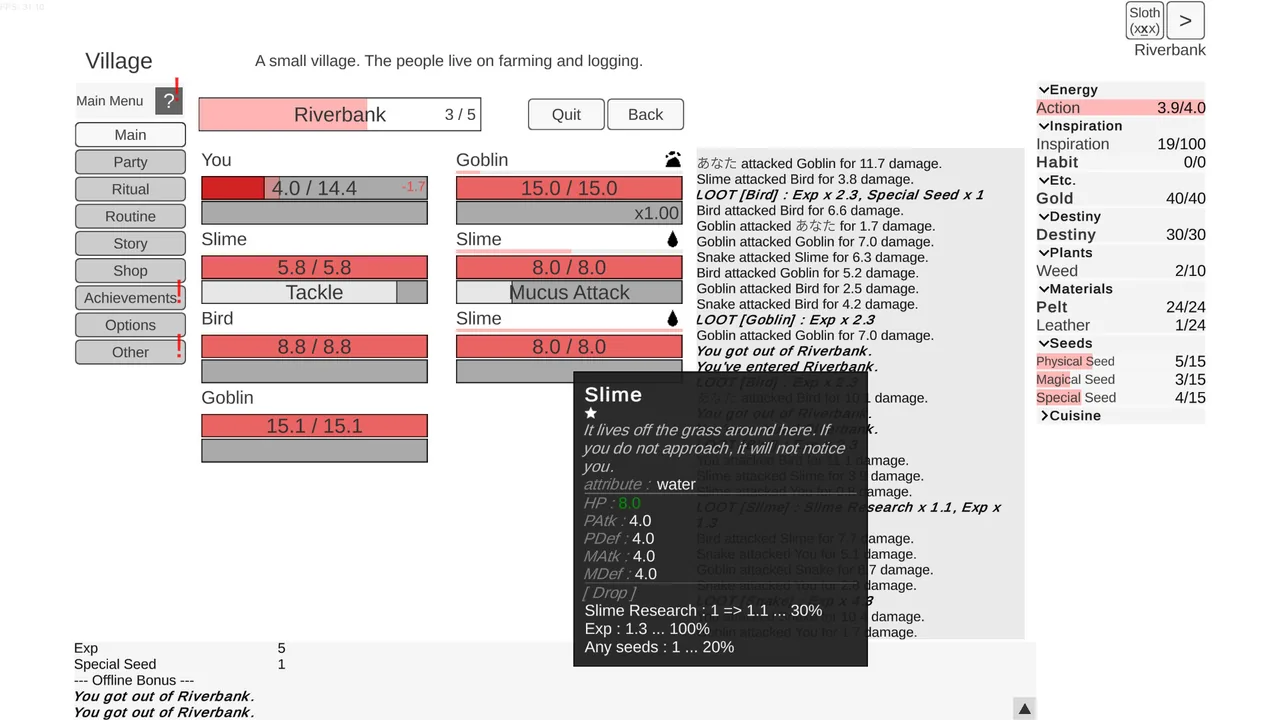
The systems that eventually reward the effort are genuinely well built. Dungeon runs automate combat entirely once unlocked, turning what starts as a manual grind into a background process a player checks in on rather than performs. The Routine tree pushes further in the same direction: it is explicitly built around an offline bonus, reproducing the progress a player would have earned had they kept the game open while it was actually closed. That's the same design promise Wanderer makes with its own away-from-keyboard systems, and Your Chronicle delivers on it in a comparable way — the game keeps working on a player's behalf, rather than punishing them for logging off.
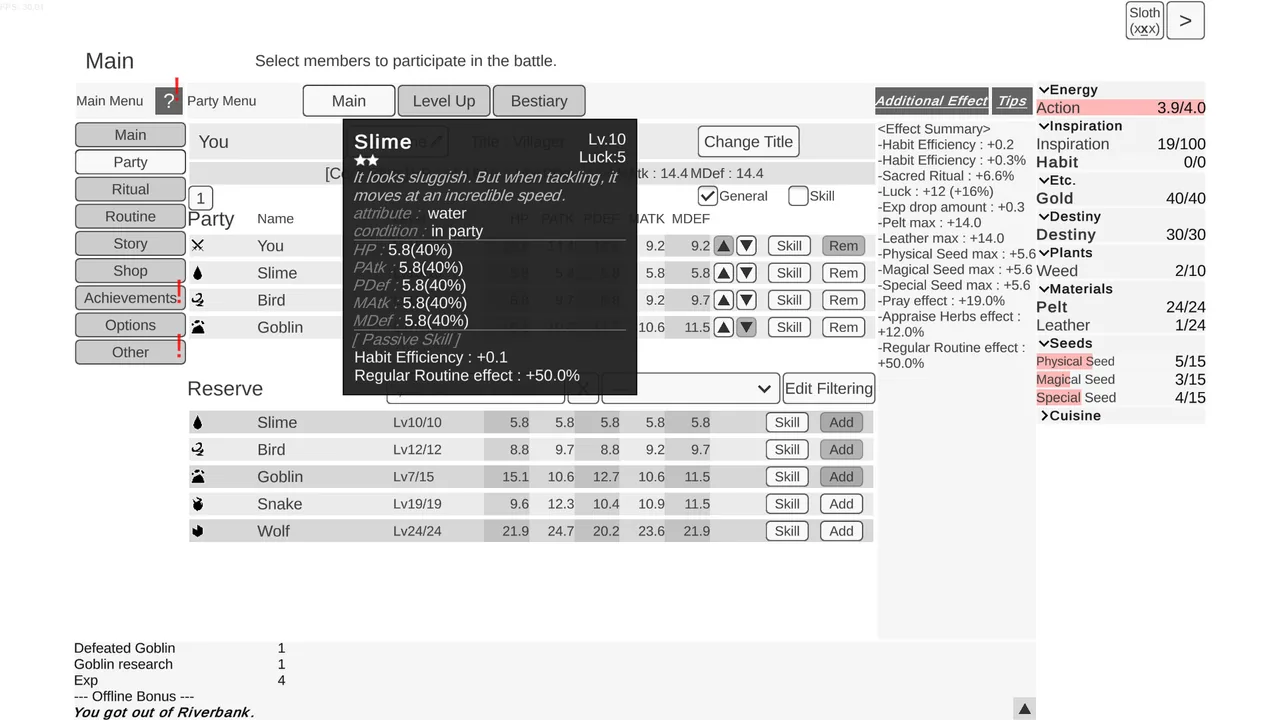
Monster summoning sits on top of that automated combat loop, giving each captured monster its own skill and equipment progression separate from the player character's. It's a reasonably deep party system for a game that presents itself primarily through text and icons, and it gives Dungeon runs a genuine build-optimisation layer rather than a single number that only ever goes up. None of this is revolutionary — collectible monster parties bolted onto idle combat is a well-worn structure — but it's executed with enough interlocking pieces (skills, equipment, party composition, automated Dungeon depth) that a committed player has real decisions to make long after the opening hours.
The interface is the price of admission
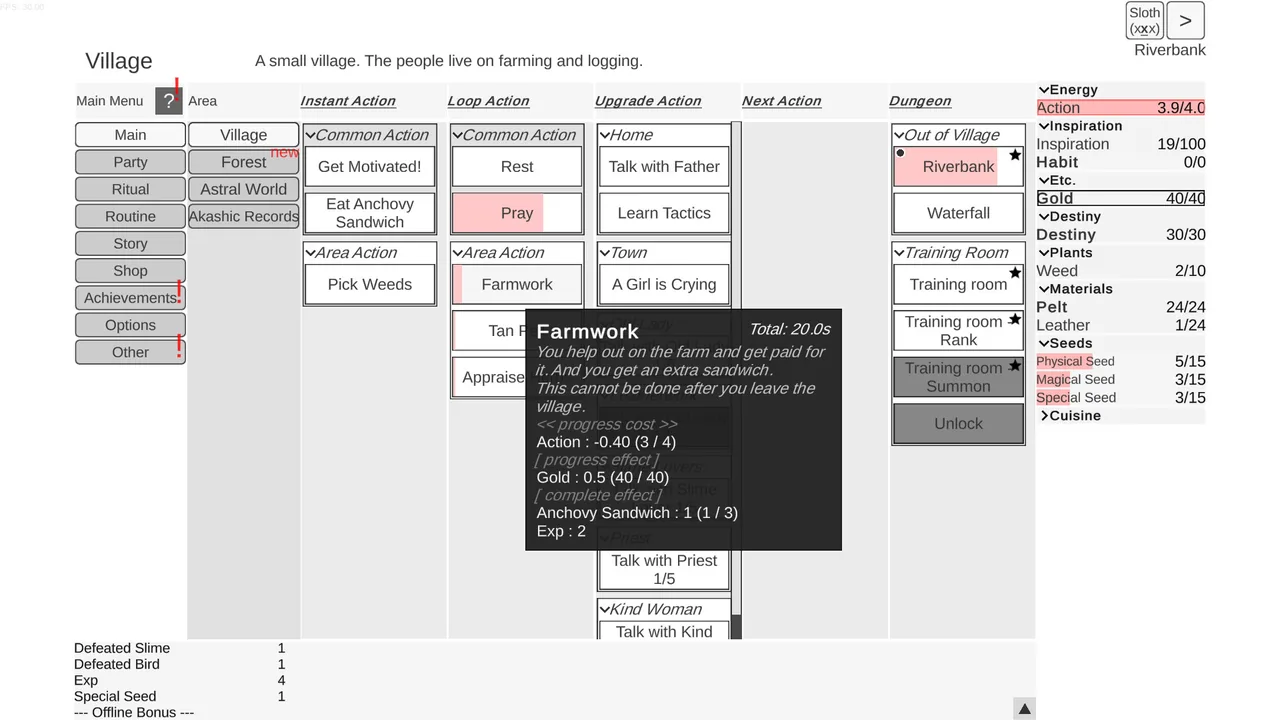
This is where the review has to stop crediting the systems and start weighing what it costs to reach them. Your Chronicle's tab layout — Action, Routine, Party, Dungeon, Shop, and more that unlock later — presents almost everything at once, with minimal sequencing to tell a new player what matters this hour versus what can wait. The in-game beginners guide exists, but by the developer's own framing it's a starting point rather than a full explanation, and the game's player base has independently built two separate wikis to cover what it leaves out. That's not unusual for a five-year-old game with this much accumulated content — Synergism and several other long-running incrementals lean on community documentation the same way — but it's worth being honest about what that means for a newcomer: understanding Your Chronicle past its first hour is, in practice, a two-tab exercise, one for the game and one for a wiki explaining the game.
Player feedback consistently circles the same complaint from a different angle: sessions that feel slow relative to how much content is technically available, particularly before automation systems come fully online. That's a fair criticism of the pacing, not just the tutorial — an idle RPG that asks players to manually grind through its densest, least-explained systems before automation kicks in is putting the hardest part of the game first, which is close to the opposite of what the genre usually does well. The Steam reviews that praise the game tend to come from players who pushed through that opening regardless; the ones that don't tend to stop within the first few hours, before the automation and Reincarnation layers have had a chance to change how the loop feels.
Reincarnation, Rubies, and where the shop actually sits
Your Chronicle's reset layer, Reincarnation, hands back Rubies — the game's premium currency — as part of its reward, alongside other permanent progress. That's a defensible structure: it means the currency that stocks the Ruby shop is earnable purely by playing, not something a free player is locked out of. Rubies also drop from Guardian kills, chests and achievements, spreading the supply across several activities rather than gating it entirely behind either spending or a single grind target.
Where it gets more complicated is what the shop actually sells. Alongside consumables and straightforward permanent upgrades, some purchases are Ruby-exclusive — Auto Sacred Ritual, an automation unlock, is the clearest example — while others, like extra Party Template slots, are available elsewhere only in limited quantity. None of that is raw combat power sold directly for cash, which keeps Your Chronicle on the right side of most players' tolerance for free-to-play monetisation. But automation is the exact thing this review has just spent two sections praising as the game's strongest design idea, and selling a piece of it — even a piece that's also earnable — means the Ruby shop is quietly monetising the fix to the game's own pacing problem. It's a softer version of the line Synergism crosses more directly with its own premium shop, and it's worth knowing about going in rather than discovering after several hours of manual grinding.
The Artwork Addition DLC sits in a much simpler category. For NZ$3.69 it adds illustrations tied to story completion and changes nothing about pacing, power or access. It's the kind of DLC that exists so a free game's most invested players have a small, guilt-free way to pay for something, and it doesn't complicate the monetisation picture the way the Ruby shop does.
Presentation and performance
Visually, Your Chronicle is closer to a well-organised menu system than a game built around scene setting — text, icons and numbers carry almost everything, with the DLC's story illustrations as the main exception. That's a fair trade for a five-year-old game built by what reads as a small team, and it keeps the hardware bar close to nothing: Steam lists a 4GB RAM minimum and 150MB of storage, and the game runs identically across Windows, macOS and Linux on Steam, plus native Android and iOS apps and browser versions on Armor Games and CrazyGames. Few idle RPGs manage a genuinely consistent experience across that many platforms without a native client feeling like an afterthought, and Your Chronicle's light footprint is a big part of why it can.
Value, five years on
The thing that separates Your Chronicle from a lot of the free incremental field is that it hasn't stopped moving. Version 2.7.13 landed in July 2026, following a steady run of point releases through the first half of the year — this isn't a project running on momentum from a 2021 launch, it's one still being actively developed more than five years later. Steam's user base backs that up with real numbers rather than just goodwill: 2,135 of 2,680 all-time reviews are positive ("Mostly Positive"), and the more recent English-language sample sits at a comparable 80% positive rate rated "Very Positive." For a completely free game with no purchase required to access any of its story or systems, that's a strong return on a player's time, provided they're willing to spend the time the interface demands before it starts paying that back.
Verdict
Six and a half. Your Chronicle earns real credit for what's actually here: a free game with thousands of story actions, a branching multi-ending structure, a genuinely useful offline-progress system, and five years of demonstrable, ongoing development rather than an abandoned Early Access listing coasting on an old trailer. The automation layer, once reached, is exactly the kind of design that respects a player's time the way this genre is supposed to.
What keeps it out of Very Good territory is how much a player has to survive before any of that becomes visible. A tab layout that dumps every system on a newcomer at once, a beginners guide that leans on outside wikis to actually explain itself, and a shop that monetises a sliver of the automation the game is otherwise generous with, all add friction that a five-year-old, actively maintained project shouldn't still have. Judge Your Chronicle purely on its systems and its price — free — and it's a genuinely rewarding idle RPG. Judge it on how it treats the first hour, and it's asking a lot of trust from players it hasn't yet earned. Wanderer's readers who value progress that keeps moving while they're away will recognise the instinct behind Your Chronicle's Routine system; just budget real time for the wiki before the rest of it clicks.
Price and store details checked 30 July 2026.
Pros and cons
Pros
- Free access to the entire base game with more than 3,000 branching story actions and no paywall blocking core content
- Automation unlocks for Dungeon battles and the Routine upgrade tree turn a click-heavy opener into something that mostly runs itself within the first several hours
- Rubies, the premium currency, drop from Guardian kills, chests, achievements and Reincarnation rewards, so the shop's automation unlocks stay earnable without spending
- The Artwork Addition DLC only adds story-completion illustrations, a genuinely optional cosmetic purchase that changes nothing about pacing or power
- Samurai Games has shipped a steady stream of numbered updates through July 2026, more than five years after launch, so the roadmap is demonstrably still moving
Cons
- The opening hours hand new players a dense grid of Action, Routine, Party and Dungeon tabs with only a thin in-game beginners guide, and two separate community wikis exist largely to cover the gap
- Reincarnation resets the run, and the currency and unlocks already spent make the decision to trigger it difficult to walk back once it's underway
- Visual presentation stays almost entirely text and icon based, so the DLC illustrations are the only real art most players will see without paying extra
- Pacing complaints are common in Steam's own user reviews, with players repeatedly describing stretches as slow or tedious relative to the story content on offer
- Ruby-exclusive purchases like Auto Sacred Ritual sell automation rather than raw power, but it's still a meaningful convenience gated behind a currency the shop constantly nudges you to top up
Screenshots
-
Your ChronicleImage: Samurai Games via Steam -
Your ChronicleImage: Samurai Games via Steam -
Your ChronicleImage: Samurai Games via Steam -
How the review scores each part of the gameWanderer Editorial -
The short versionWanderer Editorial