
Game review
Idle Iktah
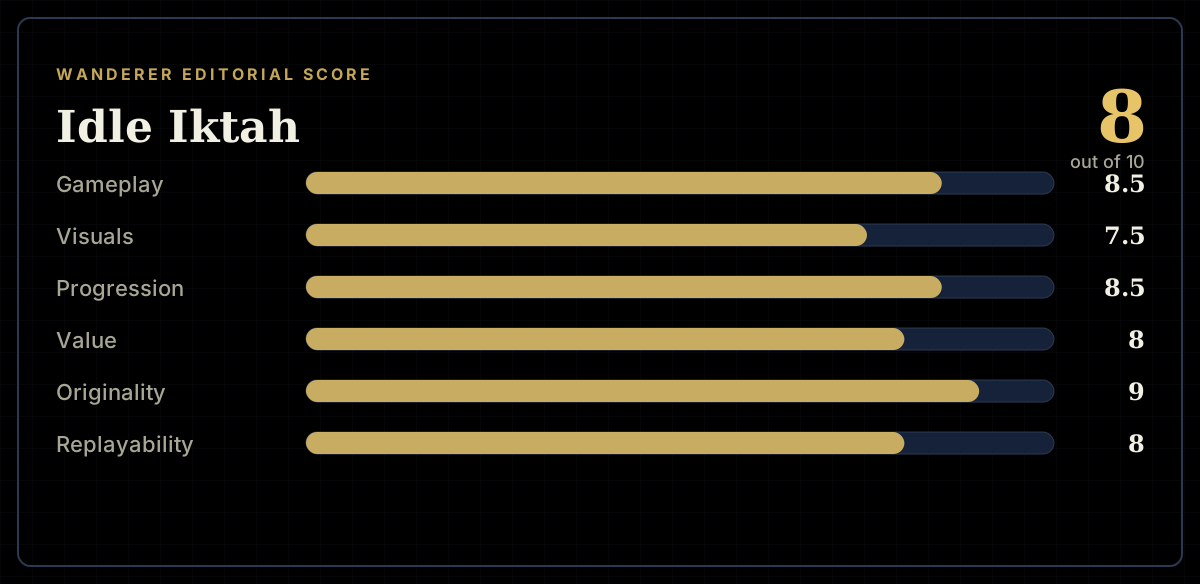
8 / 10
- Developer
- Grounded Games
- Publisher
- Grounded Games
- Released
- 5 October 2023
- Platforms
- Windows, macOS, Android, iOS
- Genre
- Incremental RPG
- Monetisation
- Free to play, with optional ads on mobile and a one-off upgrade that raises the offline cap
- Players
- Single-player
The short version
One of the most quietly confident incrementals on either store. Eighteen skills feed each other properly instead of sitting in separate tabs, the Pacific Northwest setting gives it a voice almost nothing else in the genre has, and the free version is a real game rather than a demo with a countdown attached.
The catch is structural: offline time — the currency this entire genre runs on — is the thing being sold. Four hours free, twenty-four if you pay. Everything else here is generous enough that the gate stands out more than it otherwise would.
Biggest strengths
- Skills feed each other properly — better fishing means better cooking, which means surviving longer fights
- Content unlocks in a staggered drip, so new systems keep arriving hours after most idle games have shown their whole hand
- The Pacific Northwest setting, real tide tracking and moon-phase items give it a genuine identity
Biggest weaknesses
- The base offline cap of four hours is short for a game explicitly built to be left alone
- Raising that cap to a full day means buying the upgrade, which puts the central resource behind a paywall
- Inventory and equipment management get fiddly once several near-identical materials are in play
Who it's for: Skill-grid people. Anyone who liked the shape of RuneScape's skilling but wants it to keep working while the phone is in a pocket.
Our recommendation: Install the free version and give it three days. If the skill web has its hooks in you by then, it will hold for months; if the four-hour offline cap is already annoying you by then, that is the purchase decision the game is really asking you to make.
8 / 10
Most idle games are a spreadsheet wearing a costume. Idle Iktah is a spreadsheet that has clearly been somewhere — a fictionalised Pacific Northwest of cedar, salmon runs and coastal weather, where the tide in the game follows the real tide on the Oregon coast and some items behave differently depending on the phase of the moon. That is a ridiculous amount of texture for a game that mostly asks you to pick a task and close the app.
It works because the texture is attached to systems rather than sprinkled on top of them. This is the rare incremental where the setting and the mechanics are arguing for the same thing.
What you're actually doing
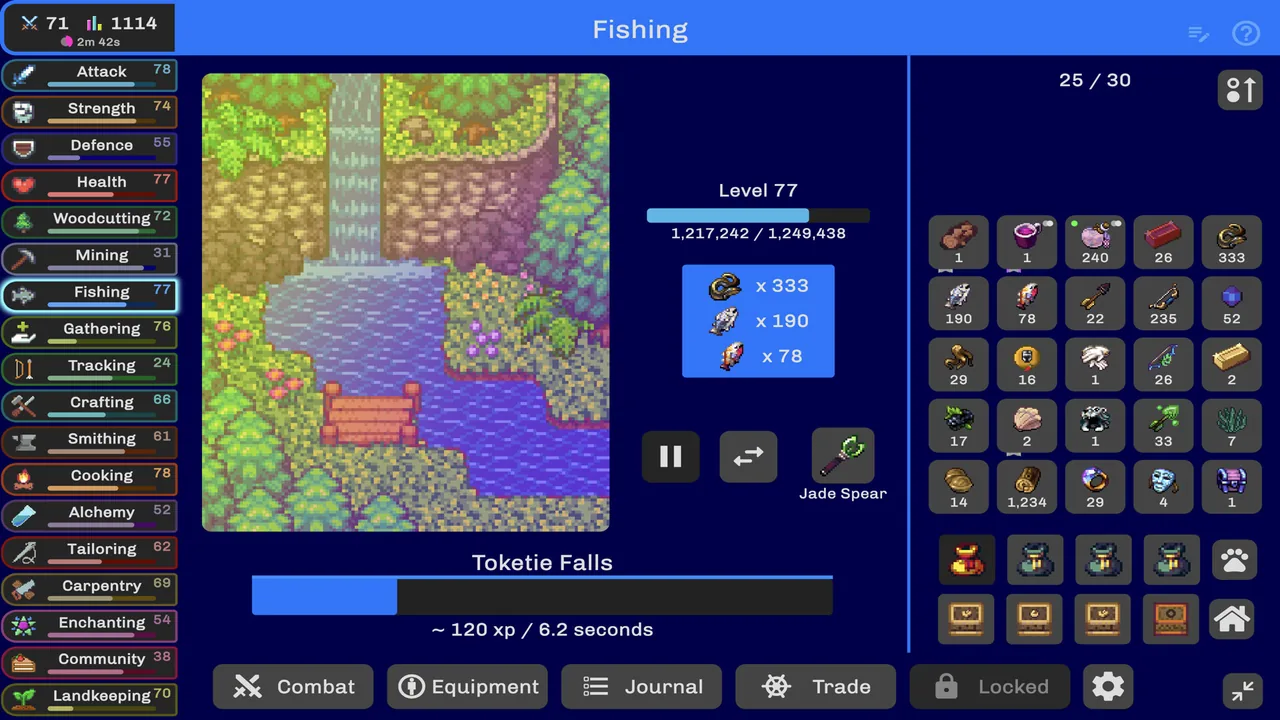
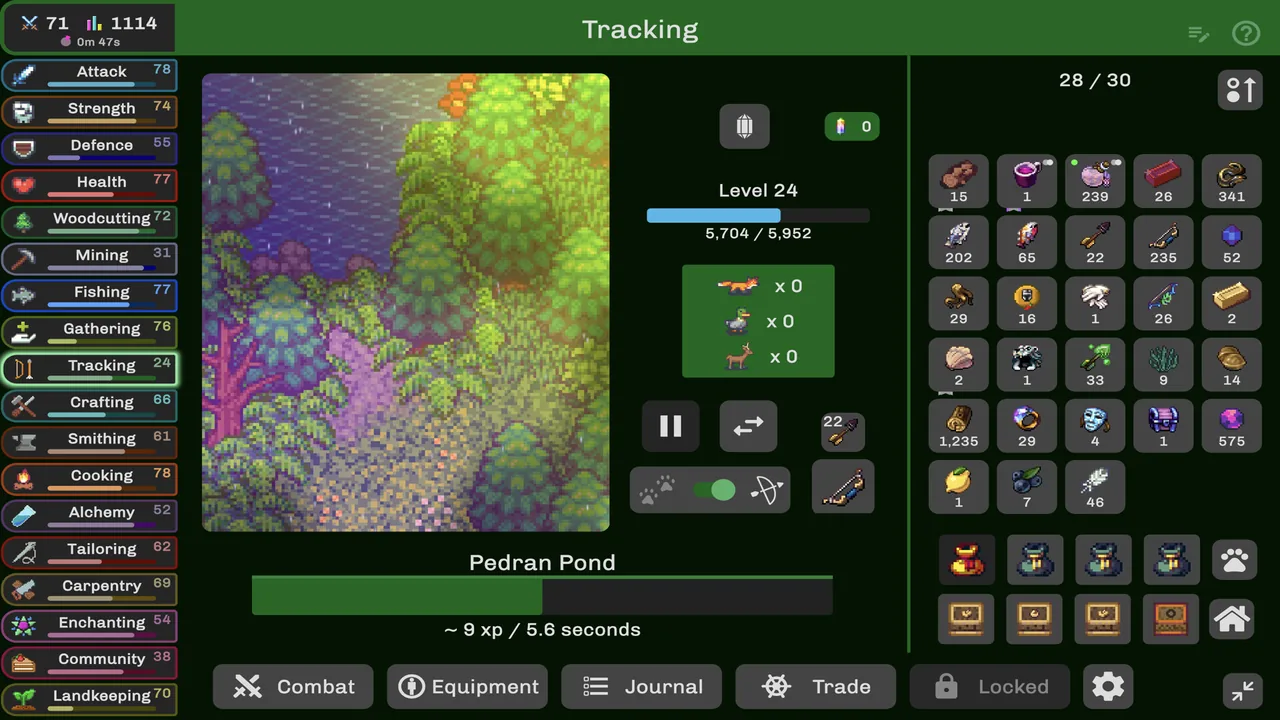
You start with nothing and pick a skill. Eighteen of them exist — woodcutting, mining, fishing, gathering, crafting, smithing, cooking, alchemy and the rest — and each one runs an action on a timer whether or not you're watching. Around them sit more than five hundred items, fifty-odd journal entries that function as quests, and a handful of minigames that break up the rhythm.
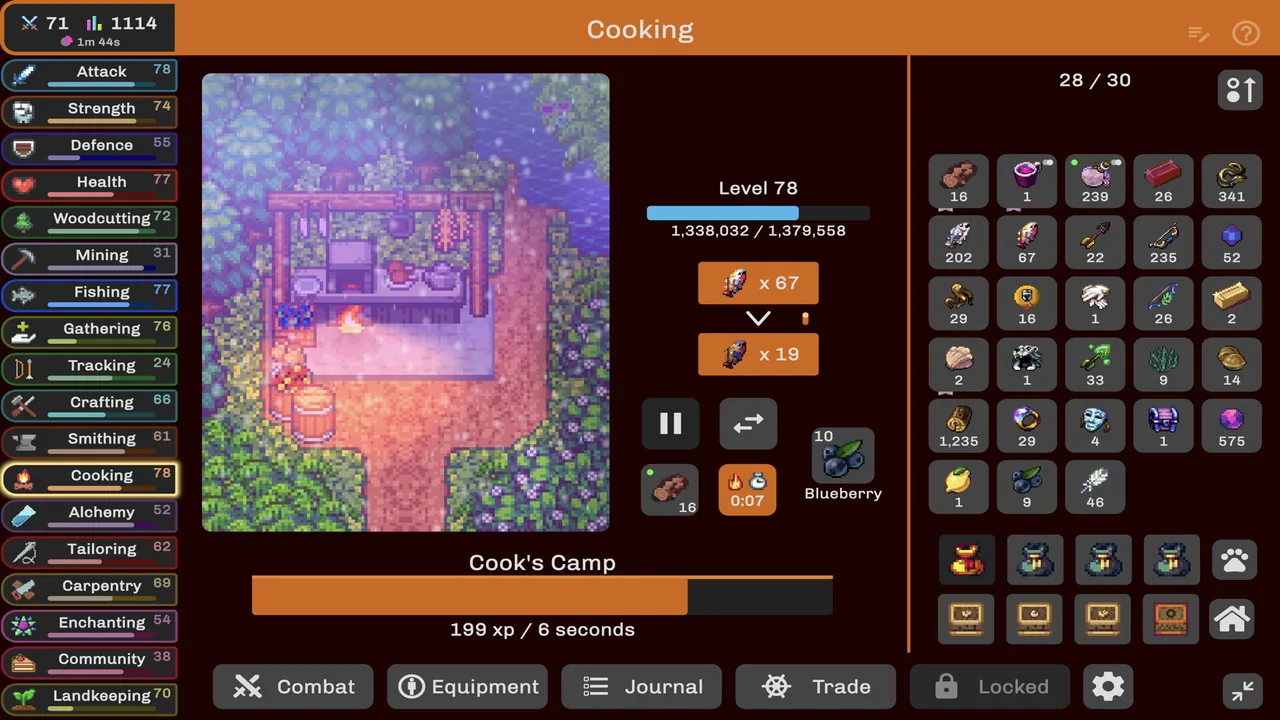
What separates it from the pile is that the skills are wired together. Higher fishing pulls better fish, better fish cook into better food, better food is what keeps you standing in a fight long enough to farm the drop you need for the next tier of gear. Pull on any thread and three others move. Plenty of idle games list a dozen skills; far fewer make you feel the consequences of neglecting one.
The drip-feed deserves credit too. New systems keep unlocking well past the point where most games in this genre have shown you everything they've got, and the reveals are paced rather than dumped. It's a slow game that keeps finding new ways to be slow at you, which sounds like an insult and isn't.
Combat is a logistics problem
Fights are resolved in the same background-tick way as everything else: critical hits, drop tables, food eaten between exchanges. There's no dodging, no positioning, no reaction test. What decides an encounter is whether you brought enough to survive it.
That makes combat a supply-chain question rather than a skill test, and it's the right call for a game you're meant to leave running. Even weak healing food stays useful as long as you have stacks of it, which quietly turns fishing and cooking into your combat build. Players who want tactics will find this thin. Players who enjoy solving a fight three skills earlier, at the smoker, will find it satisfying in a way that a combat log alone can't explain.
The flip side is that combat rarely surprises you. Once the loop is understood, the answer to a harder enemy is almost always more of the same, prepared better, and the game doesn't often challenge that assumption.
The offline question
Here's the part that decides whether you'll still be playing in a month.
Idle Iktah's free offline cap is four hours, extendable a little through equipment. The Golden Sunstone Status upgrade raises it to a full twenty-four and adds a Mastery Potion every twenty hours. On mobile there's a middle path — an optional ad restores full offline efficiency for a stretch, which is a fair enough trade and easy to ignore if you'd rather not.
Four hours is a strange number for a game whose entire pitch is that it respects your time. It covers a night's sleep badly and a working day not at all. Set a task before bed and you'll wake up to a game that stopped working hours ago, having quietly thrown away the part of the loop it sold you on.
None of this is predatory. There's no energy meter, no timer nagging you to come back, no premium currency laundering the price of anything, and the upgrade is a single one-off purchase rather than a subscription. But an idle game's core resource is hours away from it, and this one charges for them. That's a fundamentally different transaction from selling cosmetics or a supporter badge, and it's why an otherwise generous game keeps drawing the same complaint from its own players.
Judged on money alone, the deal is fine — around ten New Zealand dollars for permanent, meaningful quality of life in a game you may well play for a hundred hours. Judged on design, it puts the paywall on the one wall you'd rather it hadn't.
What Early Access still means here
The Steam build arrived in April 2026 and is still formally in Early Access, with the developer projecting six to twelve months in that state. This is not a fragile game — it's been live on mobile since October 2023 and has the version history of something well past its wobbly phase — so what "Early Access" buys here is content and balance rather than stability.
The friction that remains is the genre's usual: inventory pressure. Once a dozen near-identical materials are in play, the difference between two similar bars or two similar fish stops being obvious at a glance, and sorting and comparison become the thing you spend real attention on. It's a legibility problem more than a bug, and it's the most common thing players grumble about after the offline cap.
It's also completely single-player. No trading, no shared economy, no leaderboards worth chasing. For some people that's the appeal — nothing to keep up with. If you want your idle progress to mean something socially, this isn't it.
Presentation
Pixel art, small, tidy, unshowy. Idle Iktah isn't trying to be a looker and doesn't need to be: the readable icon grid and the calm colour palette are doing exactly the job a game you glance at twenty times a day needs done. The Pacific Northwest fauna and flora give the item lists a personality that "Copper Ore, Iron Ore, Mithril Ore" ladders never manage.
Technically it's featherweight — a gigabyte of storage, four gigabytes of RAM, Windows 10 or macOS 12 — so it runs on the old laptop in the drawer, and it's on both phone stores. Nineteen languages is generous for a studio this size.
Verdict
Idle Iktah is one of the best-constructed incrementals released in the last couple of years, and the one I'd hand to someone who says they don't like idle games. Its skill web has real consequences, its setting is more than wallpaper, and the free version is a complete game rather than a trailer with a shop attached.
It doesn't get a higher score because of where it put the price tag. When a game is designed around being closed, capping the closed-game hours at four and selling the other twenty is the one decision players will keep bumping into, and no amount of goodwill elsewhere quite smooths it over. The Early Access balance work and the inventory friction are fixable; the offline gate is a choice.
Play it free first. If it holds you for three days it'll hold you for three months, and at that point you'll know exactly what you're buying and why.
Prices and monetisation checked 29 July 2026.
If you like progression that keeps moving while the app is closed, that's the same itch Wanderer is built to scratch — though it puts its skills on one long road rather than in a grid.
Pros and cons
Pros
- Skills feed each other properly — better fishing means better cooking, which means surviving longer fights
- Content unlocks in a staggered drip, so new systems keep arriving hours after most idle games have shown their whole hand
- The Pacific Northwest setting, real tide tracking and moon-phase items give it a genuine identity
- The free build is the complete game, not a trial
- Runs on almost anything — a gigabyte of storage and 4GB of RAM
Cons
- The base offline cap of four hours is short for a game explicitly built to be left alone
- Raising that cap to a full day means buying the upgrade, which puts the central resource behind a paywall
- Inventory and equipment management get fiddly once several near-identical materials are in play
- Still Early Access on Steam, and the seams show in balance rather than stability
- Nothing social — no trading, no shared economy, no reason to care that anyone else plays it
Screenshots
-
Idle IktahImage: Grounded Games via Steam -
Idle IktahImage: Grounded Games via Steam -
Idle IktahImage: Grounded Games via Steam -
How the review scores each part of the gameWanderer Editorial -
The short versionWanderer Editorial