
Game review
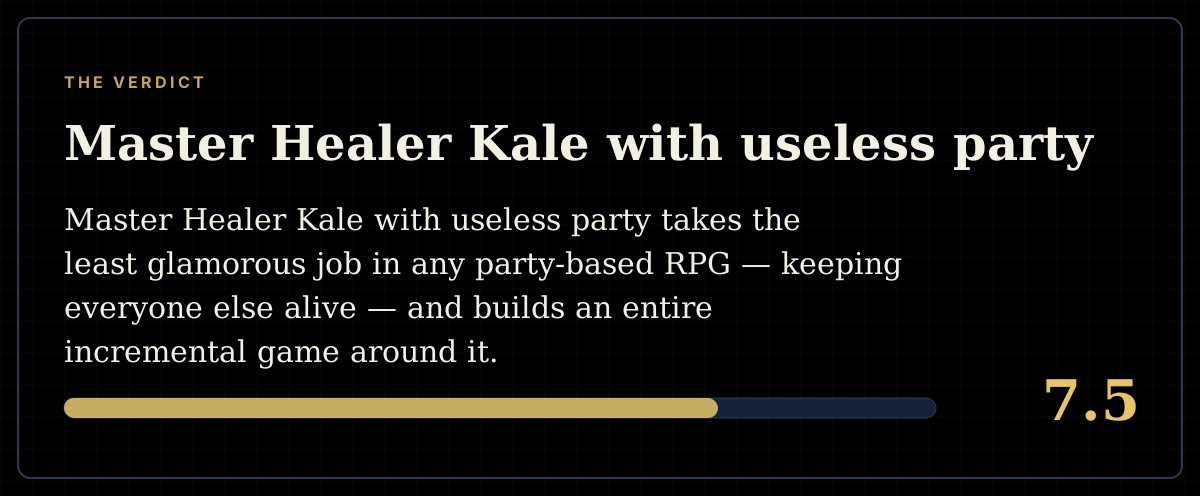
Master Healer Kale with useless party
7.5 / 10
- Developer
- Evrac Studio
- Publisher
- Evrac Studio
- Released
- 2 July 2026
- Platforms
- Windows, macOS
- Genre
- Incremental RPG
- Monetisation
- One-time purchase, no in-app purchases, no ads, no subscription
- Players
- Single-player only
The short version
Master Healer Kale with useless party takes the least glamorous job in any party-based RPG — keeping everyone else alive — and builds an entire incremental game around it. Kale is the only character you ever directly control, spending mana and cooldowns to patch up a tank who's perpetually half-asleep, a green archer and a magic user who's clearly the smartest person in the room and never lets anyone forget it, while a 200-plus node skill tree slowly turns healing spells into a real toolkit. It's a genuinely distinctive pitch, executed well for most of its short runtime, though the back stretch leans on padding and a handful of nasty bugs that a game this size shouldn't still be shipping with.
Biggest strengths
- Playing exclusively as the support role and never touching your own party's offense is a genuinely rare structure for an incremental RPG, and the skill tree commits to it rather than treating healing as a side stat
- Active spellcasting demands real attention to mana, cooldowns and timing rather than auto-resolving in the background, giving the "incremental" label actual teeth
- The bickering-party framing, with a tank who's always asleep and a mage who won't stop reminding everyone she's the smart one, gives 200-plus stat upgrades a sense of humour most skill trees don't bother with
Biggest weaknesses
- A late-game casting bug that freezes spells mid-animation shows up often enough in player reports to be a real risk on a fresh save, sometimes forcing a restart to clear
- Several of the 200-plus skill nodes are flat stat bumps rather than new decisions, and the tree's more interesting synergy upgrades are easy to miss because they sit beside a lot of filler
- The campaign is short enough, and some late dungeons repetitive enough, that a portion of players describe the ending as arriving before the systems have room to breathe
Who it's for: Incremental-game players who want their skill tree wired to actual moment-to-moment decisions rather than idle numbers ticking up, and anyone who's ever wanted the healer's chair in an MMO party without needing three other real people to show up.
Our recommendation: Worth the asking price for the novelty of its premise alone — just go in expecting a tight four-to-six-hour arc rather than a long-tail incremental, and be ready for the late dungeons to ask more patience of you than they do skill.
7.5 / 10
Party-based RPGs almost never let you play the healer and only the healer. You get the whole roster, or you get one fighter with a heal potion bound to a hotkey. Master Healer Kale with useless party does the opposite on purpose: you are Kale, self-declared best healer in the kingdom, and the rest of your party — a tank who spends more time asleep than upright, a green archer still learning which end of the bow to hold, and a magic user who is very possibly the strongest person in the room and will absolutely tell you so — fight entirely on their own initiative. Your job, for the whole game, is to keep them standing. It's a small, sharp premise, and the incremental structure wrapped around it takes that premise more seriously than most games in the genre take theirs.
Healing as the whole design, not a stat on a sheet
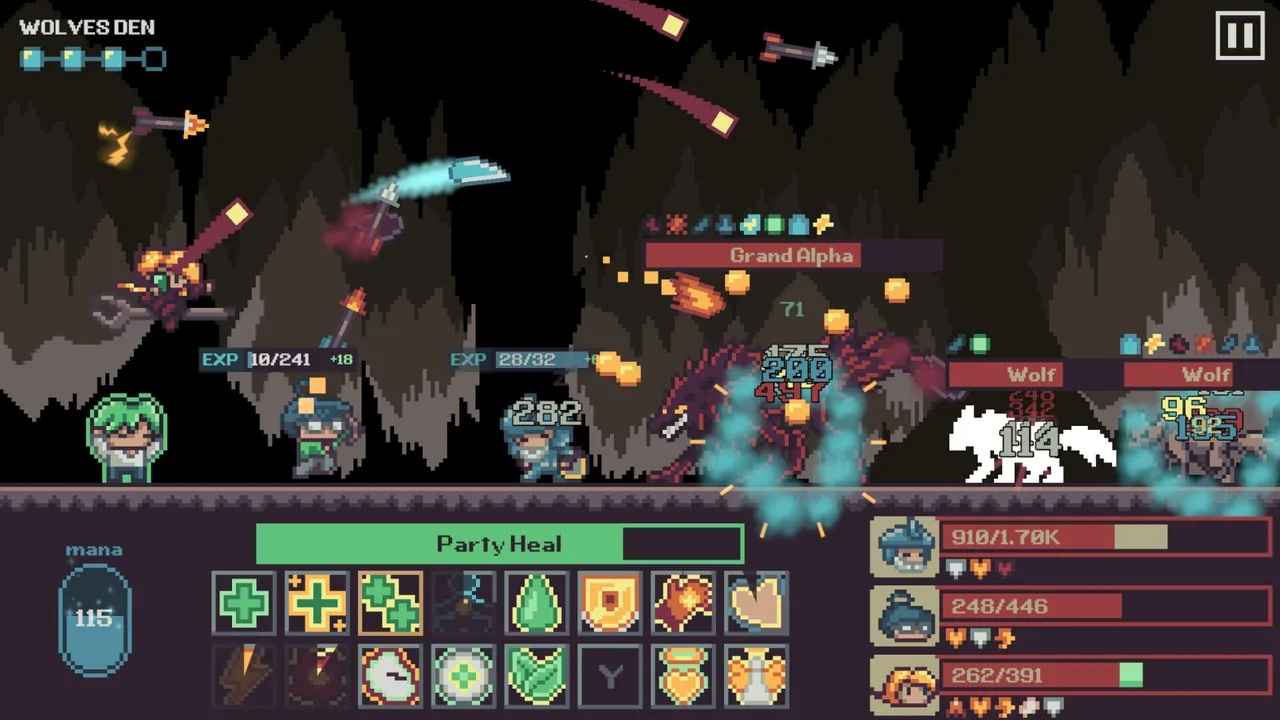
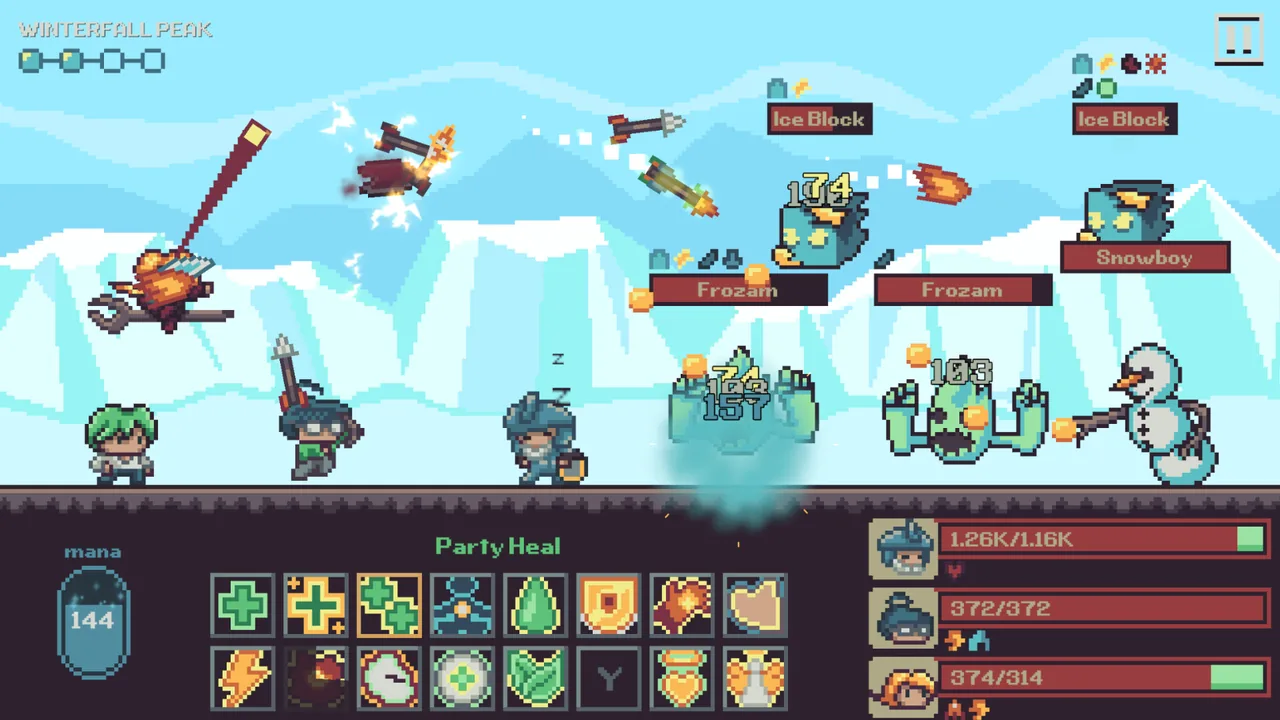
The core loop is simple to describe and less simple to execute well: your party auto-fights, you cast spells. Kale has an active kit that grows to eighteen spells across the campaign, and using it well means watching mana, tracking cooldowns and reading which party member is about to drop rather than clicking a "heal" button on autopilot. That's the detail that separates this from a lazier take on the same idea — the store page's "incremental" tag doesn't mean the fighting resolves itself while you watch. It means the numbers behind your spells grow between fights, while the fights themselves still ask something of you in the moment.
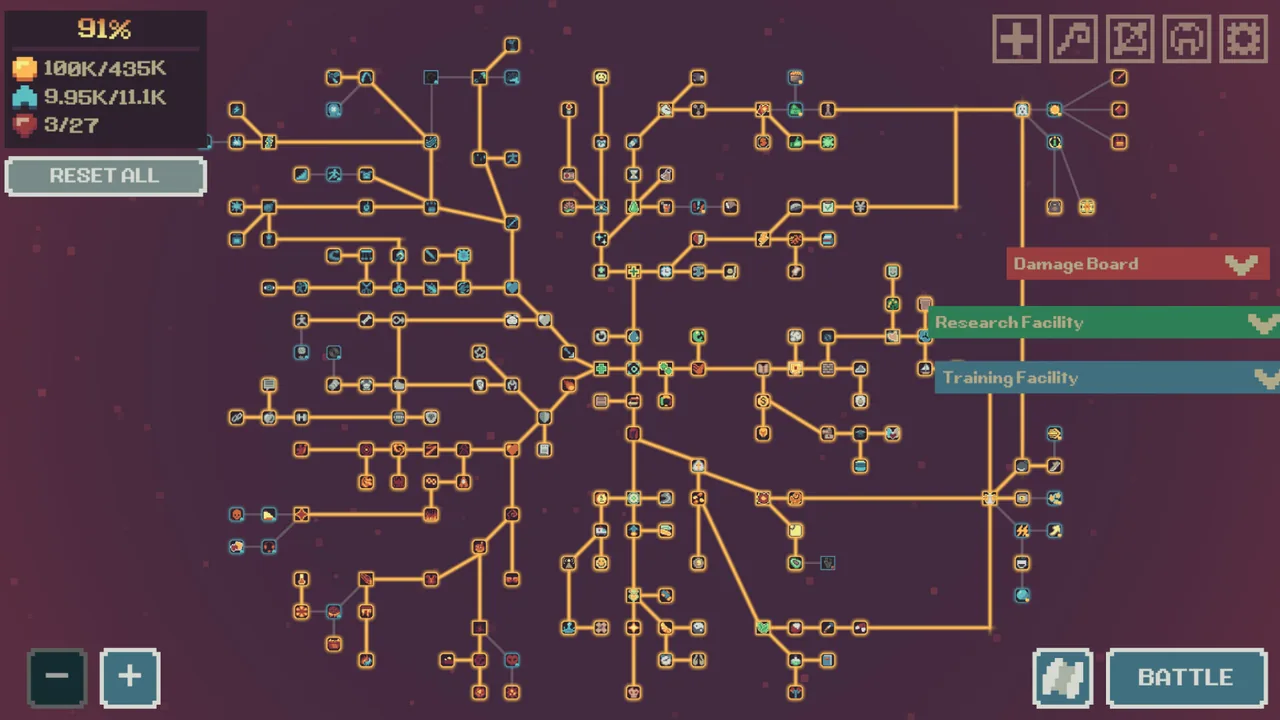
Layered on top of that loop is a skill tree that Steam's own reviewers keep describing as generous almost to a fault: over 200 nodes spanning healing potency, party damage, survivability and utility, spread across sixteen-plus dungeons. When it's working, the tree does what a good incremental skill tree should — it lets you lean into a playstyle, whether that's a pure-support build that keeps the party topped up indefinitely or a more aggressive build that trades some healing throughput for party damage buffs. Player feedback backs up that the tree "doesn't railroad you into a specific playstyle," which is a real compliment for a system with this many nodes to keep coherent.
Where the tree gets baggy
The trouble with 200-plus upgrades is that not all of them can matter equally, and Master Healer Kale doesn't fully solve that problem. A recurring note in player feedback is that a meaningful share of the tree is flat stat increases rather than new tools or synergies, and that the nodes worth genuinely planning around are sometimes tucked next to filler that looks identical on the tree's map. That's a discoverability problem as much as a balance one — the interesting build decisions exist, but the tree doesn't always signal which nodes are load-bearing and which are padding, and a UI that leans on dense upgrade text doesn't help players tell the difference at a glance.
It also means some players report reaching the credits without ever feeling forced to lean on healing at all — beating dungeons through party-damage stacking alone, which undercuts a game whose entire identity is "you are the healer." That's not the majority experience going by the overall review split, but it's a real crack in the premise for the build paths that lean hardest into offense over support.
Presentation and party banter
Visually, Master Healer Kale commits to a clean, expressive pixel-art style that carries its dungeons and character portraits well for a game of this scope, and the writing around the party's dynamic is doing more work than a short incremental RPG usually bothers with. The running joke of a tank who can't stay awake and a mage who won't let anyone forget she's the clever one gives the 200-plus stat upgrades a reason to exist beyond number-crunching — you're not just optimising abstractly, you're keeping a specific, mildly dysfunctional trio alive because you've grown fond of them by dungeon six or seven. The soundtrack is the weaker half of the presentation; it's serviceable rather than memorable, and its limited number of compositions becomes noticeable well before the campaign ends.
Length, difficulty and the late slog
Designed to be finished in around four hours, Master Healer Kale is upfront about being a short, complete experience rather than a long-tail incremental you leave running for weeks. For most of that runtime the pacing holds up. Where it strains is in the closing dungeons, where difficulty spikes and enemy-imposed complications — mana drains, extended cooldowns, tighter healing windows — arrive faster than the skill tree hands out the tools to answer them. A recurring complaint describes the late game as a slog: real playtime invested for incremental, hard-to-feel gains, which is a rough note to end on for a game whose opening hours are genuinely tight.
Nightmare Mode, offered as the post-campaign hook, raises the difficulty rather than adding new content to master it, and a share of players who've cleared it describe that as a thin reward for finishing the base game — more an endurance test than a reason to replay. Combined with the short main campaign, replayability is the category where this game has the least to offer.
Stability and rough edges
The most serious complaints in negative Steam reviews aren't about balance — they're about a casting bug that can freeze a spell mid-animation in certain late-game dungeons, sometimes requiring a full restart to clear. It doesn't appear to hit every player, but it shows up often enough across reports to be worth knowing about going in, especially since the game also lacks cloud saves, so a crash or a forced restart can cost more progress than it should. A missing pause function is a smaller but stranger omission for a game that otherwise supports controllers, touch-only play and custom volume controls — accessibility features that suggest real care went into the release, which makes the pause button's absence more conspicuous rather than less.
Value and monetisation
There's nothing to complain about on price. NZ$6.39 for a complete, self-contained campaign with no in-app purchases, ads or premium currency is a fair deal even before factoring in the positive reception, and the achievement list and Nightmare Mode give completionists a reason to stay past the credits without the game ever asking for more money to do so. For a genre where "incremental" often doubles as code for an energy-timer monetisation model, Master Healer Kale's flat, honest pricing is worth calling out on its own merits.
Final verdict
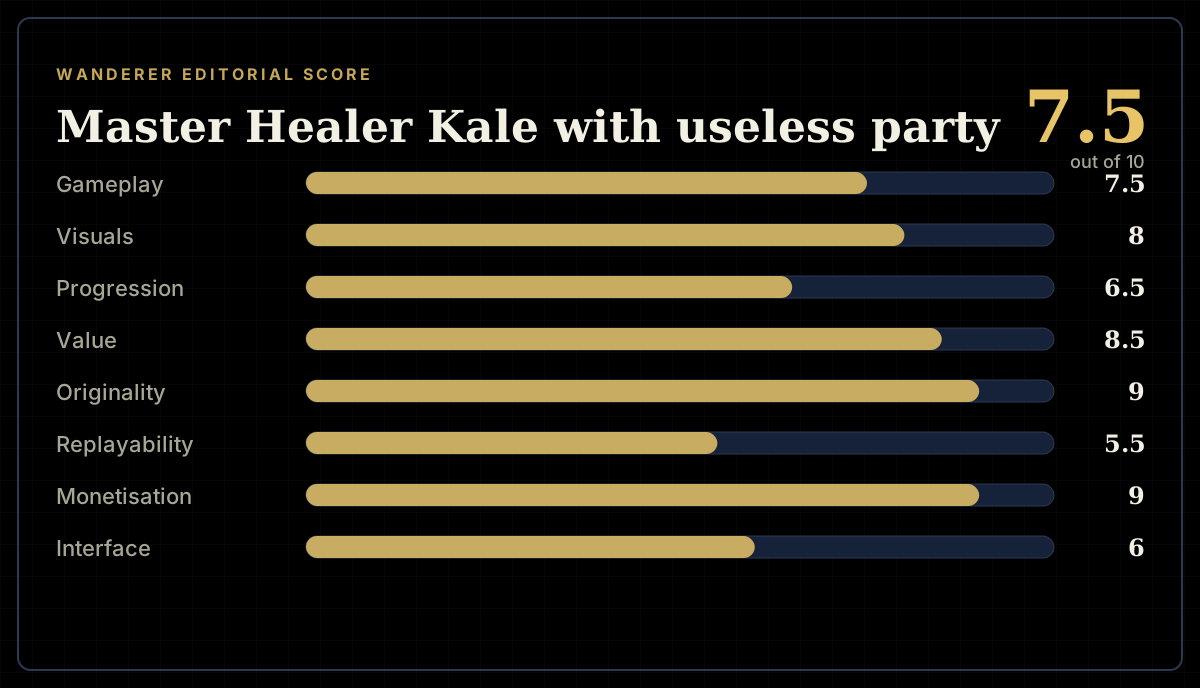
Master Healer Kale with useless party succeeds at the thing it set out to do: make healing the whole game, not the support act, and back that idea with a skill tree deep enough to reward actually thinking about it. The party banter gives the grind a personality, the active-casting combat keeps the "incremental" label honest, and the price makes it an easy pick for anyone curious about the premise. It doesn't climb higher than a 7.5 because the tree's depth is diluted by filler nodes, the closing dungeons ask for patience the systems don't quite reward, and a still-unresolved casting bug is a rough thing to hit near the end of an otherwise tight four-hour game.
Recommended for incremental fans who want their skill tree tied to real split-second decisions, and for anyone who's ever wanted to main-heal without needing a full party of other people to show up on time.
Players who'd rather that same healer instinct run a persistent, always-on world instead of a four-hour campaign might also want to look at Wanderer.
Pros and cons
Pros
- Playing exclusively as the support role and never touching your own party's offense is a genuinely rare structure for an incremental RPG, and the skill tree commits to it rather than treating healing as a side stat
- Active spellcasting demands real attention to mana, cooldowns and timing rather than auto-resolving in the background, giving the "incremental" label actual teeth
- The bickering-party framing, with a tank who's always asleep and a mage who won't stop reminding everyone she's the smart one, gives 200-plus stat upgrades a sense of humour most skill trees don't bother with
- A one-time NZ$6.39 purchase with no in-app purchases, ads or energy-refill store, appropriate for a game explicitly designed to be finished rather than farmed indefinitely
- 96% of Steam's user reviews are positive across more than a thousand ratings, an unusually strong showing for a debut-scale indie incremental
Cons
- A late-game casting bug that freezes spells mid-animation shows up often enough in player reports to be a real risk on a fresh save, sometimes forcing a restart to clear
- Several of the 200-plus skill nodes are flat stat bumps rather than new decisions, and the tree's more interesting synergy upgrades are easy to miss because they sit beside a lot of filler
- The campaign is short enough, and some late dungeons repetitive enough, that a portion of players describe the ending as arriving before the systems have room to breathe
- Nightmare Mode, the game's answer to replayability, adds difficulty without adding much new to actually do, which undercuts its appeal as a reason to start a second run
- No pause function and no cloud save support are unusual omissions for a 2026 premium release, even a short one
Screenshots
-
Master Healer Kale with useless partyImage: Evrac Studio via Steam -
Master Healer Kale with useless partyImage: Evrac Studio via Steam -
Master Healer Kale with useless partyImage: Evrac Studio via Steam -
How the review scores each part of the gameWanderer Editorial -
The short versionWanderer Editorial