Game review
Candy Box 2
7.5 / 10
- Developer
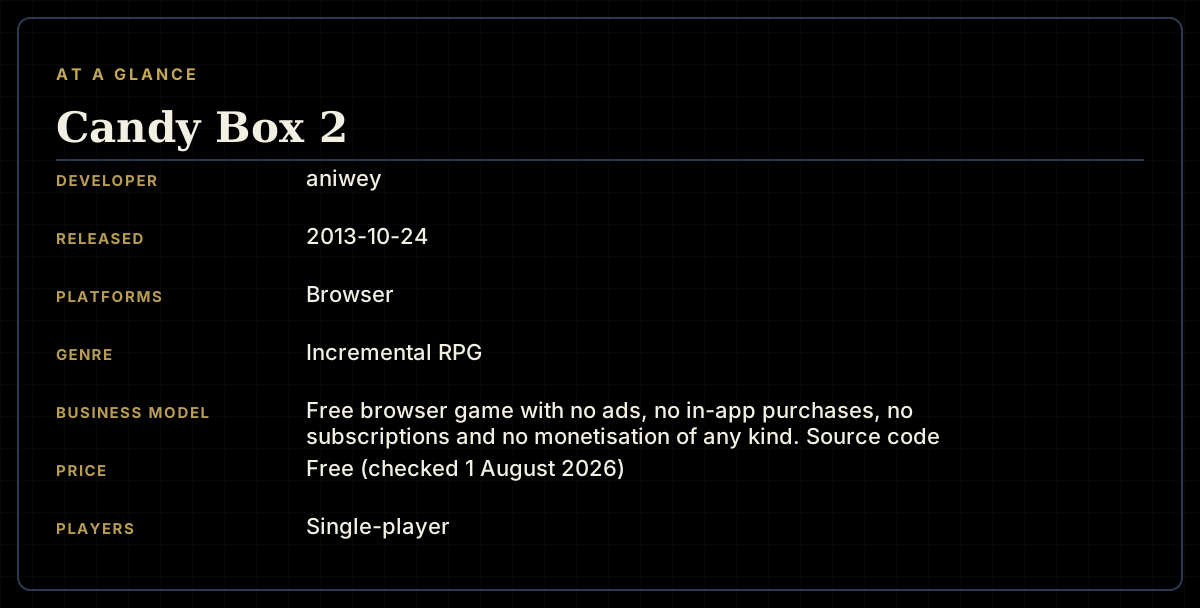
- aniwey
- Released
- 24 October 2013
- Platforms
- Browser
- Genre
- Incremental RPG
- Monetisation
- Free browser game with no ads, no in-app purchases, no subscriptions and no monetisation of any kind. Source code has been publicly available under a GPLv3-or-later licence on GitHub for years.
- Players
- Single-player
The short version
Candy Box 2 opens on a single number and a single button, exactly like the genre's other famous minimalist trick, A Dark Room. Where it goes next is different: instead of building toward one authored story with a real ending, it unpacks into a sprawling, comedic RPG — a shop, a map, an inventory, weapons, spells, bosses — that never once tells you it's there. Almost none of it is idle. Once the shop appears, the candy counter stops mattering and the actual game, an exploration-and-combat RPG wearing an incremental's clothes, takes over completely.
That concealment is also the review's central problem. Several of the best moments require outside knowledge the game itself refuses to provide, and the developer's own FAQ tells stuck players to ask a friend or check the wiki rather than look harder. In 2013 that was a reasonable bet — Candy Box 2 launched into an internet still built around active forums swapping discoveries in real time. In 2026 that context is mostly gone, and what's left is a very good free RPG that periodically stops being solvable without a browser tab you shouldn't need.
Biggest strengths
- The shop, map, quests, weapons and spells all unlock silently, so every new button feels found rather than handed to you
- Exploration and turn-based-style combat are the actual game, giving it far more RPG substance than its reputation as a clicker suggests
- A genuine 36-track composed soundtrack scores individual areas and bosses, unusually generous for a free ASCII browser game
Biggest weaknesses
- Several late-game item locations and fights give no in-game clue at all, and the developer's own FAQ points stuck players to the wiki instead of the game
- Once a puzzle or boss's specific trick is known from a guide, there's little reason to solve it again on a second run
- The opening one-candy-per-second trickle undersells how much active exploring, fighting and inventory juggling the game eventually demands
Who it's for: Players who enjoy figuring out a game's systems by poking at everything rather than reading a tutorial, and anyone curious where a chunk of the modern incremental genre's DNA actually comes from.
Our recommendation: Play it for free at candybox2.github.io and resist opening a wiki for as long as you can stand it — the first hour of genuine surprise is the best thing here. Once you're stuck on something with zero in-game clues, looking it up isn't cheating; the developer built the game assuming you would.
7.5 / 10
Most incremental games tell you what they are within the first ten seconds: here is your resource, here is what you're building toward, here is the number that will eventually be very large. Candy Box 2 tells you almost nothing. It opens on a candy counter ticking up by one per second and a single line of grey text, and every subsequent piece of the game — a shop, a wishing well, a lute you can play, a village you can walk to, an entire continent with quests, weapons, monsters and spells — arrives without a headline, an unlock notification or so much as a hint that it was coming. That refusal to narrate itself is the whole design, and thirteen years after aniwey, then a 19-year-old French student, released it as a sequel to his own earlier hit, it's still one of the clearest examples of a free browser game using concealment as a mechanic rather than a marketing trick.
A shop, a map and an RPG nobody told you about
The through-line from Candy Box's original candy-and-lollipops loop is still there at the start — plant lollipops, sell them, watch the counter climb — but Candy Box 2 uses that familiar opening as cover for something much bigger. Within the first real session the game reveals a shop selling gear, a wishing well that enchants items you throw into it, and eventually a full world map with deserts, caves, bridges and a village to explore. From there it becomes a genuine RPG: quests hand out weapons and companions, a grimoire opens a full spellcasting system, and combat against named bosses (a troll, an octopus king, a wizard, eventually a small pantheon of much nastier things) becomes the actual content loop. None of this is signposted before it appears. The game doesn't even tell you that it's about to change shape — you simply notice a new button sitting where one wasn't a minute ago.
It's worth being plain about what this means for anyone arriving from the idle-game side of the genre expecting more of the same: Candy Box 2 is barely an idle game at all. The passive candy trickle exists to get you through the first few minutes and to fund a couple of early purchases, and after that it's essentially irrelevant. The rest of the game — sometimes many hours of it — runs on active exploration, active fighting and active inventory management. If you came here looking for something that plays itself while you're away, you're in the wrong browser tab. What you get instead is one of the more expansive free RPGs to ever masquerade as a clicker.
Concealment that assumed you weren't playing alone
Judged purely as a hook, hiding the entire game behind an unremarkable opening screen is a genuinely good idea, and it's easy to see why the trick got imitated. The problem is that Candy Box 2 doesn't just withhold information the way A Dark Room does — it withholds it with essentially zero in-game recourse for a player who's stuck. Certain items sit under a specific tree on the map, or inside a cabinet in an empty house, or under a carpet, with nothing pointing at any of it. Certain fights are tuned around gear or spells you'd have no reason to suspect exist yet. There is an entire secret boss fight, added as a joke, built around the developer character himself, that a solo player has essentially no way of stumbling into on purpose. Ask the game's own FAQ what to do when you're stuck and the answer, in aniwey's own words, is to ask a friend or check the wiki — not a hint system, not an in-game nudge, an explicit redirect outside the game entirely.
That's a defensible design choice for the internet Candy Box 2 launched into. In late 2013 the game spread through exactly the kind of forums and comment threads where that redirect was frictionless — someone else had already found the chocolate bar under the tree and posted about it an hour earlier. Playing it cold in 2026 is a different experience: the forums have mostly gone quiet, and what's left is a static community wiki standing in for a conversation that used to happen in real time. The concealment hasn't changed. The safety net underneath it has mostly disappeared. That doesn't make the trick a bad idea — the joy of clicking on something you had no reason to click on and having it work is real, and it's the reason this game is still talked about — but it does mean judging it today has to account for a gap the design was never built to survive alone.
Plain text, and what it can't show you
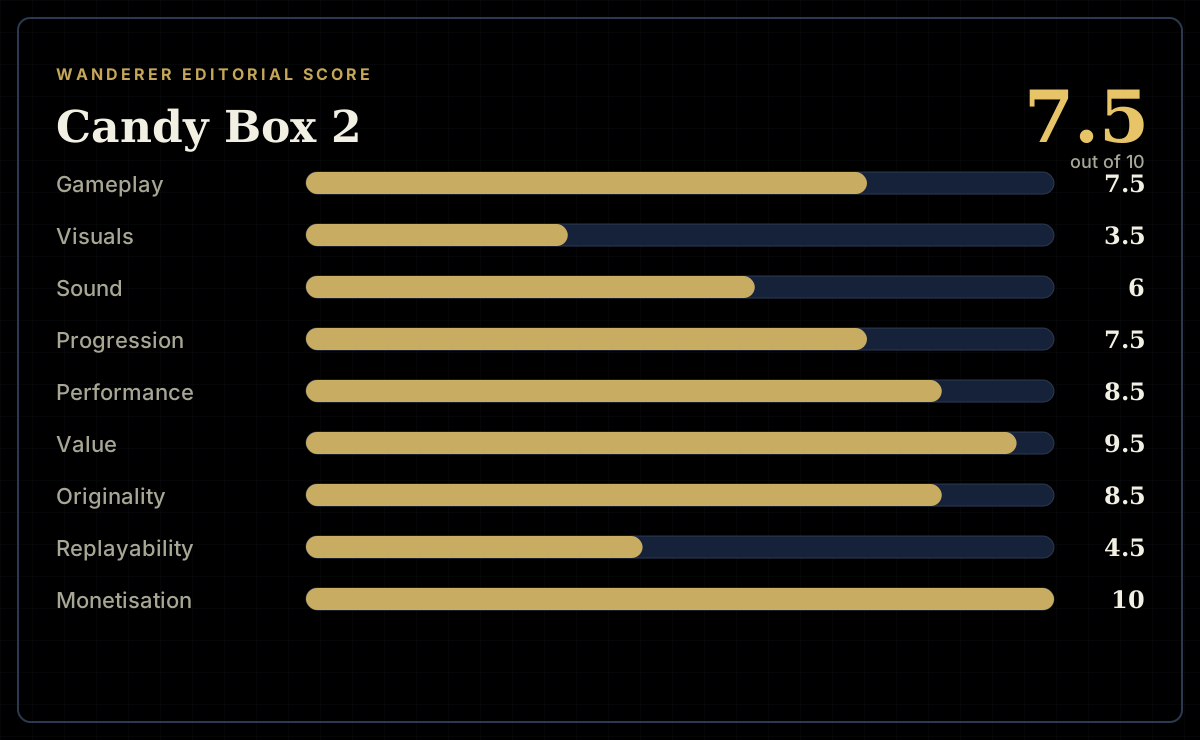
Visually, Candy Box 2 asks for nothing: coloured monospace text, simple ASCII layout, no illustration to speak of. That's the same trade-off A Dark Room and Kittens Game both make, and it works for a similar reason — a text interface can describe anything without having to draw it, which is how a game built by one person manages a whole continent, a bestiary and a wardrobe of gear without an art budget. The cost is specific to combat: there's no health bar telegraphing when a fight is about to turn, no animation cueing a dangerous attack, just numbers changing in a paragraph you have to actually read. It works well enough for the RPG layer to function, but it flattens tension in a way a hostile encounter in a game with even minimal visual feedback wouldn't be flattened.
What genuinely surprised us going back through this one is the sound. Composer Cory Pelizzari built a full, 36-track score for the game — tied one-to-one to specific areas and bosses, right down to a proper set of end-credits music — which is a level of composed audio almost nothing else this stripped-down bothers with. It's not going to out-atmosphere a game built around dread the way A Dark Room's ambient cues do, but it's more than most free ASCII games manage, and it quietly does a lot of work making individual areas feel distinct from one another when the text describing them often isn't.
What it actually left behind
Candy Box's influence gets asserted a lot and specified rarely, so it's worth being concrete about where it actually shows up. Orteil has said directly that Cookie Clicker's core mechanic — click to generate a resource, spend that resource on producers that generate more of it automatically — grew out of the lollipop farm in the original Candy Box, not as a vague inspiration but as the specific system he built on top of. IGN grouped Candy Box alongside A Dark Room and Cookie Clicker as the three games that put the incremental genre on the map in the same stretch of 2013, and the Academy of Interactive Arts & Sciences nominated it for Casual Game of the Year that same year. What it handed the genre wasn't a UI convention or a reset button — those came from elsewhere — it was the idea that a browser game could be free, could look like almost nothing, and could still be worth building a wiki around. Cookie Clicker inherited the mechanic. A decade of free incrementals inherited the model of distribution and the assumption that players would do some of the explaining for the developer.
Free, unmaintained and exactly as it was
The value case here is about as clean as this genre gets: Candy Box 2 has never charged for anything, has never run an ad, and the source code has sat publicly available under a GPLv3-or-later licence for years. There's no premium currency, no cosmetic shop, no donation prompt interrupting play. It's also, by design, done growing — the repository shows nothing but translation contributions, the occasional typo fix and a recent migration to modern hosting infrastructure; the last substantive gameplay change was long ago. That's not a criticism so much as an honest description: this is a finished, thirteen-year-old free game, not a live service, and it plays today exactly as it played in 2013, for better and worse.
Verdict
Seven and a half out of ten. Candy Box 2 earns its reputation honestly — it's a genuinely large, genuinely funny RPG hiding inside what looks like a joke of a webpage, and the moment a shop or a map quietly appears where nothing was a second ago still lands, even now. It's more ambitious in scope than A Dark Room, with a far wider cast of systems, weapons and bosses to work through, and it costs nothing at all to find out for yourself.
It doesn't reach A Dark Room's score because A Dark Room's withholding serves one coherent idea all the way to a real ending, while Candy Box 2's withholding is looser, funnier and considerably less self-sufficient — several of its best moments are only findable with outside help the game explicitly tells you to go get, and that's a heavier ask now than it was when the forums doing that work were still active. Go in prepared to look things up without guilt, and what's left is still one of the most generous free RPGs a browser has ever run, and a clear ancestor of games far bigger than it. Players who enjoy a world that keeps quietly layering new systems on top of what looked like a simple opening screen will recognise the appeal — it's the same instinct Wanderer's own gear and profession trees lean on, just with a lot more secrecy about when the next layer shows up.
Pricing and repository activity checked 1 August 2026.
Pros and cons
Pros
- The shop, map, quests, weapons and spells all unlock silently, so every new button feels found rather than handed to you
- Exploration and turn-based-style combat are the actual game, giving it far more RPG substance than its reputation as a clicker suggests
- A genuine 36-track composed soundtrack scores individual areas and bosses, unusually generous for a free ASCII browser game
- Completely free with no ads, no purchases and no monetisation of any kind, and the source has been public under GPLv3 for years
- Runs instantly in any browser with no install and negligible hardware demands, exactly as it did in 2013
Cons
- Several late-game item locations and fights give no in-game clue at all, and the developer's own FAQ points stuck players to the wiki instead of the game
- Once a puzzle or boss's specific trick is known from a guide, there's little reason to solve it again on a second run
- The opening one-candy-per-second trickle undersells how much active exploring, fighting and inventory juggling the game eventually demands
- Presentation is plain text throughout, so combat and status information depend entirely on careful reading rather than any visual feedback
- The project has had no real content added in over a decade, only translation fixes and hosting changes, so anything that frustrated players in 2013 still does
Screenshots
-
How the review scores each part of the gameWanderer Editorial -
The game at a glanceWanderer Editorial -
The short versionWanderer Editorial