Game review
NGU Industries
6 / 10
- Developer
- 4G
- Publisher
- 4G
- Released
- 5 April 2021
- Platforms
- Windows, Mac
- Genre
- Idle Factory Manager
- Monetisation
- Free to play, with an optional premium-currency Sellout Shop (Arbitrary Points) that is also earnable through normal play
- Players
- Single-player
The short version
NGU Industries takes the one thing NGU Idle never tried — spatial logistics, buildings you place and connect rather than bars you fill — and builds a genuinely interesting factory-idle hybrid out of it: material chains, work orders, research experiments, all wearing the same self-aware humour as its predecessor. For about six weeks in the spring of 2021 that was the whole story.
It hasn't meaningfully continued since. The developer's own Early Access pitch promised 12 to 24 months before a full release; Steam's own storefront now flags that the last update landed over five years ago, and the Farming feature the developer described as "partially implemented" in 2021 is still exactly that today. What's playable is free, competently built and not remotely finished, and there's no evidence it ever will be.
Biggest strengths
- Building placement and material routing give the idle loop a genuine spatial puzzle that NGU Idle never had
- Work Orders and the Experiments lab layer real optimisation decisions on top of simple production chains
- Completely free with an earnable premium currency, matching NGU Idle's clean monetisation model exactly
Biggest weaknesses
- No developer update has shipped since May 2021, and Steam's own store page now flags the stall directly
- The Farming system was described as partially implemented at launch and remains that way, with no path to completion in sight
- Progression eventually runs into the edge of what was ever built, rather than a designed endgame
Who it's for: Idle-factory fans curious about a free, several-hours-deep systems game who can accept going in that it stopped mid-sentence — not anyone hoping for the still-updating game NGU Idle turned into.
Our recommendation: Worth an afternoon if factory logistics interest you more than combat and rebirth math, and it costs nothing to find out. Don't go in expecting the farming loop to ever finish, or for anything past the current build to arrive.
6 / 10
Every sequel makes a bet about what its audience actually loved. NGU Idle's fans could have loved the toilet humour, the rebirth math, or the fact that a decade of updates never really stopped. NGU Industries bets on none of those directly — it keeps the humour, drops the rebirth structure almost entirely, and replaces it with something NGU Idle never attempted: a factory you build with your hands, tile by tile, instead of a stat sheet you train. That's a genuinely bold pivot for a sequel to make. The trouble is that the bet stopped paying out in the spring of 2021, and the game has been sitting exactly where it landed ever since.
Buildings instead of bars
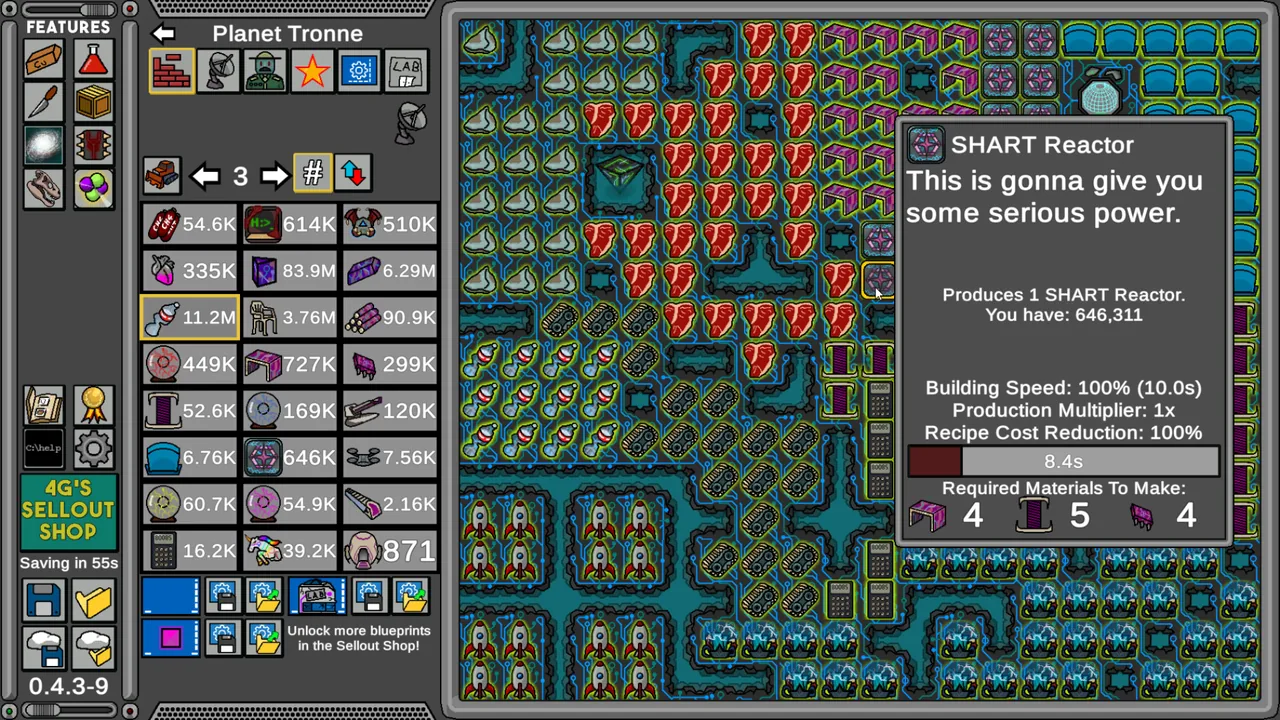
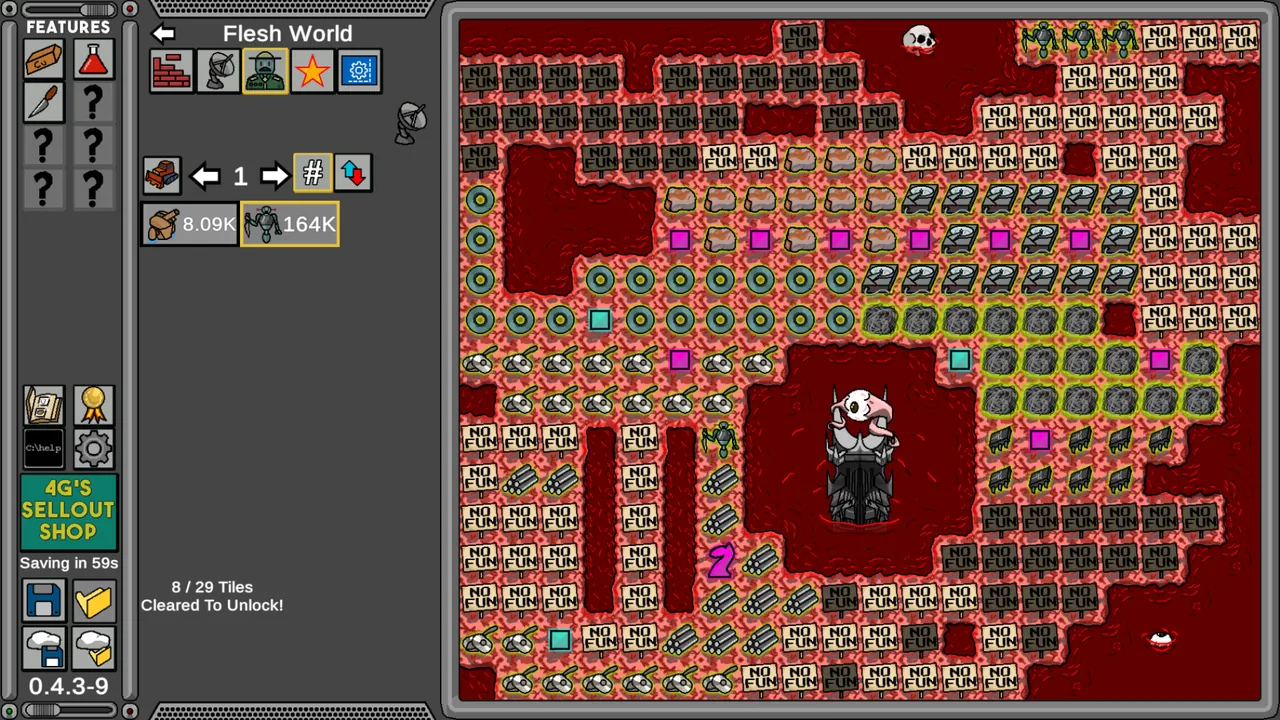
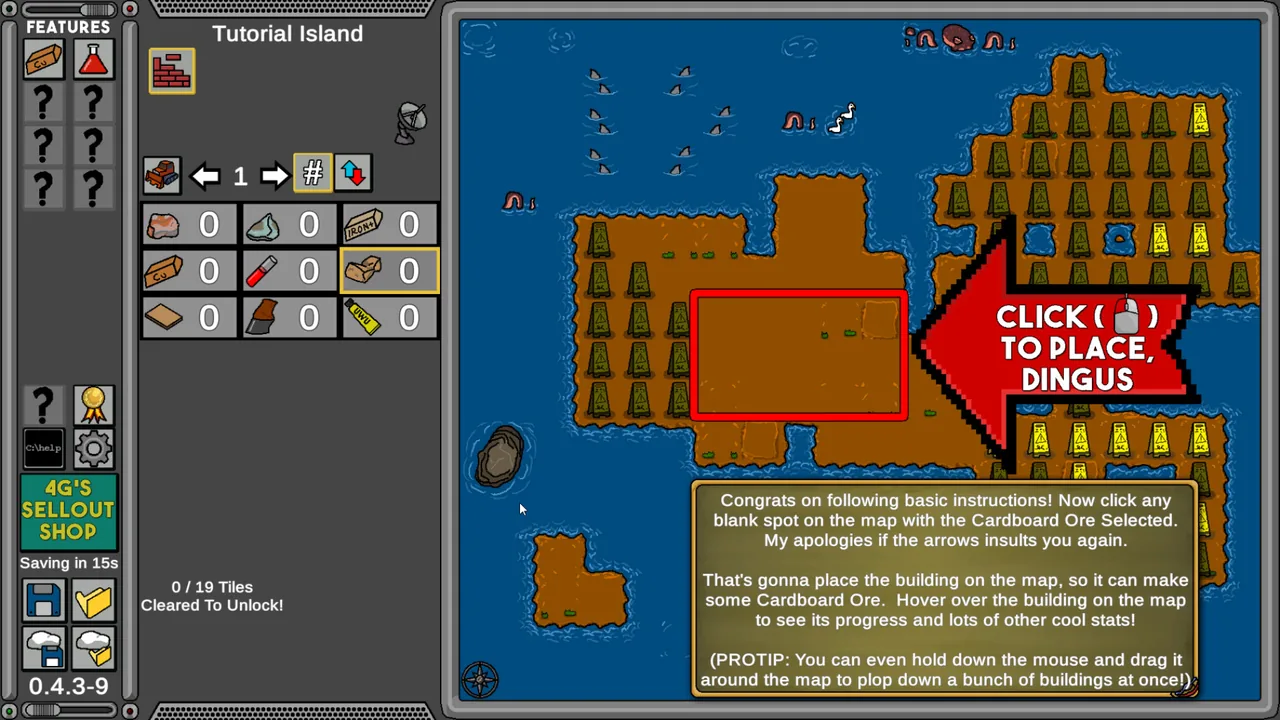
Where NGU Idle hands you a training bar and asks you to watch it fill, NGU Industries hands you an empty plot and a blueprint menu. You place production buildings, connect them to move raw materials — hundreds of hand-drawn ones, from ordinary ore to the game's own running joke of a gun-toting Buttbot — into finished goods, and slot down beacons and army units to defend and boost the layout as it grows. It's a real spatial puzzle rather than a purchase list: where you put a building and what it's next to changes how efficiently the whole factory runs, and reworking a cramped layout later is exactly the kind of optimisation problem factory-idle fans show up for.
Two systems sit on top of the base loop and do the most to make it feel like a designed game rather than a tech demo. Work Orders convert your production into discrete goals with their own rewards, giving the idle sprawl an actual sense of direction instead of just watching numbers climb. The Experiments lab lets you research permanent bonuses that feed back into the factory, which is the closest thing NGU Industries has to NGU Idle's layered permanence — progress that survives a reset and compounds. Character encounters scattered through the game, fighting everything from demons to spaceships, add a light combat layer without turning the whole thing into Adventure mode's dungeon crawl. None of it is groundbreaking on its own — factory-idle hybrids like Cell: Idle Factory Incremental cover similar ground — but building it around NGU's established comic voice and material-chain silliness gives it a personality most factory-idlers don't bother with.
The wall the developer built and never finished
Here's where the review has to stop describing systems and start describing their absence. NGU Industries launched into Early Access on 5 April 2021 with a developer FAQ that promised "about 12-24 months" before the training wheels came off — described, in the same self-deprecating voice as everything else in the game, as the point where "I will put the big boy pants on NGU INDUSTRIES." That FAQ also laid out the state of the build at launch: Factory, Work Orders and Experiments fully implemented, Farming "in a more partially implemented state."
That sentence is still accurate today, five years later, because nothing about the build has changed. The developer's own update history stops at a hotfix dated 11 May 2021, five weeks after launch. Steam's storefront doesn't bury this — it flags directly on the store page that the last developer update landed over five years ago, which is about as unambiguous a signal as a platform gives that a project has stalled. Farming remains the unfinished feature it was described as at launch. There's no evidence anywhere in the update history, the store page or the review threads of work resuming.
Player sentiment tracks this closely, and not just from a handful of loud complainers. Reviews posted well into 2022, 2023 and 2024 keep landing on the same word — abandoned — often from players who otherwise liked what they'd played and are frustrated specifically that it stopped rather than that it's bad. A few are unusually generous about it, framing years of silence as understandable solo-developer burnout on a project offered for free; more treat the lack of communication as the actual problem, separate from the quality of what shipped. Either read leads to the same practical conclusion: this is not a game in active development, whatever its Early Access tag still claims.
Value and monetisation
To 4G's credit, none of this comes with a financial trap attached. NGU Industries is entirely free, same as NGU Idle, and its premium currency — Arbitrary Points, spent in the returning Sellout Shop — is earnable through ordinary play rather than gated behind a price. There's no energy system, no ad interruptions, no pressure mechanic pushing you toward the shop. Whatever else is true about the state of the project, nobody loses money finding out whether they like it, and nothing purchasable substitutes for actually playing the factory loop. That's the one area where the sequel matches its predecessor's reputation without qualification.
The catch is that "free" only stretches so far as an excuse. A finished game that asks for money earns more slack for rough edges than a free one does, and a free game that simply stopped still costs players the hours they spend learning systems that will never be built on. Value here isn't zero — the systems that exist are competently made and several hours deep before they run out of new ideas — but it's a bounded, static kind of value rather than the growing one NGU Idle still offers a decade in.
Presentation
Visually, this is a clear step up from the original: the hand-drawn material and building art has more personality and cleaner readability than NGU Idle's UI ever managed, and the dev's promise of "improved graphics" is one of the few Early Access claims that actually held up. The writing keeps the same pun-heavy, self-aware tone — the Sellout Shop calling itself exactly that, buildings and materials with names built entirely around bad jokes — which will land the same way it does in NGU Idle: either you find it charming or you find it grating within the first hour, and nothing about the sequel changes which camp you're in.
Verdict
Judge NGU Industries purely on the systems it shipped and it's a genuinely interesting pivot — a factory-logistics idle game with real spatial decisions, built by the same developer whose rebirth math in NGU Idle earned nearly eleven thousand overwhelmingly positive reviews. Judge it as a product currently offered to players, with an Early Access tag implying ongoing development, and it's something closer to a tech demo that got frozen mid-build: one system left visibly unfinished, zero updates in over five years, and a store page that says as much outright. Both of those things are true at once, and neither cancels the other out.
That split is why this doesn't score in NGU Idle territory. The core loop works, it's free, and it doesn't punish anyone for trying it — that's worth a few hours to anyone who likes factory-idle design more than combat and rebirth math. But a game that stops delivering new systems the moment you've learned the old ones, with no endgame the developer ever intended to be an endgame, caps out well below "excellent" regardless of how clean the free-to-play model is. Players who bounced off NGU Idle's opacity won't find this an easier way in — it trades one kind of demanding design for a different, shorter one that simply ends. Players who loved NGU Idle specifically for its decade of continuous updates should know going in that its sequel doesn't share that trait, at least not yet, and arguably not ever.
Pricing, monetisation and Early Access status checked 30 July 2026.
Readers who want a similar production-chain itch without the risk of it stalling mid-build might prefer our review of Cell: Idle Factory Incremental, or NGU Idle itself, still the more reliably maintained half of this studio's catalogue.
Pros and cons
Pros
- Building placement and material routing give the idle loop a genuine spatial puzzle that NGU Idle never had
- Work Orders and the Experiments lab layer real optimisation decisions on top of simple production chains
- Completely free with an earnable premium currency, matching NGU Idle's clean monetisation model exactly
- Hand-drawn material and building art reads as a clear visual step up from the original game
- The writing keeps the same self-aware, joke-heavy tone that carried NGU Idle for a decade
Cons
- No developer update has shipped since May 2021, and Steam's own store page now flags the stall directly
- The Farming system was described as partially implemented at launch and remains that way, with no path to completion in sight
- Progression eventually runs into the edge of what was ever built, rather than a designed endgame
- A large share of recent user reviews are specifically about abandonment rather than the systems themselves
- No browser version exists, unlike NGU Idle, so there's no lower-commitment way to sample it first
Screenshots
-
NGU INDUSTRIESImage: 4G via Steam -
NGU INDUSTRIESImage: 4G via Steam -
NGU INDUSTRIESImage: 4G via Steam -
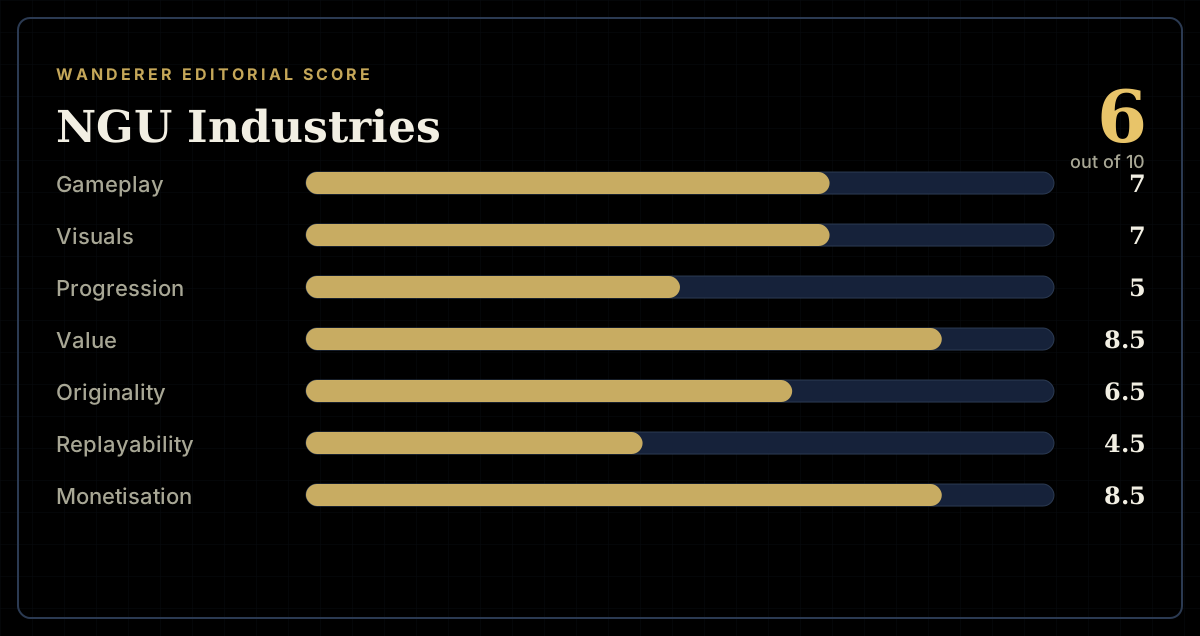
How the review scores each part of the gameWanderer Editorial -
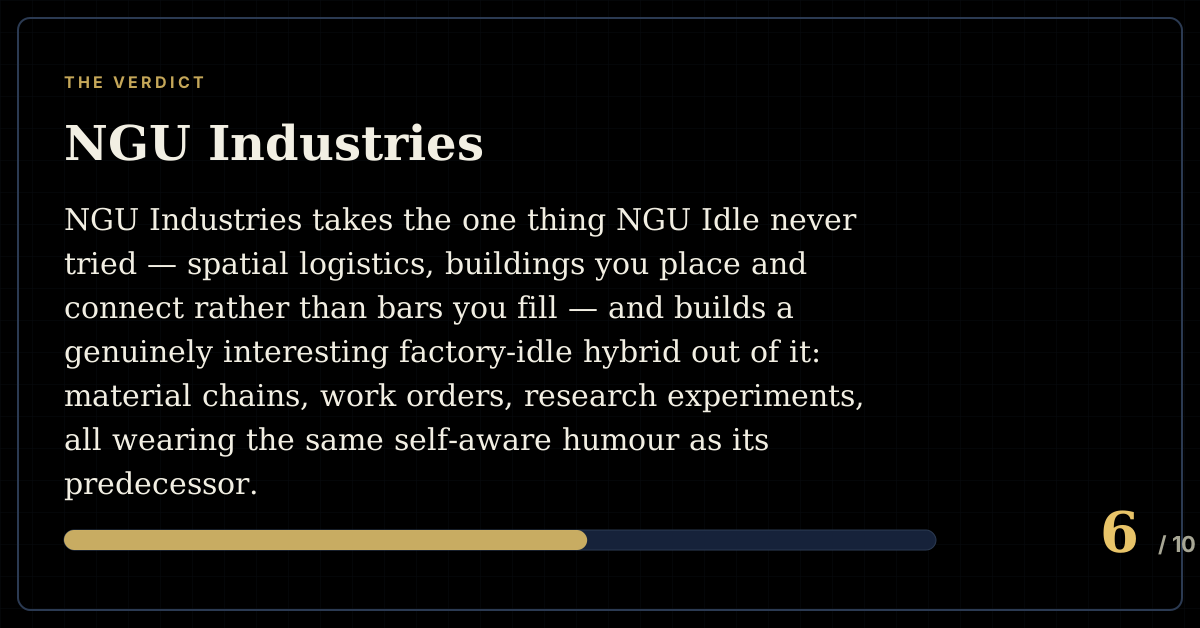
The short versionWanderer Editorial