Game review
The Perfect Tower II
7.5 / 10
- Developer
- Fire Sword Studios
- Publisher
- Fire Sword Studios
- Released
- 30 November 2025
- Platforms
- Windows, Web browser
- Genre
- Tower Defense / Incremental
- Monetisation
- Free to play. A premium currency (Ember) buys cosmetic island skins and temporary global boosts that apply to every online player, not just the buyer; a separate Modding DLC is announced but not yet priced or released
- Players
- Single-player, with shared global boosts and Steam leaderboards
The short version
The Perfect Tower II starts as a straightforward tower-defence game and quietly turns into three games stacked on top of each other: the defence layer that earns resources, a factory layer that turns those resources into more resources, and a town layer that spends them on buildings and modules. The connective tissue is a scripting system that lets you write conditional automation for almost anything the game asks you to click, and the game is honestly better once you've used it.
It also asks a lot before it gives that back. The interface is dense from the first hour, the automation language has a real learning slope even by incremental-genre standards, and the jump into the endgame Infinity system is less a difficulty curve than a wall with a door hidden in it. What's free here is genuinely free, though, and there's no premium shortcut through any of the hard parts.
Biggest strengths
- Combat, town-building and factory production genuinely feed each other instead of sitting side by side as separate minigames
- The Facility AI scripting system lets you automate almost any repeated action once you're willing to learn its rules
- Fifteen regions across five modes (Normal, Endless, Challenge, Idle, Sandbox) give real reasons to replay the same content differently
Biggest weaknesses
- The interface throws town screens, factory tabs, module inventories and combat views at new players well before it explains how they connect
- Writing an effective AI script means learning impulses, conditions and action caps that feel more like programming than like a game menu
- Reaching Infinity mode replaces a gradual curve with an outright wall — early Infinity enemies gain enough resistance to one-shot a tower without the specific counter-module first
Who it's for: Incremental and factory-game players who want a scripting layer with teeth, and tower- defence fans willing to let the genre mutate into something closer to a spreadsheet with turrets.
Our recommendation: It costs nothing and asks nothing of your wallet at any point, so the only real question is whether the automation and factory systems sound appealing rather than intimidating. If dense menus and self-written conditional logic sound like homework, this will feel like homework. If they sound like the fun part, budget more time than you expect.
7.5 / 10
Most tower-defence games ask you to place turrets and watch them work. The Perfect Tower II asks you to place turrets, then build a factory to feed them, then a town to house the factory, then a script to run the town, and only then does it consider the tutorial finished. It's a strange shape for a game to take — three genres bolted together with no seam visible between them — and the strangest part is how well the welds hold.
Fire Sword Studios released The Perfect Tower II on Steam on 30 November 2025, but calling that a launch undersells the history. The game has existed in browser-based early access since 2020, picking up more than 310 updates before its Steam 1.0 build ever appeared, and it's free on both platforms. That five-year runway shows in the density of the systems and in how confidently the game assumes you'll stick around long enough to learn them.
One tower, three economies
The surface loop is ordinary tower defence: place a single tower on a track, equip it with modules, and hold off waves of enemies moving through fifteen distinct regions. Where it departs from the genre is what those waves are actually for. Combat drops resources, resources build and upgrade a town of up to twelve structures, and several of those structures — chiefly the Factory — convert raw drops into producers that generate more resources on their own, second by second, whether or not you're actively fighting anything.
That third layer is the game's real spine. Factory producers are cheap and slow at first, then compound into an engine that dwarfs anything combat alone could generate, and higher-tier producers keep paying out while the game is closed. It's the same reward structure as any factory incremental — Cell: Idle Factory Incremental and Antimatter Dimensions both run variations on the same idea — except here the factory's output loops directly back into combat power through modules and buildings, so skipping it doesn't just slow your numbers, it stalls your ability to survive the next region. Ignoring any one of the three layers for too long makes the other two visibly worse, which is the strongest compliment an incremental's systems design can earn: the interdependence is real, not decorative.
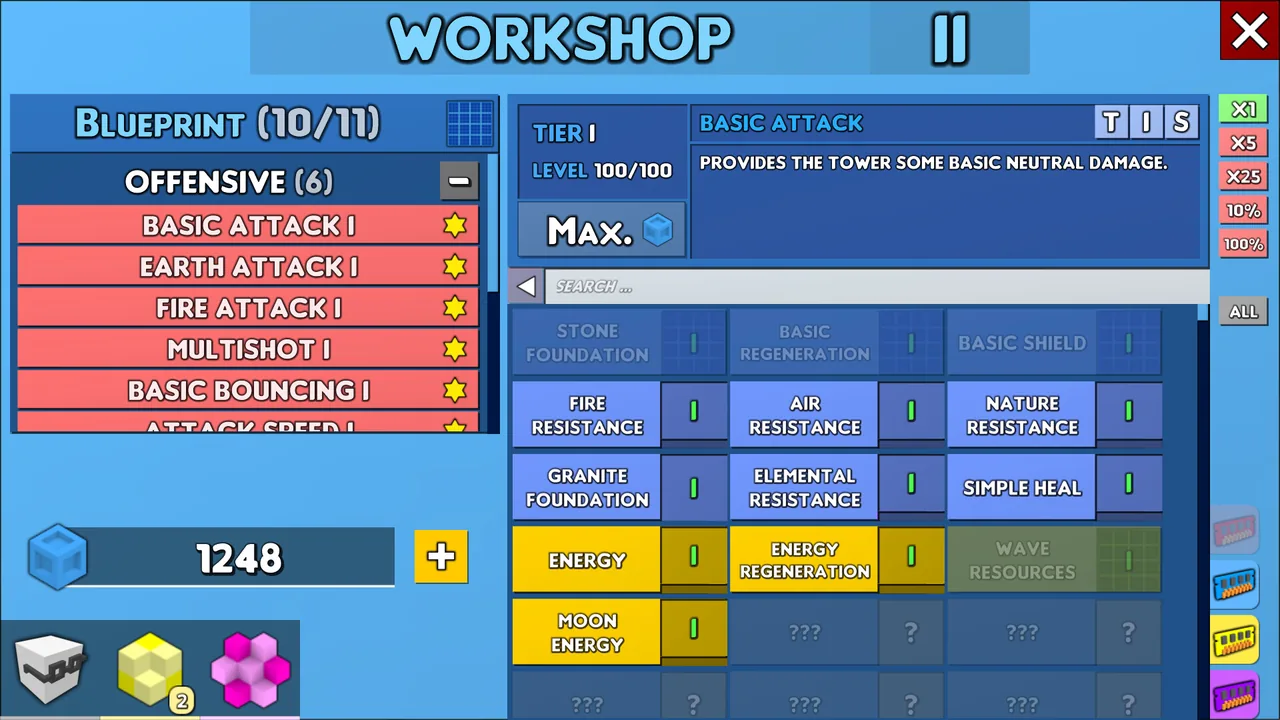
The module system carries a lot of that weight. Blueprints assemble modules — attack types, defensive foundations, regional specials, laboratory unlocks — into a build that determines how your tower actually fights, and by the time you're deep into the regional content there are hundreds of them to weigh against each other. It rewards genuine planning rather than simply slotting the highest number available, which is more than most tower-defence hybrids manage once their modules start overlapping in what they do.
The Facility AI, and what it costs to learn
The feature that separates The Perfect Tower II from its idle-genre neighbours is the Facility AI, a scripting system unlocked partway through the mid-game that lets you automate almost any repeated action: buying upgrades, running factory chains, managing museum collections, even piloting parts of combat. Scripts are built from impulses (what triggers the script), conditions (what has to be true for it to run) and actions (what it actually does), with generous but firm caps on each, and an External Editor lets you write and edit scripts with a keyboard instead of clicking through menu-based logic building. A separate Turbo Exec mode lets certain scripts fire many times per frame for tasks — like factory automation — that need speed rather than deliberation.
This is a genuinely deep system, and it's also the single biggest gate between a new player and the game's best content. Impulses, conditions and action caps are programming concepts wearing an approachable name, and the official wiki's own AI Scripts Guide exists because the in-game explanation isn't enough on its own. Compare this to Bitburner, which hands you real JavaScript against a documented API and simply expects you to bring the skill — The Perfect Tower II's scripting language is friendlier than that, built from labelled blocks rather than raw code, but it's friendlier in the way a visual programming tool is friendlier than a text editor, not in the way a video game menu usually is. Players who enjoy that kind of puzzle will find it the most satisfying part of the whole game. Players who came for tower defence and got a flowchart editor are the ones filling the "brainrot" and "it's basically a second job" corner of the Steam reviews, and the complaint is fair even when it isn't a dealbreaker.
Where the curve turns into a wall
Progression through the early and mid game is generous and mostly readable: new regions, new buildings, new module tiers arrive at a pace that keeps introducing systems rather than just inflating old numbers, which is the same trick that keeps the better factory incrementals interesting past their first few hours. Endless mode, run long enough, eventually reaches Era 100 billion and unlocks Infinity — and Infinity is where the design philosophy changes completely.
Every enemy that spawns in Infinity 1 gains roughly 1e50 resistance to your existing damage type and deals a new damage type of its own that will kill an unprepared tower outright. The intended response isn't to grind harder against the same numbers; it's to obtain two specific new modules, Infinity Foundation and Infinity Attack, that exist purely to counter the new mechanic, and nothing before that point signals quite how binary the requirement is. Each subsequent Infinity wave scales enemies further and lets them copy a growing number of your own equipped modules back at you, so the system keeps demanding fresh answers rather than settling into a stable late game. It's a deliberate design decision — a hard reset on what "difficulty" means, rather than a smoother escalation — and it will read as either a satisfying final test or an unfair ambush depending on whether you found the two counter-modules before or after your first Infinity wave ended you.
What's actually for sale
The premium currency, Ember, buys island skins and Global Boosts — temporary buffs that apply to every player online at the time, not just the one who paid. That's an unusual choice worth crediting: a purchase that benefits the whole community rather than just the buyer is about as far from predatory as a premium currency gets, and there's no equivalent of a stat-boosting item, an energy refill or a progress skip anywhere in the shop. A Modding DLC is listed on Steam as a separate, not-yet-released product that will add tools for building and sharing custom content rather than gating anything in the base game, and a mobile version is referenced in the game's own store description as still unreleased. Judged purely on what money can and can't buy, this is one of the cleaner free-to-play models reviewed here — the catch isn't in the shop, it's in how much of your own time the systems ask for before they open up.
Presentation and performance
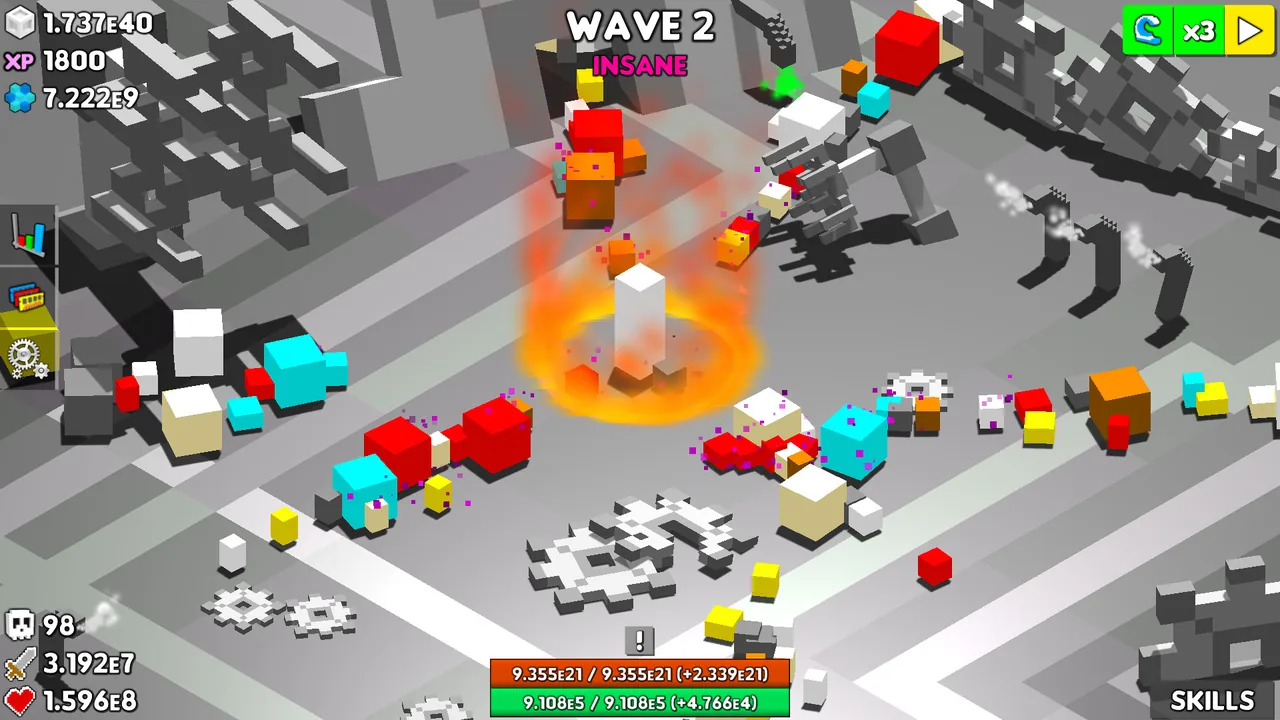
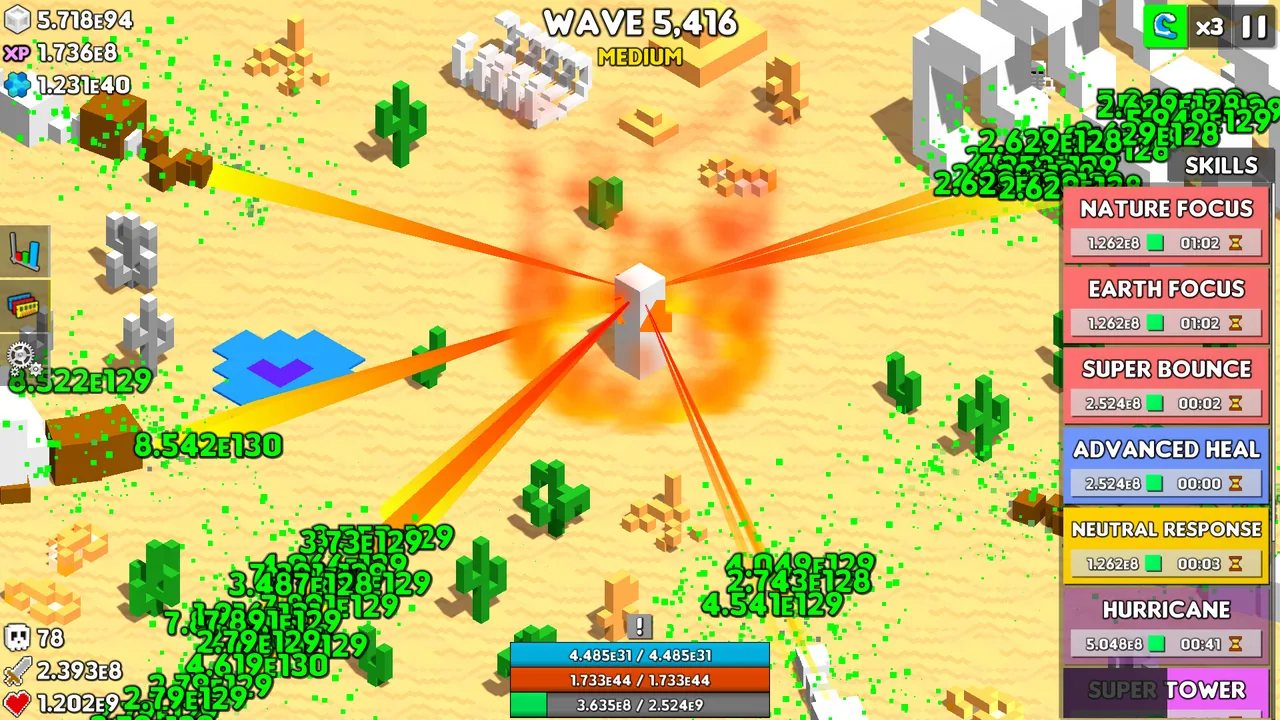
Visually, The Perfect Tower II is functional rather than striking. Regions differentiate themselves mostly through palette and particle effects rather than distinct art direction, and the interface — tabbed, dense, packed with numbers — never really lightens up even once you understand it. That's consistent with the genre rather than a specific failing, and it doesn't get in the way once you've learned where things live, but there's little here that rewards simply looking at the screen the way a more visually ambitious tower-defence game might. On the plus side, a game this system-heavy runs lightly: this isn't demanding hardware, and the ability to play the same save through a web browser away from a desktop matters more for an idle-leaning game like this than raw graphical fidelity would.
Verdict
The Perfect Tower II earns its "Very Positive" standing by doing something genuinely uncommon: it takes three genres that usually stay in their own lane — tower defence, factory automation and programmable idle progression — and makes each one meaningfully improve the other two. The automation layer isn't a convenience bolted onto a simpler game underneath; it's core enough that the game plays differently, and better, once you've learned to use it. Add a monetisation model that never asks for money to remove friction, and this is one of the more player-respecting free releases in the genre.
It's held back by exactly the thing that makes it distinctive. The scripting system that rewards patient players is a real barrier to everyone else, the interface never really simplifies itself, and the leap into Infinity mode punishes players for not already knowing what's coming rather than teaching them in the moment. None of that is dishonest — the game has never pretended to be casual — but it does mean the eight-out-of-ten experience described above is earned only by players willing to sit with the systems long enough to stop finding them intimidating.
Anyone who's enjoyed a factory incremental and wished it had actual defence gameplay wrapped around it, or enjoyed a tower-defence game and wished the meta-progression had real teeth, should find their way in. Players who just want to place towers and watch a straightforward wave counter climb should look elsewhere in the genre; this one wants a lot more from you than that, and it's upfront about the price being your time rather than your wallet.
Pricing and monetisation checked 30 July 2026.
Readers who like the idea of resource production continuing while they're logged off, without a premium currency anywhere near it, may also want to look at Cell: Idle Factory Incremental for the mobile end of the same design space, or Bitburner for a scripting-first idle game that goes even further into writing real code. Players who'd rather spend that same planning instinct on a persistent world with other people in it might also enjoy Wanderer.
Pros and cons
Pros
- Combat, town-building and factory production genuinely feed each other instead of sitting side by side as separate minigames
- The Facility AI scripting system lets you automate almost any repeated action once you're willing to learn its rules
- Fifteen regions across five modes (Normal, Endless, Challenge, Idle, Sandbox) give real reasons to replay the same content differently
- Nothing costs money except cosmetic island skins and global boosts that benefit every online player, not just the purchaser
- Factory producers keep generating resources while the game is closed, so time away is never fully wasted
- Free updates have continued past the 1.0 release, including an announced modding DLC that adds tools rather than gated content
Cons
- The interface throws town screens, factory tabs, module inventories and combat views at new players well before it explains how they connect
- Writing an effective AI script means learning impulses, conditions and action caps that feel more like programming than like a game menu
- Reaching Infinity mode replaces a gradual curve with an outright wall — early Infinity enemies gain enough resistance to one-shot a tower without the specific counter-module first
- Visual variety between regions leans on palette swaps and particle effects more than genuinely new art
- No mac or Linux Steam build, and the mobile version referenced in the game's own description still isn't released
- Community wikis and spreadsheets carry more of the optimal-play knowledge than anything the game teaches directly
Screenshots
-
The Perfect Tower IIImage: Fire Sword Studios via Steam -
The Perfect Tower IIImage: Fire Sword Studios via Steam -
The Perfect Tower IIImage: Fire Sword Studios via Steam -
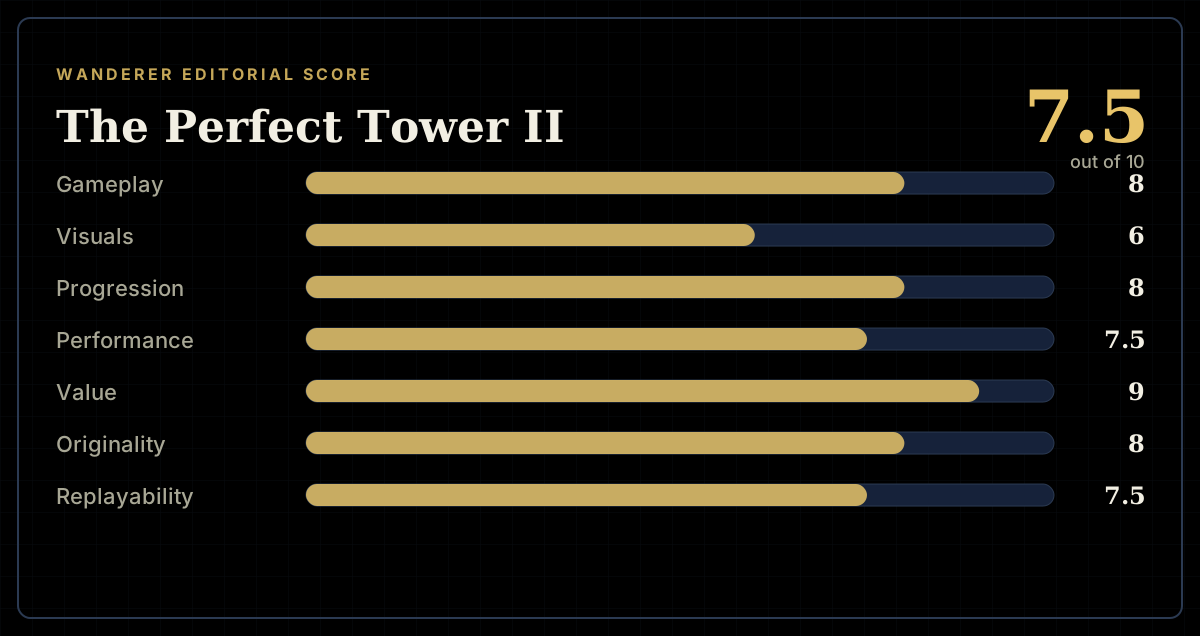
How the review scores each part of the gameWanderer Editorial -
The short versionWanderer Editorial