
Game review
Idle Block Breaker
6 / 10
- Developer
- Posh Panda
- Publisher
- Posh Panda
- Released
- 3 August 2026
- Platforms
- Windows, macOS, Linux
- Genre
- Idle Incremental Breakout
- Monetisation
- One-time purchase, no in-game store, no advertisements and no content descriptors of any kind on the store page. The in-game currency and upgrade tree are earned entirely through play.
- Players
- None — single-player only, no online features of any kind
The short version
Idle Block Breaker takes a Breakout board, bolts a sixteen-node upgrade tree and a set of phase gates onto it, and lets a solo developer's four days of Early Access patches speak for how seriously it's being maintained. The tree itself is legitimately generous for the price — 84 cumulative upgrade levels, nine block types, two vending machines and four buffs, spread across four planned phases — and the paddle-and-ball action underneath it holds up on its own terms. What keeps this from being an easy recommendation is the thing its own marketing leans on hardest: "turn it to idle mode and watch the game play itself" sounds like the offline accrual this library's readers actually want, and the game's own purchasable Idle Mode upgrade says otherwise in its own tooltip — points will not be earned outside of the game. It's an auto-play toggle for a window you still have to keep open, not a background clicker, and buyers expecting the latter are shopping on a misreading the store page never quite corrects.
Biggest strengths
- Sixteen unlockable upgrades across 84 cumulative levels give the tree real room to grow without feeling padded this early, and the developer's own screenshots show costs scaling cleanly from tens of points to low thousands within the first hour
- Two Early Access patches landed inside the first four days, one specifically fixing a paddle-stick bug on Phases 3 and 4 that was dropping the frame rate, which is a faster response than most small releases manage in their first week
- The Early Access FAQ commits to specifics rather than vague promises — a roadmap graphic dated "by Oct. 3rd" lists exactly five remaining items, and the developer states plainly the price will not rise at 1.0
Biggest weaknesses
- The purchasable Idle Mode upgrade's own in-game tooltip reads "points will not be earned outside of game" — the feature the store page's own tagline promises turns out to be an auto-play toggle for an open window, not offline or background progress, and nothing on the store page corrects that impression before you buy
- Resolution & Window Support" is listed as a still-outstanding roadmap item, and the developer's own screenshots show the play board as a small fixed square inside a much larger empty window — an odd fit for a game whose pitch is running it "on your spare monitor
- The developer's own Early Access FAQ describes only two of the four planned phases as functional at launch, with a third "in development" and a fourth not yet promised a date beyond the general October Early Access exit
Who it's for: Breakout fans who want a modern upgrade layer bolted onto the paddle-and-ball loop, and who are comfortable being an early tester for a first-time solo developer rather than a finished product. Idle-genre shoppers hunting for something to leave earning while the PC sleeps should look elsewhere.
Our recommendation: At NZ$7.89 with a developer who has already shipped two bug-fix patches in the first four days and published a dated roadmap, this is a fair bet for anyone who wants the Breakout loop itself and treats the upgrade tree as a bonus. It is not yet the background-idle game its own tagline implies, the window can't be resized or repositioned for a second monitor today, and the review sample is a single Steam user — go in accordingly.
6 / 10
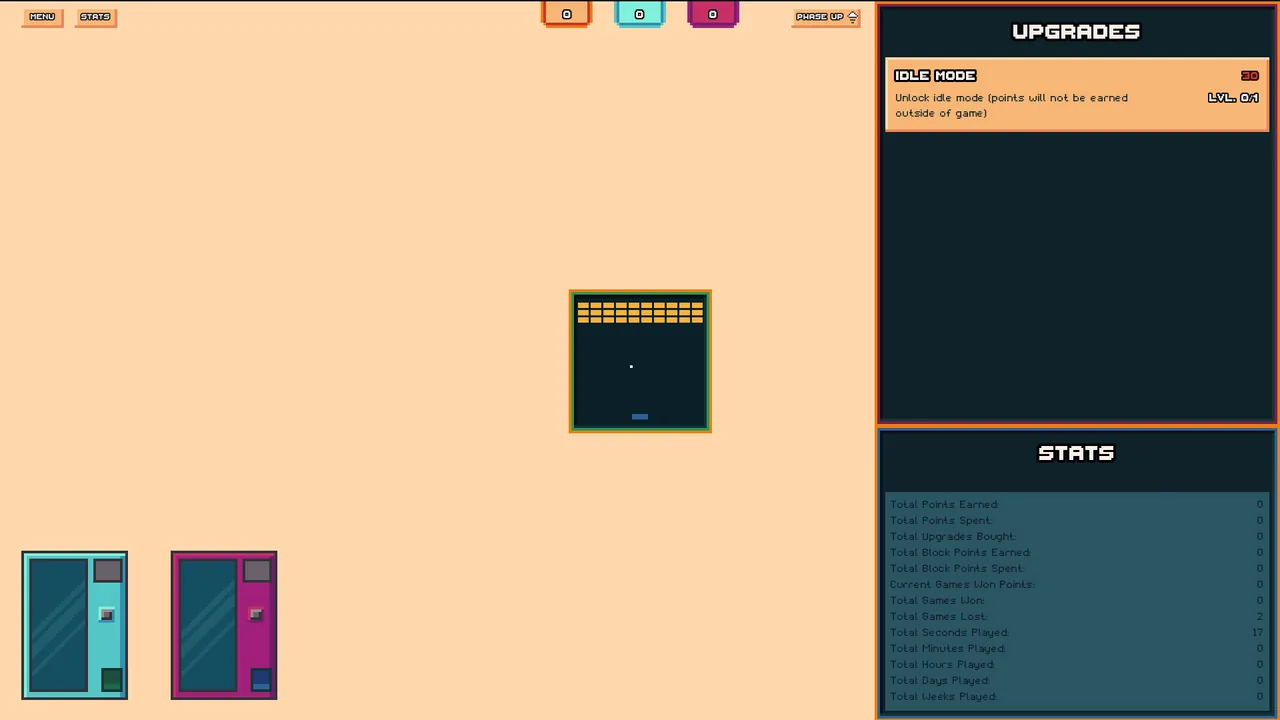
A Breakout board sits in the middle of a much bigger, mostly empty window. To its right, a panel of upgrades runs from a 30-point paddle tweak up into the thousands. In the corner, two vending machines wait to be fed a second and third currency. It's a familiar shape for anyone who has played an incremental game before, wrapped around a genuinely older shape underneath — and four days after release, one detail out of Posh Panda's own screenshots matters more than anything on the store page: the purchasable "Idle Mode" upgrade tells you, in its own tooltip, that points will not be earned outside of the game.
What "idle" actually buys you here
The store page's pitch is direct: "take control and break blocks yourself or turn it to idle mode and watch the game play itself." Community tagging backs that framing hard — Idler is the second most-voted tag on the page at 46 votes, trailing only Casual's 60 and comfortably ahead of Indie, Early Access and Singleplayer, with Automation sitting further down the list at 17. Players are calling this an idle game before the review copy does.
What the upgrade screen actually shows is narrower than that vote count implies. Idle Mode is Tier One's first purchase, a 30-point upgrade with exactly one level, described as unlocking "idle mode" — and the same panel, read in full, spells out the catch: points will not be earned outside of the game. That's the auto-play toggle working as intended, not a bug or an undocumented limitation. It lets the paddle track the ball and clear blocks without your hand on the controls, which is a pleasant, watchable way to spend a break. It does not accrue anything while Steam is closed, minimised, or the PC is asleep — the genre's actual promise, and the one this library's readers usually buy an idle game for. Nothing on the store page draws that distinction before the purchase; the tooltip inside the upgrade tree is the only place it's stated, and you only see it after paying for the tree.
Sixteen upgrades and a gate that shows its hand
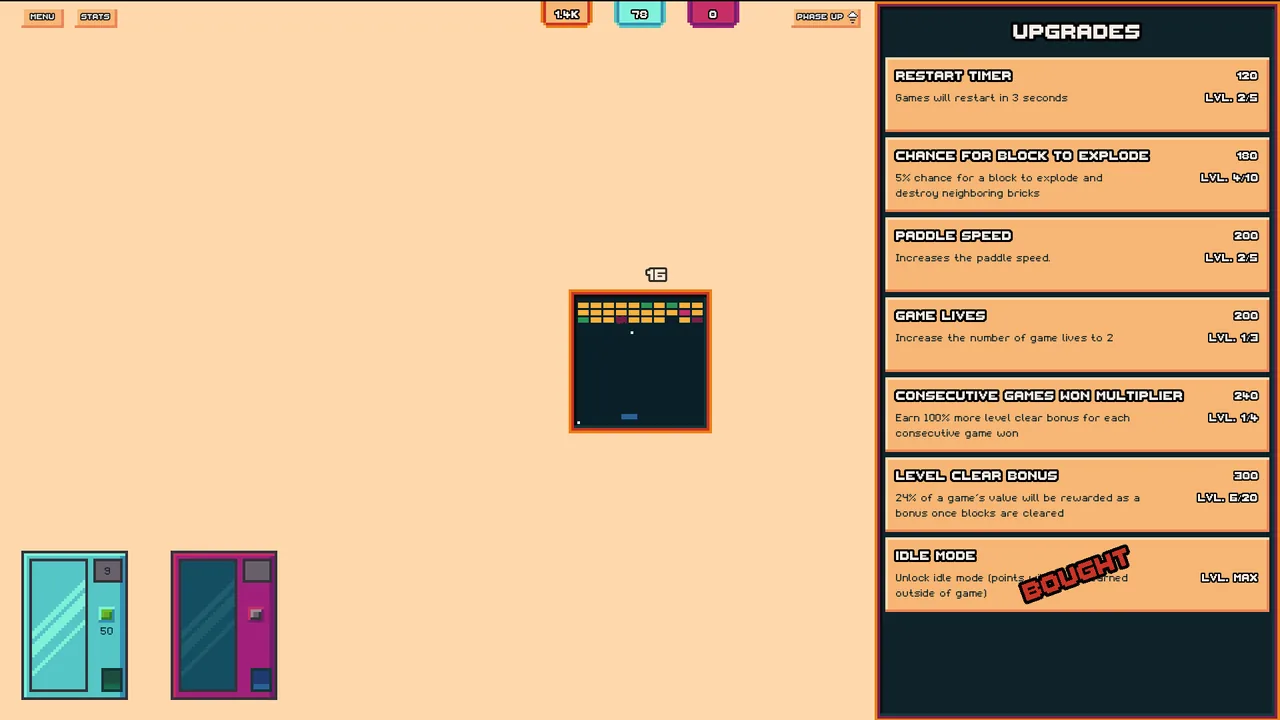
Underneath that one misleading node, the tree itself is worth taking seriously. Sixteen upgrades across 84 cumulative levels is a real spread for a NZ$7.89 game, and the developer's own screenshots show it working the way a tech tree should: Restart Timer, Chance For Block To Explode, Paddle Speed, Game Lives, Consecutive Games Won Multiplier and Level Clear Bonus all sit open from the start, with costs climbing cleanly from double digits into the low thousands as levels stack. Two currencies track alongside the main point total — a cyan and a magenta counter, each feeding its own vending machine, which is presumably where the "9 block types" and "4 temporary buffs" promised in the feature list eventually unlock, though only a handful of those are visible in the screenshots examined here.
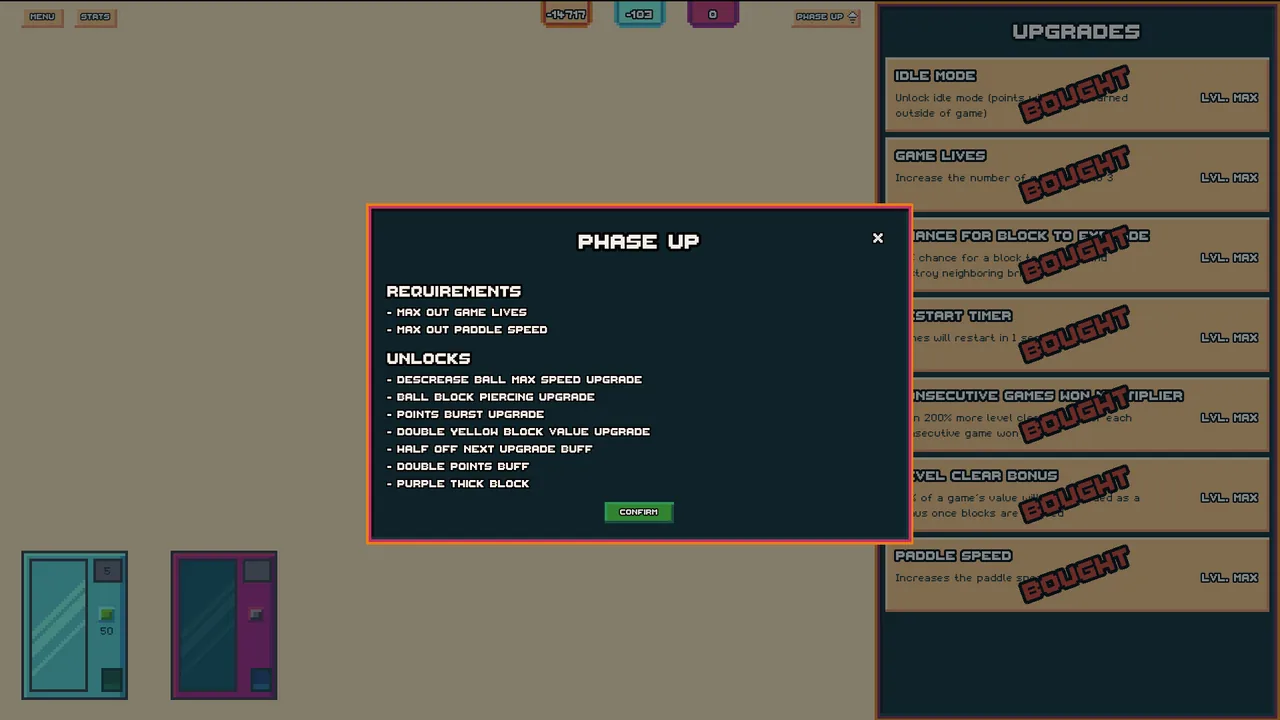
The Phase Up gate is the tree's best piece of design. Reaching it doesn't quietly relock content behind a grind wall — it opens a confirmation screen that lists every requirement (max Game Lives, max Paddle Speed) and every unlock waiting on the other side, right down to naming a new Purple Thick Block by name before you commit. That's the kind of transparency the brief has flagged as missing in worse-designed tech trees, and Posh Panda's first game gets it right on the first gate. Later screenshots show two Breakout boards clearing blocks side by side, currencies climbing into the thousands, which suggests the mid-game opens up into running multiple boards rather than just faster upgrades on a single one.
A window that isn't finished being a window
The developer's own promotional roadmap graphic is dated plainly — "by Oct. 3rd" — and lists five remaining items: Mini-mode, Mega Block, two more upgrades, Resolution & Window Support, and Full Release. That fourth line matters more than it looks. Every screenshot examined here shows the same layout: a small, fixed square playfield centred in a window several times its size, with no visible way to resize the board or the window around it. For a game whose own pitch imagines it running "on your spare monitor" while you do something else, shipping without resolution or window support is a real gap between the sales pitch and the current build — and the developer has already said so, on the record, rather than leaving players to discover it.
The presentation itself is plain but functional: a light background, a dark playfield, blocks in four or five flat colours, damage numbers popping above each clear. It reads fine at a glance, which is most of what a Breakout board needs. It's the window around it, not the board itself, that the roadmap admits isn't done.
Four days of data, honestly reported
There isn't much of a track record to lean on yet, and pretending otherwise would be dishonest. Steam's review count sits at exactly one — a positive write-up from a player with 897 minutes logged, praising the upgrades and the music, which for a four-day-old game already suggests someone left it running for a long session rather than bouncing off it quickly. The live concurrent-player check returned three. The achievement curve is the more interesting number: the first points milestone sits at 57.6%, the three phase-gate achievements come in at 38.4%, 26.9% and 15.3%, and the highest points milestone hasn't been reached by anyone yet. That's a normal shape for a brand-new Early Access release rather than evidence of a wall — most of the audience simply hasn't had four days to push that far, and the developer's own FAQ text describes only two phases as fully functional at launch with a third "in development," which lines up with a curve that thins out fast past Phase 2.
The two patches on record are a good sign regardless of any of that: one, posted 48 hours after launch, specifically named the ball-stuck-to-paddle bug that had been dropping frame rates on Phases 3 and 4, and a follow-up two days later confirmed it fixed alongside a background-music looping bug. A solo developer naming their own bugs in public and shipping fixes inside a week is exactly the kind of Early Access behaviour worth rewarding with a purchase now rather than a wait.
Final verdict
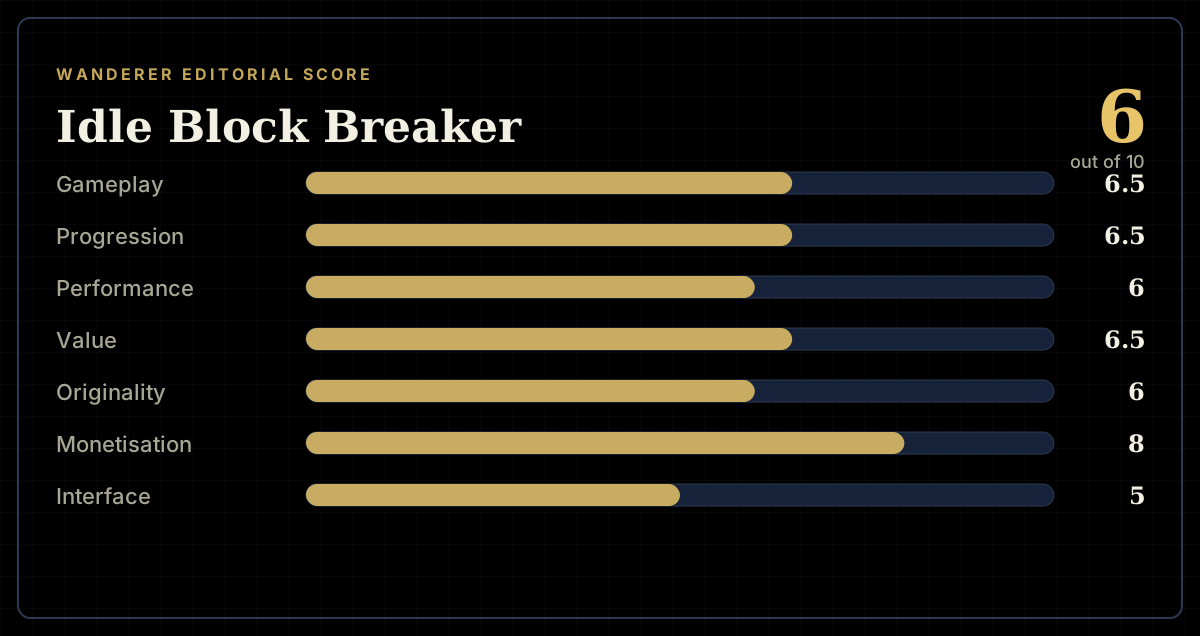
Idle Block Breaker earns a 6 for being a genuinely well-scoped Early Access debut let down by its own marketing language. The upgrade tree is real, generously sized for the price, and transparent about its gates in a way plenty of bigger incremental games aren't. The developer is visibly present, patching named bugs within 48 hours and publishing a dated, specific roadmap rather than a vague "coming soon." What it isn't, despite the tagline and the tag votes, is an idle game in the sense this library's readers mean when they go looking for one — its own Idle Mode tooltip settles that question in one line, and the promised resolution and window support that would make it fit comfortably on a second monitor is still on the to-do list, not in the build. Buy it today for the Breakout loop and the tree growing underneath it, not for something to leave earning while you're away from the PC.
Pros and cons
Pros
- Sixteen unlockable upgrades across 84 cumulative levels give the tree real room to grow without feeling padded this early, and the developer's own screenshots show costs scaling cleanly from tens of points to low thousands within the first hour
- Two Early Access patches landed inside the first four days, one specifically fixing a paddle-stick bug on Phases 3 and 4 that was dropping the frame rate, which is a faster response than most small releases manage in their first week
- The Early Access FAQ commits to specifics rather than vague promises — a roadmap graphic dated "by Oct. 3rd" lists exactly five remaining items, and the developer states plainly the price will not rise at 1.0
- A one-time purchase with no in-game store, no advertising and no content descriptors of any kind, verified directly against the store page
- The "Phase Up" gate is transparent about what it costs and what it unlocks, listing every new upgrade and block type behind it in a single confirmation screen rather than hiding the payoff
Cons
- The purchasable Idle Mode upgrade's own in-game tooltip reads "points will not be earned outside of game" — the feature the store page's own tagline promises turns out to be an auto-play toggle for an open window, not offline or background progress, and nothing on the store page corrects that impression before you buy
- Resolution & Window Support" is listed as a still-outstanding roadmap item, and the developer's own screenshots show the play board as a small fixed square inside a much larger empty window — an odd fit for a game whose pitch is running it "on your spare monitor
- The developer's own Early Access FAQ describes only two of the four planned phases as functional at launch, with a third "in development" and a fourth not yet promised a date beyond the general October Early Access exit
- Four days after release there is exactly one Steam review and a live concurrent-player count of three, so there is essentially no outside track record yet on whether the tree holds up past the opening hour
- Nine block types and four buffs are promised in the feature list but only a handful are visible in the developer's own screenshots so far, leaving most of the promised content unverified until later Early Access builds
Screenshots
-
Idle Block BreakerImage: Posh Panda via Steam -
Idle Block BreakerImage: Posh Panda via Steam -
Idle Block BreakerImage: Posh Panda via Steam -
How the review scores each part of the gameWanderer Editorial -
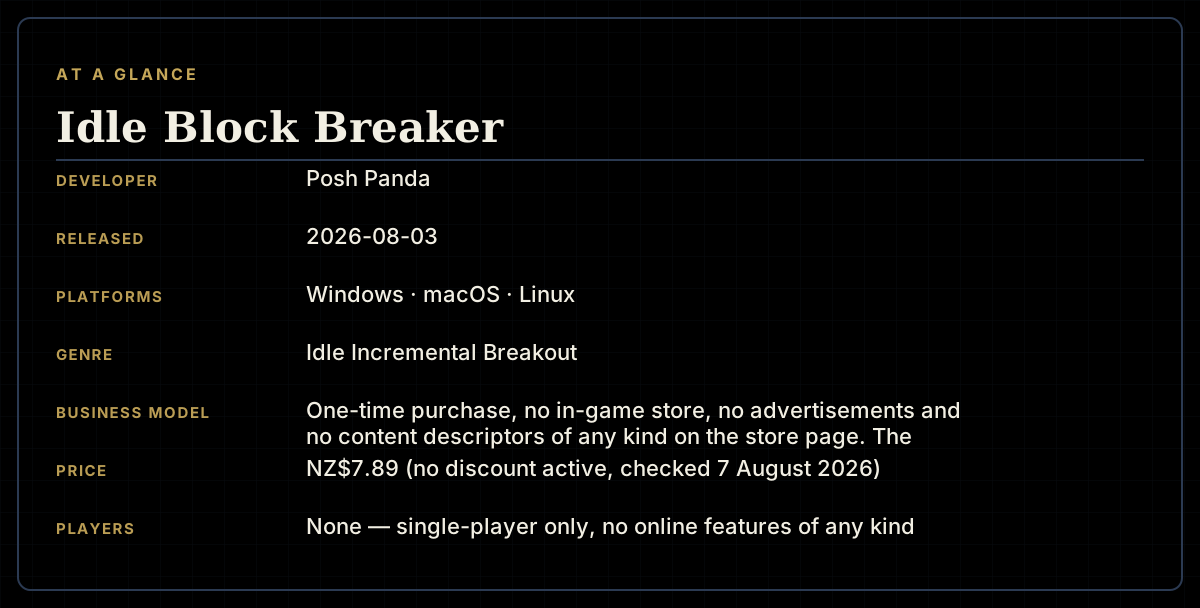
The game at a glanceWanderer Editorial -
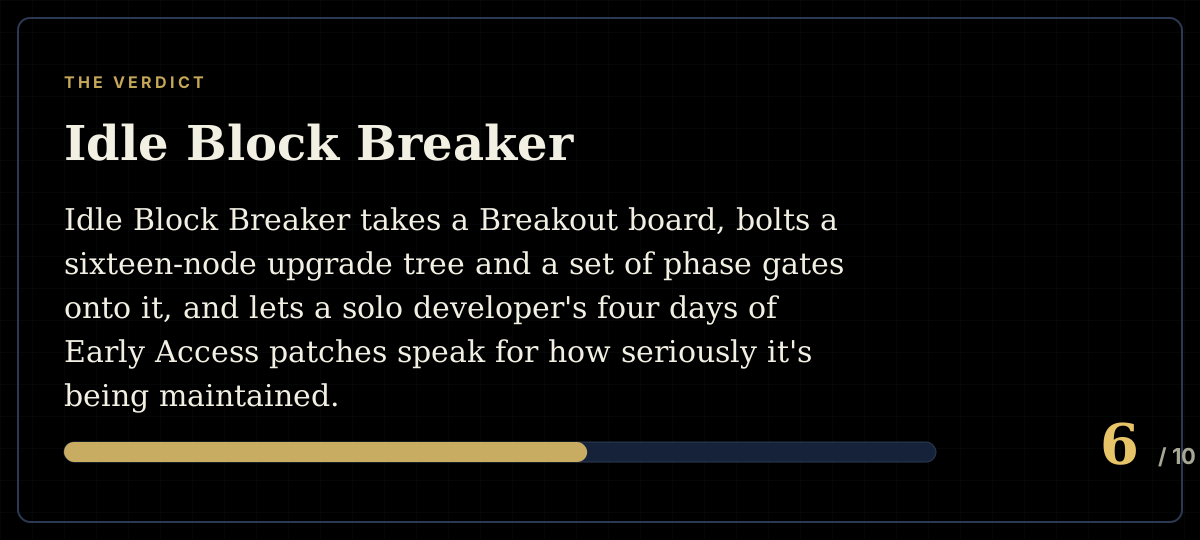
The short versionWanderer Editorial