
Game review
Vampire: The Masquerade - Coteries of New York
5 / 10
- Developer
- Draw Distance
- Publisher
- Dear Villagers
- Released
- 11 December 2019
- Platforms
- Windows
- Genre
- RPG
- Monetisation
- Paid, no in-app purchases found
- Players
- false
The short version
Coteries of New York drops players into New York's vampire underworld as a newly Embraced member of one of three clans, promising meaningful choices across a branching visual novel. Its atmosphere, writing and lore fidelity to the World of Darkness setting draw real, consistent praise — but a large, detailed share of its review corpus documents choices that don't meaningfully affect the story or its single ending, a problem serious enough that the developer publicly clarified its own store description five days after launch in response to the backlash.
Biggest strengths
- Genuinely strong, well-researched World of Darkness atmosphere and lore that multiple reviewers, including at least one who worked on the tabletop game professionally, credit as capturing the setting faithfully
- Well-written characters with real depth and personality across the vampire political intrigue the story is built around
- Three distinct playable clans offering different starting perspectives and abilities, adding some structural variety across replays
Biggest weaknesses
- A dominant, extensively documented complaint that player choices have no meaningful effect on the plot or its single ending, with specific bugs reported including characters responding as though a different dialogue option had been selected
- Confirmed directly by the developer: on 16 December 2019, five days after launch, Draw Distance publicly clarified "previously grand statements" made in the game's own store description about player choice, following reviewer backlash over misleading marketing
- The ending is widely and specifically criticised as abrupt, unsatisfying, and arriving with little narrative build-up regardless of the choices made across the preceding story
Who it's for: Vampire: The Masquerade fans and newcomers curious about the setting who want a short, atmospheric introduction rather than a game with genuine branching consequences.
Our recommendation: A reasonable, cheap primer for the setting on a deep discount; don't buy it expecting the branching choice-driven RPG its original marketing implied.
5 / 10
What it is
Coteries of New York puts players in the role of a newly Embraced vampire navigating the political intrigue of New York's undead underworld, choosing from three distinct clans — each with different starting abilities and a different narrative entry point — as they're pulled into the city's Camarilla power struggles. Developed by Draw Distance and published by Dear Villagers, it's built as a visual novel first: dialogue choices, character relationships and narrative branches are the primary means of interaction, with the game marketed around the promise of meaningful player agency shaping how that story unfolds. It released on 11 December 2019 at NZD 24.79.
Its 1,333-review English corpus sits at a genuinely divided Mostly Positive 70.7% (942 to 391), and reading through it in depth surfaces one of the more concretely documented controversies this lane has encountered — not a matter of taste, but a specific, verifiable dispute over whether the game delivered on its own advertised premise.
Atmosphere and writing that consistently lands
Where the corpus agrees is on the strength of the setting itself. "Coteries of New York does an incredible job of exploring the universe of the World of Darkness," writes one reviewer who takes care to note that both the praise and criticism found elsewhere in the corpus are valid. A particularly credible endorsement comes from a reviewer who "worked on V:TM back in the 2nd/3rd edition era" of the tabletop game, who reports genuinely enjoying the visual novel despite mixed feelings about the newer 5th edition ruleset it draws from, specifically crediting the writing with capturing the setting's tone. Multiple newcomers to the franchise independently describe the game as an effective, low-stakes way to get introduced to Vampire: The Masquerade's lore without needing prior familiarity, one explicitly noting they bought it "recovering from a medical condition" wanting something more substantial than "an idle clicker" and coming away satisfied with what they found.
A choice-driven game whose choices don't drive much
The corpus's dominant, most extensively documented complaint concerns the gap between the game's advertised interactivity and what actually plays out. One of the most detailed critical reviews lays out the problem specifically: "your ability to affect the story is INCREDIBLY limited, and I have a suspicion you literally cannot affect it at all," reporting a specific instance where "I responded to a character and they answered as if I had chosen a completely different line." The same review documents further mechanical inconsistency: attempting to use a vampiric Discipline power resulted in the game "behaving as though nothing had happened," while on other occasions the reviewer was seemingly able to use Disciplines "not even normally available" to their chosen clan. That reviewer's overall conclusion — "the game is pretending to be deeper than it really is" — is echoed independently across many other reviews: "the same lines, same [outcomes]" across multiple playthroughs, and choices that "has ZERO impact on the story," in the words of a separate detailed review comparing two full playthroughs directly.
A developer response confirming the complaint was real
What separates this from an ordinary "choices don't matter enough" complaint is a direct, documented response from the developer. One review carries a dated edit: "Edit Dec 16th, 2019: This review was written before the developers clarified some of the previously grand statements made in the game's description." That's a genuinely rare and significant thing to find preserved in a review corpus — confirmation, in the reviewer's own words and dated within days of release, that Draw Distance itself walked back claims in its own marketing copy following the backlash over exactly this complaint. Whatever the original store description promised about player choice, the developer's own public correction is about as strong a confirmation as this kind of complaint can get without needing to take any single reviewer's characterization purely on faith.
The ending, and a separate serious bug
The story's conclusion draws sharp, specific criticism independent of the broader choice debate. "The ending is horrible... you are railroaded into an ending that comes out of nowhere and makes no sense," writes one reviewer; another separately describes the game as feeling "unfinished," with the actual resolution possibly "bugged" at the time of writing. A different, more concrete technical complaint concerns a reported bug that skips entire chapters of the storyline outright — one reviewer states this was "reported and the developer has noted it, and promised a fix... last year, still nothing," a specific, dated account of an acknowledged but seemingly unresolved defect.
What the achievement data suggests about clan variety
The achievement data offers a useful window into how the three-clan structure actually functions in practice. Achievements tied to embracing or recruiting specific early-game characters cluster relatively closely together, in the 37-44% range, suggesting most players engage with a broad cross-section of the game's early clan-specific content rather than one clan dominating attention. But achievements tied to completing story branches for all three clans sit much lower, at 6.0%, alongside a finale-specific achievement at just 4.6%. That gap indicates most players experience one clan's perspective and don't return for the other two — a reasonable choice for a short visual novel, but one that's also consistent with the dominant complaint above: if the underlying plot and ending genuinely converge regardless of clan choice, as many detailed reviewers report, there's less incentive to replay through different starting perspectives than the three-clan structure might otherwise suggest.
Weighing a walked-back promise fairly
It's worth being precise about what the developer's public clarification does and doesn't confirm, since a fair review shouldn't overstate a corrected marketing claim into evidence of bad faith. Draw Distance issuing a correction five days after launch, in direct response to reviewer feedback, is arguably a responsible way to handle a legitimate miscommunication — better than ignoring the complaint or leaving misleading language in place indefinitely. The core issue this review is flagging isn't that the developer acted dishonestly on purpose, but that the finished game's actual level of narrative branching fell short of what buyers reasonably expected at the point of purchase, and that the gap was significant enough to require a public correction rather than being a minor, forgivable exaggeration. Buyers evaluating the game today, well after that correction, should judge it by the corrected, more modest description of its choice systems rather than the original, walked-back claims.
Verdict
Coteries of New York succeeds at recreating World of Darkness atmosphere and writing well enough to win over both newcomers and longtime tabletop fans, but its own developer's public correction of the game's marketing confirms what its most detailed critics document at length: the choices this visual novel is built around don't meaningfully shape the story they're embedded in. Worth a cheap purchase for the setting and writing alone, with expectations firmly recalibrated away from genuine branching consequence.
Pros and cons
Pros
- Genuinely strong, well-researched World of Darkness atmosphere and lore that multiple reviewers, including at least one who worked on the tabletop game professionally, credit as capturing the setting faithfully
- Well-written characters with real depth and personality across the vampire political intrigue the story is built around
- Three distinct playable clans offering different starting perspectives and abilities, adding some structural variety across replays
- Effective as a low-cost introduction to the Vampire: The Masquerade setting for newcomers, according to multiple reviewers who had never engaged with the franchise before
Cons
- A dominant, extensively documented complaint that player choices have no meaningful effect on the plot or its single ending, with specific bugs reported including characters responding as though a different dialogue option had been selected
- Confirmed directly by the developer: on 16 December 2019, five days after launch, Draw Distance publicly clarified "previously grand statements" made in the game's own store description about player choice, following reviewer backlash over misleading marketing
- The ending is widely and specifically criticised as abrupt, unsatisfying, and arriving with little narrative build-up regardless of the choices made across the preceding story
- A separate, reported game-breaking bug lets chapters be skipped entirely; per at least one reviewer, this was acknowledged by the developer with a promised fix that had not arrived over a year later
- Background art is reused frequently across scenes, and the overall experience is very short, with most reviewers finishing in well under twelve hours
Screenshots
-

Vampire: The Masquerade - Coteries of New YorkImage: Dear Villagers via Steam -

Vampire: The Masquerade - Coteries of New YorkImage: Dear Villagers via Steam -

Vampire: The Masquerade - Coteries of New YorkImage: Dear Villagers via Steam -
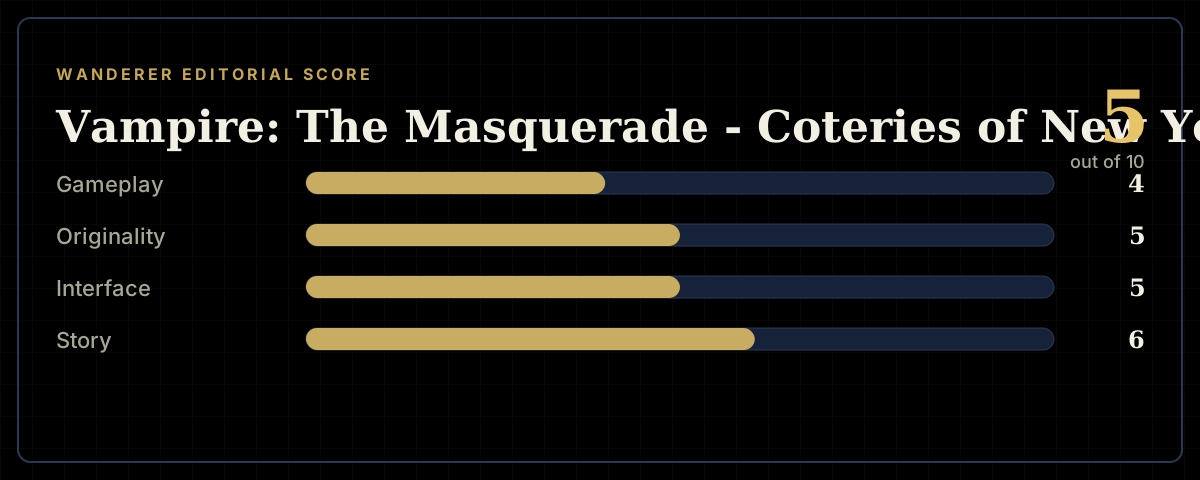
How the review scores each part of the gameWanderer Editorial -
The short versionWanderer Editorial