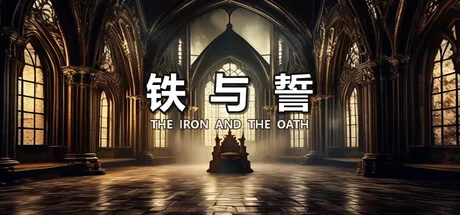
Game review
The Iron and the Oath
6.5 / 10
- Developer
- FFire Studio
- Publisher
- FFire Studio
- Released
- 2 August 2026
- Platforms
- Windows
- Genre
- Interactive fiction RPG and narrative adventure told through stat-gated branching choices
- Monetisation
- One-time purchase, no DLC listed on Steam, 26 achievements, no in-game store or premium currency
- Players
- None — single-player only, with no online or social features of any kind
The short version
The Iron and the Oath doesn't play like the RPG its Steam genre tags suggest. There's no combat system, no real-time anything — it's a turning storybook, two pages at a time, where every decision spends a resource called Willpower and nudges five attributes and a web of named relationships. That premise is executed with real care: hand-lettered chapter headings, ink-wash CG illustrations, a save-anywhere journal that logs your choices as you make them, and — unusually for a release this small — full voice narration in both English and Simplified Chinese. What the review can't do is confirm any of it lands with players, because five days after launch this game has precisely zero user reviews on Steam and zero on Metacritic, and its own achievement data implies a stat-tracked audience of roughly thirty people.
Biggest strengths
- The book-as-interface conceit is executed with real craft — page-turn navigation, a journal that logs your choices as you make them, and a stats page that tracks Willpower, five core attributes and named relationships like ledger entries
- Five chapters branching into three named routes (martial, political, scholarly by the store's own description) with nine distinct successful endings and six separate bad endings gives genuine reason to replay
- Full voice narration in both English and Simplified Chinese is a real production commitment for a release this small, and one most games at this price point skip entirely
Biggest weaknesses
- Five days after launch, the game has zero user reviews on Steam and zero critic or user scores on Metacritic — there is no outside voice to check the store page's own claims against
- Steam's own achievement percentages back-solve to a stat-tracked playerbase of only around thirty people, and the developer's news feed for the game is completely empty
- The AI Generated Content Disclosure on the store page covers CG artwork, other visual assets and audio, which will be a hard pass for some readers in a genre where hand-authored atmosphere is usually the whole appeal
Who it's for: Readers of Choice of Games-style interactive fiction and stat-gated narrative RPGs — think King of Dragon Pass or Vampire: The Masquerade — Coteries of New York — who are comfortable being early on a release with no critical or player track record yet.
Our recommendation: At NZ$10.12 for five chapters, three routes, six distinct bad endings and full narration in two languages, the scope justifies the price on paper, and the monetisation is as clean as it gets — one purchase, nothing else to buy, ever. What it doesn't have yet is anyone else's opinion to weigh against your own; buy it as a bet on an unproven small studio, not as a consensus pick.
6.5 / 10
Open The Iron and the Oath and you're looking at a leather-bound book, cracked open to two facing pages, with a handful of tabs running down each spine — a crest, a relationships icon, a candle, a journal, a settings cog, a wax seal. There's no HUD, no health bar, no map. You read a paragraph of prose, you pick one of two or three responses, and the book turns the page. That's the entire game. It's an unusually literal way to build an RPG, and against the Adventure/Indie/RPG tags Steam has filed it under, it's worth saying plainly up front: this is interactive fiction, full stop, closer in spirit to King of Dragon Pass or Vampire: The Masquerade — Coteries of New York than to anything with a combat system.
A storybook, not a battlefield
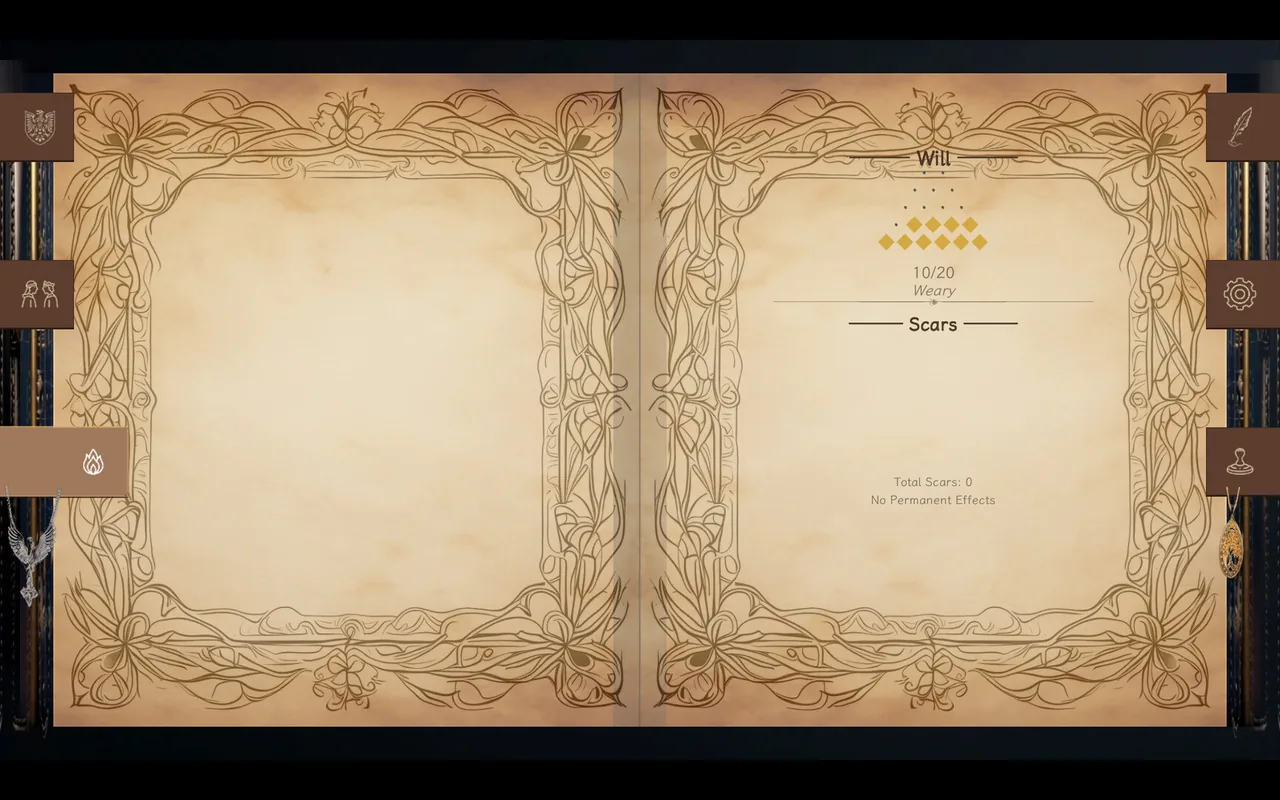
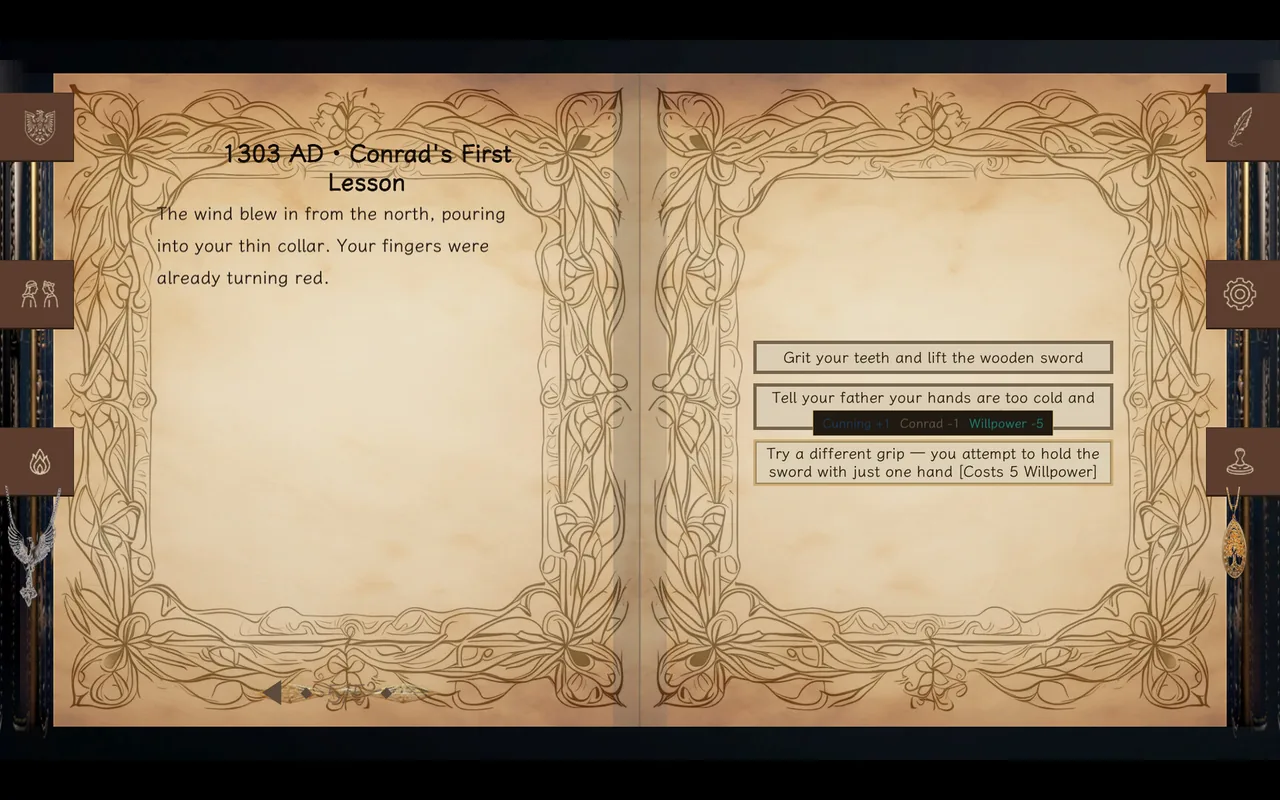
Karl von Aiden — the character you play, born into a noble house in the year 1298 per the opening chapter — is built around five attributes the store page names as Martial, Scholarly, Faith, Political and Social, plus a spendable resource called Willpower that ticks down as the story leans on you. Choices are gated by these numbers: some options are simply available or unavailable depending on where your stats sit, and others let you pay Willpower for a path you couldn't otherwise take, the way the game's very first real decision offers "try a different grip" on a practice sword for a flat five-point cost. It's a clean, legible system, and one screenshot of the character sheet shows exactly how it's tracked — a diamond meter reading "10/20, Weary" alongside a running Scars counter for permanent consequences.
What it never becomes is combat. The store page promises you can "pursue martial valor, political cunning, or scholarly wisdom" across three branching routes, and the achievement list confirms three route-defining unlocks named Way of the Sword, Way of the Shadow and Way of Faith — but even the sword route resolves through the same paragraph-and-choice structure as the political or scholarly ones. If you're coming to this expecting anything with hit points or turn order because Steam calls it an RPG, recalibrate: the tension here is entirely about which door your stats let you open, not about winning a fight.
Five chapters, three routes, and a curve that says not many people have finished
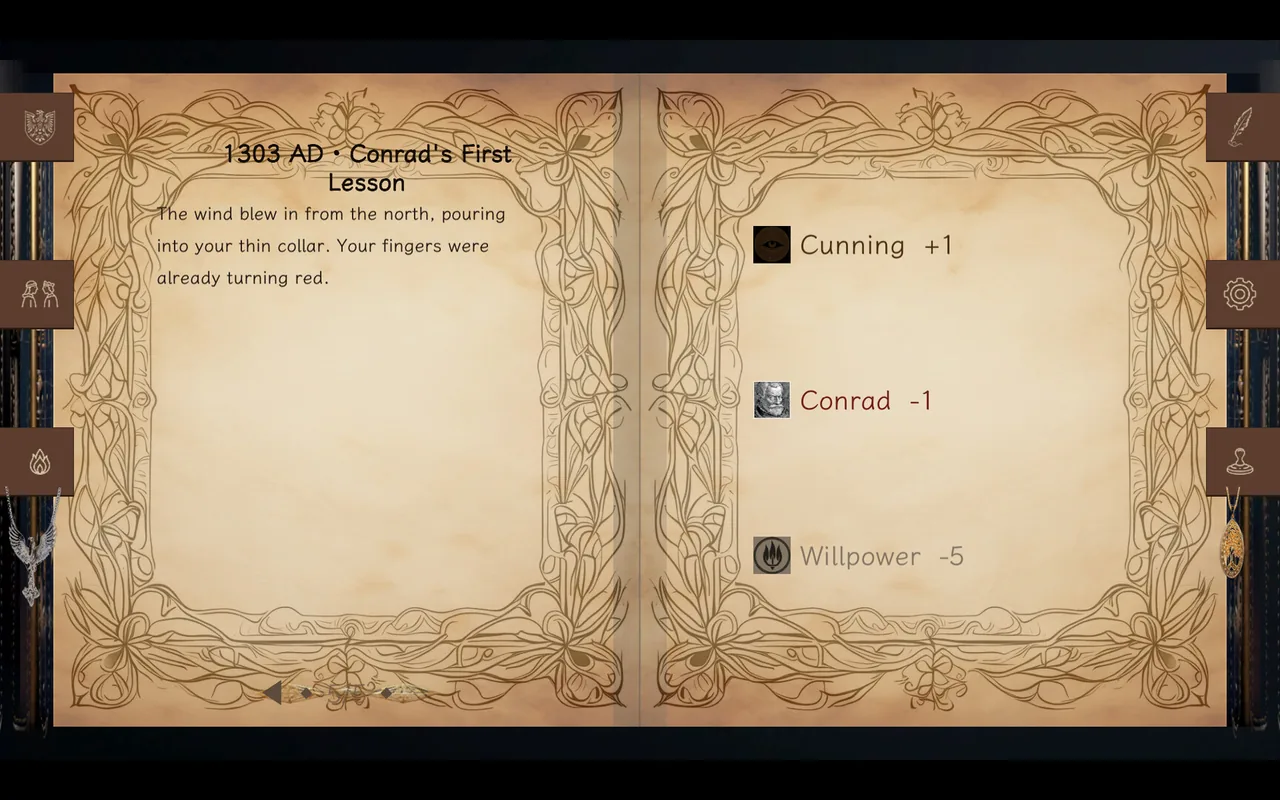
The scope, at least on paper, is real. Five chapters carry Karl from childhood ("Conrad's First Lesson," reads one early title card) toward an adult reckoning, splitting into three named routes, each promising — per the store description — "unique story arcs, allies, and endings." The full achievement count backs that structure up with specifics rather than marketing copy: separate unlocks for ch1 through ch5, three route completions, nine distinct successful endings split three-to-a-route, and six separately named bad endings (extinct, broken, branch, silence, alone, ordinary) that the store page bills as "unique trigger conditions."
Steam's global achievement percentages are the only outside evidence available on how that plays out, and they're worth reading carefully rather than at face value. Chapter completion runs 31.2% for chapter one down to a tied 21.8% for chapters three, four and five — a smoother drop-off than most story games manage, though the tie across three separate chapters is unusual and may reflect how few accounts these percentages are drawn from. Route completion splits unevenly: the political route (route_b) leads at 12.5%, the martial route (route_a) sits at 9.3%, and the scholarly route (route_c) trails at just 3.1%. Individually, every single ending sits at 9.3% or lower, and six of the nine successful endings — plus a majority of the bad ones — currently read exactly 0.0%. Back- solving those percentages against plausible denominators lands consistently around thirty players with recorded stats, which is a genuinely tiny sample to draw firm conclusions from. It's not enough to call the game short or its endings unreachable. It is enough to say, honestly, that almost no one has played this far into it yet — which the next section explains.
An unusually quiet five days
Here's the finding that shapes this whole review: as of 7 August 2026, five days after launch, The Iron and the Oath has zero user reviews on Steam. Not a mixed score, not a small sample skewed one way — zero, checked five separate times with day-range and cursor parameters set to pull the full history rather than a truncated default. Metacritic's page for the game shows the same thing from the critic side: no critic reviews, no user reviews. The developer's Steam news feed for the app has never posted anything. Support runs through a single personal email address with no listed website. None of that is disqualifying on its own — plenty of small, worthwhile games launch quietly — but it does mean this review can't lean on anyone else's account of whether the writing holds up over five full chapters, whether the routes genuinely diverge the way the store page claims, or whether the "over 40 attribute gates" the description advertises actually produce meaningfully different playthroughs. Those are the developer's own words, not an independently verified count, and right now there is no community verifying them either way.
Worth a name-check for anyone searching: this is not the same game as The Iron Oath, an unrelated 2023 tactical RPG from Curious Panda Games with a near-identical title. They share nothing but a few words.
Presentation, and the disclosure that comes with it
Where the game does show its hand, it shows real intent. The promotional screenshots depict ink-wash CG illustrations — a snow-bound cathedral stairwell is the strongest of the set — set against hand-lettered chapter headers and page-turn navigation with a working journal that logs entries as the story progresses ("Events recorded: 0 / Your story has just begun" on a fresh save). Full voice narration ships in both English and Simplified Chinese, which is a real cost most releases at this price point don't take on. Accessibility support is unusually complete for a niche title too: adjustable text size, subtitle options, custom volume controls, play without timed input, and a touch-only control scheme alongside mouse.
All of that sits next to the store page's own AI Generated Content Disclosure, which states plainly that "some CG artwork, visual assets, and audio assets in this game were created with the assistance of AI generation tools and then manually refined and integrated by the developer." That's a factual disclosure, not an allegation from a review corpus this game doesn't yet have — but it's worth knowing before you buy, particularly in a genre where hand-authored prose and art are usually the entire pitch, and doubly so alongside a Steam page that names Simplified Chinese as the only other supported language and lists a QQ address as its sole point of contact, both consistent with a very small — plausibly solo — Chinese studio taking on ambitious scope with limited resources.
Value
At NZ$10.12 (10% off an already modest NZ$11.25), the asking price matches what's actually on offer: five chapters, three routes, nine successful endings, six bad ones, and full dual-language narration, for a single payment with nothing else to buy. There's no DLC on the store page and no sign one is planned. Whatever else is true of this launch, the monetisation isn't the part that needs defending.
Final verdict
The Iron and the Oath earns a 6.5 for genuine craft in a niche its Steam tags undersell — a turning-book interface, real branching structure, and a level of narration investment that a studio this size didn't have to attempt. It doesn't score higher because there is, right now, nothing to weigh that craft against: no reviews, no critic coverage, no community discussion, and an achievement curve too thin to settle whether the writing sustains five chapters the way the pitch promises. If you're the kind of reader who tracks down Choice of Games-adjacent interactive fiction before anyone else has an opinion on it, the price is fair and the scope is real. If you'd rather let a few dozen other players find the rough edges first, there's no shame in waiting — there's currently nobody to wait behind.
Pros and cons
Pros
- The book-as-interface conceit is executed with real craft — page-turn navigation, a journal that logs your choices as you make them, and a stats page that tracks Willpower, five core attributes and named relationships like ledger entries
- Five chapters branching into three named routes (martial, political, scholarly by the store's own description) with nine distinct successful endings and six separate bad endings gives genuine reason to replay
- Full voice narration in both English and Simplified Chinese is a real production commitment for a release this small, and one most games at this price point skip entirely
- A flat NZ$10.12 one-time purchase with no DLC, no premium currency and no in-game store is about as honest a monetisation model as this genre gets
- Accessibility options are unusually thorough for a niche release — adjustable text size, subtitle options, custom volume controls, playable without timed input, and a touch-only control scheme
Cons
- Five days after launch, the game has zero user reviews on Steam and zero critic or user scores on Metacritic — there is no outside voice to check the store page's own claims against
- Steam's own achievement percentages back-solve to a stat-tracked playerbase of only around thirty people, and the developer's news feed for the game is completely empty
- The AI Generated Content Disclosure on the store page covers CG artwork, other visual assets and audio, which will be a hard pass for some readers in a genre where hand-authored atmosphere is usually the whole appeal
- Despite Adventure/RPG genre tags, there is no combat system of any kind — every conflict, including the "martial valor" route, resolves through the same attribute-gated choice screens as every other decision
- The only listed support channel is a personal email address, with no official website, so there's no visible plan for post-launch patches or communication if something goes wrong
Screenshots
-
The Iron and the OathImage: FFire Studio via Steam -
The Iron and the OathImage: FFire Studio via Steam -
The Iron and the OathImage: FFire Studio via Steam -
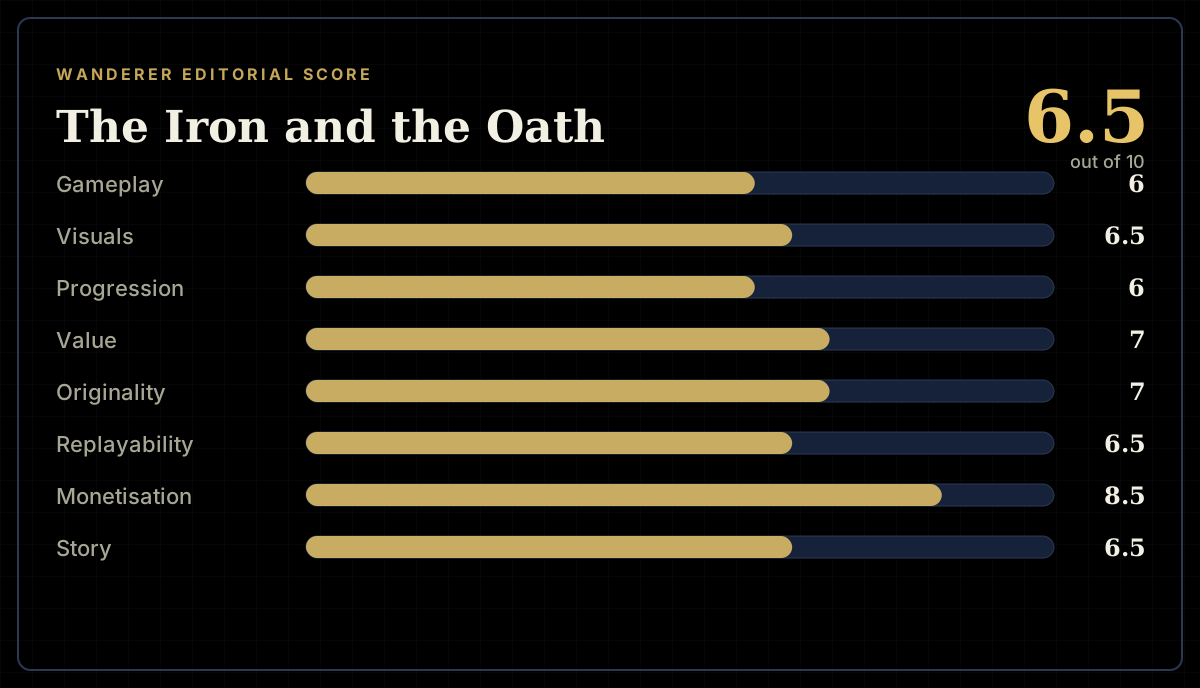
How the review scores each part of the gameWanderer Editorial -
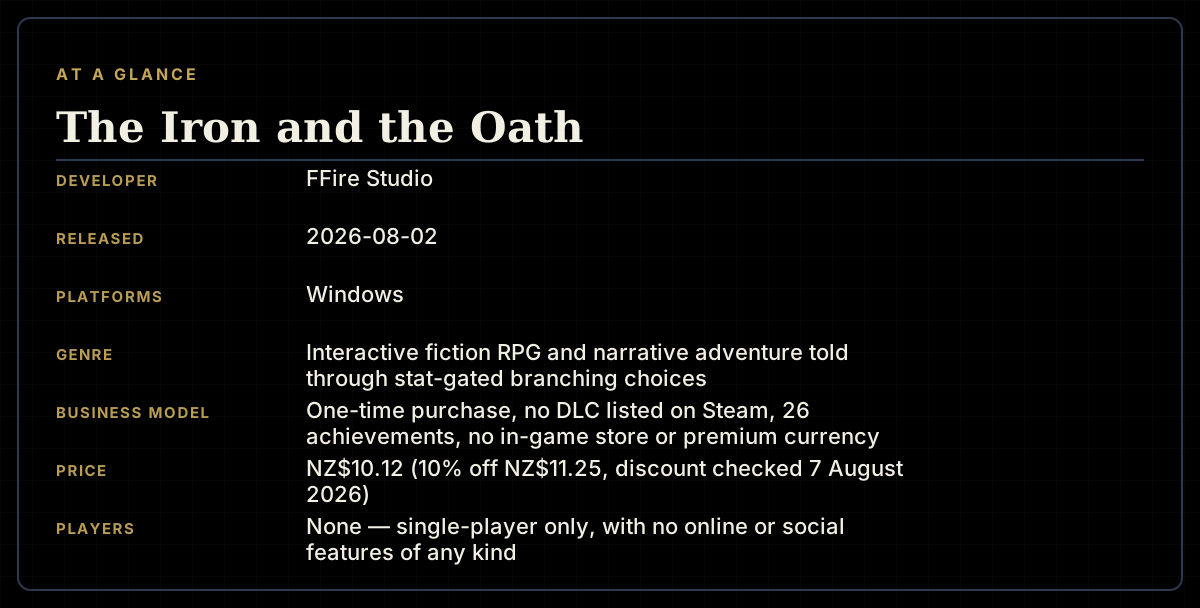
The game at a glanceWanderer Editorial -
The short versionWanderer Editorial