
Game review
Legends of Savvarah: Children of the Sun
7 / 10
- Developer
- ST Sinovar
- Publisher
- ST Sinovar
- Released
- 23 January 2025
- Platforms
- Windows
- Genre
- Interactive Fiction, Fantasy RPG
- Monetisation
- One-time purchase, no DLC or in-game currency
- Players
- Single-player
The short version
Children of the Sun follows Nuelli, a young woman born without meaningful magical ability in a world built on it — a rare flaw that instead lets her see the very threads magic is woven from, and the shadow-dotted eyes that have watched her since childhood. It's an entry in developer ST Sinovar's independently-authored Legends of Savvarah fantasy series, offering a heavily branching interactive story with sixteen distinct endings and relationships, including romance options, that reviewers describe as genuinely consequential rather than cosmetic. The small but engaged Very Positive corpus (85 reviews) is dominated by specific, detailed praise for the art, world-building and writing — several reviewers explicitly contrast it favourably against a crowded field of lower-effort anime-otome-style visual novels — while a handful of dissenting reviews argue the opposite: that choices matter less than advertised and the pacing drags.
Biggest strengths
- The sixteen endings draw specific, repeated praise for containing real variation rather than being cosmetic dressing on one central outcome, with reviewers describing choices that function as genuine explorations of character rather than binary success/failure branches
- Reviewers consistently single out the art, character designs and original soundtrack as standout elements, with more than one specifically contrasting the game favourably against a wider field of lower-effort, similarly-marketed visual novels
- The world-building is described as unusually deep for the format, with reviewers likening the experience to "playing through another world's mythology" rather than a generic fantasy backdrop assembled for the story alone
Biggest weaknesses
- At least one reviewer directly disputes the "choices genuinely impact the progression" claim from the store page, reporting that most choices "mostly dont matter" and describing several dead ends — a direct contradiction of the game's own central selling point that a prospective buyer should weigh against the more numerous reviews praising choice depth
- A separate reviewer reports the game "mostly boring" and had to push themselves to finish it, a blunter dissent that, while a minority view in this small sample, is specific enough to note rather than dismiss
- One detailed positive reviewer flags a specific reproducible visual bug — a scene transition to a particular location where the background fails to update — alongside some rough machine-translation-adjacent phrasing in spots
Who it's for: Visual novel and interactive-fiction readers who want a genuinely branching fantasy story with real world-building behind it, particularly anyone who enjoys replaying to see meaningfully different outcomes rather than a single "true" path with cosmetic detours. Less of a fit for readers who want fast pacing or expect every choice to swing the plot dramatically, since even positive reviewers describe some choices as subtler explorations of character rather than branch points with immediate consequences.
Our recommendation: A confident recommendation for genre fans at NZ$11.79 — reviewers who went in skeptical of a crowded, often shallow field of choice-based fantasy visual novels consistently report being won over by the depth of the writing and world here, though the dissenting reviews are specific enough to be worth a look before buying if pacing or choice-impact are dealbreakers for you.
7 / 10
A girl who sees what magic is made of
Children of the Sun's premise inverts the usual chosen-one fantasy setup. Nuelli is born into a world defined by magic with almost no aptitude for it herself — a rare, stigmatized flaw among her people. What she gets instead is a different kind of sight: she can see the very threads magic is woven from, and, since childhood, a darkness dotted with watching eyes that nobody else can perceive. From that starting point, the story branches into investigating her visions, uncovering her people's history, and being drawn into a conspiracy involving divine entities — or not, entirely depending on the choices a player makes along the way.
That branching structure is the game's central claim to attention, and reviewers largely back it up with specific detail rather than generic praise. Sixteen distinct endings are described not as cosmetic variations on one "true" outcome but as meaningfully different explorations of the world and its characters, with one detailed review specifically noting that choices which would end most games in a flat "game over" instead become opportunities to learn more about the world and its cast. That's a genuinely higher bar than most choice-driven visual novels clear, and it's the single most repeated point of praise across the sample — reviewers aren't just saying the endings differ from each other, they're saying the choices leading there feel like they belong to the characters rather than existing purely to fork the plot.
Standing out in a crowded, often shallow genre
More than one reviewer frames their praise in direct contrast to the wider field the game competes in. One specifically calls it "a gem... among all the anime otome slop," and another opens their review admitting the store page itself had them worried the story might be generic before the actual writing won them over. That's a meaningful pattern — reviewers arriving skeptical of a crowded, often formulaic genre and being specifically surprised by the depth here — rather than uncritical enthusiasm from an audience predisposed to like anything in the category. The art, character designs and original soundtrack draw consistent, specific praise alongside the writing, and the world-building is repeatedly described in terms usually reserved for larger productions — "another world's mythology" rather than a backdrop assembled to serve one linear plot.
A real, if minority, dissent
Not every account agrees, and the dissenting reviews are specific enough to take seriously rather than dismiss as genre mismatch. One reviewer directly contradicts the store page's own "choices genuinely impact the progression" claim, reporting that most choices "mostly dont matter" and citing dead ends that undercut the promised branching depth. A separate reviewer found the whole experience "mostly boring" and had to push themselves through to the end. Both are minority positions in this small sample, but they're concrete enough — naming the specific claim they're disputing, rather than offering vague dissatisfaction — to flag clearly for anyone deciding whether to buy in. A third, otherwise glowing review also notes a specific, reproducible visual bug: a scene transition to one particular location where the background fails to update, alongside occasional rough phrasing the reviewer attributes charitably to translation rather than poor writing.
Part of a larger, independently-built world
Children of the Sun isn't a standalone experiment — it's one entry in ST Sinovar's Legends of Savvarah series, alongside separately-titled games Time of Pariah and Flowers and Scorpions, each its own purchase rather than DLC for a single base game. That structure matters for how the corpus reads: several reviewers specifically identify this as their first exposure to the series and explicitly say the experience made them want to seek out the others, which is a stronger vote of confidence than praise for a single isolated title usually carries. It suggests a developer building a genuinely coherent shared world across multiple releases rather than reusing a name for otherwise unconnected games, and reviewers treat the wider Savvarah setting — its history, its magic system, its recurring threads between entries — as a real asset rather than a marketing label.
The romance and relationship system fits into that same picture of depth over breadth. Rather than a roster of interchangeable love-interest archetypes, reviewers describe a comparatively small but well-developed cast where relationships are earned through the branching choice structure rather than unlocked through a simple affection meter. That ties back into the core replayability pitch: seeing a different character's arc, or a different facet of an existing one, is presented as a genuine reason to run through the sixteen endings rather than padding for padding's sake.
The verdict
Children of the Sun earns its Very Positive reception through specific, detailed praise rather than vague genre goodwill — reviewers repeatedly single out real branching consequences, strong world-building and character writing that outperforms much of its crowded genre neighbourhood. The dissenting view that choices matter less than promised is worth weighing seriously rather than waving away, but it remains a minority position against a larger, more detailed body of praise from reviewers who describe genuine investment in the world and a desire to explore the rest of the Savvarah series afterward. At NZ$11.79, that's a solid bet for interactive-fiction and fantasy readers specifically looking for branching structure with real teeth behind it — and for anyone who finishes it wanting more, the wider Savvarah series is right there waiting, which is exactly the outcome several of its own reviewers report having.
Pros and cons
Pros
- The sixteen endings draw specific, repeated praise for containing real variation rather than being cosmetic dressing on one central outcome, with reviewers describing choices that function as genuine explorations of character rather than binary success/failure branches
- Reviewers consistently single out the art, character designs and original soundtrack as standout elements, with more than one specifically contrasting the game favourably against a wider field of lower-effort, similarly-marketed visual novels
- The world-building is described as unusually deep for the format, with reviewers likening the experience to "playing through another world's mythology" rather than a generic fantasy backdrop assembled for the story alone
- Multiple reviewers who came in as their first exposure to the Legends of Savvarah series report wanting to seek out the other entries afterward, a strong signal of genuine investment rather than a one-off curiosity purchase
- Character writing draws specific praise for nuance and diversity across a wide cast, with reviewers crediting well-developed romance-capable relationships rather than a checklist of interchangeable love interests
Cons
- At least one reviewer directly disputes the "choices genuinely impact the progression" claim from the store page, reporting that most choices "mostly dont matter" and describing several dead ends — a direct contradiction of the game's own central selling point that a prospective buyer should weigh against the more numerous reviews praising choice depth
- A separate reviewer reports the game "mostly boring" and had to push themselves to finish it, a blunter dissent that, while a minority view in this small sample, is specific enough to note rather than dismiss
- One detailed positive reviewer flags a specific reproducible visual bug — a scene transition to a particular location where the background fails to update — alongside some rough machine-translation-adjacent phrasing in spots
- The individual playthrough length is on the short side according to at least one reviewer, which is by design given the sixteen-ending replay structure but worth knowing if you're expecting a single long session rather than several shorter branching ones
- The review sample is small (85 total), so while the praise for writing and art is detailed and specific enough to trust, it hasn't yet been tested against a large, broad audience
Screenshots
-

Legends of Savvarah: Children of the SunImage: ST Sinovar via Steam -

Legends of Savvarah: Children of the SunImage: ST Sinovar via Steam -

Legends of Savvarah: Children of the SunImage: ST Sinovar via Steam -
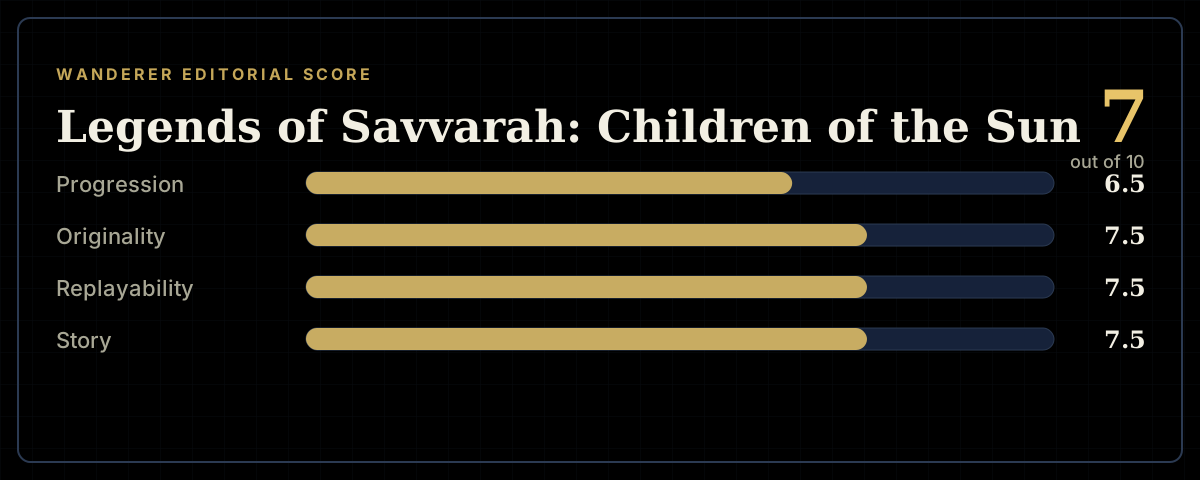
How the review scores each part of the gameWanderer Editorial -
The short versionWanderer Editorial