
Game review
Neo Cab
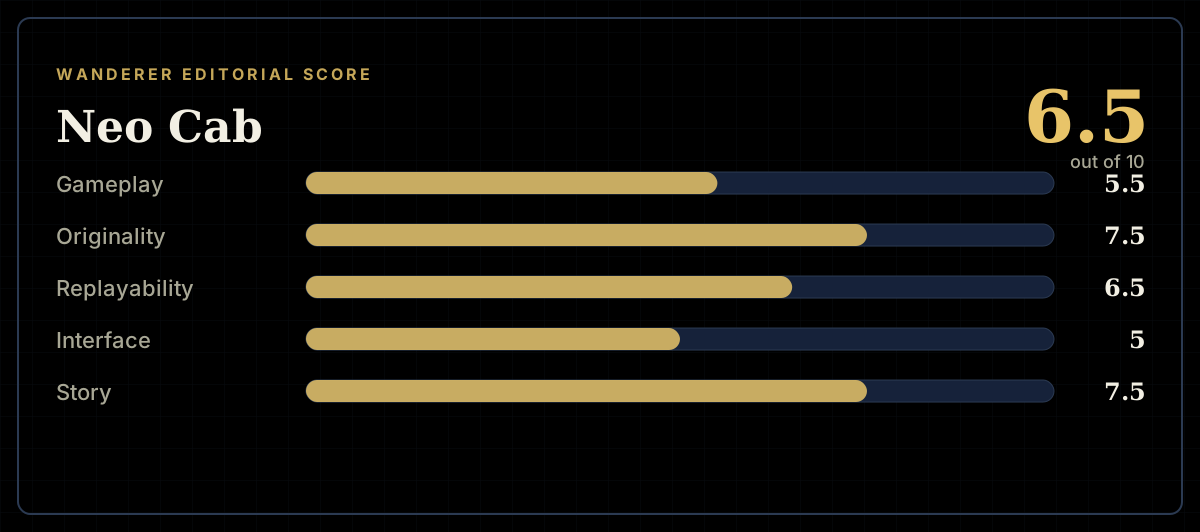
6.5 / 10
- Developer
- Chance Agency
- Publisher
- Fellow Traveller
- Released
- 3 October 2019
- Platforms
- Windows
- Genre
- Adventure
- Monetisation
- Paid, no in-app purchases found
- Players
- false
The short version
Neo Cab puts players in the seat of Lina, one of the last human rideshare drivers in an automation-dominated near-future city, picking up passengers whose stories unfold across a handful of tense, emotionally loaded nights. Its central conceit — a 'Feelgrid' that tracks Lina's emotional state and restricts which dialogue options are available depending on how she's feeling — is meant to make conversations feel psychologically real. A large, detailed portion of its own review corpus argues it instead produces exactly the opposite: the frustrating sensation of being denied the response you actually want to give, at the exact moments the story wants you to feel most in control.
Biggest strengths
- Genuinely strong, socially engaged writing that tackles real, weighty themes — bodily autonomy, racism, religion, mortality — through specific passenger stories rather than abstract commentary
- A distinctive neon-cyberpunk visual style and soundtrack that reviewers consistently praise for creating a cohesive, immersive mood
- Real replay value from multiple, meaningfully distinct branching endings, confirmed by a spread of achievement completion rates across several different late-game outcomes
Biggest weaknesses
- The core Feelgrid mechanic is the target of the corpus's most detailed and most repeated complaint: dialogue options are frequently greyed out or blocked based on Lina's tracked emotional state, which many reviewers experience as an illusion of choice rather than meaningful branching
- Multiple reviewers report this restriction landing hardest at pivotal narrative moments, including the ending, where a preferred response is denied specifically because "emotions said so"
- At least one detailed reviewer reports a continuity bug where dialogue referenced events that hadn't actually occurred in their specific playthrough, undermining the sense of a coherent, reactive story
Who it's for: Fans of narrative-driven, choice-based games (ELIZA, Night Call) who are prepared for a mechanic that deliberately limits agency as its core theme rather than maximises it.
Our recommendation: Worth playing for the writing and setting, but go in understanding the Feelgrid mechanic is restrictive by design — decide whether that sounds like thoughtful characterisation or frustrating railroading before buying.
6.5 / 10
What it is
Neo Cab casts the player as Lina, one of the last independent human drivers competing against autonomous vehicles run by the monopolistic Capra corporation in the near-future Automation City of Los Ojos. Arriving to move in with her childhood friend Savy, Lina instead finds herself pulled into a tense handful of nights picking up a rotating cast of passengers, each carrying their own story and their own effect on her emotional state. That state is tracked by the game's signature mechanic, the Feelgrid — a visible meter that shifts based on how conversations go, and which directly gates which dialogue options are available to the player at any given moment. The pitch is that this should make Lina feel like a real, psychologically consistent person rather than a blank vessel for player choice, reacting authentically to a hard day rather than robotically offering every possible response regardless of mood.
It released on 3 October 2019 at NZD 21.99, developed by Chance Agency and published by Fellow Traveller. Its 931-review English corpus sits at a strong Very Positive (768 to 163), and reading through it in depth surfaces one of the more focused, single-issue debates this lane has documented: almost the entire critical conversation around this game centers on one specific mechanic, argued in detail from multiple angles.
Strong writing, a distinctive world
Where the corpus agrees almost universally is on the quality of the writing and setting. "The game takes on a lot of tough/controversial topics — racism, bodily autonomy, religion, and killing/death," writes one reviewer, specifically praising how much there was "to discuss with the other characters" as a result rather than finding the subject matter heavy-handed. Another compares the experience directly to "ELIZA meets Night Call," calling it "a game about saying the right things in a game of emotional chess" and praising the setting's blend of "man versus machine, dystopian corporation versus free-spirited vigilante." The neon-lit visual presentation and soundtrack draw consistent, specific praise as well — "aesthetically I loved the neon city," writes one reviewer, and multiple others separately credit the atmosphere with making the four-or-so-hour runtime feel genuinely immersive rather than thin.
The Feelgrid problem, argued in detail
The corpus's dominant critical thread is remarkably focused and specific for a narrative game. "Good story, but ultimately a letdown, as the game doesn't give you the ability to make major impactful choices," writes one reviewer, reporting confusion at how often a desired dialogue option simply wasn't available "because Lina 'wasn't feeling like' pushing" a particular line. A separate reviewer frames the frustration even more sharply: "it's a choice game where you have no choice, a decision game that doesn't let you make decisions," despite genuinely admiring the game's "absolutely beautiful design" and "pleasantly chill audio" elsewhere in the same review. The complaint reaches its sharpest point around major branching moments — one reviewer reports the ending specifically as "the biggest letdown," describing two of three intended choices as blocked outright "because emotions said so," leaving only a single available path at the moment that should have felt most consequential.
It's worth taking this complaint seriously as a design critique rather than a misunderstanding of the game's intent, because the reviewers raising it clearly understand what the Feelgrid is trying to do — several explicitly acknowledge the thematic goal of tying dialogue to emotional realism — and argue specifically that the execution undermines rather than serves that goal by making players feel punished rather than characterised. One reviewer sums up the tension memorably: "Welcome to Tell-Me-What-To-Feel-And-What-To-Do, The Game," calling the mechanism "unintuitive" on top of restrictive.
A genuine counter-argument, and a real bug
Not every account of the Feelgrid is negative — several reviewers describe the restriction as a deliberate, successful piece of characterisation, part of what makes Lina feel like a specific person with a bad day rather than a player-insert. That's a legitimate reading the mechanic clearly supports for some players, even as it frustrates others. Separately, at least one detailed reviewer reports a more straightforward technical problem: dialogue that referenced plot events which hadn't actually happened in their specific playthrough, a continuity bug distinct from the intentional design tension around player agency, and worth flagging plainly as a quality issue rather than folding it into the broader Feelgrid debate.
What the achievement data reveals about the ending debate
The distribution of ending-related achievements offers a useful window into just how consequential player choice actually is by the numbers, regardless of how restrictive any individual conversation might feel in the moment. Rather than one dominant outcome that nearly everyone reaches, completion rates spread meaningfully across several distinct endings: "saved_allie" at 8.2%, "stay_at_babylon" at 6.8%, "out_of_coin" at 5.7%, "early_termination" at 3.7%, and "destroy_feelgrid" at a comparatively high 10%. That spread suggests the game's branching structure is genuinely responsive to the accumulated pattern of choices across a full playthrough, even if any single dialogue prompt within that playthrough can feel constrained. It's a useful distinction for weighing the Feelgrid complaint fairly: the criticism is almost always about moment-to-moment choice within a conversation, not about whether the overall narrative meaningfully branches by the end — and the achievement data supports the idea that it does branch substantially, even for players frustrated by individual locked-out lines along the way.
Reconciling the design intent with the player experience
The most useful way to read this game's central controversy is as a genuine gap between design intent and player experience rather than a simple bug or a simple misunderstanding. Chance Agency clearly built the Feelgrid to make dialogue choice reflect psychological state rather than pure player preference — a legitimately interesting design goal that few narrative games attempt as directly. The reviewers most frustrated by it aren't failing to grasp that intent; they're arguing, often in real detail, that being told what your character is and isn't "feeling like" saying, at the exact moment you've formed a clear intention about what to say, produces irritation rather than the intended sense of psychological authenticity. Both readings can be correct for different players simultaneously, which is exactly why this corpus splits the way it does rather than converging on either a clear rave or a clear pan.
Verdict
Neo Cab tells a genuinely well-written, socially engaged story in a distinctive, well-realized cyberpunk setting, anchored by a central mechanic that's clearly trying to do something more thoughtful than typical dialogue-tree branching. Whether that mechanic succeeds is a real, ongoing argument within its own audience rather than a settled matter — a significant, detailed share of players experience it as frustrating railroading rather than meaningful characterisation, especially at the story's most pivotal moments. Worth playing for the writing regardless, with expectations set accordingly around how much real control you'll actually feel you have.
Pros and cons
Pros
- Genuinely strong, socially engaged writing that tackles real, weighty themes — bodily autonomy, racism, religion, mortality — through specific passenger stories rather than abstract commentary
- A distinctive neon-cyberpunk visual style and soundtrack that reviewers consistently praise for creating a cohesive, immersive mood
- Real replay value from multiple, meaningfully distinct branching endings, confirmed by a spread of achievement completion rates across several different late-game outcomes
- A well-realized central relationship and setting that several reviewers say made them feel like "a cab driver in the near future" in a way that stuck with them after finishing
Cons
- The core Feelgrid mechanic is the target of the corpus's most detailed and most repeated complaint: dialogue options are frequently greyed out or blocked based on Lina's tracked emotional state, which many reviewers experience as an illusion of choice rather than meaningful branching
- Multiple reviewers report this restriction landing hardest at pivotal narrative moments, including the ending, where a preferred response is denied specifically because "emotions said so"
- At least one detailed reviewer reports a continuity bug where dialogue referenced events that hadn't actually occurred in their specific playthrough, undermining the sense of a coherent, reactive story
- A short overall runtime, around 4 hours for a single playthrough, that some reviewers feel doesn't fully deliver on the premise's potential even accounting for replayability across different routes
Screenshots
-

Neo CabImage: Fellow Traveller via Steam -

Neo CabImage: Fellow Traveller via Steam -

Neo CabImage: Fellow Traveller via Steam -
How the review scores each part of the gameWanderer Editorial -
The short versionWanderer Editorial