
Game review
Undying One Review
6 / 10
- Developer
- Novens Studio
- Publisher
- Novens Studio
- Released
- 27 August 2026
- Platforms
- ["Windows"]
- Genre
- RPG
A Twenty-Eighth Consecutive Launch Without a Single Review
Undying One released on Steam on 27 August 2026 and has zero user reviews at the time of writing, extending this stretch's run of unreviewed launches to twenty-eight. A necromancer-army roguelite with real-time combat and active pause is a fairly crowded pitch on Steam right now, which makes the total silence a little less surprising than some of this run's more distinctive titles, but nearly a month without a single review is still a notable gap for a genre this popular. This review is built entirely from the developer's own store page description, not from verified play.
Every Corpse Is a Recruit
The core premise is straightforward and well-worn but still effective: play a necromancer who converts every defeated enemy into a loyal summon, with that creature's original stats, spells, and combat behaviours preserved and then allowed to grow alongside the player. Summons are explicitly typed into tank, mage, support, and DPS roles, and can be actively deployed — sent to overwhelm a fight, held on a defensive line, ordered to focus down a priority target, or recalled to safety — which gives the army-building fantasy a genuine tactical layer rather than just a growing pile of passive followers. That's the right instinct for a "turn defeated enemies into your army" game: the interesting part isn't the initial acquisition, it's what a player does with a roster once they have one, and Undying One appears to commit real design attention to deployment choices rather than treating the army as a single aggregate power number.
A Dynamic AI Layer, On Both Sides
The store page makes a specific and testable claim about summon behaviour: that each undead ally chooses its own targets, spells, and priorities based on threat level, distance, enemy weaknesses, its assigned role, and "randomly selected tactical behaviours," explicitly promising that "no two fights ever play out the same." That's a meaningfully more ambitious AI claim than most summon-based roguelites bother making, where followers typically just auto-attack the nearest target. Whether that stated variety holds up as genuinely different fight-to-fight, or settles into a handful of recognisable behaviour patterns once a player has seen enough encounters, is exactly the kind of claim that can only really be judged through extended play — but it's a promising design ambition to make explicit on a store page rather than leave implicit.
Combat itself runs in real time but leans on an active-pause system, letting the player freeze the action to issue precise orders, manage the undead line-up, or time a spell for the right moment before dropping back into real-time chaos. That's a sensible compromise for a game asking players to simultaneously fight and manage a growing roster — pure real-time control would make army micromanagement nearly impossible at scale, while a fully turn-based structure would undercut the "intense" combat the store page promises.
Spells That Grow Sharper and Costlier
Progression leans on a usage-based evolution system: casting a spell repeatedly makes it stronger, and keeping a summon alive longer makes it more powerful, with the explicit tradeoff that stronger spells also become more expensive to cast, keeping mana pressure a constant factor rather than something that eases as a run goes on. That's a cleaner progression hook than a simple experience-point curve, since it directly rewards the specific spells and summons a player actually uses rather than handing out generic stat increases, though it also risks funnelling every run toward whichever one or two spells happen to synergise best with the mutator and enemy mix on offer. A rotating set of unlockable mutators (random starting spells, reduced maximum mana, increased vulnerability, disabled support spells, unstable corpses) and a persistent between-run shop for permanent upgrades and new archetypes round out a fairly standard but well-assembled roguelite meta-progression loop, alongside a dedicated Infinite Arena mode for players who want an endless test rather than a structured run. Tying each mutator to its own unlock condition rather than making the whole set available from the start is a small but sensible pacing choice, giving early runs a simpler baseline to learn the AI and deployment systems before harder, more chaotic variants are layered on top.
A Familiar Shape at a Fair Price
Undying One is Windows-only, supports English, French, and Spanish, and carries partial controller support alongside full achievement and cloud-save integration. At NZ$14.75 with no discount at the time of writing, and no in-app-purchase category listed on the store page, its entire spell-evolution and shop-unlock economy appears to run on in-game currency earned through play rather than any real-money layer. The pricing sits comfortably in the mid-range for the genre, matched to a scope that looks solid rather than exceptional — a well-constructed take on an already-popular necromancer-roguelite formula rather than a title trying to redefine it.
Verdict
Undying One takes a familiar necromancer-army premise and backs it with a genuinely tactical deployment system, an ambitious dynamic-AI promise for its summons, and a usage-based spell-evolution loop that rewards specific playstyles rather than generic grinding. Its biggest challenge isn't design ambition but crowd noise: real-time roguelites built around raising a fallen enemy's power are common enough on Steam that this one will need its AI variety and deployment tactics to genuinely stand out once players start comparing notes, and the interface score here reflects real-time army micromanagement being one of the harder things to communicate clearly on screen without extensive UI iteration — something no store page description can fully confirm either way. A month of silence is less surprising here than for this run's more unusual titles, but still worth flagging, and this assessment rests entirely on the developer's own description rather than anyone's actual playthrough.
Screenshots
-
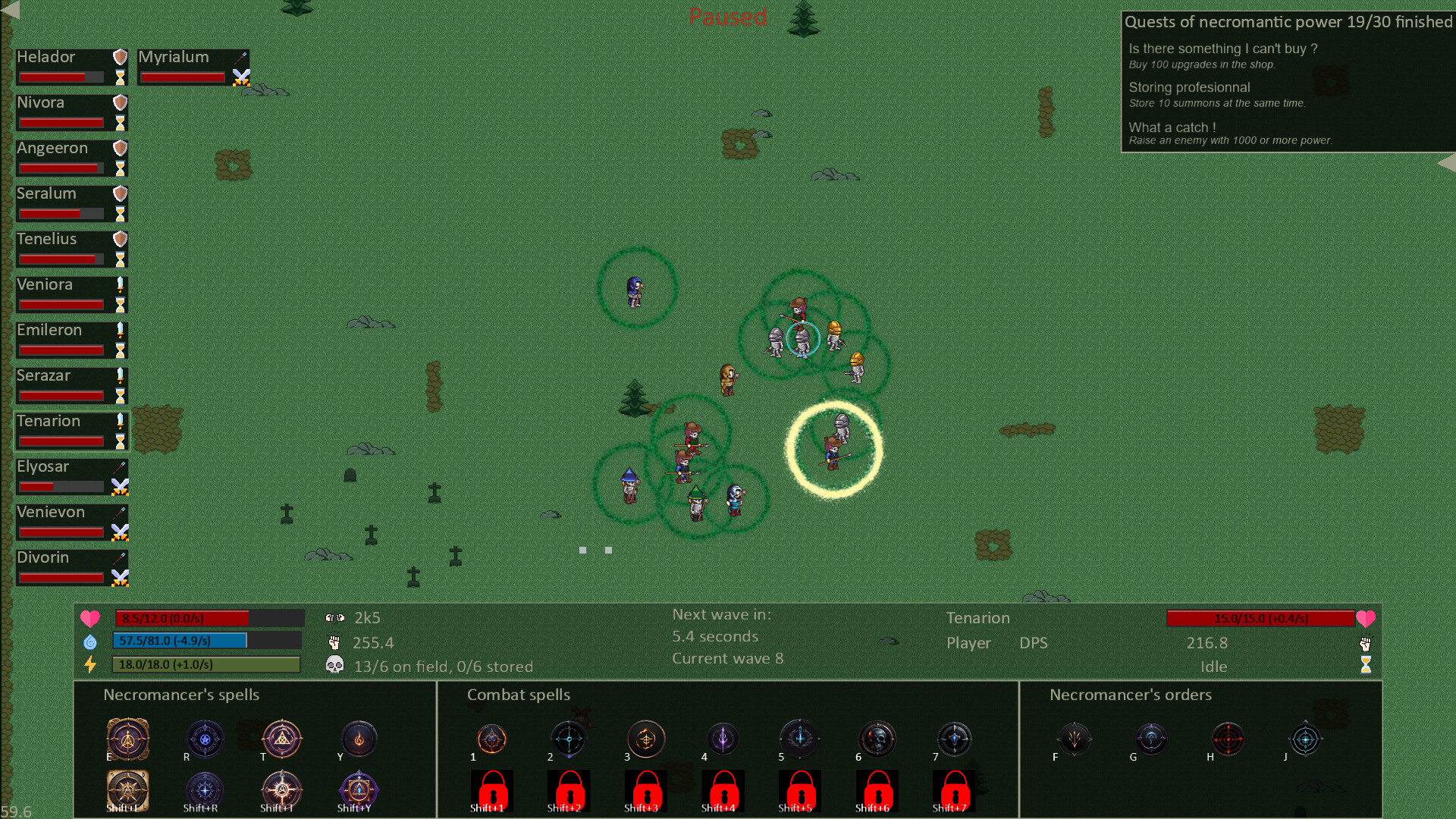
A paused wave-8 encounter, with the full named-summon roster and a mostly locked demo spell hotbar visible along the bottomImage: Novens Studio via Steam -
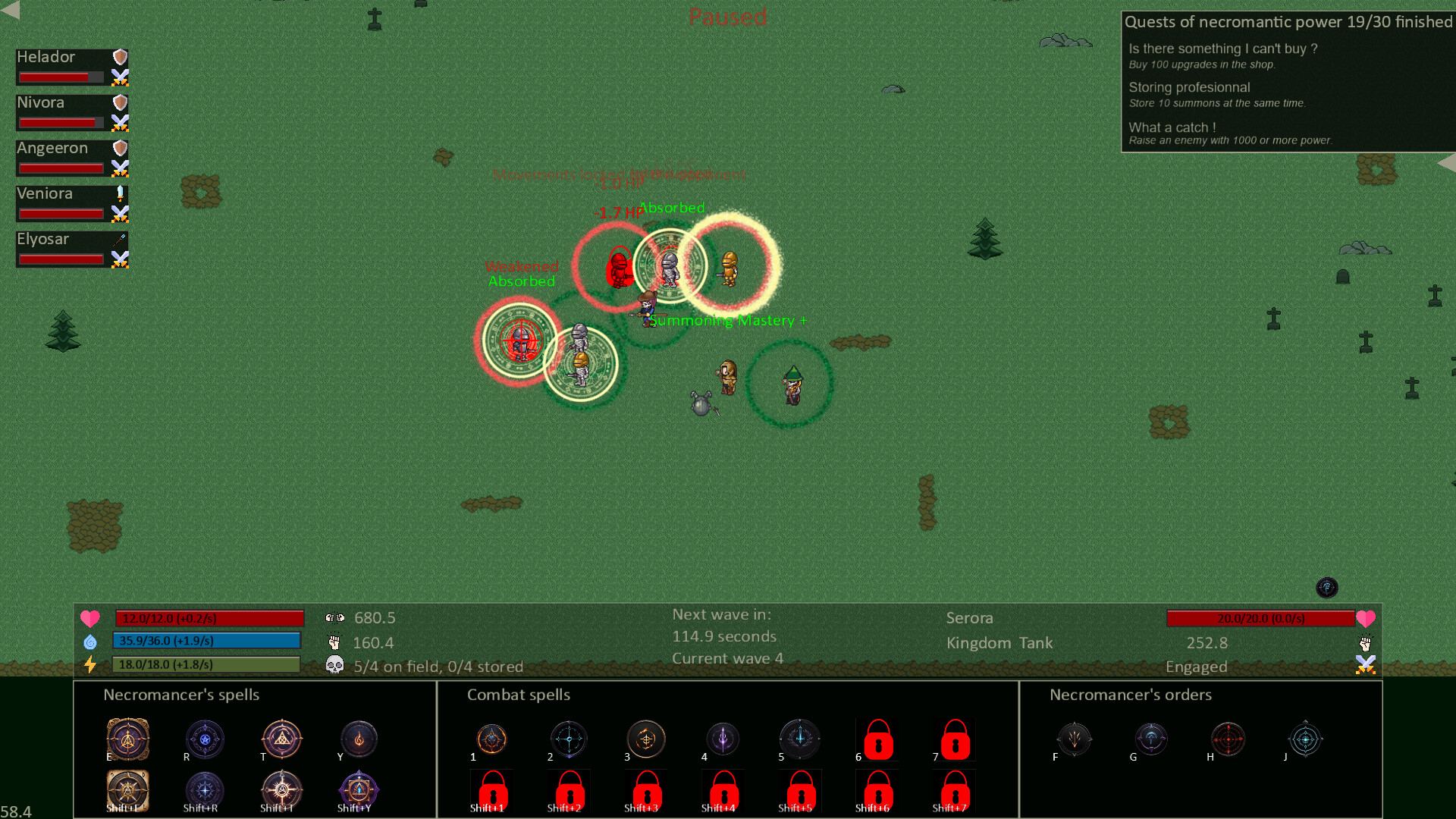
A tighter skirmish against a Kingdom Tank, with status effects and a Summoning Mastery bonus triggering mid-fightImage: Novens Studio via Steam -
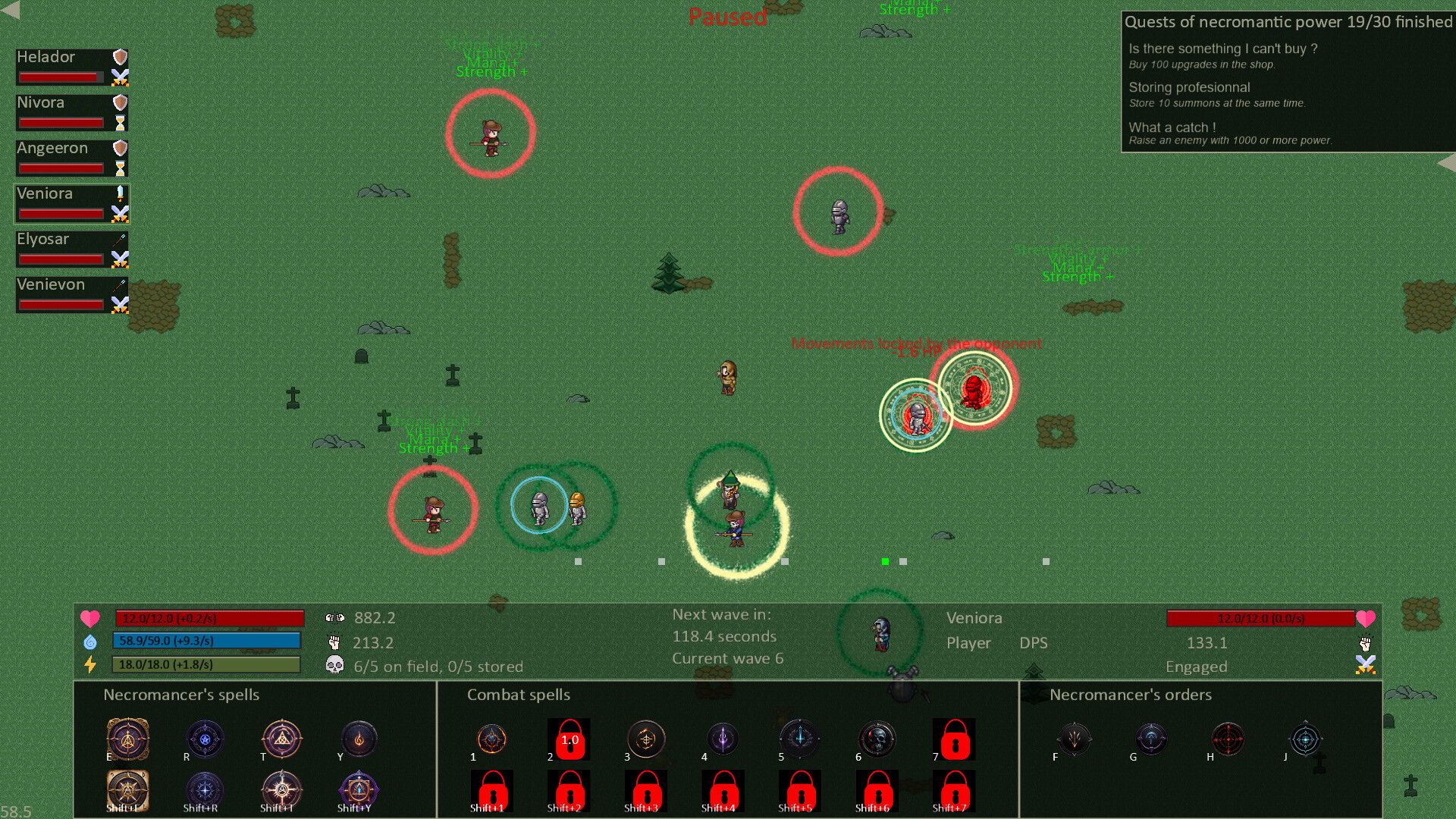
A spread-out wave-6 fight, with stat bonuses triggering across the field and one enemy locked in placeImage: Novens Studio via Steam