Game review
Shadowlight Review
7 / 10
- Developer
- Unangwata
- Publisher
- Rogue
- Released
- 11 September 2026
- Platforms
- ["Windows"]
- Genre
- RPG
Light and Shadow Decide Who Lives
Shadowlight's pitch is unusually blunt for a store page: "The game is difficult, so play smart." It's a turn-based, ASCII-rendered stealth roguelike built around a single governing rule — stay in shadow and a thief-class player character is effectively invisible, but step into any torch's light and "every monster that can see you comes for your throat." The core loop rewards patience over aggression: stalk torch-bearing guards from darkness, strike for triple damage on an unseen target, then melt back into cover before the next threat notices. The store page is explicit that this isn't a power fantasy — "you are not a warrior — in a fair fight you die. So never fight fair" — which sets Shadowlight apart from the more forgiving stealth-adjacent roguelikes that let a player brute-force a bad position.
A Roguelike Built From ASCII, Not Sprites
Rather than assuming familiarity, the store page includes a short primer for anyone who's never touched a classic roguelike: "@ represents your character... Monsters are represented with symbols (O is an orc)... 1 move is 1 turn, you move then monsters." Movement runs on the numeric keypad across nine directions, letting a player step diagonally, wait in place to let darkness creep back over a lit tile, or close a door to cut off a torch's light entirely. One reviewer, admitting they were "skeptical about the visuals," reported getting hooked "a few deaths later," while another described the concept directly: "you have to stealth, fight, and explore dungeons made entirely out of ASCII art" and called it "genuinely original" for RPG fans willing to give it a chance. That reception matters for a genre choice this deliberately old-school — the game is betting that its light-and-shadow system carries enough novelty to outweigh graphics some players will bounce off immediately.
Backstabs, Riposte, and a Kit Built Around Not Fighting Fair
The ability kit reinforces the stealth-first design rather than offering a workaround for it. Shadowmeld lets a character vanish into shadow on demand, Shadowsight can see through a monster's own stealth, and Shout deliberately draws enemies — and the light they carry — toward a chosen point, useful for luring a patrol away from a locked box. Riposte adds a defensive option: dropping into a parry stance to turn aside an incoming blow and answer with a doubled strike, which gives a cornered thief a way out that doesn't rely purely on running. Enemies push back against rote tactics too — Shadelings can melt into shadow the same way the player can, and the High Priest can lock a character in place with Paralyze, meaning the store page's warning to "learn their tells or die to them" isn't just flavour text.
Four Descents With Their Own Rules
Procedural generation covers four distinct settings, each with its own palette, monster roster, and lighting behaviour: standard dungeons, a green-lit temple, a torchlit manor heist, and deep crystal caves. The manor heist stands out as a distinct objective rather than pure descent-and-loot — the brief is to slip past patrolling guards, lift a locked box, and "escape unseen," with getting spotted meaning a player flees empty-handed rather than simply taking damage. Progression outside a single run comes from crafting: every 50 kills yields materials usable at a workbench, away from watching enemies, to forge healing potions, smoke bombs, and trap kits. Combined with real light-with-distance-falloff simulation from both wall torches and monsters, it's a more systemic take on "light versus dark" than the phrase usually implies in roguelikes that use it as pure flavour. The store page also flags specific presentation choices behind the ASCII wall — filled-tile walls rather than bare line-art, a scrolling camera instead of a fixed grid, and a "banded warm palette" meant to make torchlight feel like an actual light source rather than a colour swap — details aimed at making the format feel deliberate rather than like a retro shortcut.
A Small, Positive Early Reception
Shadowlight's review sample is thin — five total reviews at time of writing, three of them in English, and all three positive. Beyond the reviewer drawn in despite initial skepticism about the ASCII presentation, a third wrote simply that the game "has a rather distinctive look, as you can see from the images on its page, though if that's the kind of thing you enjoy, you'll get some joy" — a fair summary of how binary the visual style's appeal is likely to be. None of the available English reviews report bugs, performance issues, or complaints about the difficulty being unfair rather than demanding, though the sample is too small to treat that as a firm verdict on either front. Steam's category list shows Trading Cards and Leaderboards but no Steam Cloud or Achievements, so progress tracking and cross-device saves aren't part of the current feature set — worth knowing for anyone planning to switch machines mid-run.
Verdict
Shadowlight commits fully to a single idea — light exposes you, shadow protects you, and every tool in the kit exists to manipulate that boundary rather than to brute-force past it — and builds four visually distinct settings, a heist objective, and a genuinely threatening enemy roster around it. The classic ASCII presentation and steep, explicitly unforgiving difficulty will filter out a chunk of the audience before the mechanics get a fair hearing, and the current review sample is too small to say with confidence how the game holds up over a longer campaign. But for roguelike players who want stealth to be the actual system rather than a reskinned combat loop, and who don't need modern 3D dungeon dressing to get invested, Shadowlight is a cheap, focused, and distinctive pickup.
Screenshots
-
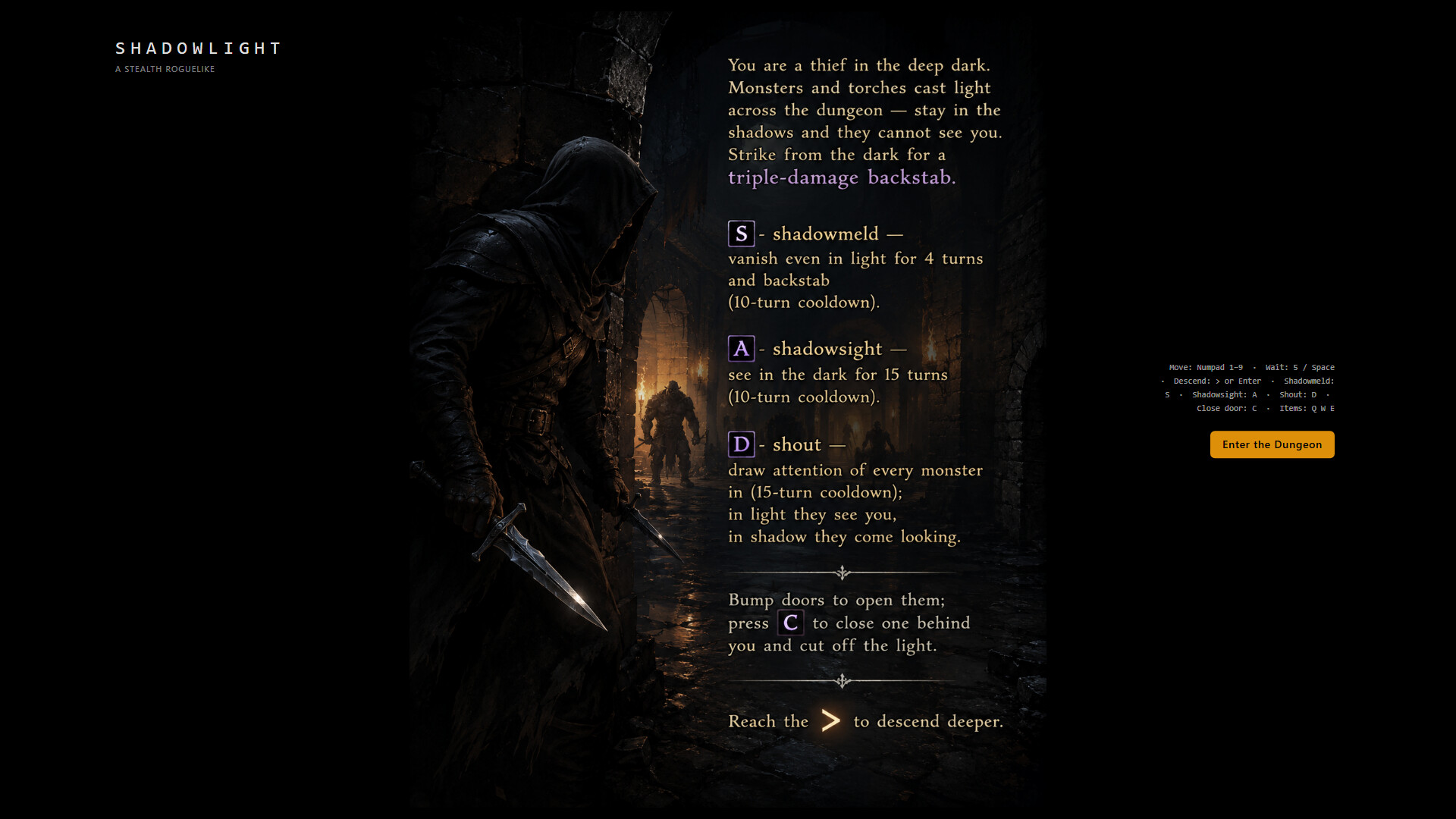
The control primer explaining Shadowmeld, Shadowsight, and Shout before a run beginsImage: Rogue via Steam -
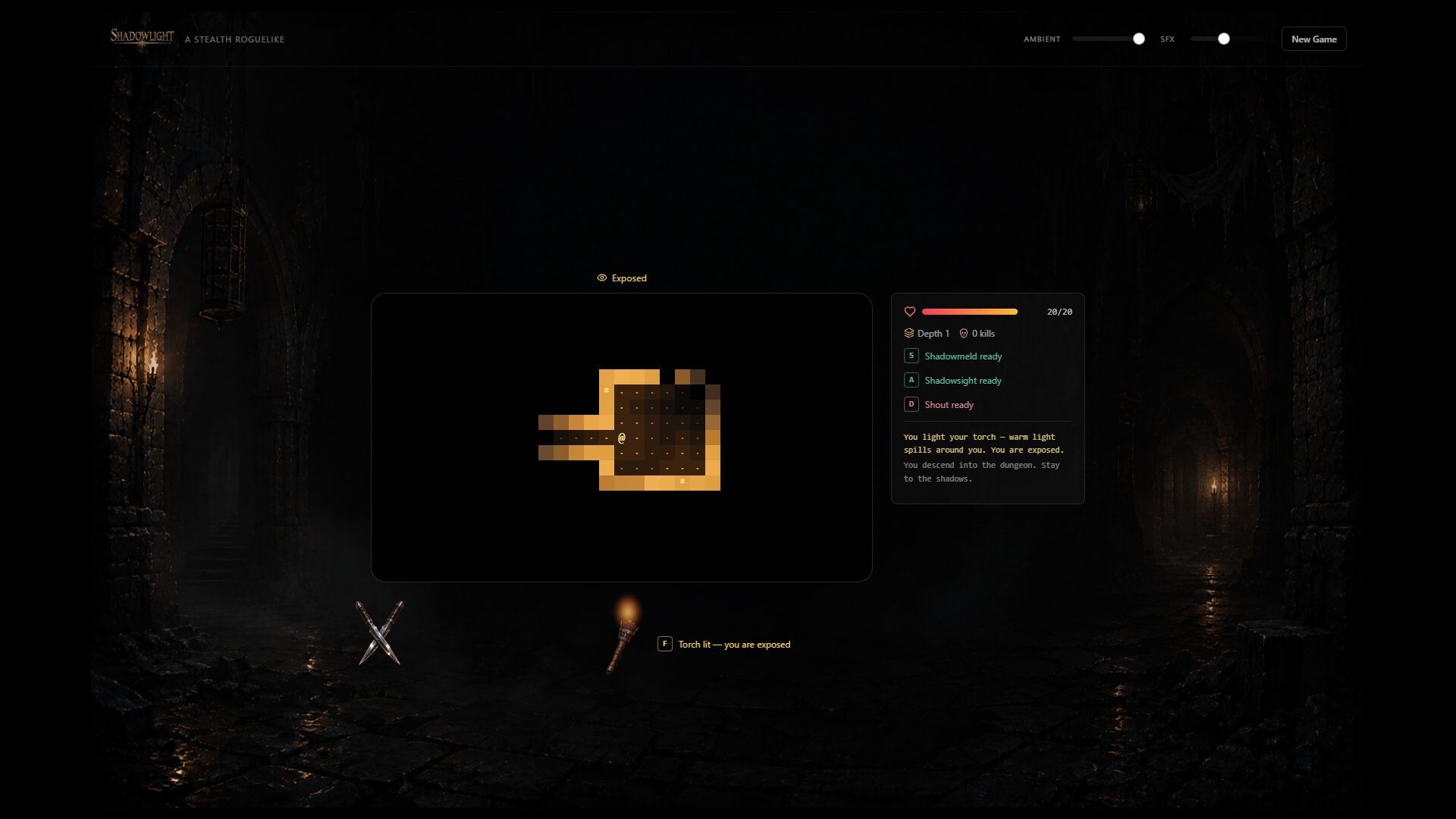
A lit torch exposing the player's position on the dungeon gridImage: Rogue via Steam -
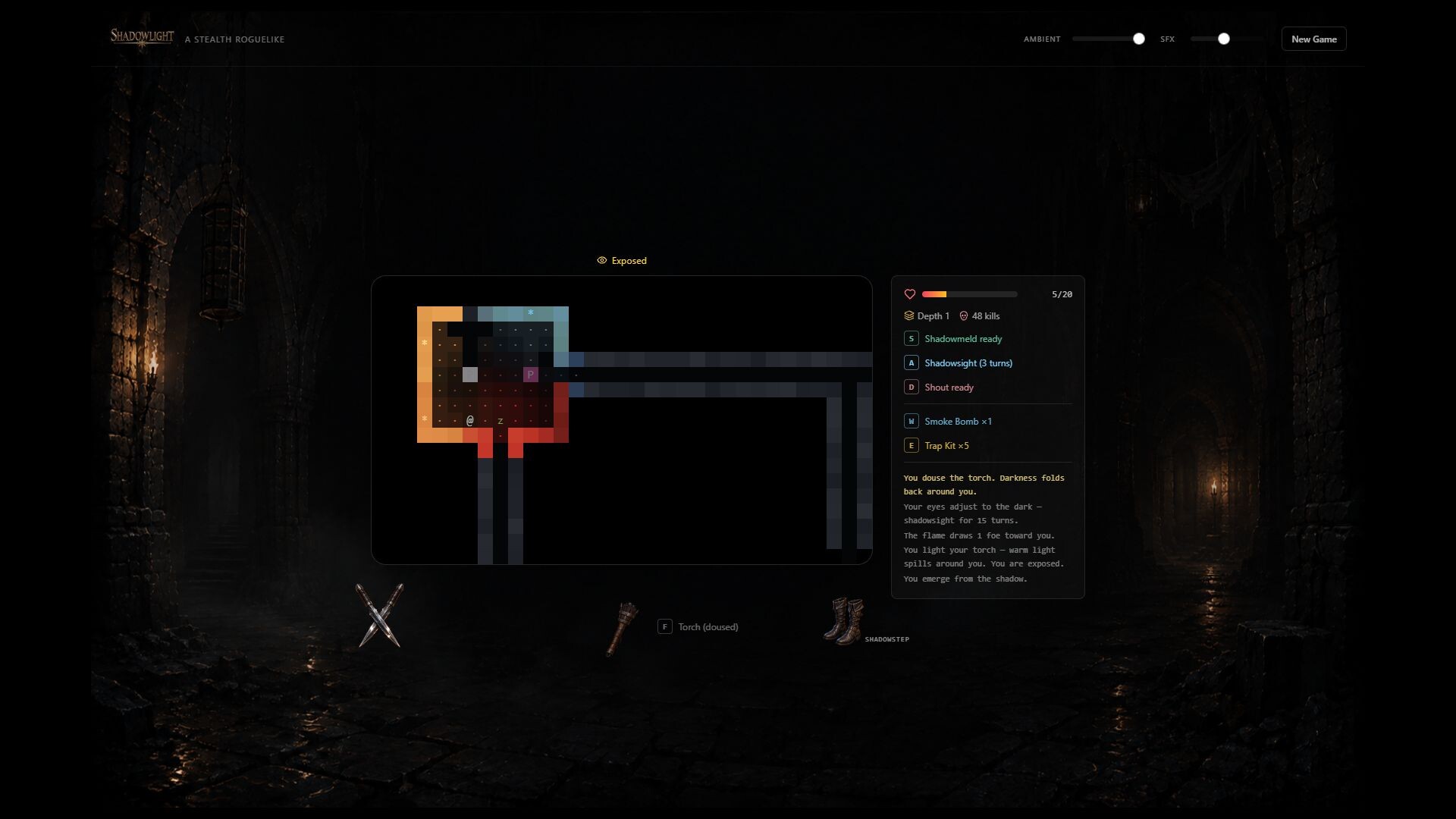
Dousing the torch to fold back into darkness, with a Smoke Bomb and Trap Kit in reserveImage: Rogue via Steam