Game review
Atomcraft Review
7.5 / 10
- Developer
- Triplejump
- Publisher
- Triplejump
- Released
- 23 July 2026
- Platforms
- ["Windows", "Mac", "Linux"]
- Genre
- Simulation
A Chemistry Simulator That Happens to Be a Game
Atomcraft launched into full release on Steam on July 23, 2026, from solo-developer-led studio Triplejump, following a demo and Steam Playtest period earlier in the year that built enough buzz to carry a wishlist well past release. It belongs to the falling-sand genre made famous by The Powder Toy, where every material on screen exists as an individually simulated pixel, but Triplejump's twist is genuinely ambitious: the entire periodic table is present and behaves according to real chemistry, and the actual goal, repairing a crashed spaceship by collecting every element, gives that simulation an objective The Powder Toy never had. The review sample is overwhelmingly positive, 96% across 334 reviews, and repeatedly frames this as the missing link between a raw physics toy and an actual game.
Real Chemistry as the Core Mechanic
The praise that dominates the sample isn't really about combat or exploration, it's about the chemistry itself. Multiple reviewers, including at least one self-identified chemistry teacher, single out the accuracy of the reactions and their real-world conditions, and describe genuinely falling down Wikipedia rabbit holes after triggering an unexpected reaction in-game, discovering, for instance, why quicklime glows at high temperatures or what a specific isotope is actually used for. Building machines, forges that smelt ore into metal, electrolysis rigs that split water into hydrogen and oxygen, distillation setups that separate gas mixtures, is consistently described as deep and satisfying once a player pushes past an admittedly steep early learning curve, with an in-game reaction guide covering what to make without spelling out exactly how to build the machine that makes it.
Content Gaps and a Debate Over the Early Access Label
The most pointed and recurring criticism in the sample isn't a bug, it's a labeling complaint. Atomcraft launched as a full 1.0 release, but a cluster of detailed negative and mixed reviews note that only the starting planet is actually playable, with further areas and features marked "coming soon," and no Early Access disclaimer anywhere on the store page. Several reviewers explicitly say this should have shipped as Early Access, and one frames the omission as an outright deception, even while acknowledging the developer isn't acting maliciously and is visibly still building the game out. It's a fair complaint on the evidence: the publicly posted "1.0+ Roadmap" and near-daily patch notes since launch look a lot more like a game still finding its final shape than a finished product, even if most reviewers ultimately decide the current content is worth the asking price regardless.
Rough Physics, Real Bugs
Beyond the labeling debate, reviewers flag specific and consistent technical shortcomings. There is no heat conduction between solid materials, only radiant heat, which several builders call out as a real limitation on machine design since a heated forge won't warm anything it isn't directly touching. Gas-and-liquid interactions draw similar complaints, with more than one reviewer noting that lighter gases don't reliably rise through denser ones, undermining certain machine designs entirely. On the stability side, a meaningful minority reports memory-related slowdowns and crashes during long single sessions, severe enough that a few reviewers recommend closing and restarting the game every couple of hours as a workaround, alongside occasional stutters tied to particle-heavy weather effects like rain and snowfall.
A Developer the Community Trusts
Running through nearly every review, positive or critical, is genuine confidence in the developer. Reviewers repeatedly describe rapid, visible responses to bug reports on Discord and in the Steam discussions, quality-of-life changes arriving within days of being requested, and a philosophy that favors polish over rushing new content, a contrast several reviewers draw explicitly against "content content content" development elsewhere in the genre. That trust appears to be doing real work in softening the impact of the labeling and stability complaints above; several reviewers who list real problems still recommend the game specifically because they expect the developer to keep fixing them.
A Deep, Niche Sell
Atomcraft is upfront about not being for everyone, and its own fans agree: this is, as one reviewer puts it, "a virtual chemistry set which feels a bit like a game," not the reverse, and players expecting a conventional survival-crafting loop with combat and exploration will find both nearly absent (two enemy types, a mostly featureless overworld). For the audience it is built for, people who enjoyed Oxygen Not Included, Noita, or The Powder Toy and always wished the chemistry underneath was real, the sample suggests it delivers something close to unmatched in its niche.
Comparisons to Sandustry Are Inevitable, and Instructive
Several reviewers have also played Sandustry, a similar recent falling-sand release, and the comparisons drawn are consistent enough to be useful: reviewers who prioritize automation and factory-building at scale tend to favor Sandustry, while those most excited by realistic chemical interaction and a genuinely deep periodic table favor Atomcraft. One reviewer sums up the split bluntly, calling Atomcraft the better choice for building complex processing machines but naming Sandustry the stronger pure automation game. That specificity is a good sign for a young genre; it suggests Atomcraft has already carved out a distinct identity rather than existing as one interchangeable falling-sand clone among several.
Verdict
Atomcraft is an unusually rewarding case of a niche genre finding a genuinely new hook: real periodic-table chemistry wrapped around machine-building objectives, executed with enough care that even players who came in knowing nothing about chemistry describe learning real facts by accident. The rough UI, missing heat-transfer mechanics, and a launch content scope that plenty of reviewers feel was mislabeled as a finished 1.0 rather than an honest Early Access release are real drawbacks worth knowing about going in. But a responsive, trusted solo developer and a simulation depth that has no real competitor make this an easy recommendation for anyone the pitch appeals to at all.
Screenshots
-
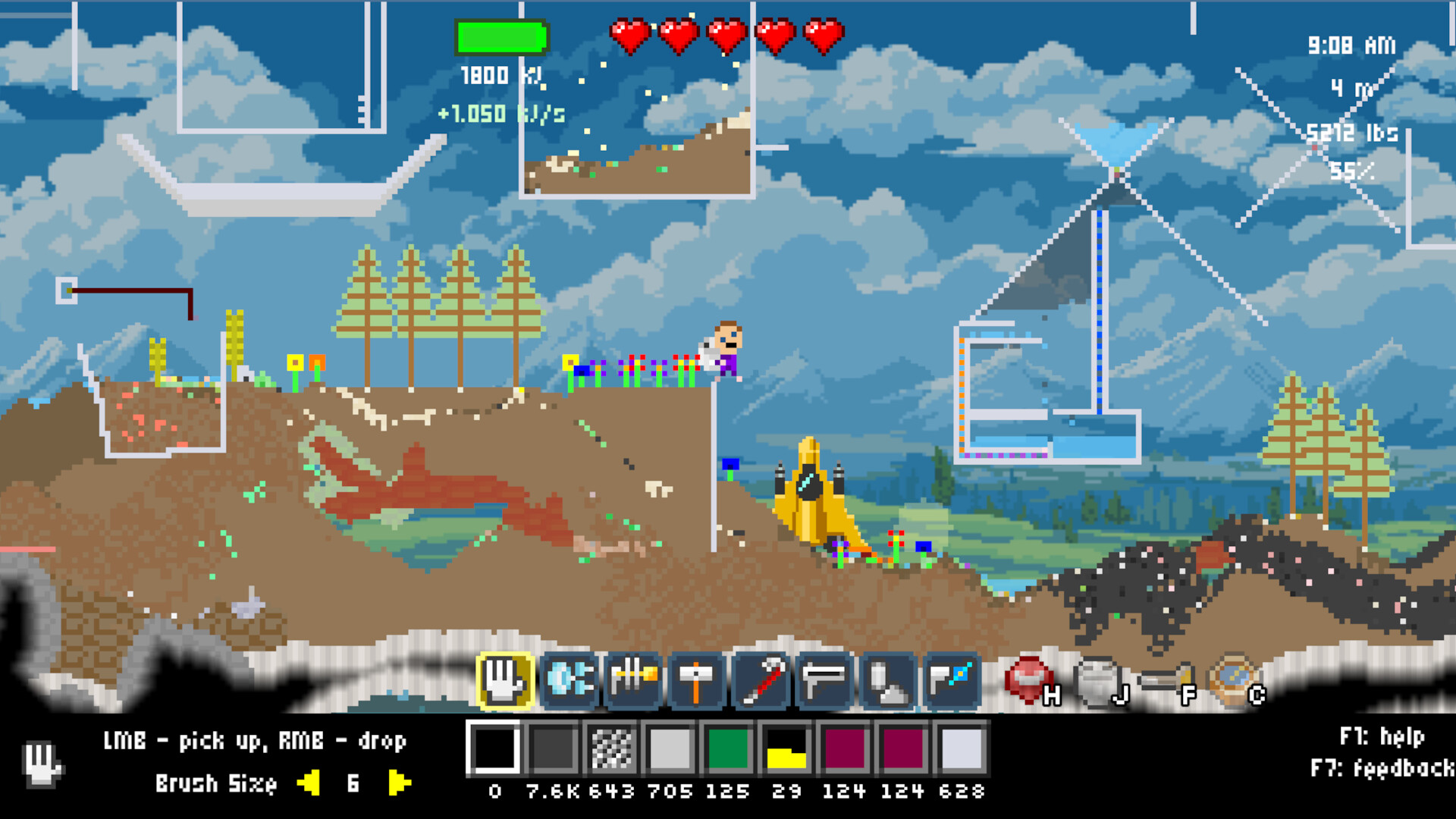
The overworld surface, dug open to reveal ore deposits, near the crashed ship the player is working to repair.Image: Triplejump via Steam -
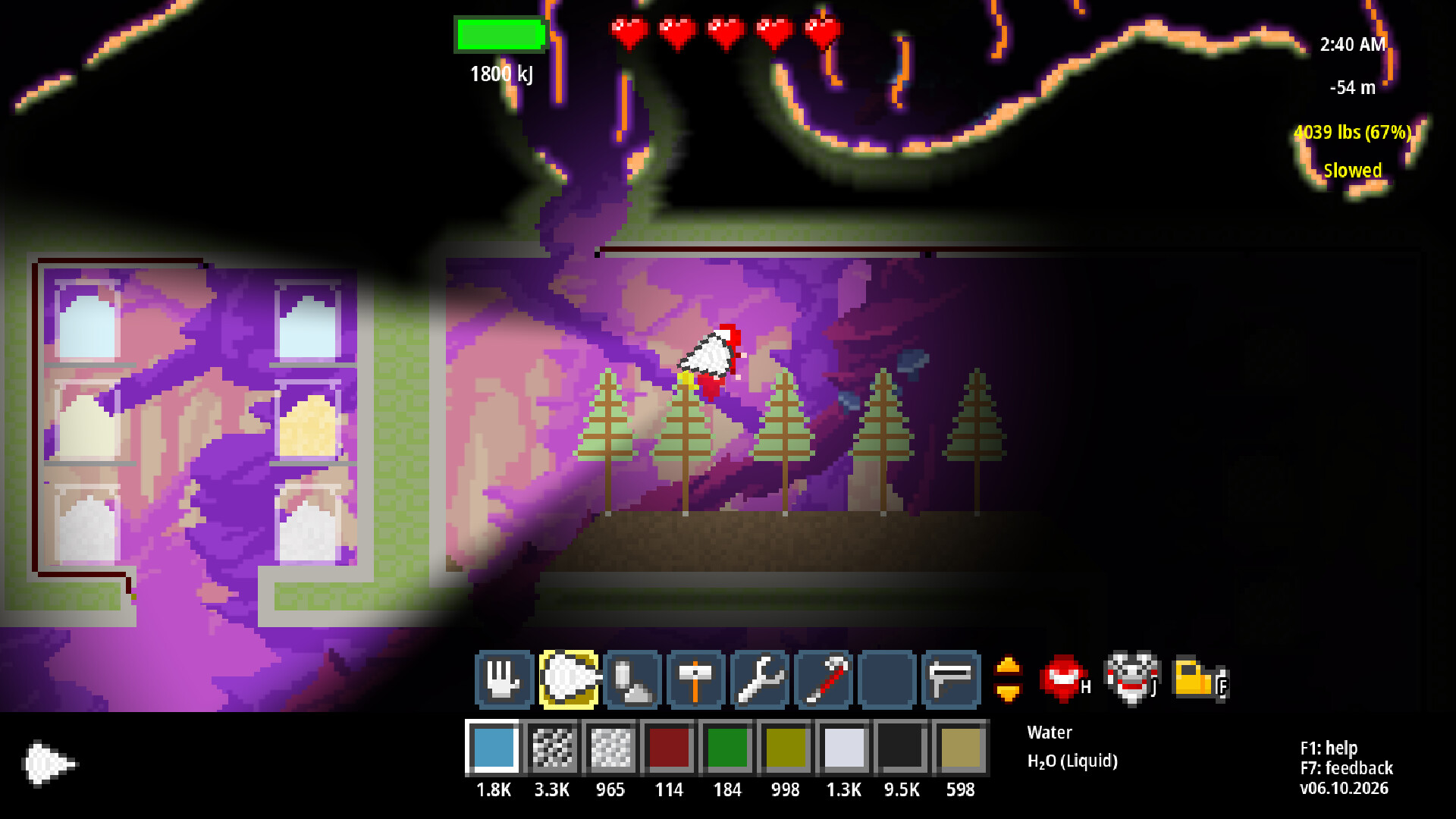
Underground, where purple mineral deposits and pooled water sit among the dozens of trackable substances shown in the bottom bar.Image: Triplejump via Steam -
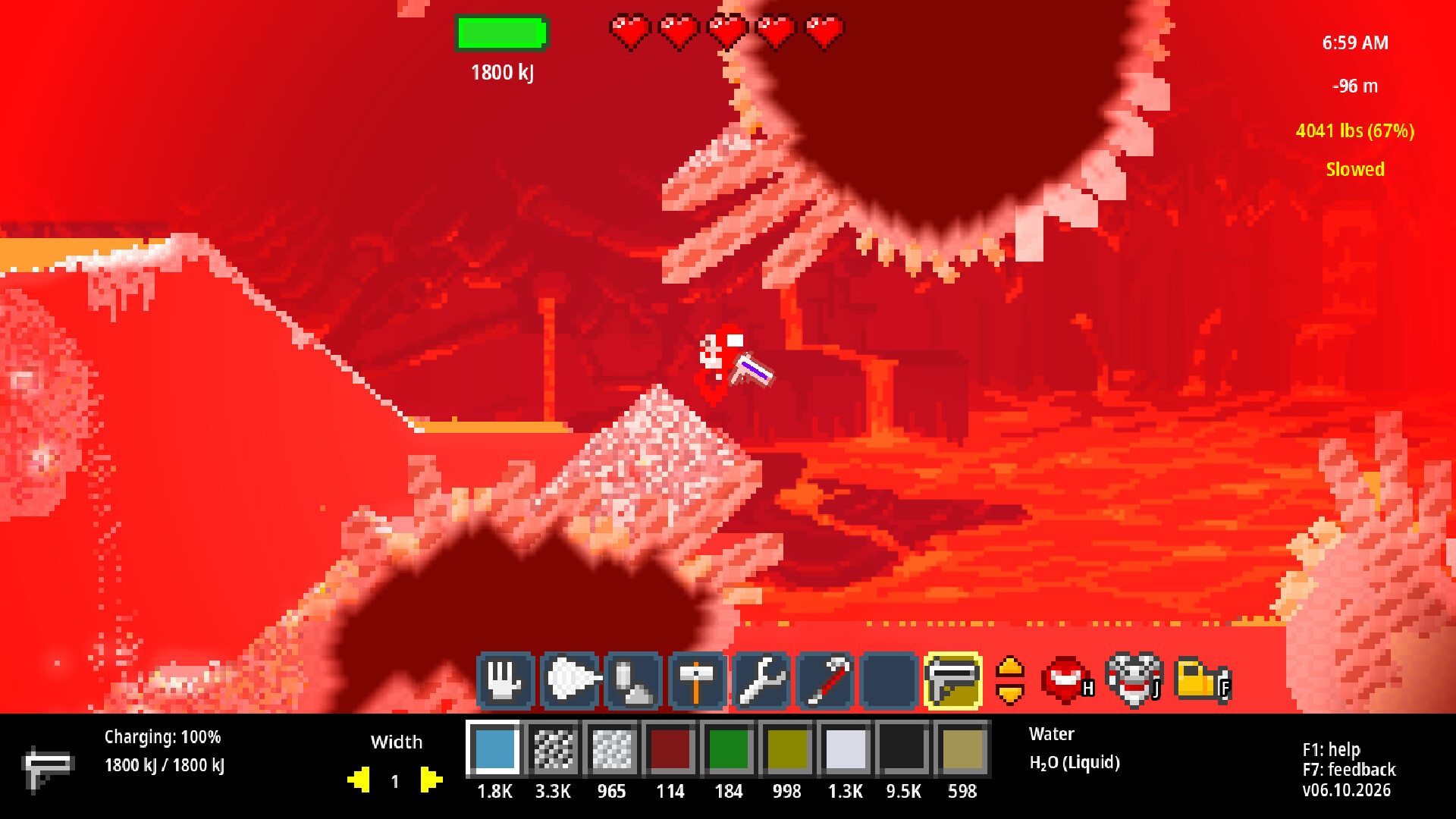
A lava cavern deep underground, one of several extreme biomes standing between the player and the elements needed to finish the game.Image: Triplejump via Steam