Game review
Medieval - Embers of War 2 Review
6 / 10
- Developer
- Evil Bunneh Inc.
- Publisher
- Evil Bunneh Inc.
- Released
- 3 September 2026
- Platforms
- ["Windows"]
- Genre
- RPG
A Seventeenth Consecutive Launch Without a Single Review
Medieval - Embers of War 2 released on Steam on 3 September 2026 and currently has zero Steam user reviews, extending an unbroken run of unreviewed launches covered in this stretch of the schedule to seventeen. Co-op action games in particular tend to rely on word of mouth from groups of friends deciding to buy in together, so a quiet launch window here is a plausible visibility problem rather than necessarily a quality signal. This review is built entirely from the developer's own store page description, not from verified play.
More Than a Hero Running Into Battle
The pitch positions the player explicitly above the level of a lone combatant: "you are more than just a hero running into battle. Your decisions on the battlefield matter." Concretely, that means calling in supporting units, capturing and holding strategic points, and choosing where to commit forces, framed as creating "an advantage" against an enemy that "isn't just waiting to be defeated" but can draw on "the same battlefield mechanics and capabilities available to you." That symmetrical design — where the AI opponent uses the identical toolkit the player has access to, rather than a scripted set of encounter-specific behaviours — is a meaningful claim if it holds up, since asymmetric AI that simply spawns predetermined waves tends to make battlefield control feel more like memorisation than genuine strategy. Whether the AI's use of shared mechanics actually produces adaptive, situationally responsive play, or just applies the same toolkit in predictable patterns, is exactly the kind of thing that only becomes clear with extended play.
A Colorful Low-Poly Battlefield, Built for Four
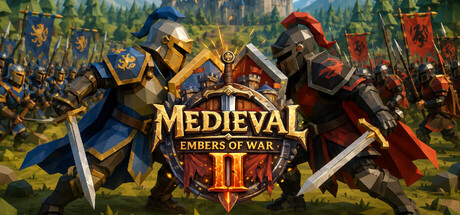
Visually, the game is described as "a colorful low-poly medieval world" viewed from a top-down perspective, a style choice that tends to favour clarity over spectacle — a reasonable trade-off for a game whose core appeal depends on being able to read unit positions and capture-point states at a glance during a busy battle. The headline feature is local co-op for up to four players, with each participant controlling "their own hero while managing their units and working with the rest of the team." That's a demanding design target: coordinating four independent heroes, each juggling their own unit-calling and point-capture decisions, requires either very legible shared-state UI or a fair amount of pre-battle communication between players, and the store page doesn't detail how the game surfaces teammates' unit compositions or captured-point ownership at a glance. Remote Play Together support is also listed among the categories, meaning the four-player co-op doesn't strictly require everyone to be on the same couch, which matters for a genre that often loses players simply because coordinating a shared physical setup is harder than getting online at the same time.
The single-player category is also listed alongside the co-op modes, which raises a separate question the store page doesn't directly answer: whether the battlefield-control loop of calling units and holding points still feels engaging when one player is managing every hero-adjacent decision alone, or whether the design genuinely depends on the social layer of coordinating with other people to feel complete. A capture-and-hold system built around "the same tools" for both sides could work well solo against AI, but it could equally turn out to be the kind of game that only sings once there are real teammates making independent, occasionally conflicting decisions on the same battlefield.
Two Modes, One Core Loop
Content is split between "an introductory, objective-based campaign" that "gradually introduc[es] new gameplay elements," and a "free-form" Skirmish mode built around the same capture-points-and-push-toward-camp loop without a fixed narrative structure. That's a sensible division of labour for a battlefield-control game — a guided campaign to teach the individual systems (which units to call, when to hold a point versus push forward) before handing players the open-ended Skirmish mode to apply what they've learned against the AI or alongside friends. The store page frames the whole design around a fairly small set of "simple ideas: fight together, make smart decisions, and take control of the battlefield," which suggests an accessible entry point rather than a deep, systems-heavy strategy game, though that same simplicity is also a risk if the strategic layer turns out to be too thin to sustain repeated skirmishes once the campaign is finished.
A Fair Price for a Co-op Niche
At NZ$12.49 with no discount at the time of writing, that's a reasonable price for a co-op-focused indie title, particularly given that local and Remote Play Together co-op for up to four players effectively multiplies the value for a group that buys in together, even if only one copy is strictly required for couch co-op. There's no mention on the store page of any monetisation beyond the base purchase, and English is the only listed supported language. As with several other 0-review co-op titles, its core appeal is heavily dependent on actually having three friends interested in trying it at the same time, which is a real practical barrier separate from the quality of the game itself.
Verdict
Medieval - Embers of War 2 pitches an accessible top-down co-op battlefield-control game, built around calling in units, capturing strategic points, and facing an AI opponent that claims to draw on the same tools as the player, split across a teaching campaign and an open-ended Skirmish mode for up to four players. Like every other title covered in this stretch, it remains completely unreviewed by Steam's user base at the time of writing, so whether the symmetrical AI design actually produces adaptive rather than predictable opposition, and whether four simultaneous heroes can coordinate cleanly without a confusing UI, are unverified claims rather than confirmed strengths. Its fair price and genuine four-player co-op focus make it a reasonable pick for a group of friends looking for something lighter than a full RTS, with the standing caveat that this assessment rests entirely on the developer's own description rather than anyone's actual playthrough.
Screenshots
-
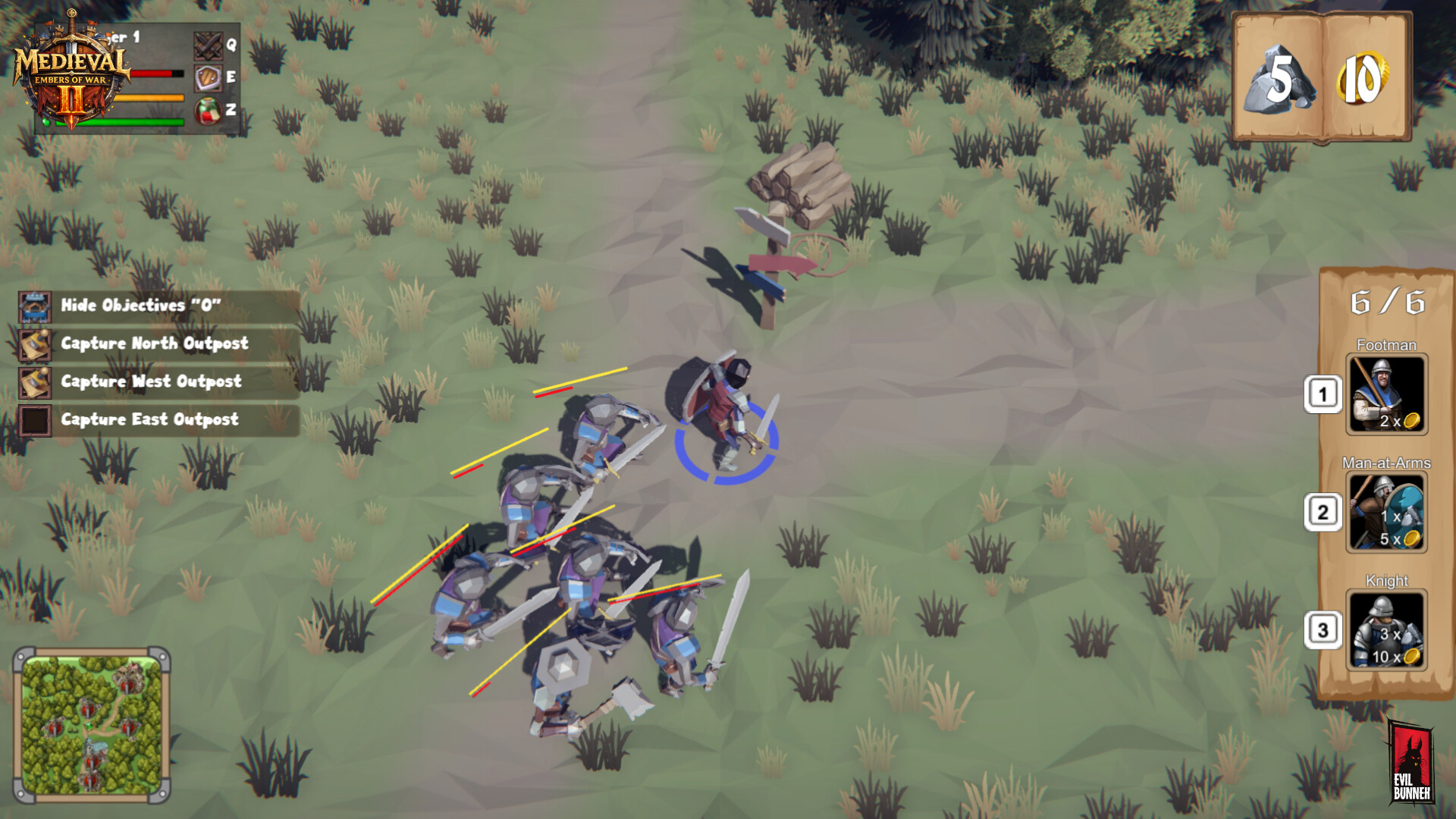
The objectives panel tracks which outposts remain to be captured, while the unit-summon panel on the right lets the hero call in Footmen, Men-at-Arms, or Knights for a resource costImage: Evil Bunneh Inc. via Steam -
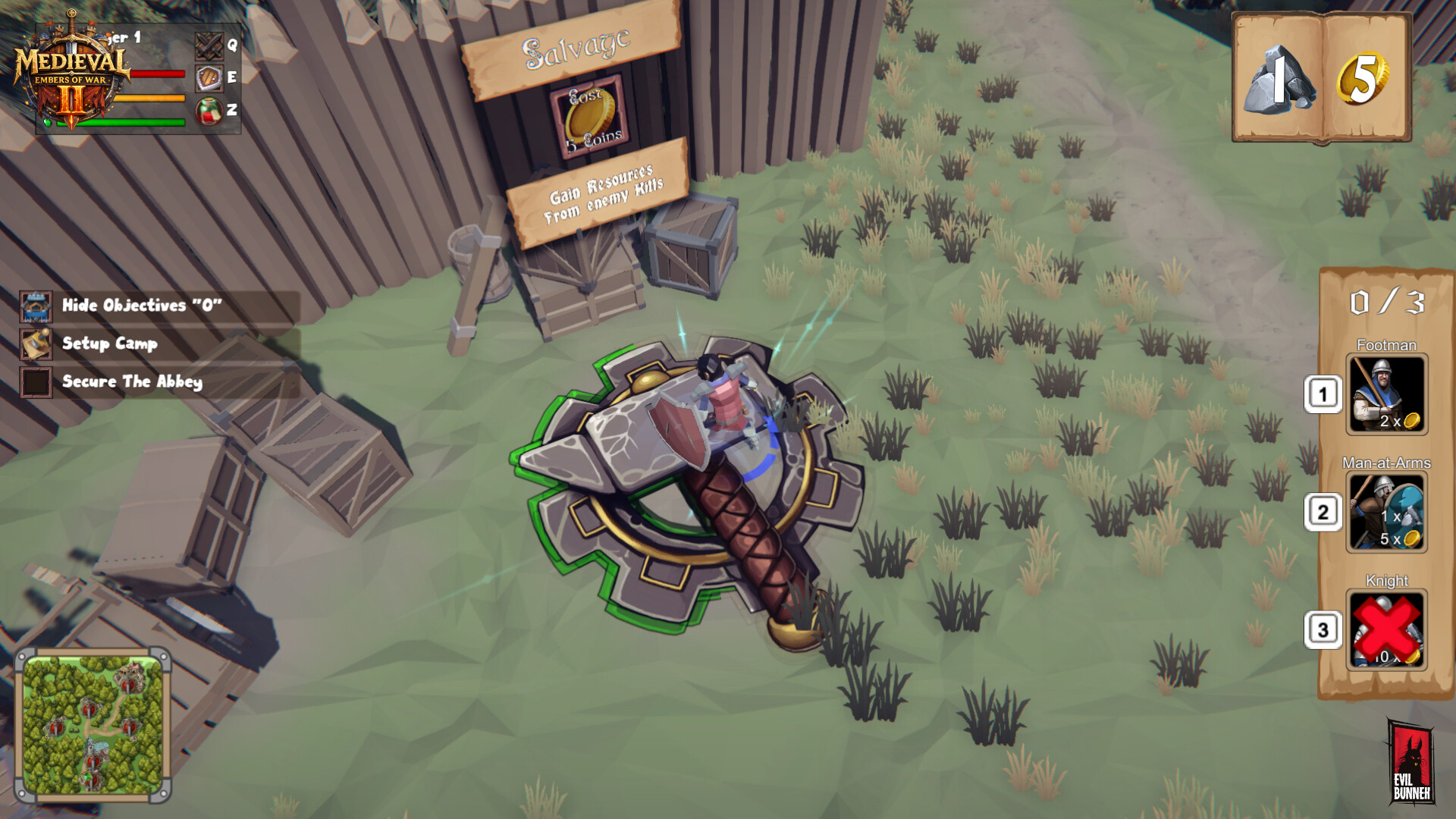
Capture points glow green as they're claimed, and camp upgrades like this Salvage station let resources flow in from combat kills rather than only from captured pointsImage: Evil Bunneh Inc. via Steam -
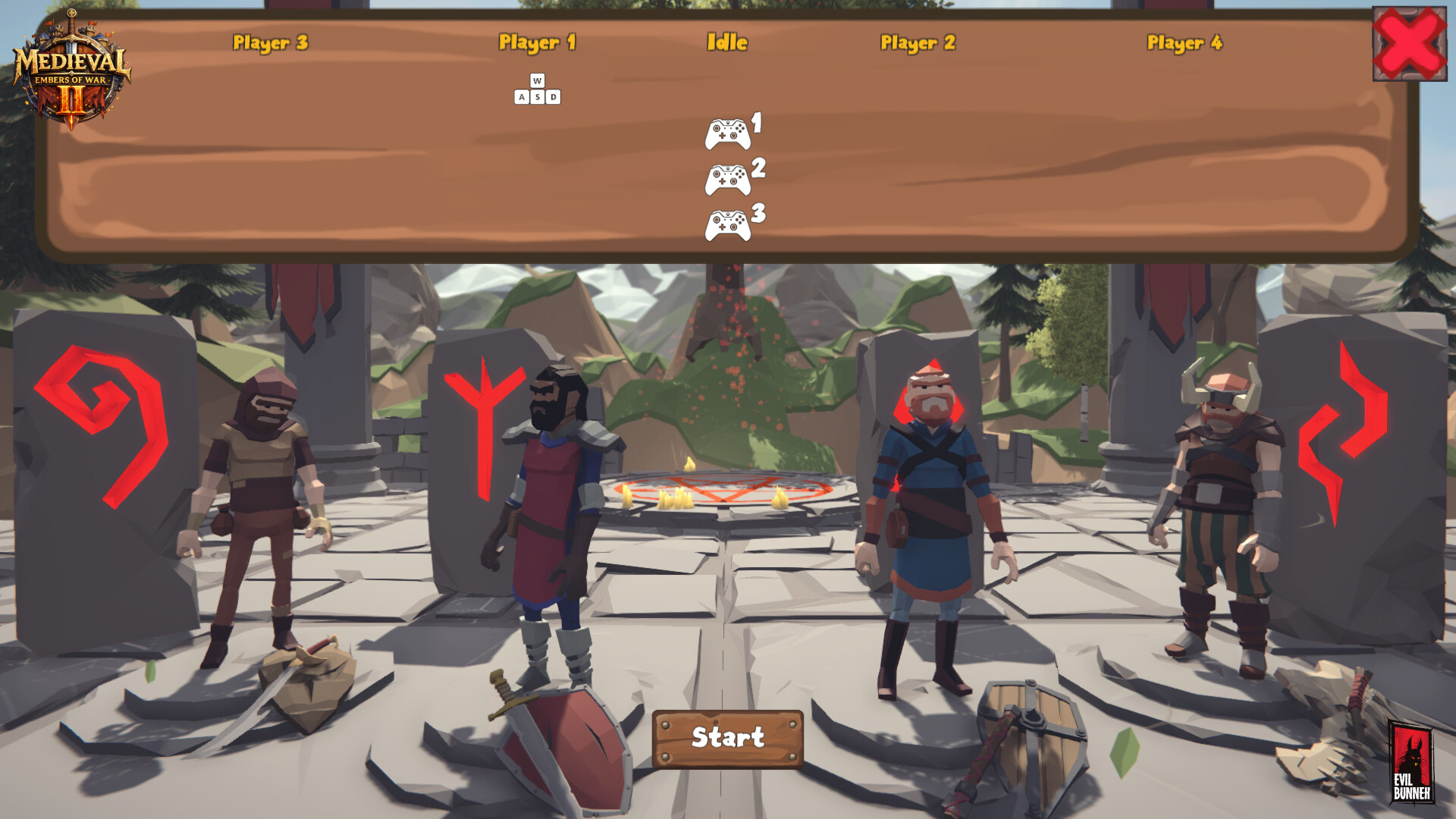
The pre-battle lobby assigns each of up to four players their own hero and input device, whether keyboard or controller, before a match beginsImage: Evil Bunneh Inc. via Steam