Game review
Trumps Of Albion Review
6 / 10
- Developer
- Ka Yan Liu
- Publisher
- Ka Yan Liu
- Released
- 14 September 2026
- Platforms
- ["Windows", "Linux"]
- Genre
- RPG
A Nineteenth Consecutive Launch Without a Single Review
Trumps Of Albion released on Steam on 14 September 2026 and has zero user reviews at the time of writing, extending this stretch's run of unreviewed launches to nineteen. That absence matters more here than for most games in this run, because Trumps Of Albion is explicitly built around a shared, persistent world — "one Britain, not a thousand copies" — where other players are meant to be encountered as living characters on the same map. A title with this design premise and no visible population is worth approaching with particular caution, since the entire pitch depends on other people actually being there. This review is written entirely from the developer's own store page description, not from verified play.
One Hand, Two Uses
The premise is a deadpan-comic Arthurian conceit: Merlin, sealed away after Camlann, has bound "every blade and every footstep" into a card rite, so that all movement and combat across Britain is resolved by the cards a player is dealt. The store page describes a genuinely unusual dual-use mechanic — "your best travel card is your best attack card" — meaning the same sixty-card daily hand is spent moving across a route-map of the British Isles and fighting instanced, tactical duels on a charge-time clock. Defense is likewise tied to "the guard printed on the card you just committed," and every play is framed as irreversible: "a decision you can't take back." That's a more structurally interesting hook than most card-RPGs manage, since it forces a genuine trade-off between hoarding cards for a fight and spending them to reach one, rather than treating movement and combat as separate resource pools.
A World That Doesn't Stop When You Log Out
The persistent-world framing is central to the pitch: "log out on any device and your character stays on the map — a living NPC others can meet, trade blows with, or hunt." The store page is explicit that this is a single shared space rather than sharded instances, positioning population itself as a core feature — "more players means more world, never more worlds." That's an ambitious design for an indie release, but it's also a design that can fail quietly and completely if the population never arrives: a persistent world with nobody in it stops being a living Britain and becomes an empty map with your own character standing in it. Steam's category tags confirm genuine multiplayer infrastructure — PvP, online co-op, and cross-platform multiplayer are all listed — but also list single-player as a supported mode, suggesting the game is at least designed to be playable solo if the shared-world layer turns out to be thin at launch. Given the zero-review status, whether the map actually has other travelers on it right now is entirely unverifiable from the store page alone.
Beating a Trump, Building a Legend
Progression is tied to defeating "Trumps" — the great souls of Arthurian legend that Merlin bound into his deck, some of which have "torn free" and now walk the map as bosses. Beating one reportedly lets a player "rip its page loose" and claim its skill, a neat thematic justification for boss-drop power that ties directly into the game's card-based framing rather than being a generic loot mechanic. Character building runs through three bloodlines and a branching tree of callings — "knights, hedge-mages, wayfarers and the promotions they open" — with skills organized around an elemental wheel, and the store page notes that a torn Trump page "rewrites your hand," implying boss kills meaningfully reshape a build rather than just adding a new ability to an existing one. That's a reasonably deep progression structure on paper, though how balanced the three bloodlines are against each other, and how much genuine build variety the elemental wheel supports, are both unverified.
Deadpan Comedy, Straight From the Source
The tone is described as "deadpan gag-comedy" built on real Arthurian source material — Malory's Le Morte d'Arthur, the Mabinogion, the Gawain-poet — with the store page claiming "every joke is pulled from the real record," positioning the player as "the straight man" in an otherwise "unhinged" Britain. That's a specific and somewhat unusual comic approach for a fantasy RPG, leaning on genuine literary absurdity rather than generic meme humor, though its success obviously depends entirely on execution the store page can't demonstrate. The game supports English and Traditional Chinese and is playable in-browser or on desktop, and at NZ$15.92 with no discount at the time of writing, it sits mid-pack for price among this run's zero-review candidates — not a negligible impulse buy, but not unreasonable for a persistent-world RPG if the shared-world premise actually delivers.
Verdict
Trumps Of Albion pairs a genuinely clever dual-use card mechanic and a thematically justified boss-and-bloodline progression system with an ambitious persistent-world premise that is unusually exposed to its own zero-review status: a shared Britain that depends on other players being present is a much riskier proposition to launch quietly than a single-player game with the same lack of reviews. Steam confirms real multiplayer infrastructure and a single-player fallback mode, but whether the world currently has any population worth encountering, and whether the three bloodlines and elemental skill wheel hold up under actual play, remain entirely unverified. It's one of the more mechanically distinctive picks in this stretch, but also one of the few where the absence of any reviews is itself a meaningful piece of information about the game's current state rather than just an absence of data.
Screenshots
-
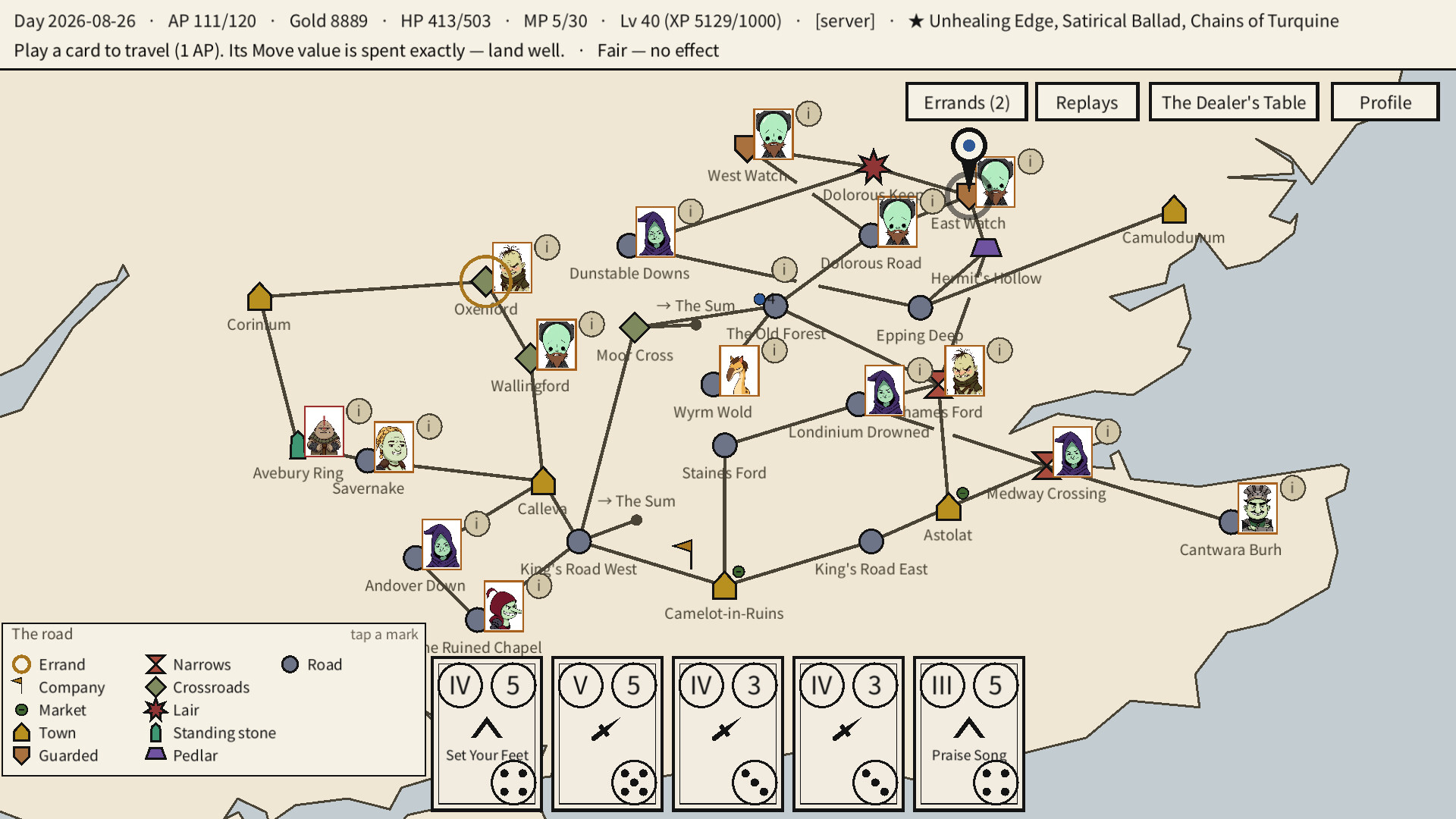
The route-map doubles as the game's travel interface, with a hand of cards spent to move between towns, crossroads and narrows across a single, shared BritainImage: Ka Yan Liu via Steam -
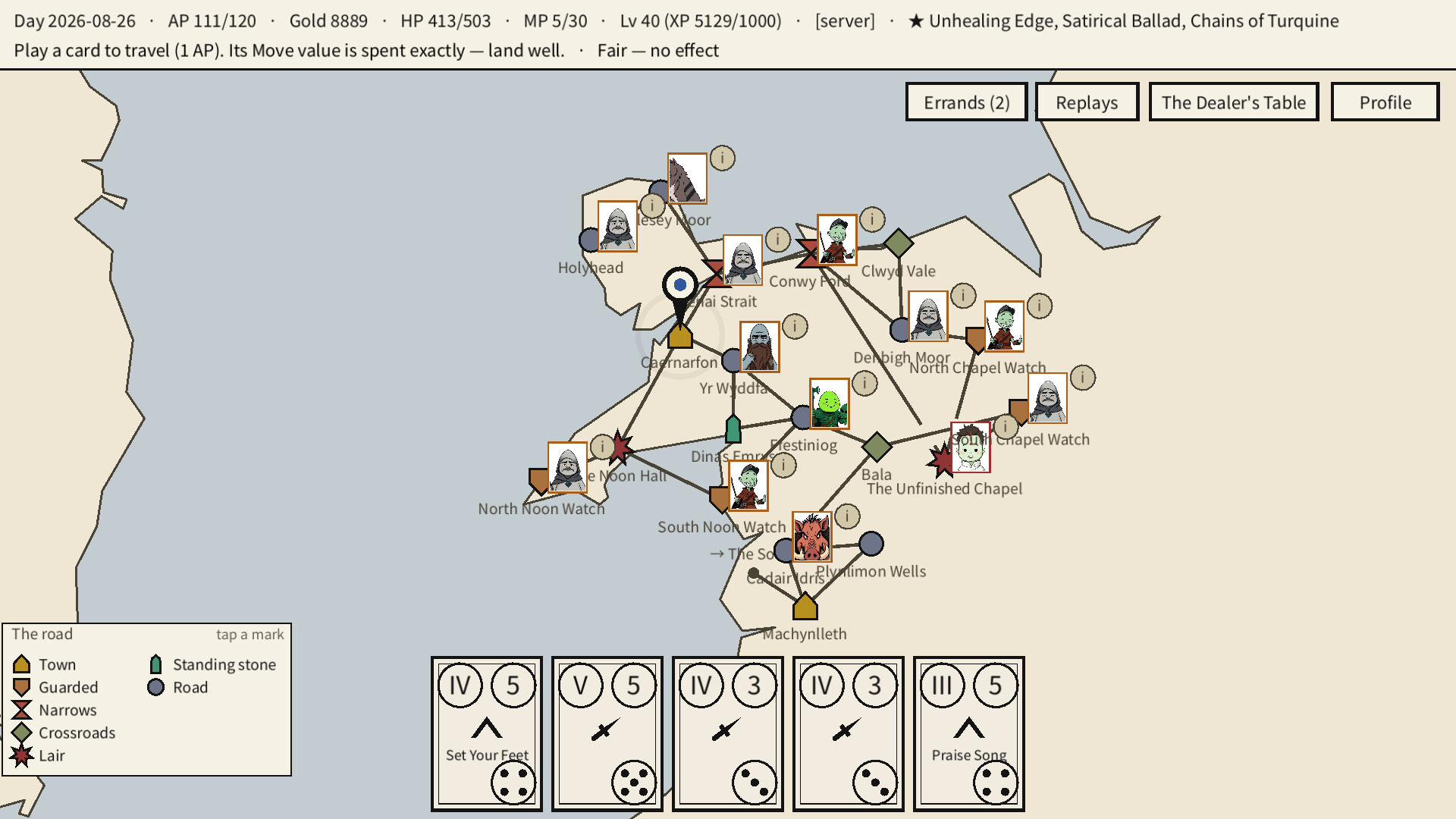
A separate stretch of the map in north Wales, populated with named NPC encounters and guarded settlements rather than a generic overworldImage: Ka Yan Liu via Steam -
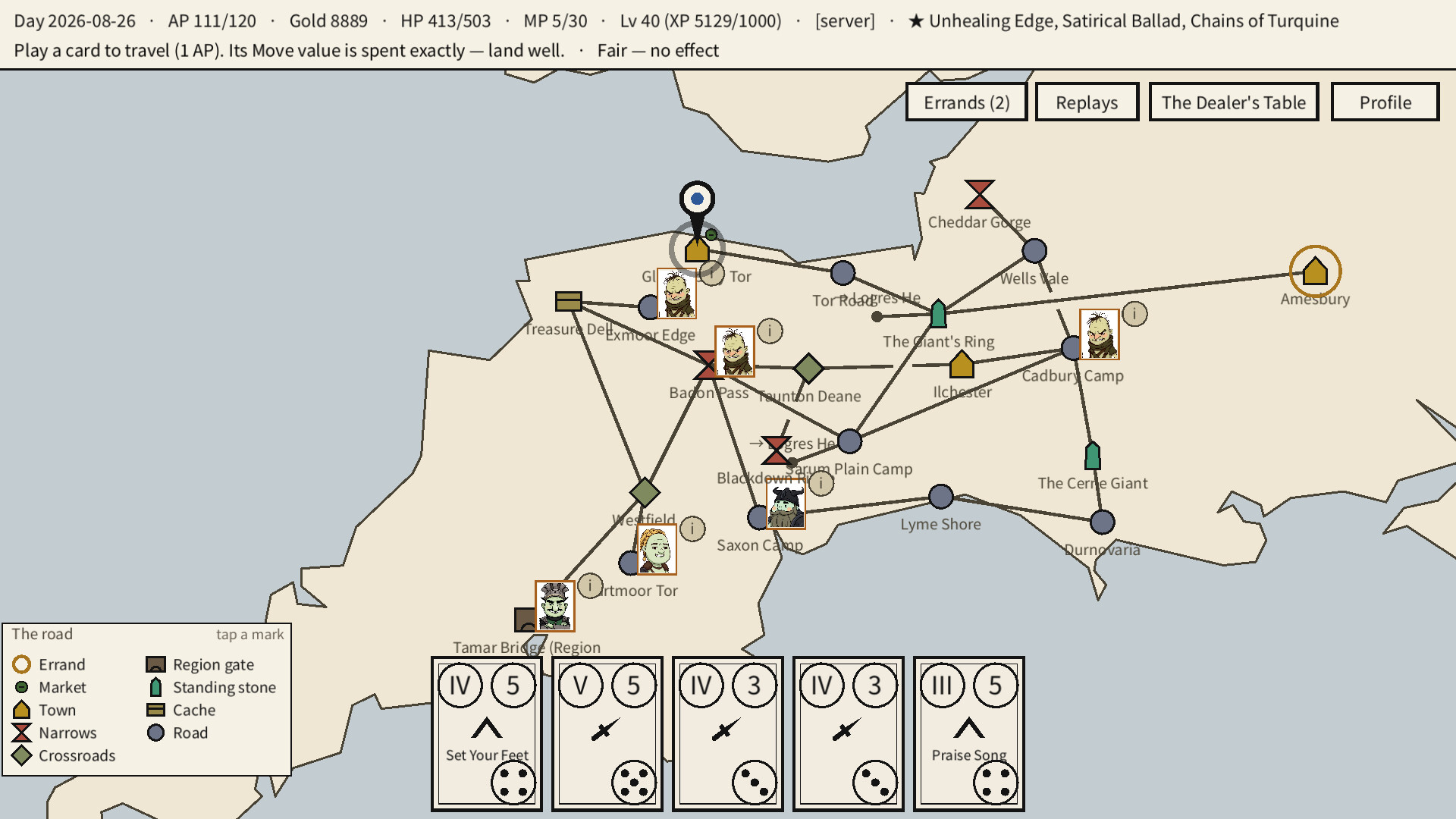
The Wessex stretch of the map, naming real Arthurian sites like Glastonbury Tor and The Giant's Ring among its travel nodesImage: Ka Yan Liu via Steam