
Game review
Soul Monsters: The Machine Kingdom and the Lich Queen Review
6 / 10
- Developer
- Industrial Miracle
- Publisher
- Industrial Miracle
- Released
- 24 July 2026
- Platforms
- ["Windows"]
- Genre
- RPG
Two Months Out, Still Zero Reviews
Soul Monsters: The Machine Kingdom and the Lich Queen released on Steam on 24 July 2026, and despite being on sale for close to two months by the time of writing, it still has zero Steam user reviews. That's a longer review-free stretch than most titles covered in this run, and it applies to a game with noticeably more content described on its store page than many quieter launches — 75 stages, four playable campaigns, and 120-plus cards. This review is built entirely from that store page description, not from verified play, and the near two-month silence is worth flagging as its own data point about visibility rather than quality, separate from any judgment about whether the systems described below actually hold up.
A War Seen Through Four Sets of Eyes
The premise pits a mechanical Machine Kingdom against a rising Lich Queen, with the conflict experienced through the "intertwined campaigns" of four playable characters — Kain, Johanna, Rockefeller, and Kael — each of whom "sees the war differently." The store page frames the appeal explicitly around perspective: "only by walking all four roads do you learn who they truly were, and what the war was really for." That's a more structurally ambitious narrative pitch than most roguelike deckbuilders attempt, which typically settle for a single protagonist and a handful of alternate classes; asking players to complete four separate campaigns to assemble one story is a meaningfully bigger commitment than picking a favourite character and sticking with them; whether the four perspectives actually diverge enough narratively to justify that commitment, rather than mostly reusing the same story beats with a different face attached, is exactly the kind of thing that's hard to judge without any player account to check it against.
120-Plus Cards Across a 75-Stage Campaign
Mechanically, the game is a "story-driven roguelike deckbuilder" built around "tactical turn-based combat" with buffs, poison, shields, and targeted effects layered on top of a card pool the store page puts at "120+ cards, relics, and potions." The pitch promises that "no two runs play the same," achieved through chaining combos, stacking status effects, and reshaping a deck mid-run "as the battlefield turns against you" — standard deckbuilder-roguelike language, but backed here by a notably large campaign structure: 75 stages spread across the four playable perspectives, rather than the shorter act-based runs more typical of the genre. A card pool in the 120-plus range sits comfortably in line with established genre benchmarks for build variety, though the real test of a deckbuilder is less the raw card count and more whether enough of those cards feel worth building around rather than being obvious filler — again, not something the store page description alone can settle.
The 75-stage figure is also worth pausing on relative to the four-campaign structure. If that number describes the total combined length across all four characters, each individual campaign would work out to something closer to 18 or 19 stages — a fairly standard length for a single deckbuilder run. If instead each of the four perspectives independently spans something closer to the full 75 stages, the total playtime on offer would be considerably larger than the headline number suggests. The store page doesn't specify which reading is correct, and it's the kind of ambiguity that a single completed playthrough would resolve immediately but that a store description alone leaves genuinely open.
A Branching Map Layered Onto the Card Combat
Between fights, the game uses a "branching roguelike map" that lets players "carve your own path" by picking battles, gambling on random events, spending at shops, and resting before harder encounters — the now-familiar node-map structure the genre has largely standardised on since it works well for balancing risk against preparation. What stands out here is how that structure interacts with the four-perspective campaign: since each of Kain, Johanna, Rockefeller, and Kael presumably has a distinct card pool and campaign path built around their view of the war, the branching-map decisions likely carry different weight depending on which character's road a player is currently walking, giving the same underlying map structure four different strategic contexts to be read through rather than one. The store page also notes four-language support for interface and subtitles (English, Korean, Japanese, Russian), suggesting a broader intended audience than a purely English-market indie release — though it's worth noting the store page's own screenshots at the time of writing show the game running with Korean-language UI text rather than English, which isn't necessarily representative of how the game looks with the English option selected.
A Modest Discount for a Content-Heavy Deckbuilder
At NZ$8.15 with a 15% discount off NZ$9.59 at the time of writing, Soul Monsters sits at the budget end of the deckbuilder-roguelike space for a game claiming 75 stages and four separate campaigns' worth of content — a scope that, if it holds up, would represent solid value relative to the asking price. There's no mention on the store page of any monetisation beyond the base purchase. Given the near two-month gap since release with no reviews at all, prospective buyers drawn to the four-perspective structure should treat the total absence of community feedback as a genuine unknown rather than assume the quiet launch simply reflects an unlucky lack of attention for an otherwise solid game.
Verdict
Soul Monsters: The Machine Kingdom and the Lich Queen pitches an unusually ambitious structure for a roguelike deckbuilder — four distinct playable perspectives converging on one story, a substantial 75-stage campaign, and a card pool north of 120 — wrapped in hand-drawn dark-fantasy art. Nearly two months after release it remains completely unreviewed by Steam's user base, a longer silence than most titles in this stretch, which makes its promised narrative payoff and card-pool depth unverified claims rather than confirmed strengths. Its modest, discounted price keeps the downside of trying it fairly low, making it a reasonable pick specifically for deckbuilder fans curious about the four-perspective structure — with the standing caveat that this assessment rests entirely on the developer's own description rather than anyone's actual playthrough.
Screenshots
-
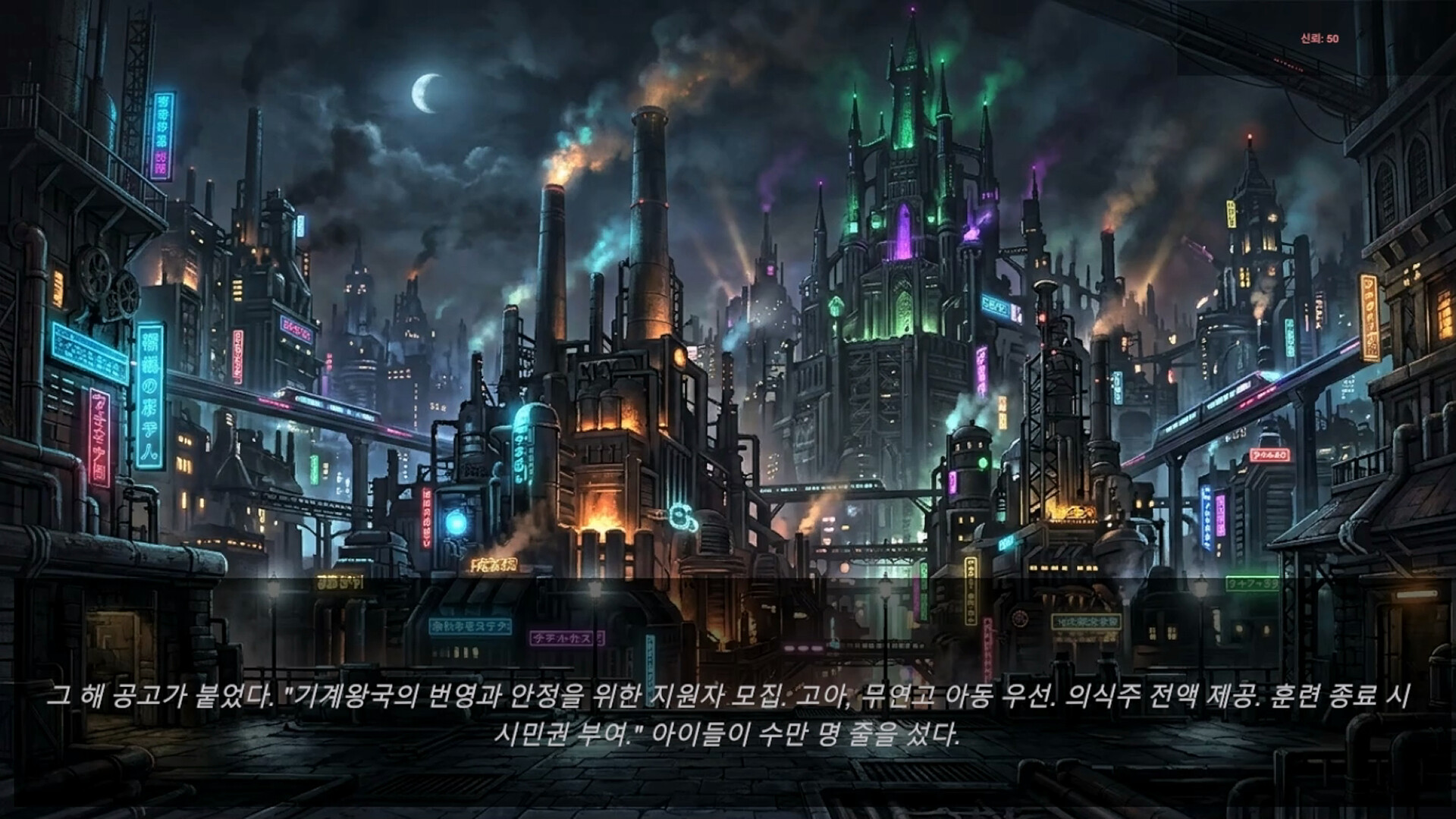
A hand-painted cutscene establishes the Machine Kingdom's industrial cityscape, shown here with Korean-language dialogue text on the store page's screenshotImage: Industrial Miracle via Steam -
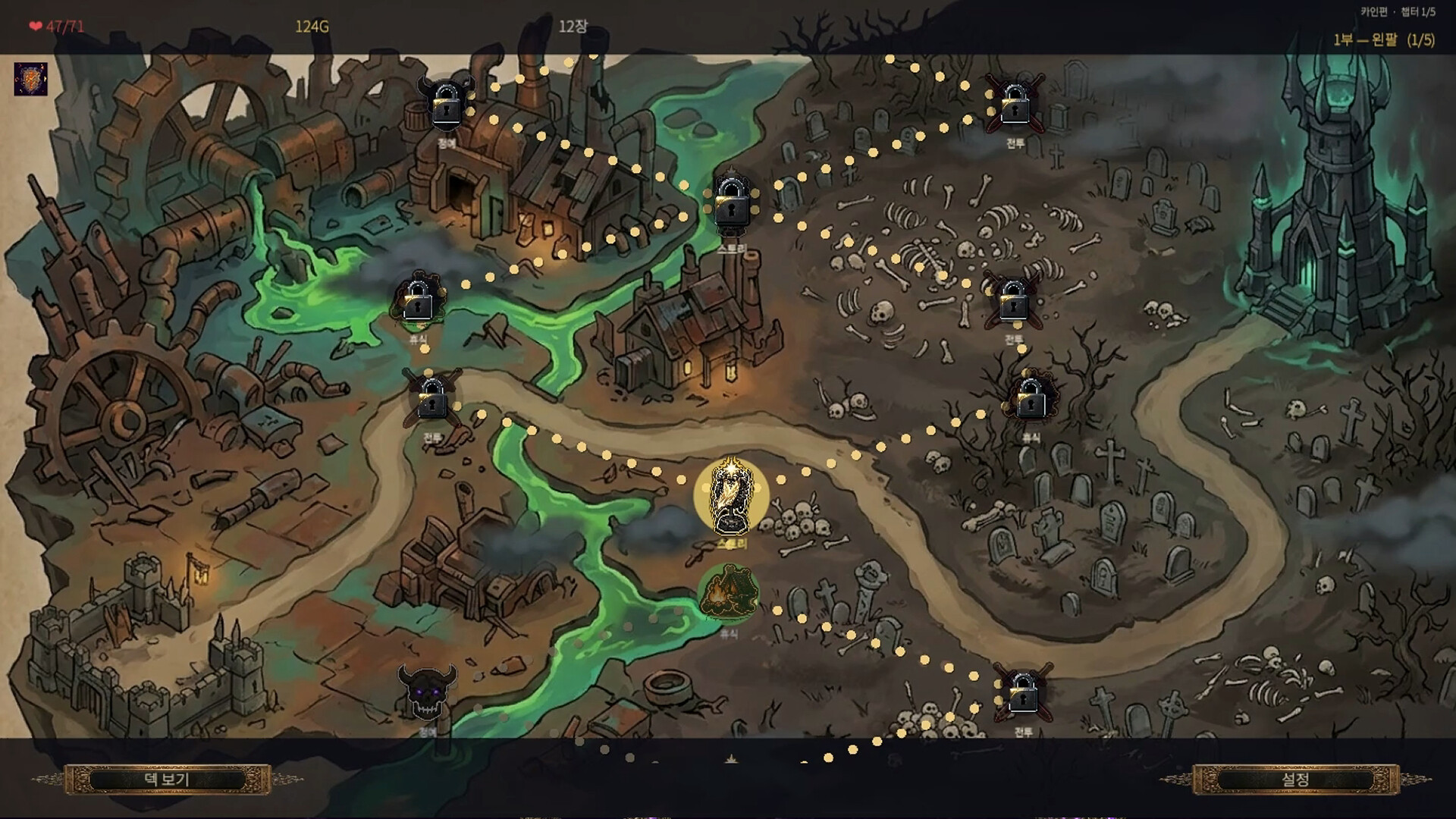
The branching map lays out locked battle, elite, and rest nodes across a route from the Machine Kingdom's ruins toward the Lich Queen's towerImage: Industrial Miracle via Steam -
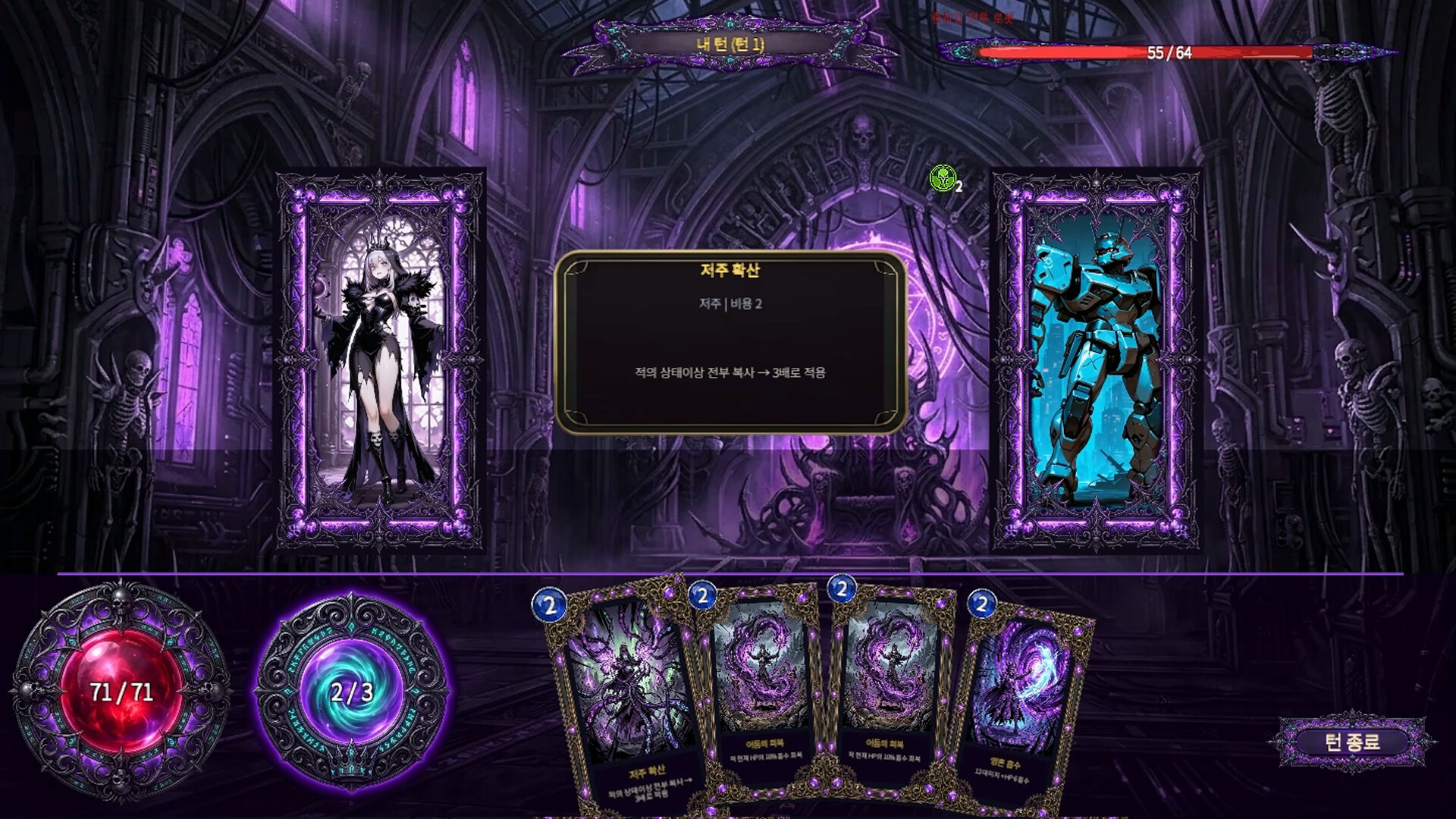
Combat pits the player against a mechanical opponent with a hand of status-effect cards, shown here with the store page's Korean-language screenshot despite English being a listed supported languageImage: Industrial Miracle via Steam