Game review
The Ancient Caverns Review
6 / 10
- Developer
- Meridian Studios
- Publisher
- Meridian Studios
- Released
- 14 August 2026
- Platforms
- ["Windows", "Linux"]
- Genre
- RPG
A Twenty-Third Consecutive Launch Without a Single Review
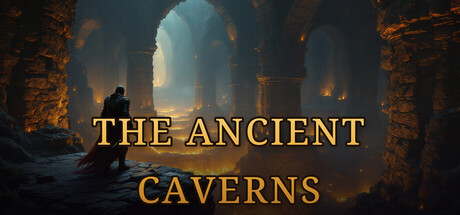
The Ancient Caverns released on Steam on 14 August 2026 and has zero user reviews at the time of writing, extending this stretch's run of unreviewed launches to twenty-three — well over a month since release for a game working a familiar, well-liked formula. Dark-fantasy dungeon-delving roguelites with permadeath and lasting meta-progression are a proven, popular shape, which makes the total silence here a little more surprising than for a stranger pitch. This review is built entirely from the developer's own store page description, not from verified play.
Four Classes, One Cavern That Never Repeats
The pitch is a fairly classic roguelite skeleton: choose a class — warrior, mage, rogue, or alchemist, each with "its own gear, skills and rhythm" — then descend through procedurally generated floors across "distinct biomes," with monster difficulty tied to depth reached rather than a fixed clock. That tier-scaled approach to difficulty, rather than a timer or wave-count, is a sensible fit for a game that wants floor-by-floor descent to feel like the core tension rather than a race against an external pressure. A skill tree lets players spend "hard-won points" on abilities like firebolts, frost novas, and chain lightning, which suggests build variety within each class rather than a single fixed kit per archetype — though the store page doesn't specify how deep that tree runs or how much it diverges between the four classes.
Whether "RPG" is the right primary label for a game whose own key features lean heavily on action-roguelite language — procedural floors, permadeath runs, "one more floor" pacing — is worth asking directly, given the genre tags list Action ahead of RPG here. The class-plus-skill-tree-plus-itemization structure is real RPG scaffolding, closer to something like a Diablo-lite build system than to a stat-and-dialogue RPG, and that distinction matters for anyone picking this up expecting deep character-building conversations or branching narrative choices rather than combat-focused build variety.
Death Takes the Gear, Not the Progress
The permadeath structure follows an established and fair-feeling roguelite convention: dying strips the current run's weapons, armour, reagents and gold, but any "rare artifacts" dragged back to the surface persist permanently and "quietly" make the next attempt stronger. That's the standard shape of meta-progression in this genre — enough loss to make each run matter, enough permanent gain to make failure feel like forward motion rather than total reset — and it's a well-tested design that reduces the sting of an unlucky death without eliminating stakes entirely. A town hub between runs lets players spend gold, take on villager quests, and fill out an "Artifact Museum," giving the permanent-collection loop a visible showcase rather than just a stat sheet buried in a menu.
That town-and-museum framing is a small but meaningful touch: turning permanent artifacts into displayed trophies rather than abstract percentage boosts gives the meta-progression loop a visible sense of accumulation across many runs, which matters for a genre that lives or dies on whether "just one more attempt" feels earned rather than repetitive. Whether the actual artifact pool is large and varied enough to sustain dozens of runs, or thin enough that the museum fills up quickly and the incentive to keep descending fades, is a question only extended play could answer.
Loot, Craft, and the Depths Ahead
Between artifacts and class gear, the loot economy runs on reagents gathered mid-run and brewed into potions, letting players "forge your build from whatever the caverns give you" rather than shopping for a predetermined ideal loadout. That's a reasonably common roguelite crafting hook, but it does put real weight on random reagent drops feeling generous and varied enough that a run doesn't stall out on bad luck alone — a risk inherent to any procedurally generated loot system that the store page can't confirm one way or the other. Steam Achievements and Steam Cloud support are both listed, along with accessibility options for camera comfort, custom volume controls, and playable-without-timed-input support, a welcome level of accessibility detail for a genre that often assumes twitch reflexes are non-negotiable.
A Familiar Shape at a Mid-Range Price
The Ancient Caverns is Windows and Linux only, supports a wide spread of fourteen languages including English, French, German, Japanese, Korean, and Simplified and Traditional Chinese, and is priced at NZ$15.75 with no discount at the time of writing — a reasonable mid-range ask for a genre where players often compare against long-established, content-dense competitors. No in-app-purchase category is listed on the store page, so the loot and crafting systems described appear to run entirely on in-run drops and gold rather than any real-money shortcut, which is the more player-friendly default for a permadeath roguelite. At this price point, the game is competing less on novelty — this exact loop has been built many times before — and more on how tightly the four classes, skill trees, and biome variety are executed against genre veterans who've played dozens of similar caverns already.
Verdict
The Ancient Caverns doesn't reinvent the dark-fantasy roguelite formula, but it assembles a competent, complete version of it: four distinct classes with their own skill trees, tier-scaled procedural descents, permanent artifacts that build toward a visible town museum, and a fair permadeath structure that takes gear rather than progress. Its central risk isn't a broken pitch but a crowded one — this is a genre with many strong, established competitors, and the store page alone can't say whether the class builds, biome variety, and artifact pool have enough depth to hold up against dozens of hours the way the best of them do. Its complete lack of reviews over a month after release is hard to read as a quality signal either way for a formula this well-trodden and well-liked when done right; it may simply reflect how much competition exists in this specific corner of the roguelite genre. This assessment rests entirely on the developer's own description rather than anyone's actual playthrough.
Screenshots
-
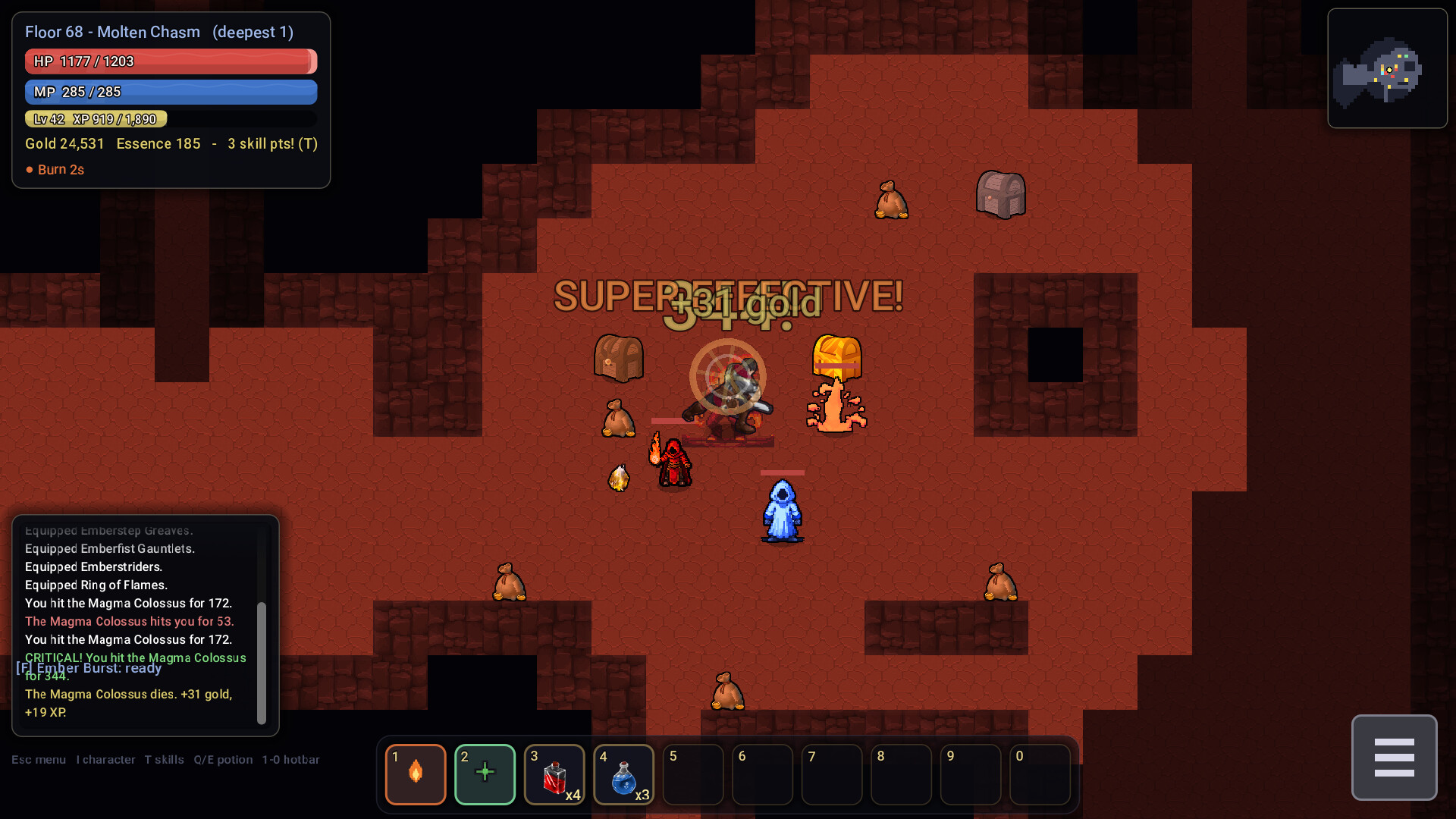
A deep-floor boss fight against a Magma Colossus, with the run's accumulated gold, essence and skill points tracked in the corner HUDImage: Meridian Studios via Steam -
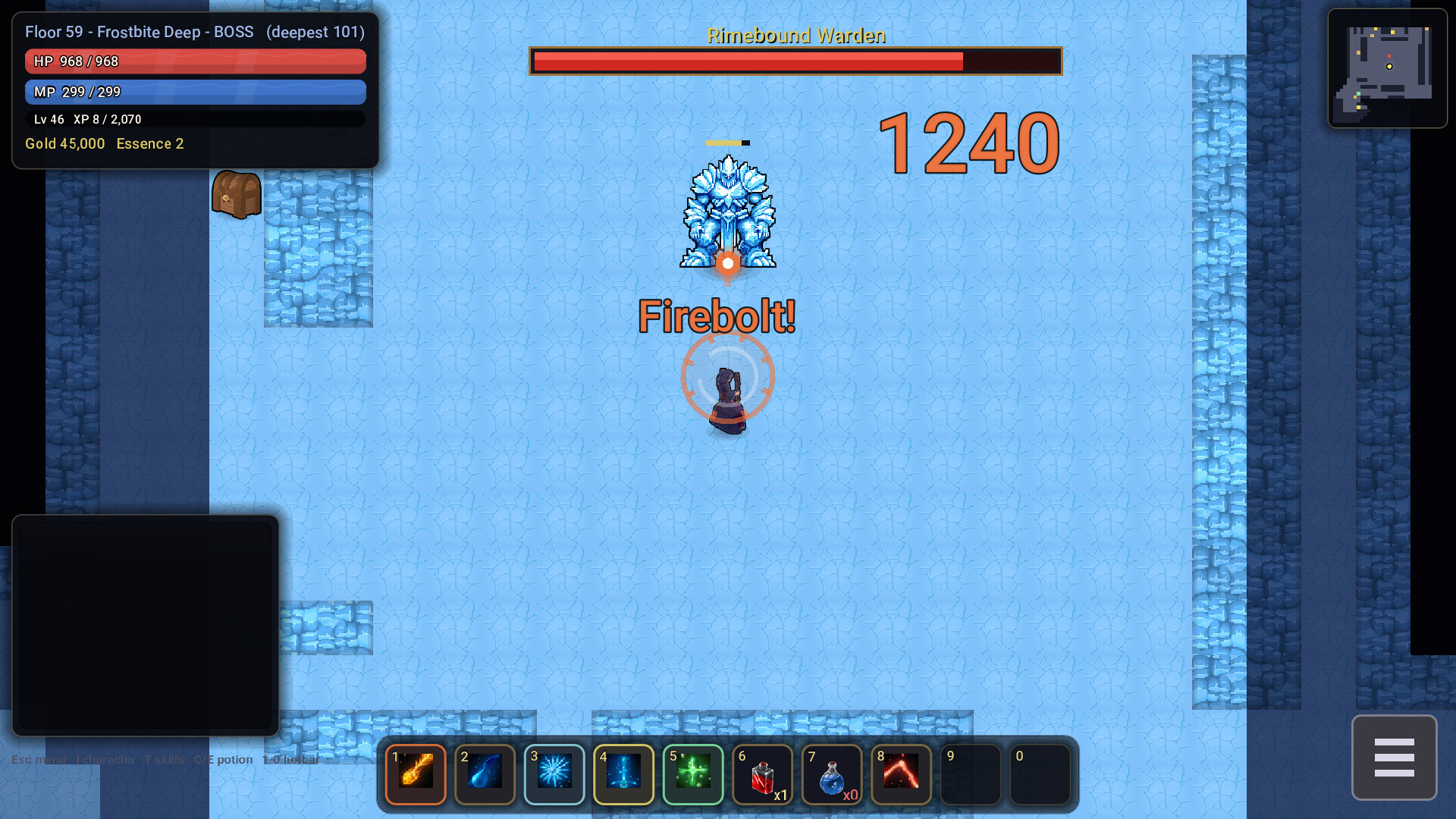
A biome boss fight in the Frostbite Deep, casting Firebolt against the ice-themed Rimebound WardenImage: Meridian Studios via Steam -
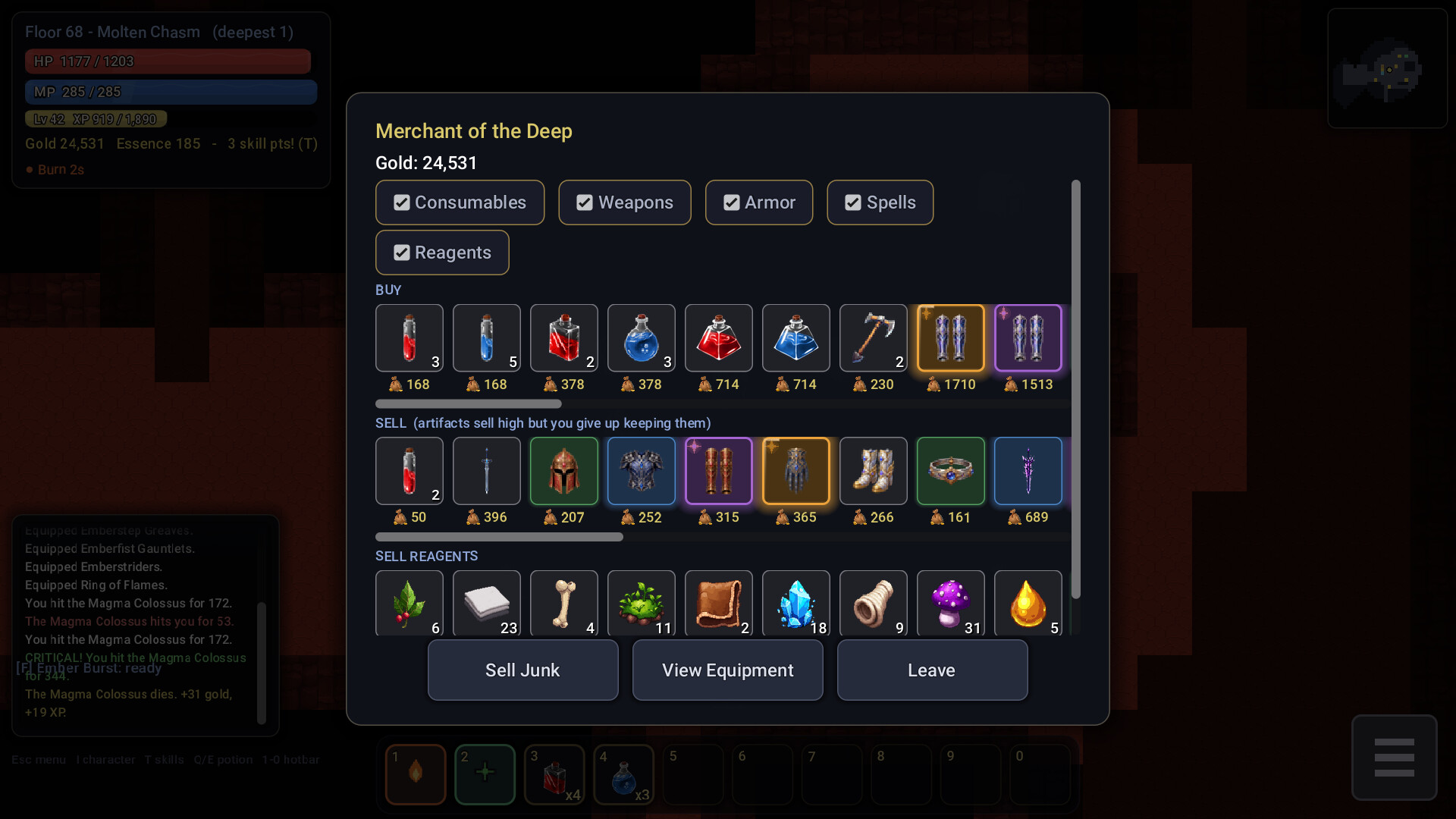
The in-run merchant screen, where gold and reagents gathered from the caverns can be spent on gear and consumablesImage: Meridian Studios via Steam