
Game review
Wardenmark Review
6 / 10
- Developer
- Morass
- Publisher
- Morass Games
- Released
- 20 August 2026
- Platforms
- ["Windows", "Mac", "Linux"]
- Genre
- RPG
A Fourteenth Consecutive Launch Without a Single Review
Wardenmark released on Steam on 20 August 2026 and currently has zero Steam user reviews, extending an unbroken run of unreviewed launches covered in this stretch of the schedule to fourteen. It's a crowded genre to launch into unnoticed — "survivors" roguelites live and die on build variety and moment-to-moment feel, both of which are notoriously hard to judge from screenshots alone — but the store page's specific claims about persistent campaign structure and telegraphed difficulty are worth examining in detail even without hands-on play. This review is built entirely from the developer's own store page description, not from verified play.
One Warden, an Auto-Casting Storm
The core loop follows the established survivors template: the player leads "a single Concord Warden" into "short, frantic arena missions," where "your spells fire on their own" and the player's job is reduced to positioning and build choices — "to move, to read the field, and to choose what you become." That's a faithful application of the genre's central appeal, automating direct combat execution so the player's decisions live entirely in movement and the drafting of upgrades as they level. Five wardens are described, each opening with a different signature ability — "the Soldier's cleave, the Archer's volley, the Mage's homing bolt, the Trickster's chaining spark, the Engineer's auto-turret" — giving five structurally distinct starting points for a genre where build variety is usually the main draw across repeated runs.
Wide Coverage or Deep Mastery
The store page frames the drafting decision explicitly as a trade-off: players can "build wide for omnidirectional coverage, or reserve picks to deepen one spell toward mastery." That's a clean, legible choice to offer at every level-up, since it gives even a single run internal texture beyond just picking whatever the game happens to offer — a player consciously choosing to specialise into one spell is making a meaningfully different bet than one spreading picks across many, and the claim that "no two runs draft the same storm" suggests the developer is leaning on that choice, plus the five distinct warden signatures, to keep the moment-to-moment drafting from converging on one obviously optimal path. Whether the balance actually holds up that way in practice, rather than settling into a small number of dominant builds once players learn the system, is exactly the kind of thing that takes a community's collective playtime to reveal.
A Campaign That Carries Its Build Forward
Structurally, Wardenmark departs from the genre's usual one-run-and-restart format in a specific way: missions "chain into six-node expeditions" where "your build and your health persist from node to node, so a run is a growing story, not a string of restarts." That's a meaningful design choice — most survivors-likes treat each individual mission as a fresh, self-contained build-up, but stringing six nodes together with persistent health and build state raises the stakes of every node's outcome, since damage taken early in an expedition carries forward rather than resetting. Reaching the end of an expedition means facing "the faction warlord," a distinct boss capping off each themed tour, and clearing campaign stages unlocks new wardens and "stage modifiers" that reshape later runs — a reasonable structure for extending replayability once the core roster has been unlocked.
Past the twelve-stage main campaign, the store page describes "an unbounded escalation with a boss every fifth node" called the Dread tail, for players who want to keep pushing a single build's limits indefinitely. Twelve described biomes, each with "its own faction swarm and telegraphed hazards," suggests reasonable content breadth for a budget-priced solo-developer roguelite, and the specific claim that "every threat is telegraphed and contact damage is paced, so a death is a misplay you can learn from, not a coin-flip" is a clear statement of design philosophy — one that, if it holds up, would distinguish Wardenmark from survivors-likes where late-game screen-filling chaos can make individual deaths feel arbitrary rather than earned.
A Negligible Price for a Genre Regular
At NZ$1.59 with no discount at the time of writing, Wardenmark is priced at the very bottom of the indie spectrum, cheaper than almost anything else covered in this stretch and well below the typical asking price for survivors-likes with a full campaign structure and five playable characters. There's no mention on the store page of any monetisation beyond the base purchase, and 61 listed achievements — ranging from a first kill to "a level-60 legend" and clearing the full campaign with every warden — suggest a reasonably substantial amount of content to work through relative to the price. English is the only listed supported language, which is a narrower reach than several other titles in this stretch but not unusual for a small solo-developed release.
Verdict
Wardenmark applies the established survivors-roguelite formula with a genuinely distinctive campaign structure, chaining missions into persistent-build six-node expeditions capped by faction warlords, backed by five structurally different wardens and an explicit design philosophy built around telegraphed, learnable threats rather than screen-filling chaos. Like every other title covered in this stretch, it remains completely unreviewed by Steam's user base at the time of writing, so whether its build variety holds up against genre veterans, and whether its telegraphed-danger philosophy actually delivers fair rather than frustrating deaths, are unverified claims rather than confirmed strengths. Its negligible price makes it close to a no-risk pick for survivors-roguelite fans curious about its persistent-campaign twist, with the standing caveat that this assessment rests entirely on the developer's own description rather than anyone's actual playthrough.
Screenshots
-
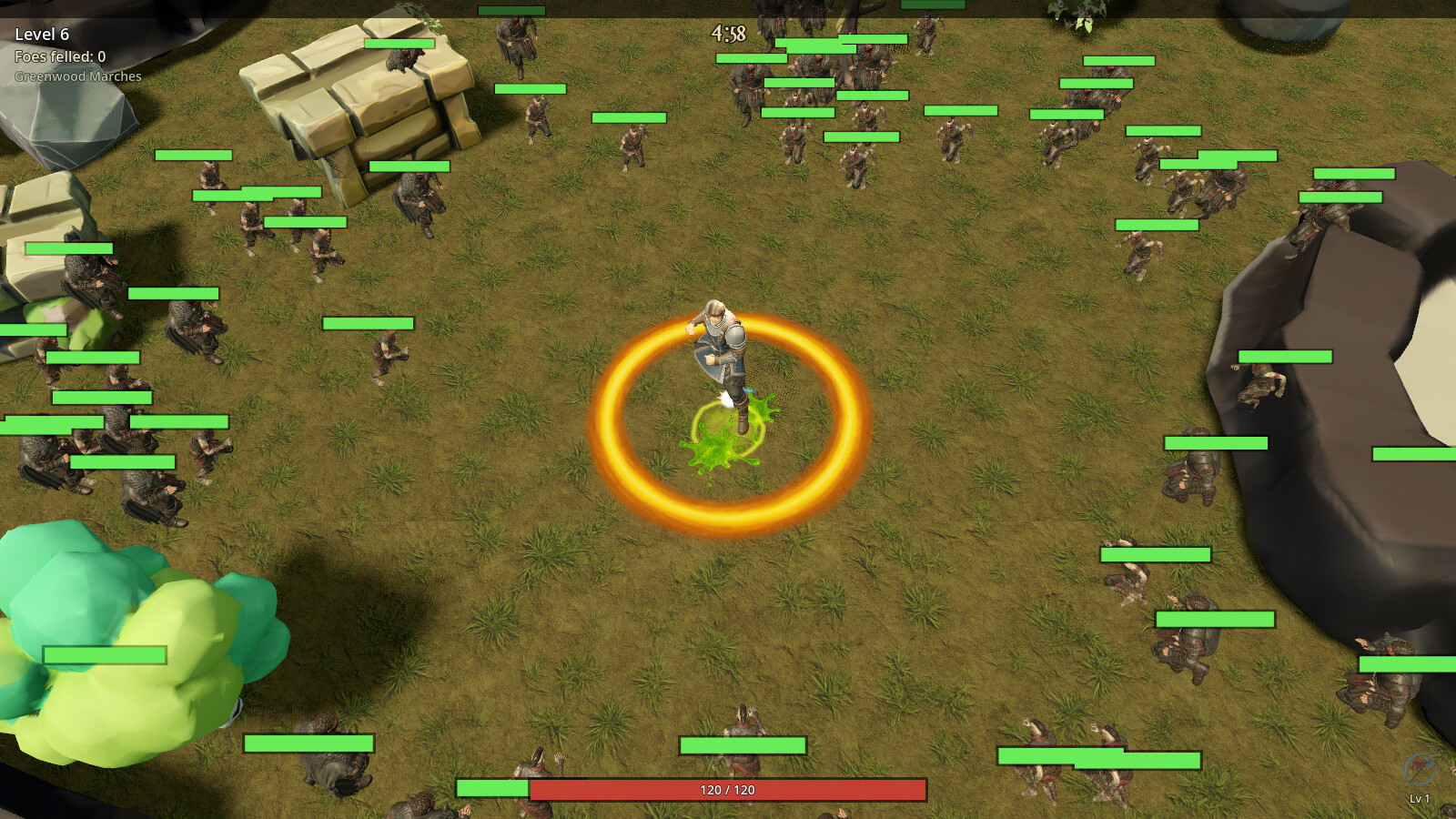
An orange ring spell and a spreading pool of poison show two of the warden's auto-casting spells overlapping against a swarm of approaching enemiesImage: Morass via Steam -
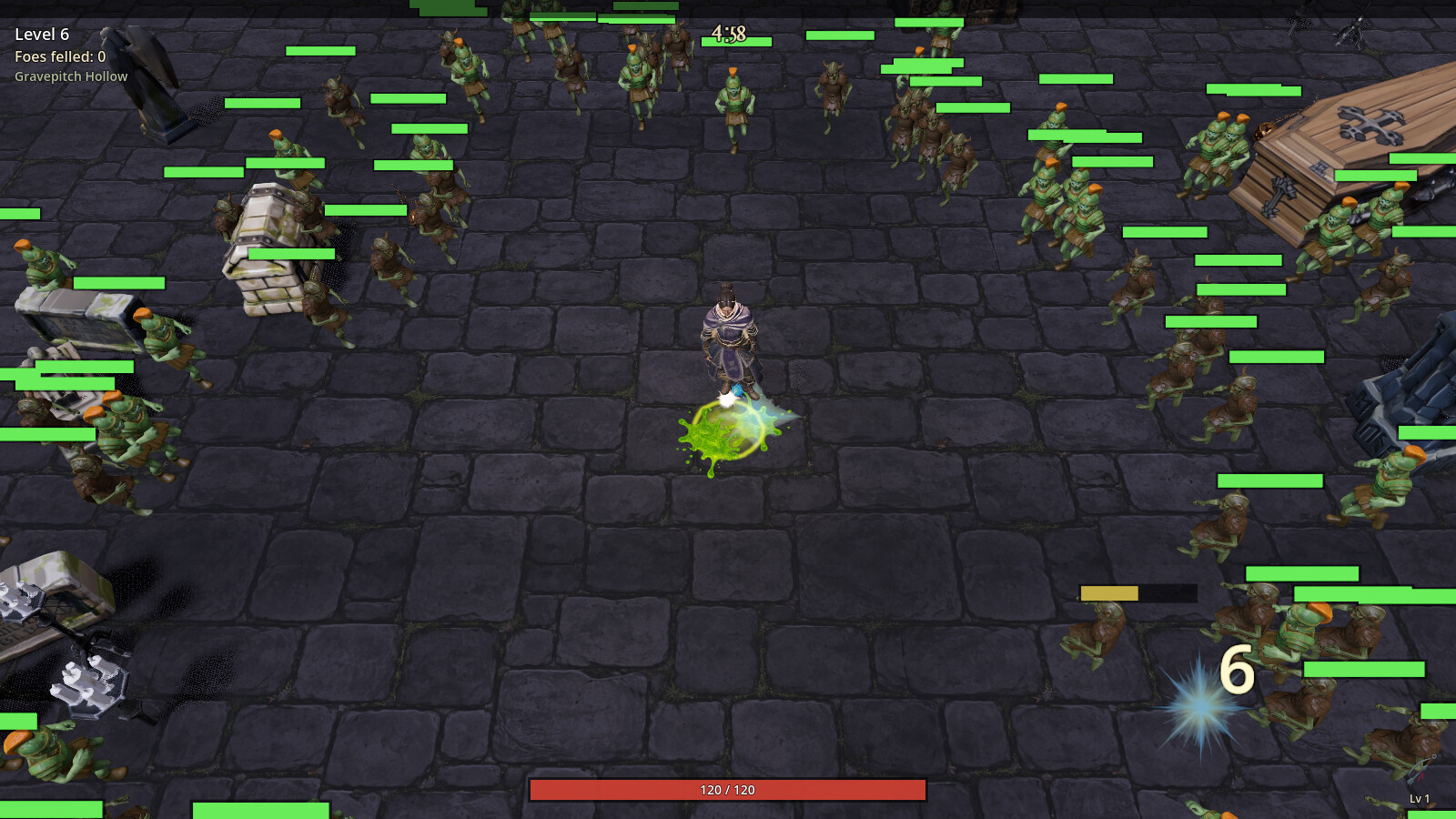
The Gravepitch Hollow biome swaps the earlier grassland for cramped stone corridors, still tracking health, level, and a running foes-felled count in the cornerImage: Morass via Steam -
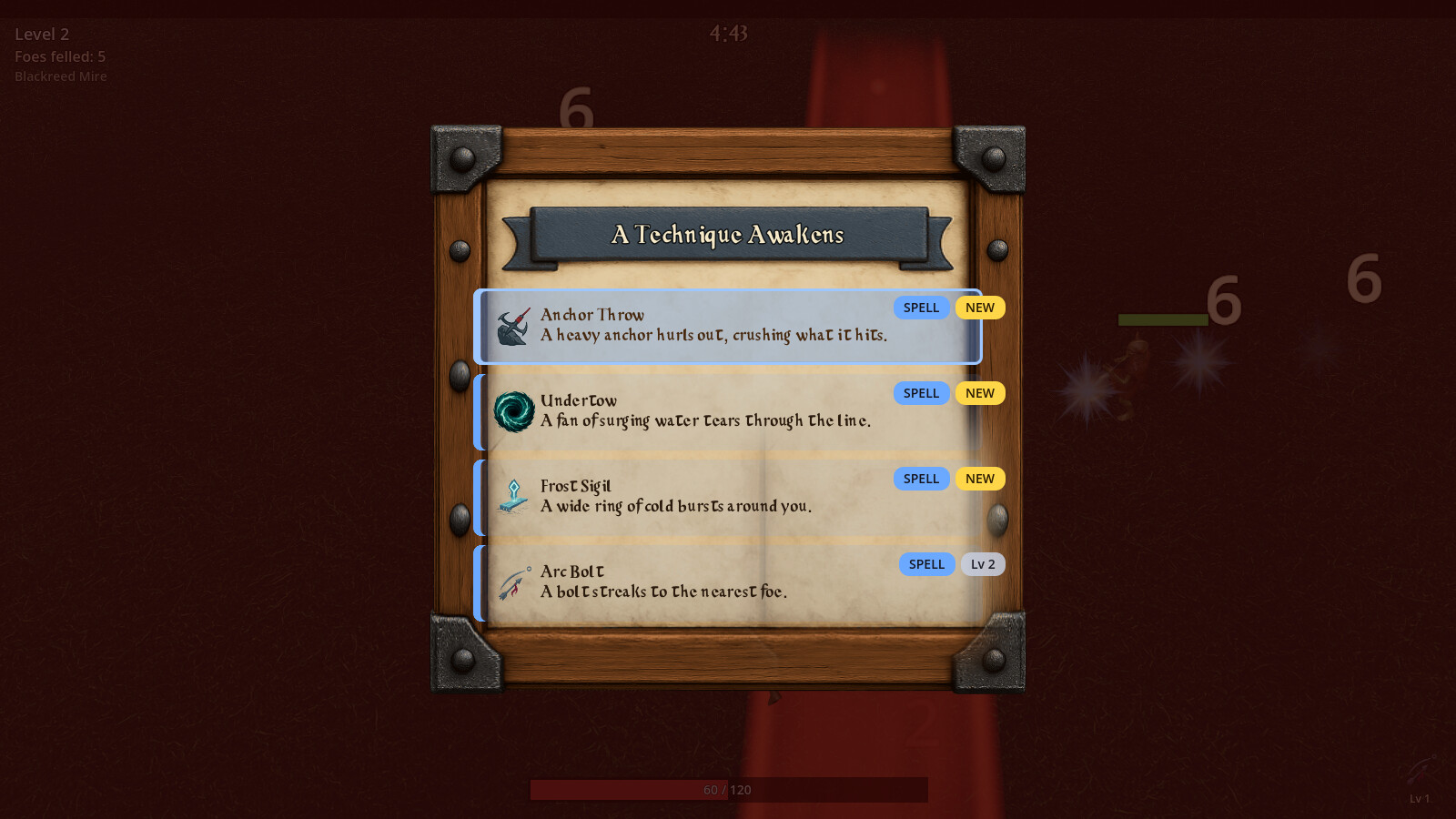
Levelling up presents a short list of new or upgradable spells, each described in a single evocative line rather than a bare stat blockImage: Morass via Steam