
Game review
HEX Review
5 / 10
- Developer
- yocco
- Publisher
- yocco
- Released
- 4 September 2026
- Platforms
- ["Windows"]
- Genre
- RPG
A Thirty-Fourth Consecutive Launch Without a Single Review
HEX released on Steam on 4 September 2026 and has zero user reviews at the time of writing, extending this stretch's run of unreviewed launches to thirty-four. At NZ$4.79, a solo-developer roguelike sitting entirely unnoticed more than two weeks after launch fits the broader pattern this stretch keeps turning up, though in this case the developer's own store page description is unusually sparse even by the standards of budget indie releases, which makes an outside assessment considerably harder to ground in specifics. This review is built entirely from the developer's own store page description, not from verified play.
Judgment Over Combat Reflexes
HEX pitches itself around a specific philosophical stance: survival "does not demand the courage to charge headfirst into danger," but rather "the clarity of judgment to decide what to use, where to use it, and how to create an advantage." That framing positions the game as a thinking-first roguelike rather than a reflex-driven one, with items treated as "vital resources that can turn the tide of desperation" instead of optional support tools bolted onto a combat-focused core loop. That's a reasonable design lane for a dungeon crawler to occupy, and it's a distinct enough pitch from the genre's more action-oriented entries that it's worth taking at face value, but the store page stops short of naming a single specific item, enemy type, or player stat that would let a reader judge whether that judgment-over-reflexes promise is backed by real mechanical depth or is simply restating "use your items wisely" in more dramatic language.
Board Control and Battle-Altering "Builds"
The store page's most concrete mechanical claim is the presence of special elements called "Builds" that appear throughout the dungeon and are described as dramatically influencing the flow of battle, letting a player "break apart dangerous situations, restrict enemy actions, and carve out your own path to survival." Combined with the "board control" framing in the game's own pitch, this suggests a spatial, position-based layer sitting alongside whatever combat exists — using the dungeon's own layout and these Build elements as tools rather than treating the environment as pure backdrop. That's a genuinely interesting hook if it holds up, since environmental interaction is often an underused lever in roguelike design, but as with the judgment-over-combat pitch, the description never specifies what a Build actually looks or plays like in practice, leaving the entire system's real depth unverifiable from the outside.
An Alien World, Barely Sketched
The narrative setup is reduced to a single paragraph: an alien world overrun by "strange and unsettling enemies," and a protagonist named Ria Rainville whose reason for being drawn into this place is posed as an open question rather than answered. That's an intentionally mysterious hook rather than a fully absent one, but it leaves HEX with almost no stated worldbuilding, named enemy types, or story beats to anchor an assessment of how much narrative content the release actually contains beyond its core dungeon-crawling loop. Between the vague combat philosophy, the unspecified Build system, and this single-paragraph setup, HEX's own marketing material is among the thinnest documented in this entire review stretch, which is itself worth flagging plainly rather than papering over with confident-sounding description.
Official screenshots do fill in one gap the store text leaves open: a visible five-stat character sheet — ATK, UNI, DEF, AGI, and LUK — confirms a real, if unnamed, RPG stat system sitting underneath the vague "judgment over combat" framing, alongside a floor-numbered dungeon structure, a status-condition indicator, and a hunger-style secondary resource bar tracked next to HP. None of that is mentioned anywhere in the store page's own description, so it's worth stating plainly as a screenshot-only finding rather than an inference.
A Low Price for an Unclear Amount of Content
One detail is significant enough to flag ahead of any purchase decision: Steam's own supported-languages field lists Japanese only, and every screenshot bears this out — dialogue boxes, status labels, and menu prompts throughout are rendered entirely in Japanese, with no visible option for English text. That's a real problem specifically because the store page's own About-the-game description is written entirely in English with no language disclaimer anywhere in it, creating a genuine mismatch between how the game is marketed and what an English-speaking buyer would actually encounter after installing it. For a narrative-adjacent roguelike whose core hook is built around "judgment" and reading item and Build interactions correctly, a language barrier of this kind isn't a cosmetic inconvenience — it directly undercuts the "clarity of judgment" pitch the game leads with, since a player who can't read the dialogue or item descriptions has considerably less to judge by.
At NZ$4.79 with no discount and no in-app-purchase category listed on the store page, HEX carries little financial risk regardless of how its systems actually play out, and DualShock controller support alongside Steam Achievements suggests at least a basic level of post-launch polish and structure. Still, the near-total absence of specifics about the dungeon-crawling loop's actual depth — no confirmed item roster, no detailed Build mechanics, no named enemy types beyond "strange and unsettling" — combined with the undisclosed language barrier, means the low price is doing a lot of the work in making this a reasonable gamble rather than the game's own description doing so.
Verdict
HEX pitches a thoughtful, judgment-over-reflexes roguelike built around item management and a "board control" spatial layer, and screenshots confirm a real five-stat character system underneath that vague pitch, but its own store page is thin enough that almost none of those systems are described in concrete terms — no named items, no detailed Build mechanics, no enemy roster. More seriously, the store page's entirely English marketing carries no hint that the actual game runs in Japanese only, a mismatch that materially undercuts the purchase decision for anyone shopping the English store page at face value. At NZ$4.79 the direct financial downside is small, but the language barrier is a real cost regardless of price, and this rating rests entirely on the developer's own description and official screenshots rather than anyone's actual playthrough.
Screenshots
-
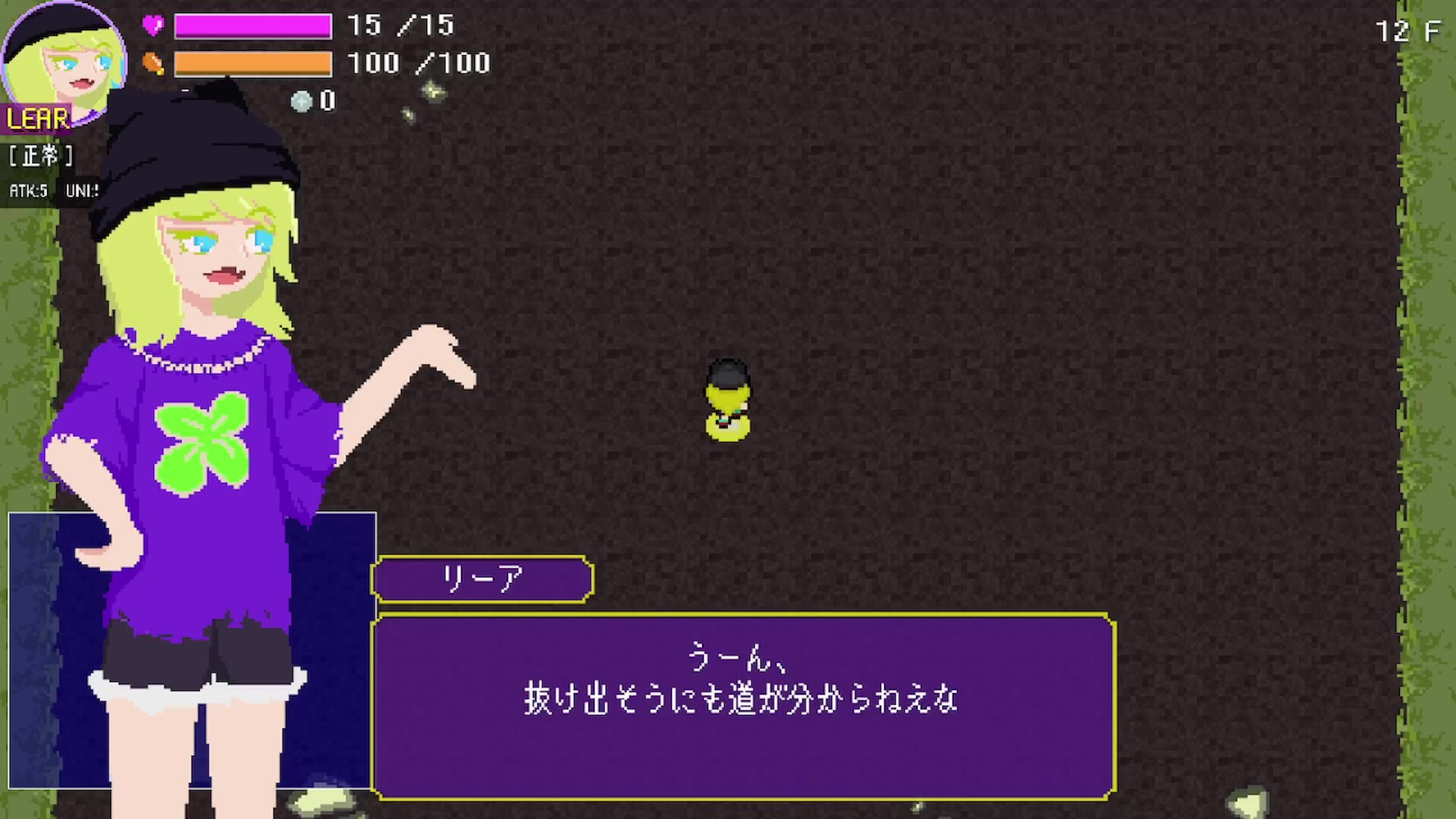
A dungeon floor and dialogue exchange, both rendered entirely in Japanese despite the store page's English-only descriptionImage: yocco via Steam -
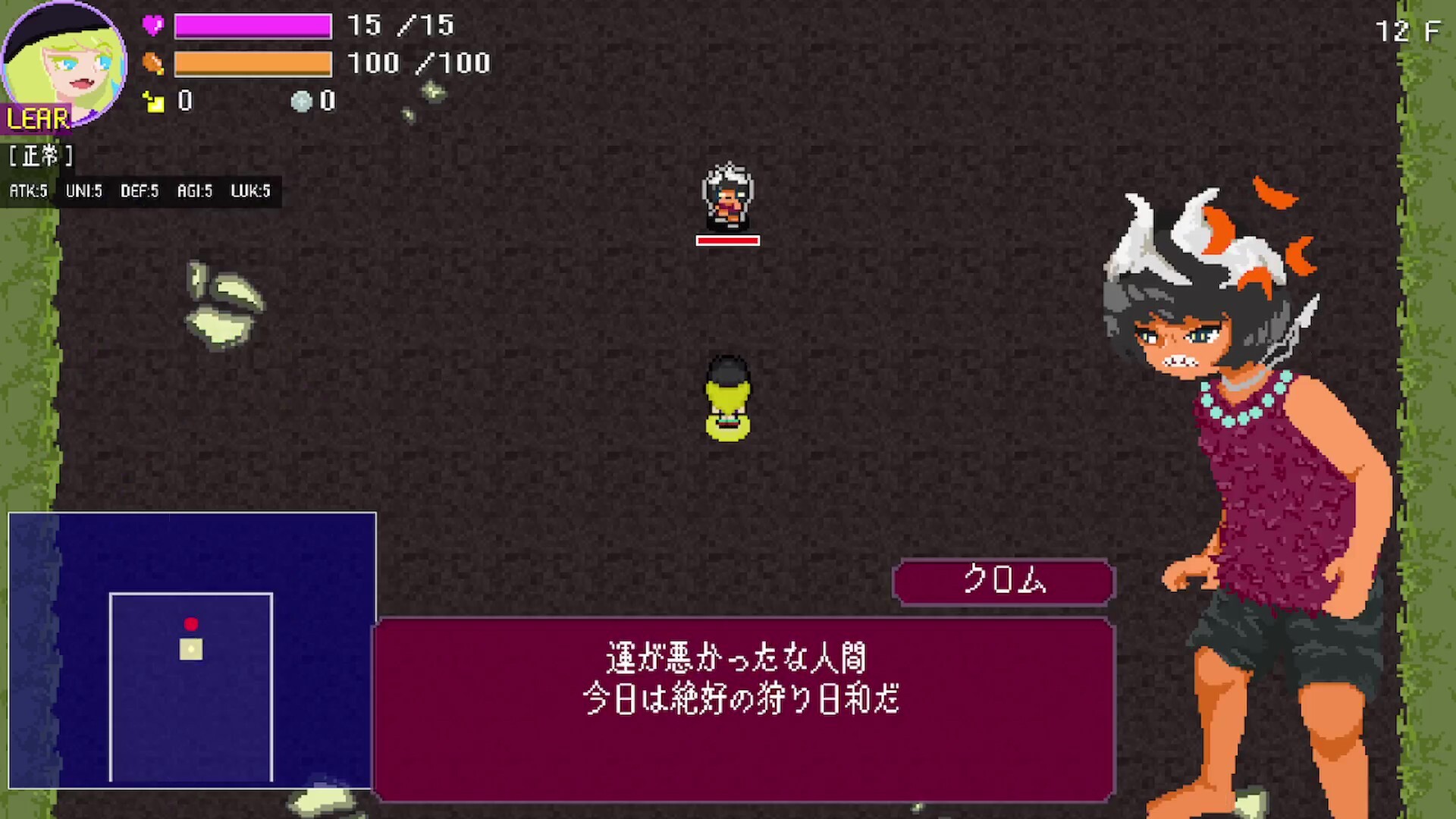
A five-stat character sheet (ATK/UNI/DEF/AGI/LUK) confirmed on screen, despite no stat system being named on the store pageImage: yocco via Steam -
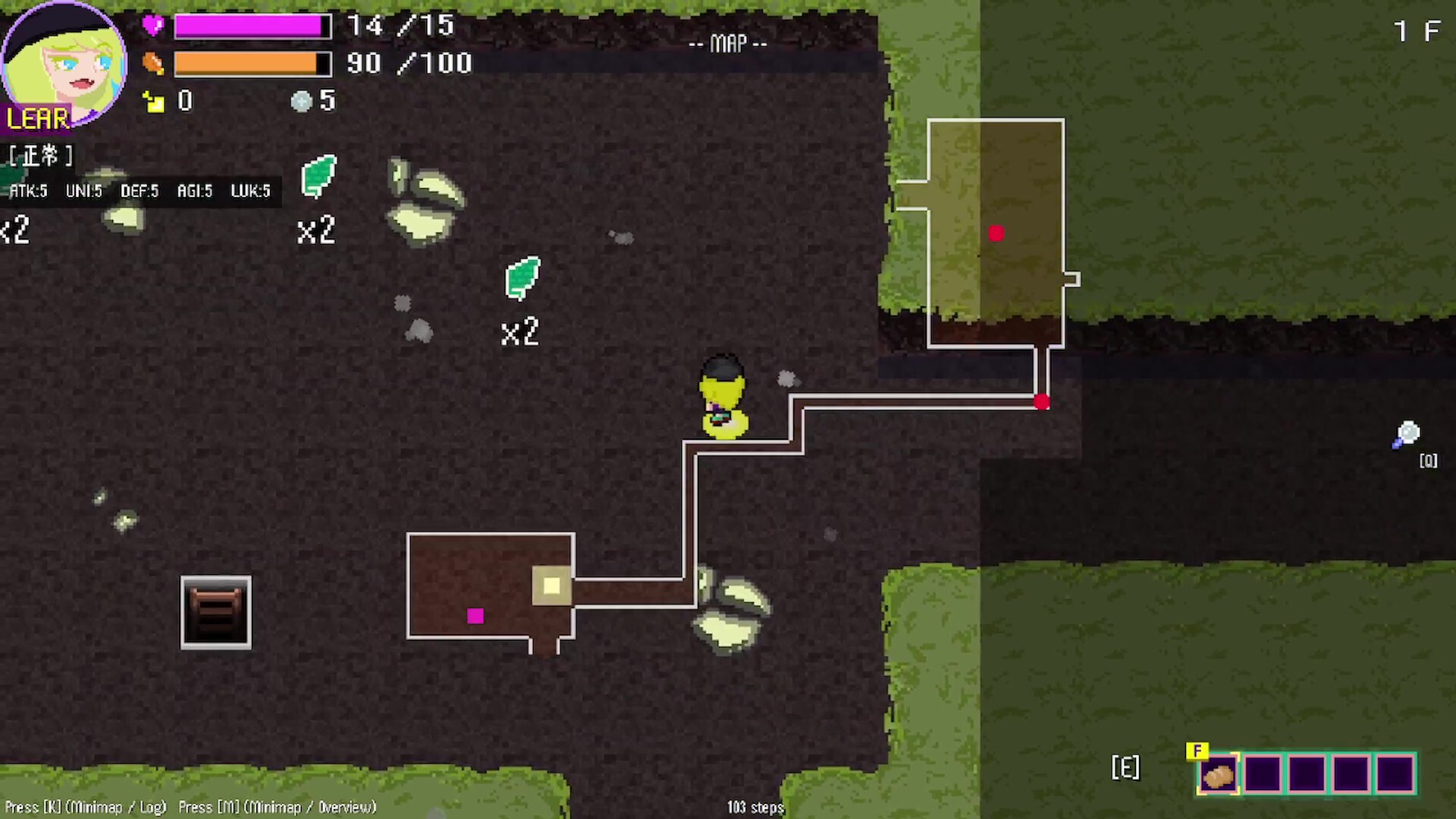
A floor-based dungeon layout with a minimap, item pickups, and a five-slot inventory barImage: yocco via Steam