
Game review
Trizon
6.5 / 10
- Developer
- Ling
- Publisher
- IndieArk
- Released
- 14 May 2025
- Platforms
- Windows
- Genre
- Indie, Strategy
- Players
- Single-player
The short version
Biggest strengths
- A genuinely distinctive signature mechanic — fusing any two cards together to combine their costs, stats, and effects into wild new combinations — that reviewers consistently credit as the game's real hook
- An addictive, escalating power curve that multiple reviewers describe playing for hours in a single sitting despite low initial expectations
- A demonstrably active, responsive solo developer who reviewers say answers questions quickly and shipped a requested change removing restrictions on carrying collection cards across runs
Biggest weaknesses
- Thin audio-visual presentation, most notably just a single music track reused throughout, which multiple reviewers flag as a real, specific gap
- Card and spell effects are reported as visually flat, lacking the particle effects or flourishes players expect from a fantasy card battler
- A distinctly anime-inflected English translation that several reviewers describe as awkward or confusing, though generally forgivable rather than a dealbreaker
6.5 / 10
Fuse any two cards together, and see what happens
Trizon is a roguelike deckbuilder that borrows its combat rhythm from the genre's autobattler wing — creatures fight it out on their own once placed, while instant-effect spells layer on top — but its real hook is a single, well-executed idea: any two cards in your hand can be fused together, merging their costs, stats, and effects into something genuinely new. That's a meaningfully different design proposition from most deckbuilders, where card pools are fixed and strategy is about sequencing and synergy rather than literal combination, and reviewers who came in skeptical consistently describe it clicking hard once they see what it enables. "I had low expectations, but I ended up playing 11 hours non-stop," one reviewer writes, describing exactly the kind of unexpected hook this review sample repeats often enough to treat as a genuine, reliable strength rather than a one-off reaction.
Based on the available English-language review sample of 30 reviews — 27 positive, 3 negative, landing at an overall Positive rating — that fusion mechanic is doing most of the work in winning players over, frequently despite real reservations about everything surrounding it. One reviewer's account of the escalating absurdity the system enables is worth quoting for how specifically it captures the appeal: "I upgraded a single card and ended up with something that annihilated" entire encounters — the kind of emergent, self-generated power spike that roguelike deckbuilders live or die on, and Trizon's fusion system appears to deliver it reliably.
An Inscryption comparison the developer isn't hiding from
Several reviewers explicitly frame Trizon as a close cousin of Inscryption's card-battling roguelike loop, and do so as praise rather than criticism. "This game is HEAVILY inspired by Inscryption, and they're not even hiding it. I'm stating this as a good thing, I loved Inscryption's roguelike... If you liked Inscryption, buy this game," one reviewer writes, specifically calling out the "cheese build" potential of experimenting with card combinations as one of the most fun parts of the experience. A separate reviewer draws a different, equally specific genre comparison, describing the tribute-cost system (playing weaker cards to power up stronger ones) as reminiscent of Yu-Gi-Oh's summoning mechanics: "your cards have a cost, which can be reduced by tributing (hence the Yu-Gi-Oh similarity)... it's unique, the 'limitless' summons remind me of oldschool Yu-Gi-Oh, scratching a roguelike itch I didn't know I had." Landing comparisons to two well-regarded, structurally different card games in the same review sample is a reasonable signal that the fusion-and-tribute system genuinely occupies its own niche rather than simply cloning either.
The presentation gap reviewers keep bumping into
Set against that mechanical strength, the most heavily upvoted single review in the sample — 40 votes, and explicitly negative — identifies a specific, concrete presentation shortfall: "The game has a pretty big presentation problem; there's only one song. That song you hear in the trailer? That's the only one." That's an unusually specific and easily verified complaint, and it recurs in less prominent but corroborating form elsewhere in the sample as evidence the game's audio budget simply didn't extend past a single loop. The same reviewer extends the complaint to visual feedback: "while the art on the cards is pleasant to look at, the game feels a bit robotic," a sentiment echoed independently by a separate positive reviewer who still flags the same specific gap: "I can't help to think they lack visual effects. For example, when you use a fireball I was expecting flashy fire particles, an explosion or something similar, but it's no different than any other card, they all feel the same."
The translation draws its own, more mixed assessment. "The translation comes across as distinctly anime-style, which it's nice that I can tell, and adjust expectations accordingly, but it's not how native English speakers would phrase things," the top negative reviewer notes, a complaint echoed more bluntly by a separate reviewer's terse pros-and-cons list: "English translation pretty confusing." Neither framing treats the translation as a dealbreaker on its own, but both identify it as a real, specific rough edge in a genre that depends on clearly understanding what each card fusion actually does.
Balance that swings hard once the system clicks
The most consistent structural criticism beyond presentation concerns difficulty balance, and it's worth noting because it cuts in both directions depending on which reviewer is describing it. "The main idea on which the gameplay is centered is really interesting and fun, yet it can get out of hand really quickly," one reviewer writes, describing the fusion system's combo potential as something that snowballs faster than the game's difficulty curve can keep pace with. A separate reviewer states the same dynamic even more starkly: "the only good thing is gameplay, and it is not balanced AT ALL, you become op in about 10 runs, but its fun" — treating the imbalance as a real flaw while still recommending the game specifically because the resulting power fantasy is enjoyable rather than frustrating. A more critical reviewer takes the opposite framing, arguing the unique gameplay is undercut by uneven balance and a story that doesn't hold together: "The storyline is unfollowable. The gameplay is unique but not balanced well. It gets old fast." Between those accounts, the fair reading is that Trizon's difficulty curve is genuinely uneven, but that unevenness reads as charming, snowballing power fantasy to some players and as a structural flaw undermining long-term engagement to others.
Notably, Trizon ships with no Steam achievement system at all — a genuine gap for a roguelike deckbuilder, a genre where achievement lists commonly provide exactly the kind of long-tail structure and completionist goals that keep players engaged well past the core loop's initial novelty. Combined with the reported speed at which the fusion system's power ceiling gets reached, that absence reinforces the read of Trizon as a tight, replayable short-to-medium session game rather than one built for extended, structured long-term investment.
A developer worth crediting directly
One specific, recurring positive signal in the sample deserves attention on its own: multiple reviewers independently praise the developer's responsiveness. "Developer is very active and quick to respond to questions," one reviewer writes, while a separate reviewer credits a concrete, fast turnaround on a specific piece of community feedback: "Devs response are quick and they instantly remove the restrictions on bringing collection card across multiple runs. Nice Job!" For a solo-developer roguelike still rough around some of its presentation edges, that kind of demonstrated responsiveness is a meaningful signal about the game's likely trajectory, even without a documented long-term update history to point to yet.
Where this leaves it
Trizon backs a genuinely distinctive, well-executed central idea — fusing any two cards together into something new — with presentation that clearly didn't get the same level of investment: a single reused music track, flat visual effects, and a rough anime-inflected translation are all specific, corroborated gaps rather than vague complaints. Balance swings hard once players learn to exploit the fusion system, which plays as a feature to some and a flaw to others, and the complete absence of an achievement system leaves the game without much long-tail structure once that power ceiling is reached. For deckbuilder fans specifically drawn to Inscryption or Yu-Gi-Oh-style summoning mechanics and willing to look past thin production values, Trizon delivers a genuinely fresh hook at a fair price, backed by a developer who appears to be listening.
Pros and cons
Pros
- A genuinely distinctive signature mechanic — fusing any two cards together to combine their costs, stats, and effects into wild new combinations — that reviewers consistently credit as the game's real hook
- An addictive, escalating power curve that multiple reviewers describe playing for hours in a single sitting despite low initial expectations
- A demonstrably active, responsive solo developer who reviewers say answers questions quickly and shipped a requested change removing restrictions on carrying collection cards across runs
- Cheap enough at its asking price that even critical reviewers rarely call it poor value
Cons
- Thin audio-visual presentation, most notably just a single music track reused throughout, which multiple reviewers flag as a real, specific gap
- Card and spell effects are reported as visually flat, lacking the particle effects or flourishes players expect from a fantasy card battler
- A distinctly anime-inflected English translation that several reviewers describe as awkward or confusing, though generally forgivable rather than a dealbreaker
- Widely reported balance swings, with players becoming dramatically overpowered within around ten runs once the fusion system's combo potential clicks
- A thin, hard-to-follow story layered over the run structure, and no Steam achievement system at all to give structure to longer-term play
Screenshots
-

TrizonImage: IndieArk via Steam -

TrizonImage: IndieArk via Steam -

TrizonImage: IndieArk via Steam -
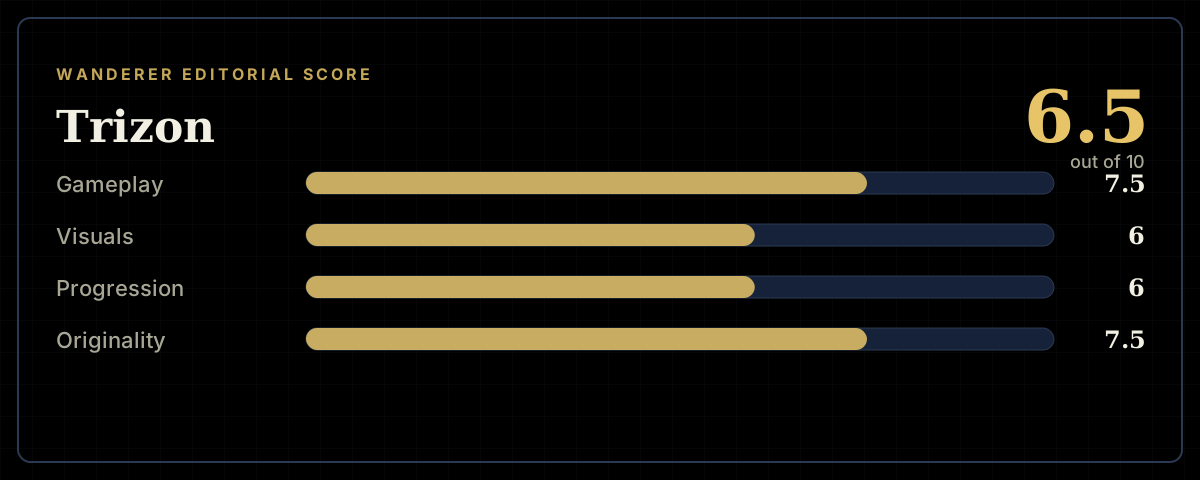
How the review scores each part of the gameWanderer Editorial -
The short versionWanderer Editorial