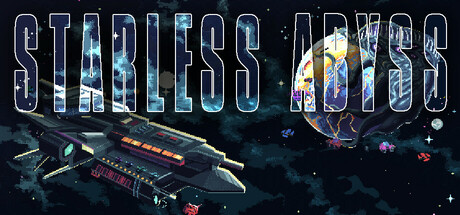
Game review
Starless Abyss
6 / 10
- Developer
- Konafa Games
- Publisher
- No More Robots
- Released
- 25 April 2025
- Platforms
- Windows
- Genre
- Indie, Strategy
- Players
- Single-player
The short version
Biggest strengths
- A genuinely distinctive hybrid, blending deckbuilding with squad-based tactical combat on a hex grid, in a sci-fi/horror setting reviewers repeatedly call a rare and well-executed combination
- Strong presentation across the board — atmosphere, music, and art style are singled out as strengths even by reviewers who are otherwise critical of the mechanics
- A wide achievement spread (56.9% down to 0.5% across 44 achievements) confirms genuine long-term challenge content for players who push into higher difficulties
Biggest weaknesses
- Repeatedly compared unfavourably to Slay the Spire by its own reviewers, who describe the card synergies as more obvious and set-in-stone, leaving many cards outside a chosen build feeling useless
- Persistent crash reports, including specifically after completing a run, which can cost the progression the run was meant to bank
- No save protection against a crash or forced exit, a serious problem for a roguelike built around extended repeat playthroughs
6 / 10
Deckbuilding meets the tactics grid
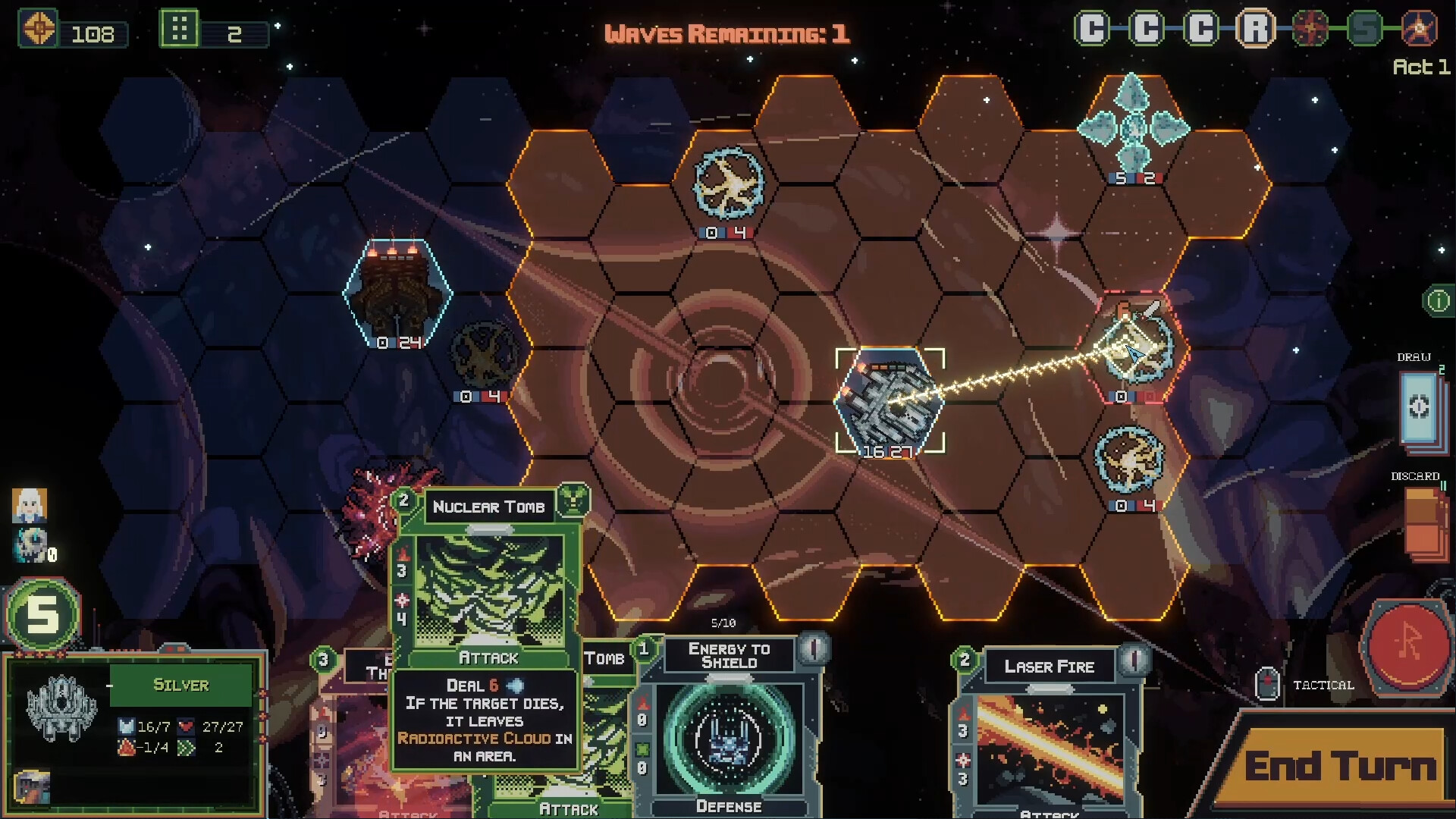
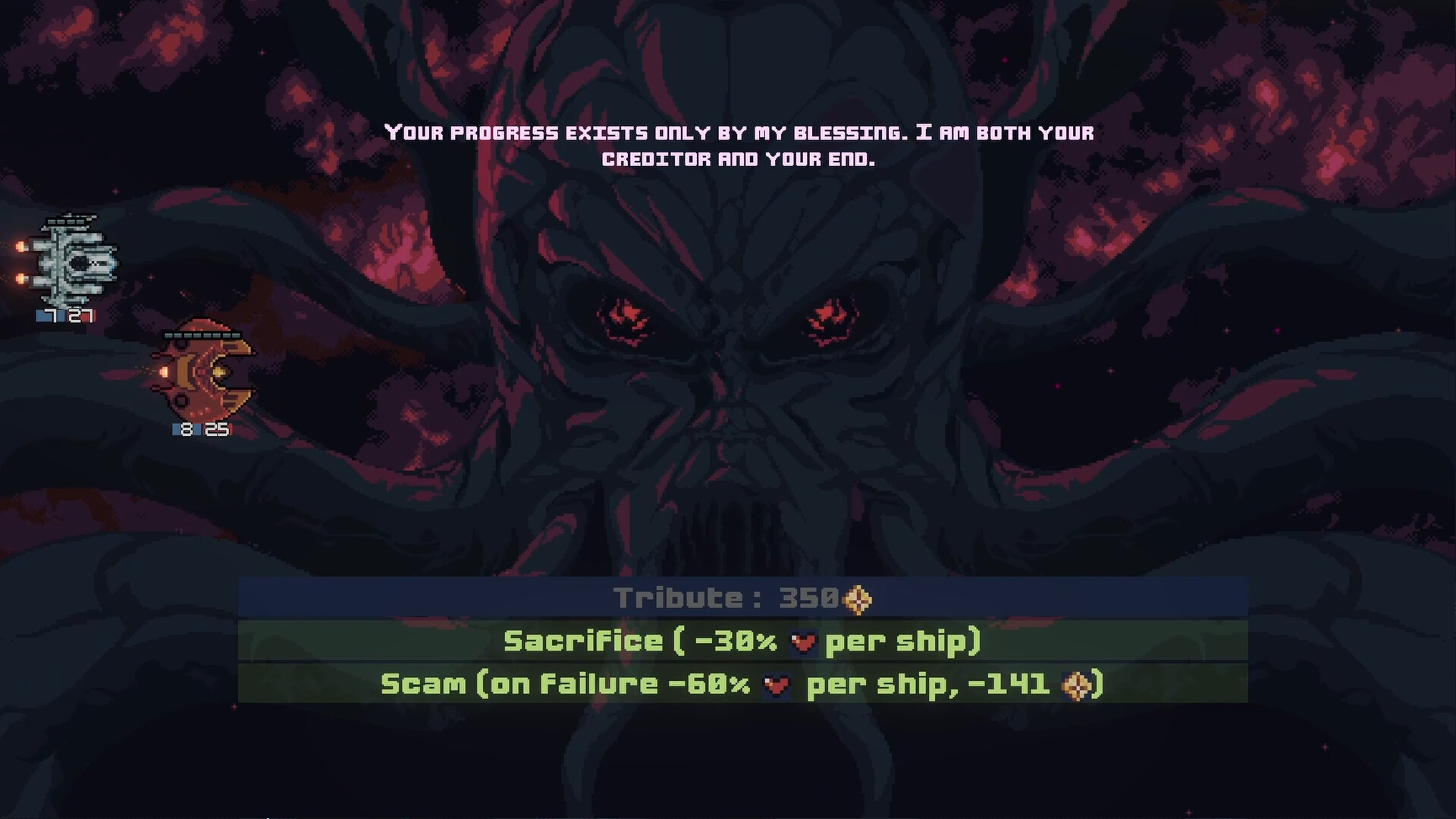
Starless Abyss combines two genres that don't often meet: turn-based deckbuilding in the Slay the Spire mould, and squad-based tactical combat played out on a hex grid, wrapped in a science-fiction horror premise about humanity's Proximae defenders bracing against an eldritch alien invasion. It's a legitimately uncommon pairing, and reviewers consistently credit it as the game's most interesting idea — rather than a single character managing one hand of cards, you're commanding a small squad across positional space, where where a unit stands matters as much as what card you play. One detailed review calls it, simply, "a hidden gem and quite innovative in its sub-genre," specifically praising the sci-fi/horror atmosphere as a rare combination executed with real craft.
The presentation backs that reception up. Reviewers across the spectrum — including several who land on an overall negative verdict — carve out consistent praise for the art direction, the music, and the tonal cohesion of the whole package, describing the experience as "stylish" and "juicy" even when they have serious reservations about what's happening mechanically underneath.
The comparison it can't escape
The single most consistent critical thread in the review sample is a direct, largely unfavourable comparison to Slay the Spire, the genre's dominant reference point. "It's too much like Slay the Spire without adding anything different or compelling enough," one reviewer writes, adding that the experience made them want to go play Slay the Spire instead — a fairly damning kind of praise-by-comparison. The specific complaint underneath that framing is about build variety: reviewers describe card synergies as more obvious and predetermined than the genre's best examples, to the point that once a build direction is chosen, cards outside that direction become effectively dead weight rather than genuine alternate paths. A separate reviewer frames the same problem more generally: "falls in the trap of many deckbuilders where you always take the card that draws you two cards and it becomes easy," describing a dominant-strategy problem common to the genre that Starless Abyss doesn't appear to have solved any better than its predecessors.
A related, more specific complaint concerns encounter design rather than the cards themselves: multiple reviewers describe bosses that seem to directly counter whatever build a player has committed to, rather than presenting a fair test of a well-built deck. "There is a very thin line between a deckbuilder that encourages experimentation and one that looks at your build and says, 'Oh, I see what you picked. Here's a boss that hard-counters it,'" one detailed review puts it — a sharp, specific articulation of a design tension the game seems to land on the wrong side of for a meaningful share of its audience.
Stability and accessibility problems that cost real progress
Beyond the balance discussion, a cluster of technical complaints is worth treating separately because they concern reliability rather than design taste. Persistent crashes are reported by multiple reviewers, notably including crashes that occur specifically after completing a run — precisely the moment a roguelike is meant to bank its progress. Compounding that is a specific, serious quality-of-life gap: the game reportedly offers no save protection against a crash or a forced exit, meaning a lost-power or alt-F4 scenario can erase a run's progress entirely in a genre explicitly designed around extended, repeated play sessions.
A separate accessibility concern deserves its own mention rather than folding into general UI criticism: one reviewer, who states they are not personally epileptic, specifically warns that the interface's frequent flashing lights and rapid bright transitions gave them a headache and could pose a real risk to photosensitive players — a concrete, checkable hazard distinct from ordinary complaints about UI clarity, which several other reviewers separately describe as cluttered and hard to parse even without the flashing-lights issue.
A "solved" first run doesn't mean a solved game
One review offers a data point worth taking seriously precisely because it cuts against the "too easy" and "too derivative" framing in an interesting way: a player who cleared all three acts on their very first run nonetheless describes the game as feeling like it's "missing a bit of depth," rather than concluding it was simply too generous. That's a useful distinction from the achievement data's own story — while the earliest milestones sit above 50%, the curve falls away sharply into single digits and below 2% for the hardest late unlocks, meaning the vast majority of the playerbase is not clearing everything on a first attempt the way that one reviewer did. A first-run clear on standard difficulty and a 0.5%-tier full-mastery achievement can both be true of the same game; what the negative reviews are actually describing is less "the game has no challenge" and more "the interesting strategic decisions run out well before the difficulty does," which is a more precise and more damning version of the complaint than simple ease would be.
That distinction matters for anyone weighing whether to buy: players chasing a single satisfying campaign clear are likely to find the difficulty reasonable and the atmosphere worth the price; players hoping for the kind of open-ended, ever-shifting strategic depth that keeps Slay the Spire's community engaged years after release are the ones most likely to hit the game's ceiling early and feel the comparison sting.
Where this leaves it
Starless Abyss has a genuinely novel concept — grid-based tactical squad combat fused with deckbuilding, in a sci-fi horror setting few games attempt — executed with real atmospheric craft that both fans and critics of the game agree on. What holds it back from a stronger recommendation is a familiar deckbuilder problem it doesn't solve any better than its more famous influences, compounded by real reliability issues (crashes, no crash-proof saving) and a specific, reported accessibility hazard in its own interface. Worth trying for the concept and the presentation, with real caution warranted around its current stability and a genuine heads-up for photosensitive players before diving in.
Pros and cons
Pros
- A genuinely distinctive hybrid, blending deckbuilding with squad-based tactical combat on a hex grid, in a sci-fi/horror setting reviewers repeatedly call a rare and well-executed combination
- Strong presentation across the board — atmosphere, music, and art style are singled out as strengths even by reviewers who are otherwise critical of the mechanics
- A wide achievement spread (56.9% down to 0.5% across 44 achievements) confirms genuine long-term challenge content for players who push into higher difficulties
- Published by No More Robots, an indie label with a track record of supporting distinctive small-team projects post-launch
Cons
- Repeatedly compared unfavourably to Slay the Spire by its own reviewers, who describe the card synergies as more obvious and set-in-stone, leaving many cards outside a chosen build feeling useless
- Persistent crash reports, including specifically after completing a run, which can cost the progression the run was meant to bank
- No save protection against a crash or forced exit, a serious problem for a roguelike built around extended repeat playthroughs
- A flashy, cluttered UI criticized for making the game state hard to read at a glance, with one reviewer specifically flagging frequent flashing lights and quick bright transitions as a photosensitivity concern
- Boss encounters are reported to sometimes directly counter a player's specific build choices rather than testing it fairly, which several reviewers find feels punishing rather than skill-testing
Screenshots
-
Starless AbyssImage: No More Robots via Steam -
Starless AbyssImage: No More Robots via Steam -
Starless AbyssImage: No More Robots via Steam -
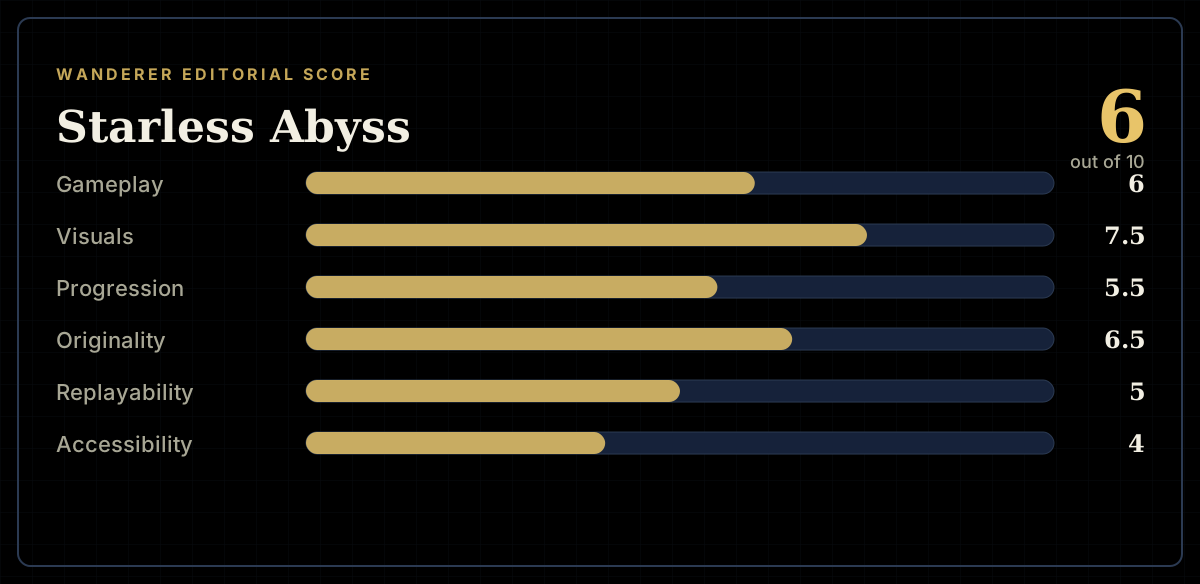
How the review scores each part of the gameWanderer Editorial -
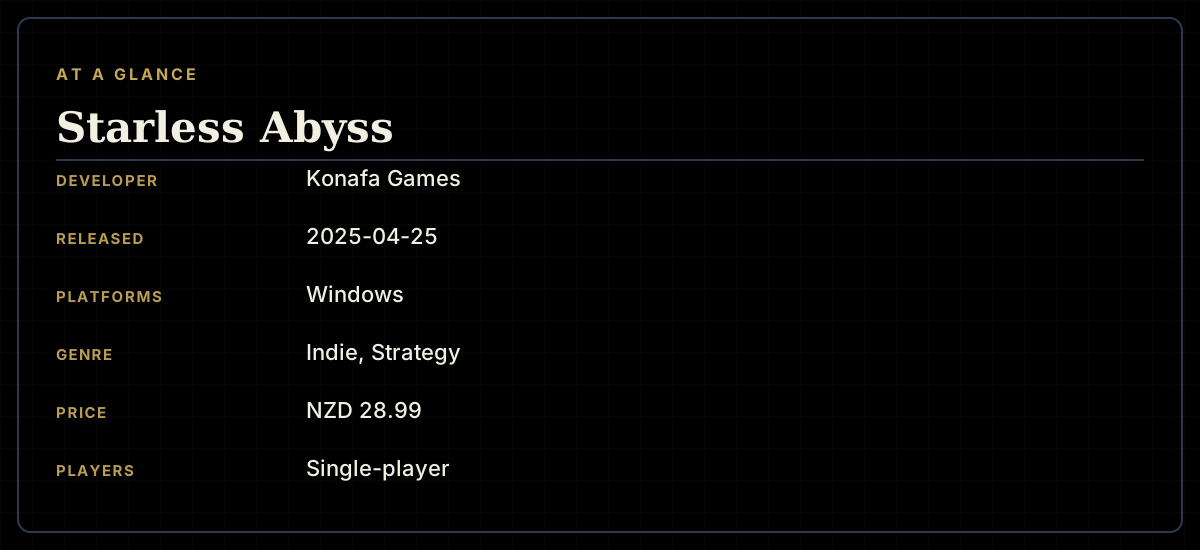
At a glanceWanderer Editorial -
The short versionWanderer Editorial