
Game review
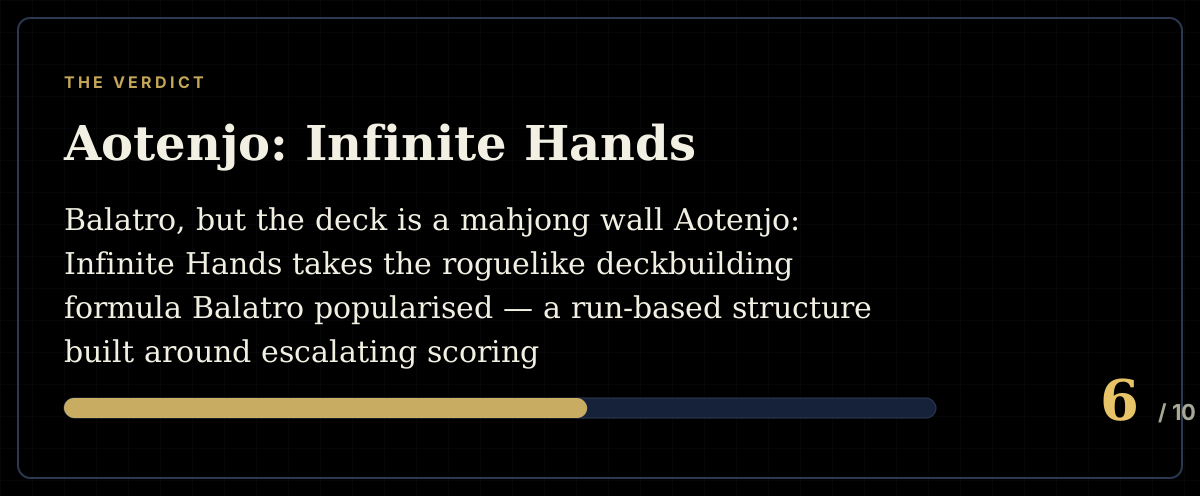
Aotenjo: Infinite Hands
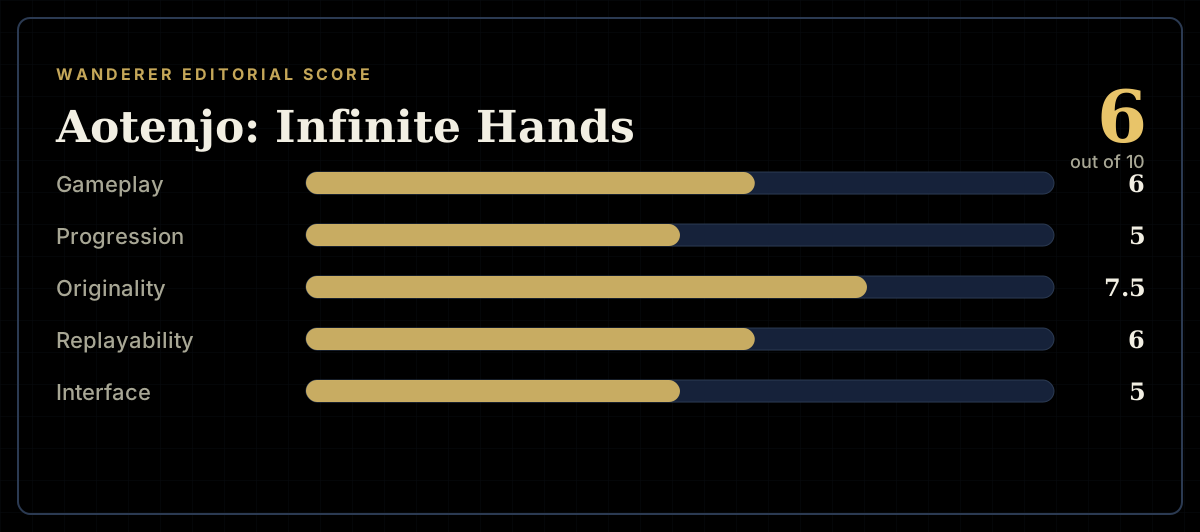
6 / 10
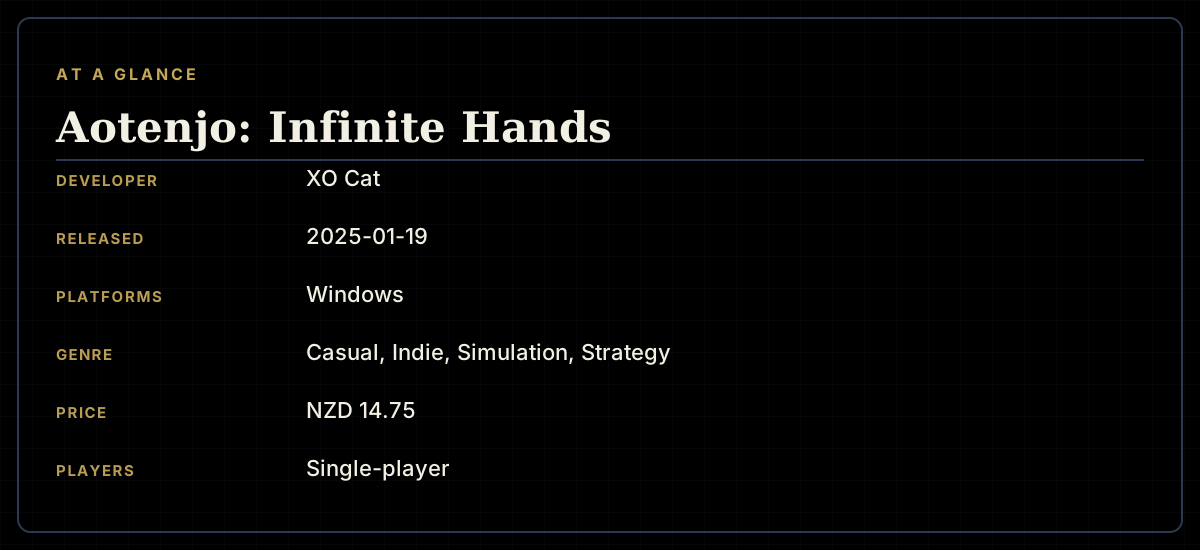
- Developer
- XO Cat
- Publisher
- XD
- Released
- 19 January 2025
- Platforms
- Windows
- Genre
- Casual, Indie, Simulation, Strategy
- Players
- Single-player
The short version
Biggest strengths
- A genuinely inventive premise — Balatro's roguelike scoring-run structure rebuilt around Mahjong hand construction instead of poker — that multiple reviewers say carves out its own identity rather than feeling like a reskin
- Reviewers who are both Mahjong enthusiasts and Balatro fans specifically report the combination works better than they expected, describing surprising depth in how the two traditions combine
- A wide, 46-achievement completion spread (87.7% down to 0.5%) confirms real structural depth and a long tail for players willing to master its systems
Biggest weaknesses
- Experienced real-world Mahjong and Riichi players report the scoring system departs far enough from actual mahjong logic to feel unfamiliar and, at higher difficulties, excessively chance-based rather than skill-rewarding
- Multiple reviewers who came in as Balatro fans report the game imported that game's structure without matching its legibility, citing an overload of one-use items and artifacts that are difficult to track or build associations around
- Difficulty past the second tier is repeatedly described as feeling closer to pure RNG than a fair escalation of the earlier, well-tuned difficulty curve
6 / 10
Balatro, but the deck is a mahjong wall
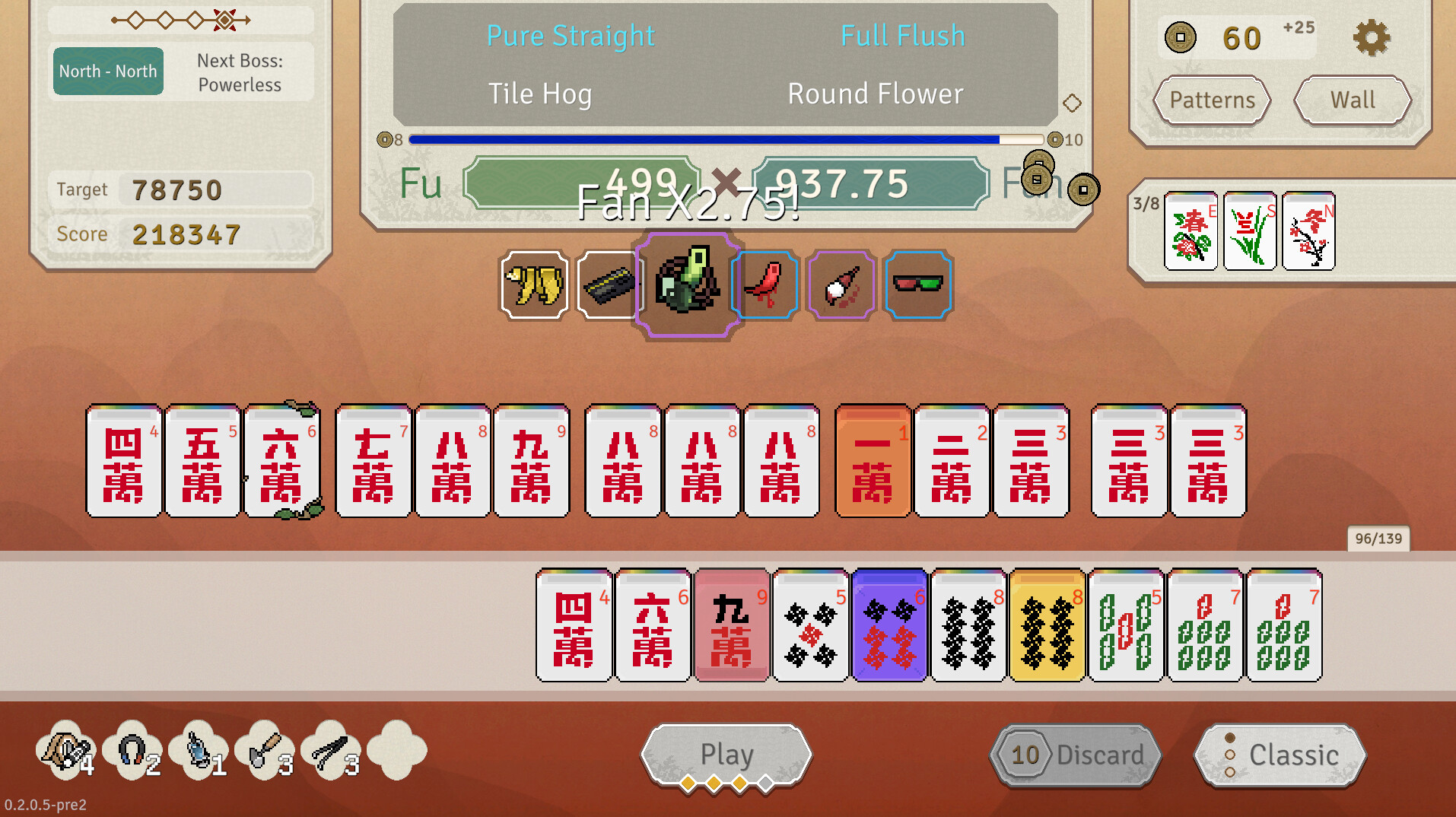
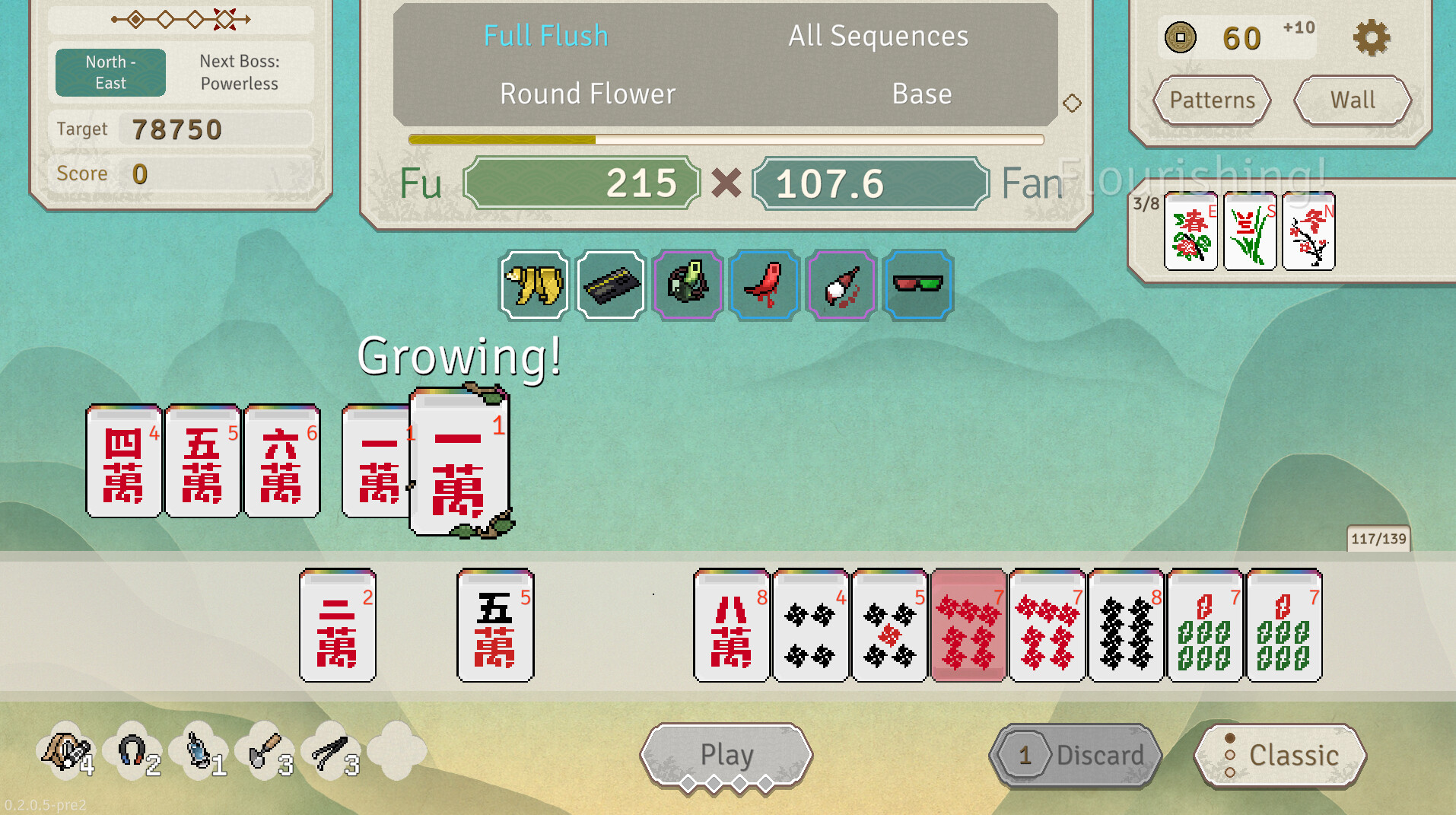
Aotenjo: Infinite Hands takes the roguelike deckbuilding formula Balatro popularised — a run-based structure built around escalating scoring thresholds, one-shot power-ups, and synergy-hunting between rounds — and rebuilds it around Mahjong hand construction instead of poker. Rather than five-card hands, you're assembling sets and pairs from mahjong tiles, chasing score multipliers through artifacts and gadgets that modify how your hands resolve. It's an unusually direct and unusually risky homage: as one detailed review points out, "Balatro worked because the rules of poker are universally understood," while mahjong's hand-construction rules are considerably less familiar to a Western audience, putting real pressure on Aotenjo to teach its own foundation clearly before layering roguelike complexity on top.
For a meaningful share of its audience, that gamble pays off. Reviewers who describe themselves as both mahjong enthusiasts (citing real-world experience in Riichi communities and games like MahjongSoul) and Balatro fans report the combination working better than they expected — "Saying this is Balatro for Mahjong fans does not do it enough justice," one review states, going on to praise the interesting combos and genuine strategic decision-making on offer. Another reviewer with FFXIV and MahjongSoul experience calls it "not only what I expected and wanted it to be, but so much more," specifically noting it doesn't merely graft Balatro's systems onto mahjong tiles but changes enough of its own rules to develop a distinct identity.
Two different audiences, two different disappointments
The negative review sample splits cleanly along the same two lines of inspiration, and it's worth treating each complaint separately because they come from genuinely different expertise. Experienced real-world mahjong players report the game's departures from actual mahjong scoring logic — playing sets sequentially with individual pairs rather than resolving a fully-formed hand at once, for instance — create real friction for anyone bringing prior mahjong knowledge to the table, and several separately report that as difficulty rises, success feels driven more by the luck of the draw than by strategic skill. One reviewer with 60 hours logged states this without hedging: "This game is not for people with experience playing Mahjong... I can say without a doubt that this game is far too chance based," specifically citing stage 10 and beyond as a point where even well-built scoring engines can't guarantee clearing a boss.
Reviewers coming from the Balatro side raise a different but related concern: the game imports Balatro's structural DNA without matching its famous clarity. "It takes a lot of DNA from Balatro which wouldn't be a problem were it not for the fact it doesn't understand WHY Balatro works," one detailed review argues, pointing specifically to a glut of one-use items that are hard to remember or build associations around — the opposite of Balatro's own carefully legible joker system, which teaches its rules through repetition and clean iconography. A separate reviewer frames the same concern more broadly as "scope creep," suggesting the game has accumulated systems faster than its tutorialisation and interface clarity have kept pace with them.
A year into Early Access, still finding its shape
One of the more telling reviews in the sample opens by noting the game is "a full year after release" and still hard to recommend broadly, which is a useful anchor point: this isn't a fresh, rough Early Access build still finding its footing in its first weeks, but a genre experiment that's had substantial time to refine its most commonly cited problems and, per multiple reviewers, still hasn't fully resolved the difficulty-scaling and clarity complaints. That's not necessarily damning on its own — plenty of well-regarded Early Access roguelikes take years to reach their final form — but it does mean prospective buyers should weigh the current, well-documented rough edges rather than assume they've since been smoothed away.
The achievement data suggests there's genuine structural depth worth the wait for players willing to engage with the learning curve: the completion spread runs a wide, gradual range from 87.7% for the earliest unlock down to a cluster of sub-1% achievements at the extreme high end, spread across 46 total achievements — a shape consistent with a deep, still-being-mastered system rather than a shallow one.
A joke that captures the whole review split
One of the most-upvoted reviews on the store page makes its point in a single line: "In 4-player mahjong, you can expect to lose 75% of the time. Aotenjo fixes this by letting you lose 100% of the time." It's a joke, but it's also a genuinely useful summary of the tension running through this entire review sample — a game whose core hook (turning a normally social, luck-mitigated game into a solitary, escalating-difficulty gauntlet) is exactly what real mahjong players find alienating and exactly what roguelike-deckbuilder fans came looking for. Neither reaction is wrong; they're responding to the same design decision from opposite directions, which is a large part of why this game's reception splits so cleanly along which genre a given reviewer approached it from.
That's a useful frame for a prospective buyer: the question isn't really "is this a good game," it's "which of the two traditions this game is fusing do you care about more, and how much are you willing to let the other one bend to accommodate it." Reviewers who answer that question going in tend to have a much better time than reviewers who expected one genre's rules to hold and found the other genre's priorities winning out instead.
Where this leaves it
Aotenjo: Infinite Hands is a genuinely bold experiment that succeeds at proving Balatro's roguelike-deckbuilder format can work with a completely different card foundation, and for players who bring genuine enthusiasm for both mahjong and Balatro-style runs, it delivers something distinct and worth playing. Where it currently falls short, according to two quite different but equally credible audiences, is exactly where a game this ambitious is hardest to get right: teaching an unfamiliar ruleset clearly enough, and keeping difficulty scaling feel fair rather than luck-dependent as complexity accumulates. Worth trying for players specifically drawn to its premise, with the understanding that a year of Early Access hasn't yet resolved the core clarity and balance complaints its own most engaged reviewers keep raising.
Pros and cons
Pros
- A genuinely inventive premise — Balatro's roguelike scoring-run structure rebuilt around Mahjong hand construction instead of poker — that multiple reviewers say carves out its own identity rather than feeling like a reskin
- Reviewers who are both Mahjong enthusiasts and Balatro fans specifically report the combination works better than they expected, describing surprising depth in how the two traditions combine
- A wide, 46-achievement completion spread (87.7% down to 0.5%) confirms real structural depth and a long tail for players willing to master its systems
- Still in active Early Access a full year after launch, with a genuinely engaged and vocal player community still debating its design in detail
Cons
- Experienced real-world Mahjong and Riichi players report the scoring system departs far enough from actual mahjong logic to feel unfamiliar and, at higher difficulties, excessively chance-based rather than skill-rewarding
- Multiple reviewers who came in as Balatro fans report the game imported that game's structure without matching its legibility, citing an overload of one-use items and artifacts that are difficult to track or build associations around
- Difficulty past the second tier is repeatedly described as feeling closer to pure RNG than a fair escalation of the earlier, well-tuned difficulty curve
- A recurring "scope creep" complaint, with reviewers noting systems have been added faster than the game's own clarity and onboarding have kept pace
Screenshots
-
Aotenjo: Infinite HandsImage: XD via Steam -
Aotenjo: Infinite HandsImage: XD via Steam -

Aotenjo: Infinite HandsImage: XD via Steam -
How the review scores each part of the gameWanderer Editorial -
At a glanceWanderer Editorial -
The short versionWanderer Editorial