
Game review
RACCOIN: Coin Pusher Roguelike
6.5 / 10
- Developer
- Doraccoon
- Publisher
- Playstack
- Released
- 31 March 2026
- Platforms
- Windows
- Genre
- Roguelike Deckbuilder
- Monetisation
- One-time purchase, no DLC or in-game currency
- Players
- Single-player
The short version
RACCOIN fuses two things that shouldn't work together as well as they do: the physical, satisfying chaos of an arcade coin pusher, and the build-a-run-then-cash-out structure of a Balatro-style roguelike deckbuilder. It launched 31 March 2026 to Very Positive, 85%, across 2,784 reviews. What separates this corpus from a typical launch, though, is its single most important review — 1,238 votes, nearly five times the runner-up — which isn't a gameplay critique at all. It's a detailed technical audit documenting telemetry that fired before the game's own opt-in consent screen and continued transmitting a persistent user ID even after players opted out, which publisher Playstack patched out in version 1.0.24 only after the report became public. A separate, more ordinary complaint thread argues the core loop, once the novelty wears off, doesn't have enough mechanical "hook" to sustain repeat runs.
Biggest strengths
- A genuinely novel hybrid concept — physical coin-pusher mechanics driving a roguelike run structure — that reviewers, even critical ones, credit as a fresh idea rather than a reskin
- Charming, polished art direction and presentation draw specific praise, including from reviewers who otherwise found the gameplay underwhelming
- The publisher did ultimately respond to the telemetry report: version 1.0.24 removed GameAnalytics and its associated endpoints, and committed in a public forum thread to disclosing any future reactivation in patch notes rather than silently
Biggest weaknesses
- The single most-upvoted review in the entire corpus is a detailed technical privacy audit, not a gameplay critique: it documents GameAnalytics telemetry firing before the game's own opt-in screen, a newsletter endpoint on Google Cloud, and a persistent user ID transmitted even after opting out — all present in the version that originally shipped
- The publisher's fix, shipped as patch 1.0.24, followed public criticism rather than preceding it, and the patch notes' own wording — analytics collection is disabled "for now" — leaves the door open to reactivation, a caveat the reviewer specifically flags as not equivalent to renewed consent
- A separate, unrelated complaint thread argues the core gameplay loop is more satisfying to describe than to actually play: several detailed reviews say the concept is "missing the hook," with runs feeling more passive than the build-crafting comparison to Balatro implies
Who it's for: Players drawn to the coin-pusher-meets-deckbuilder premise who want a short, charming session or two, and who are satisfied that the pre-consent telemetry issue was patched out following public pressure. Less of a fit for players specifically seeking Balatro-level long-term build depth, or anyone who wants a publisher's handling of a privacy complaint to have been proactive rather than reactive.
Our recommendation: Worth a look at its price point for the novelty of the concept, now that the telemetry issue documented below has been patched — but read that section before buying, and go in expecting a charming few hours rather than the deep, endlessly replayable roguelike its comparisons to Balatro might imply.
6.5 / 10
RACCOIN's premise is disarmingly simple to picture and genuinely unusual to see executed: an arcade coin pusher — the physical, chaotic machines that stack coins on a shelf until enough weight sends a jackpot spilling over the edge — rebuilt as the engine for a Balatro-style roguelike run, where the items and coins you buy between pushes shape increasingly wild combos. Developer Doraccoon and publisher Playstack released it 31 March 2026 to a Very Positive 85% across 2,784 reviews. But the review that matters most in this corpus isn't about the coin pusher at all.
The most important review here is a privacy audit
By a wide margin, the single most-upvoted review on RACCOIN's Steam page — 1,238 votes, nearly five times its nearest competitor — is a detailed technical investigation into the game's telemetry. The reviewer documents, with specific endpoint names and a linked Steam forum thread, that the originally shipped version "ran a surprisingly elaborate telemetry stack in the background: GameAnalytics fired before the OptIn screen, a newsletter endpoint sat in Google Cloud, a persistent user_id was transmitted even after OptOut, and a local SQLite database buffered events." In plainer terms: the game was reporting data before asking permission, and continued identifying the same player even after that player explicitly declined.
The review goes on to document the response: a Playstack community representative, posting under the handle "liv," first confirmed receipt of the criticism, initially stated no immediate change was planned, then shipped patch 1.0.24 a few days later, quoted directly as saying "we have disabled all Game Analytics and its related settings. The game no longer collects or transmits data." The reviewer flags the patch notes' own more cautious wording — collection is disabled "for now" — as leaving room for reactivation, though credits Playstack's follow-up commitment to disclose any such change in future patch notes as "a concession to transparency" rather than full GDPR-standard consent. This review earned its outsized vote count precisely because it forced a real fix; per the pattern this library has flagged before, publisher-side infrastructure and data-handling decisions are frequently the actual top complaint on a review page, well ahead of anything about the game itself, and RACCOIN is a clean, unusually well-documented example of exactly that.
Set the telemetry story aside, and there's a smaller, separate gameplay debate
Independent of the privacy issue, a second thread of criticism argues the core loop doesn't fully deliver on its premise. "It's missing the 'Hook,'" reads one 252-vote negative; a similarly detailed review agrees "most of the gameplay happens in the shop and not in the coin pusher machine" — a real design tension for a game whose entire pitch is the coin pusher. Several reviewers describe runs "deflating" quickly once the game's main tricks have been seen, and the achievement data is consistent with that: strong early engagement (83.6% for a first loss, 42.5% for a first win) falling off sharply toward full-collection achievements under 1%.
Final verdict
RACCOIN's core hybrid idea is a genuinely fresh one, well-liked by most of its player base, and the developer's presentation and polish draw real praise even from disappointed reviewers. But the honest headline for anyone considering this purchase is what the corpus itself elevated to the top: a specific, documented telemetry problem that existed at launch and was fixed only after public pressure, with a "for now" caveat in the fix's own patch notes. That's been addressed, not erased, and it belongs in any fair account of this game alongside the more ordinary complaint that the gameplay itself doesn't quite live up to its own premise.
Pros and cons
Pros
- A genuinely novel hybrid concept — physical coin-pusher mechanics driving a roguelike run structure — that reviewers, even critical ones, credit as a fresh idea rather than a reskin
- Charming, polished art direction and presentation draw specific praise, including from reviewers who otherwise found the gameplay underwhelming
- The publisher did ultimately respond to the telemetry report: version 1.0.24 removed GameAnalytics and its associated endpoints, and committed in a public forum thread to disclosing any future reactivation in patch notes rather than silently
- Achievement data shows a healthy early engagement curve (83.6% for a first loss, 42.5% for a first win), suggesting the core loop is at least accessible even to reviewers who found it thin later on
- Cheap enough at NZ$19.49 that reviewers who bounced off it after a few hours generally don't describe it as a bad-value purchase, just a shorter one than expected
Cons
- The single most-upvoted review in the entire corpus is a detailed technical privacy audit, not a gameplay critique: it documents GameAnalytics telemetry firing before the game's own opt-in screen, a newsletter endpoint on Google Cloud, and a persistent user ID transmitted even after opting out — all present in the version that originally shipped
- The publisher's fix, shipped as patch 1.0.24, followed public criticism rather than preceding it, and the patch notes' own wording — analytics collection is disabled "for now" — leaves the door open to reactivation, a caveat the reviewer specifically flags as not equivalent to renewed consent
- A separate, unrelated complaint thread argues the core gameplay loop is more satisfying to describe than to actually play: several detailed reviews say the concept is "missing the hook," with runs feeling more passive than the build-crafting comparison to Balatro implies
- Multiple reviewers specifically say more of the interesting decision-making happens in the pre-run shop than in the coin-pusher machine itself, undercutting the game's own central gimmick
- Deep completion is very steep even by roguelike standards — several achievements sit under 1% global completion, and multiple reviewers report the game "deflating" quickly after their first few runs once its main tricks are seen
Screenshots
-
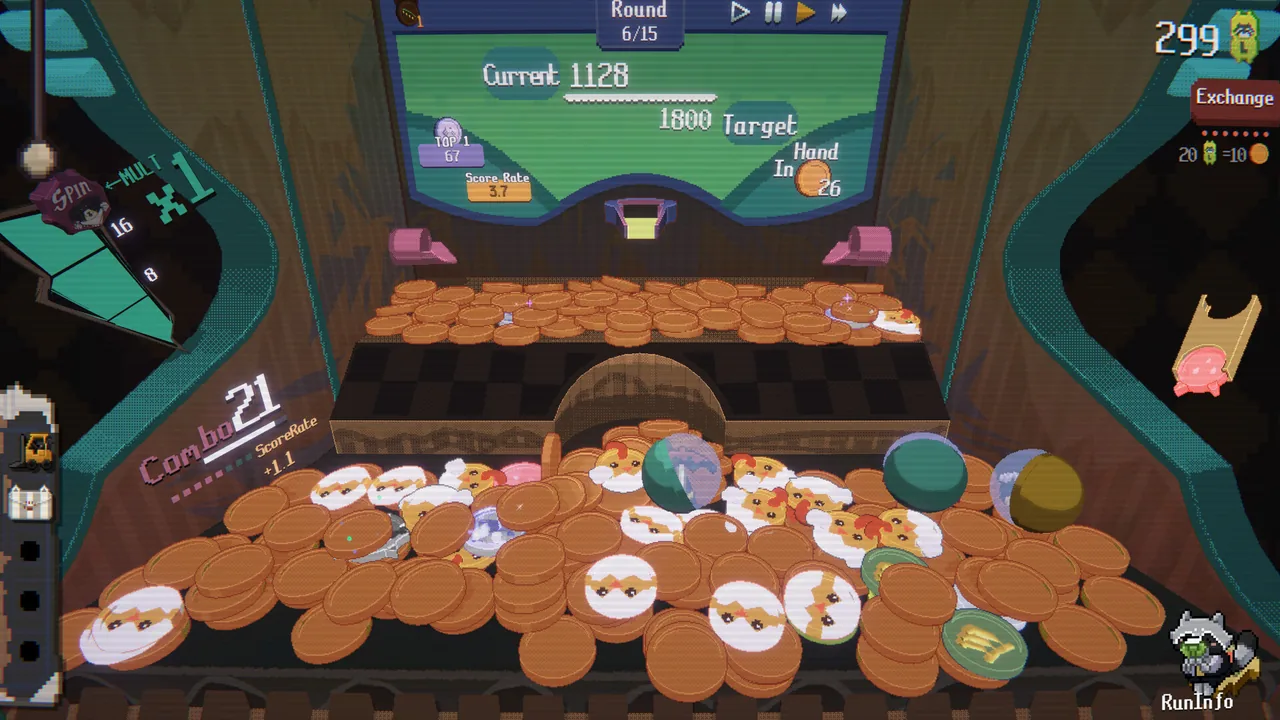
RACCOIN: Coin Pusher RoguelikeImage: Playstack via Steam -

RACCOIN: Coin Pusher RoguelikeImage: Playstack via Steam -

RACCOIN: Coin Pusher RoguelikeImage: Playstack via Steam -
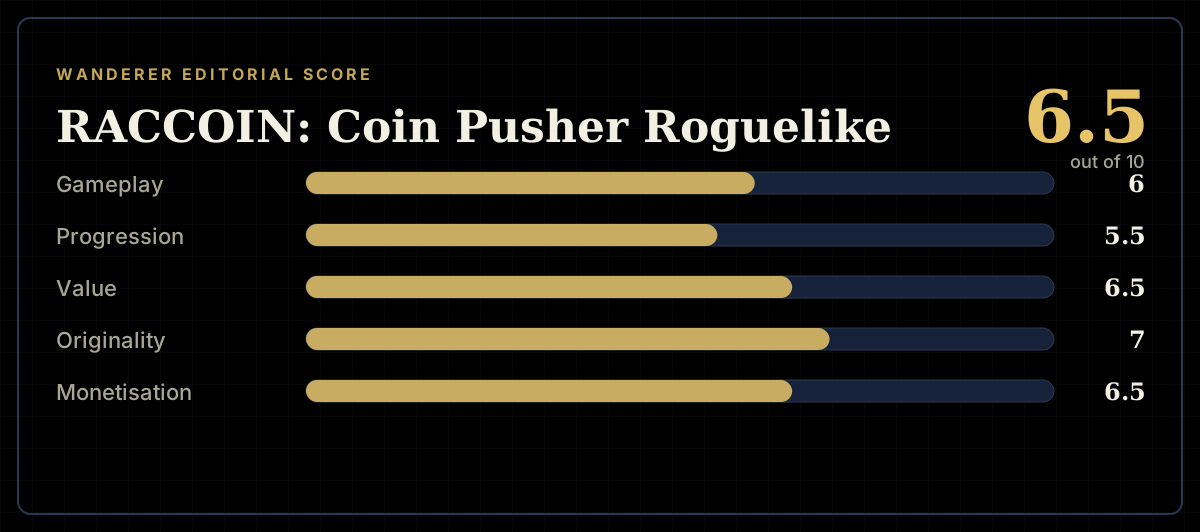
How the review scores each part of the gameWanderer Editorial -
The short versionWanderer Editorial