
Game review
The Rewinder 2
6 / 10
- Developer
- MistyMountainStudio
- Publisher
- Gamirror Games
- Released
- 25 May 2025
- Platforms
- Windows
- Genre
- Action, Adventure, Indie, RPG
- Players
- Single-player
The short version
Biggest strengths
- A significantly larger, more ambitious scope than the original, including multiple distinct endings confirmed by both reviewers and a wide 45-achievement spread
- Consistently praised lore, characters, and setting rooted in Chinese mythology, carried over and expanded from the well-regarded first game
- Upgraded art direction, including full character portraits, that multiple reviewers specifically single out as a visible step up
Biggest weaknesses
- A structural genre pivot from pure puzzle-adventure to souls-like combat is the dominant, deeply polarizing complaint, with critics calling the added combat sluggish, unrewarding, and out of step with what made the first game work
- Multiple reviewers report leftover untranslated Chinese text appearing in the English version, a rough edge for a game this dependent on story and dialogue
- Reported minor graphical bugs and out-of-bounds map exploits
6 / 10
A beloved puzzle series pivots toward action, and splits its own audience
The Rewinder 2 follows a well-regarded puzzle-adventure rooted in Chinese folklore and mythology, and it inherits that game's strongest assets wholesale: an evocative, culturally specific setting of cursed villages and haunted dungeons, memorable ghost and monster designs, and a genuine sense of place that reviewers on both sides of this game's reception continue to praise without reservation. What it doesn't inherit unchanged is the gameplay itself — where the original was a focused puzzle-adventure, The Rewinder 2 folds in real-time action combat with a distinctly souls-like flavour, alongside an expanded map, new traversal tools, and multiple distinct endings. That's a genuinely significant structural pivot for a sequel, and based on the available English-language review sample of 13 total reviews (11 positive, 2 negative, landing at an overall Positive rating), it's the single decision that defines nearly every review of this game, in both directions.
The combat pivot that most divides the sample
The most heavily upvoted review in the entire sample — 108 votes, from a reviewer who reports being roughly halfway through the game — states the objection as directly as possible: "Look, I get it, souls likes are really popular, but not every game needs to be a souls like. This game could have been a top notch puzzle game just like the first one, but instead it's a low tier souls like that nobody wants." The same reviewer goes further, describing the actual play experience in blunt terms: "The saddest thing about a game is it's not fun to play, and this game is just that sad... if not for the first game I would have refunded it around the first hour. It's just SUCH a SLOG to play." That's a specific, credible complaint from someone who evidently came in as a fan of the original and found the new combat actively unpleasant rather than merely different.
A separate, heavily upvoted Chinese-language review reaches an even harsher structural conclusion, arguing the developer misread why the first game succeeded in the first place. Translated, the core of the complaint is that the studio abandoned the puzzle-focused design that made the original a hit in favour of combat mechanics the reviewer describes as stiff and unresponsive, framing the shift toward action-RPG combat as chasing a trend rather than building on a genuine strength — and specifically naming the resulting loss of the series' original core audience as the cost of that choice. When a heavily upvoted review in the game's own primary market makes essentially the same core argument as the top English-language review, independently and in different words, that's a strong signal the combat complaint reflects a real, widely shared reaction rather than a narrower cultural or platform-specific gripe.
The counter-case: fans who wanted the change, or accepted it
Set against that, the majority of the English-language sample is positive, and several of those reviews specifically address the divide rather than ignoring it. "The Rewinder 2 is definitely not a perfect game and THAT'S OKAY!! ... What I'm noticing for a lot of negative reviews is that they were expecting a slightly tweaked clone of the first game and discarded the trailers because if you look at what they advertise you'll know what you're getting into. Personally, I'm glad they changed things up," one reviewer writes, arguing the pivot was clearly telegraphed pre-release rather than a bait-and-switch. A separate reviewer frames the combat as a net neutral rather than a highlight: "I'm happy that combat is not too frustrating, it doesn't get in the way of Story Progression" — a notably different read from the "slog" framing above, and one that suggests actual difficulty and pacing experience varied meaningfully between players.
One detailed positive review specifically pushes back on the souls-like framing itself while still wanting more of the original's core strength: "Dont compare it to a souls like game, totally not at all, but I do agree with a bit more puzzle and I want a bigger map... As for the special tools, I was hoping to use them more but sadly there wasn't a lot of place to use it." That's a genuinely useful, more measured middle position within the positive sample — someone who enjoyed the game overall but shares the underlying wish that the puzzle-and-tool-based design had remained more central relative to the new combat systems, without going as far as calling the whole experience a failure.
What's carried over well: lore, art, and the puzzles that remain
Across nearly the entire sample, regardless of position on the combat question, reviewers agree on what The Rewinder 2 gets right. "The Rewinder 2 has new gaming mechanics but retains what I loved from the original: its lore, its artstyle, the horror, its compelling characters, and most of all: The Puzzles. The wonderful soundtrack too," one reviewer writes, crediting continuity in exactly the areas where the original built its reputation. Another reviewer specifically credits a visible step up in character presentation: "The art has a big upgrade with full character portraits, it was really interesting to see the variety of sprites and the faces all looked unique." A separate reviewer frames their attachment to the underlying setting in more personal terms, expressing continued affection for the series' Chinese-mythology roots and hope for the studio's future work — a sentiment echoed by another reviewer who specifically credits the story's grounding in Chinese lore and says they loved this entry even more than the original.
A recurring, more minor complaint concerns localization quality specifically around leftover source-language text: "playing in English there are a few untranslated Chinese lines that I am lost on," one reviewer notes, a specific and fixable production gap distinct from the larger combat debate, but a real one for a game whose appeal depends heavily on its story and dialogue landing clearly. Reviewers also mention small technical rough edges — minor graphical bugs and the ability to walk out of the intended map bounds — that read as ordinary launch-window polish issues rather than anything more serious.
What the achievement spread confirms about scope
The achievement data offers real, useful confirmation of just how much bigger this sequel's scope actually is. Across 45 total achievements — more than three times the structural depth suggested by many other games this lane has covered — the completion curve runs from 65.9% for an early milestone down to just 2.2% for the hardest late-game goal, with distinct clusters around specific late-game and "bad end" achievements sitting in the single digits. That's directly consistent with reviewer reports of multiple distinct endings and a much larger explorable map than the original offered, and it argues for a genuinely substantial, if divisive, sequel rather than a rushed or thin follow-up. Whatever the verdict on the combat itself, the underlying game clearly has real content behind it.
Where this leaves it
The Rewinder 2 is a case study in a sequel that expanded its scope significantly while changing the core interaction model in a way that's split its existing fanbase cleanly down the middle. Players drawn specifically to the original's tightly focused, combat-free puzzle design report real frustration with a souls-like combat layer several call sluggish and unrewarding, while players more open to genre blending, or who simply enjoy the underlying world enough to forgive rougher combat, report a genuinely worthwhile, expanded experience built on the same strong lore, art, and puzzle foundation. Both camps agree the writing, setting, and presentation remain genuinely strong. Recommended cautiously: go in expecting an action-adventure with puzzle elements rather than a puzzle game with light combat bolted on, and temper expectations for the fights themselves accordingly.
Pros and cons
Pros
- A significantly larger, more ambitious scope than the original, including multiple distinct endings confirmed by both reviewers and a wide 45-achievement spread
- Consistently praised lore, characters, and setting rooted in Chinese mythology, carried over and expanded from the well-regarded first game
- Upgraded art direction, including full character portraits, that multiple reviewers specifically single out as a visible step up
- The acclaimed puzzle-solving that defined the original is still present and still well liked by players who push past the new combat
Cons
- A structural genre pivot from pure puzzle-adventure to souls-like combat is the dominant, deeply polarizing complaint, with critics calling the added combat sluggish, unrewarding, and out of step with what made the first game work
- Multiple reviewers report leftover untranslated Chinese text appearing in the English version, a rough edge for a game this dependent on story and dialogue
- Reported minor graphical bugs and out-of-bounds map exploits
- Several reviewers who loved the original's tightly focused puzzle design feel the new combat crowds out rather than complements it, with less puzzle content overall relative to the added action systems
Screenshots
-

The Rewinder 2Image: Gamirror Games via Steam -

The Rewinder 2Image: Gamirror Games via Steam -

The Rewinder 2Image: Gamirror Games via Steam -
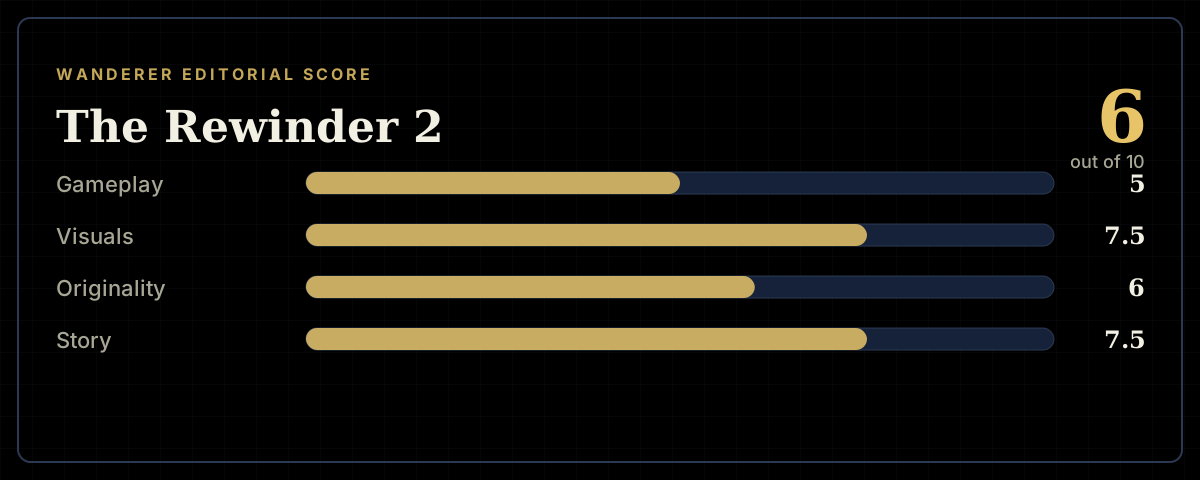
How the review scores each part of the gameWanderer Editorial -
The short versionWanderer Editorial