Game review
The Quiet Below Review
6.5 / 10
- Developer
- Ihor Filonenko
- Publisher
- Ihor Filonenko
- Released
- 5 September 2026
- Platforms
- ["Windows"]
- Genre
- RPG
A Twenty-Seventh Consecutive Launch Without a Single Review
The Quiet Below released on Steam on 5 September 2026 and has zero user reviews at the time of writing, extending this stretch's run of unreviewed launches to twenty-seven — barely over two weeks since release, a shorter gap than most titles in this run, though still notable for a genre with a genuinely dedicated, review-eager fanbase. Traditional roguelikes tend to attract vocal, detail-oriented communities quickly, which makes even a short silence like this one worth flagging. This review is built entirely from the developer's own store page description, not from verified play.
No Chosen One, Just a Guild Badge
The framing is deliberately unglamorous: the player is "not the chosen one," but a freelance adventurer with "a guild badge, a little gold, and just enough nerve to take work that saner people refuse." That's a refreshing tonal choice for a dark-fantasy RPG, trading epic destiny for mercenary pragmatism, and it's backed by a structural guild-rank system running from D to S through promotion quests — giving the player a concrete, numeric measure of standing in the world rather than an abstract sense of growing importance. The world itself is procedurally generated from a single seed across six regions, each populated with towns, dungeons, resource nodes, and wandering merchants, which suggests a persistent, explorable overworld rather than a series of disconnected dungeon instances stitched together by menus.
Contracts Are the Plot
Rather than a authored main quest, the game's throughline is a contract economy: suppression, scouting, and delivery jobs send the player across the overworld into specific dungeons, with a genuine cost-benefit choice baked into travel itself — walk to save gold, or pay for a faster road, gathering regional materials either way. That's a structurally interesting way to generate narrative momentum without hand-authored story beats, letting emergent economic decisions (which contract is worth the risk, which road is worth the toll) stand in for scripted plot progression. Between jobs, a fairly comprehensive town loop handles the traditional RPG maintenance rhythm — buying supplies, repairing and upgrading gear, selling loot on what's described as a genuinely reactive "consignment market," crafting potions, and resting at the inn — with the economy explicitly stated to respond to player behaviour, since "dumping ore crashes its price."
That economic reactivity is a meaningfully deeper commitment than most RPGs bother with; a market that actually tracks supply and demand rather than offering fixed buy/sell prices forces real strategic thinking about when and where to sell loot, rather than treating merchants as static vending machines. Whether that system stays interesting once a player learns the patterns, or whether it settles into a predictable rhythm of always selling elsewhere rather than genuinely fluctuating, is the kind of long-term economic-balance question only extended play could answer.
Cleaves, Backstabs, and Enemies That Listen
Combat runs on a turn-based melee-and-ranged system built around named weapon techniques — cleave, backstab, lifesteal, thorns, bleed, burn, thrust — each tied to mastering a specific weapon class and gated behind cooldowns, giving combat a genuine build-crafting layer beyond simple stat growth. Noise and awareness are explicit mechanical variables: enemies hunt by sight and sound, and a careful player can slip past threats while they remain unaware, turning stealth into a viable alternative to every encounter rather than an afterthought bolted onto a combat-only design. Enemy variety is described across archetypes (aggressive, coward, ranged, pack, patrol, defender, charger, support) with pack-based AI that "howls, surrounds, and retreats together," and a mutation layer (volatile, mirror, stone skin, vampiric, phasing, corrosive) that reshapes familiar enemy types into meaningfully different threats — a level of stated systemic depth in enemy design that most budget roguelikes don't attempt.
Clarity Over Decoration
The game commits fully to ASCII visuals — "no pixel art, no 3D, just a clean terminal-style view into the dark" — which is a deliberate throwback to the genre's earliest roots (Rogue, NetHack, Angband) rather than a budget compromise dressed up as a stylistic choice. That's a defensible design stance for a solo developer: ASCII rendering sidesteps the enormous asset-production cost of pixel art or 3D modelling while staying genuinely legible for a systems-dense RPG, though it will also be an immediate dealbreaker for players who need visual spectacle to stay engaged with a dungeon crawler, regardless of how deep the underlying systems run. The Quiet Below is Windows-only, English-only with full audio support, and priced at NZ$14.25 with no discount at the time of writing — a reasonable mid-range ask for a genre where players often compare against decades-old, deeply iterated free classics. No in-app-purchase category is listed on the store page, so gear, contracts, and crafting all appear to run on in-run gold and materials only.
Verdict
The Quiet Below leans hard into traditional roguelike austerity — ASCII visuals, procedural generation, permanent consequences implied by its dark-fantasy framing — while building a genuinely dense RPG scaffold underneath: a reactive market economy, a guild-rank promotion ladder, weapon-mastery techniques on cooldowns, and stealth-aware enemy AI with a real mutation layer. Its biggest risk isn't a lack of ambition but an audience ceiling: ASCII-only visuals will filter out a large share of players before they ever see how deep the contract economy or combat techniques run, regardless of quality. A two-week silence from Steam's reviewers is shorter than most titles in this run but still notable for a genre this review-hungry, and this assessment rests entirely on the developer's own description rather than anyone's actual playthrough.
Screenshots
-
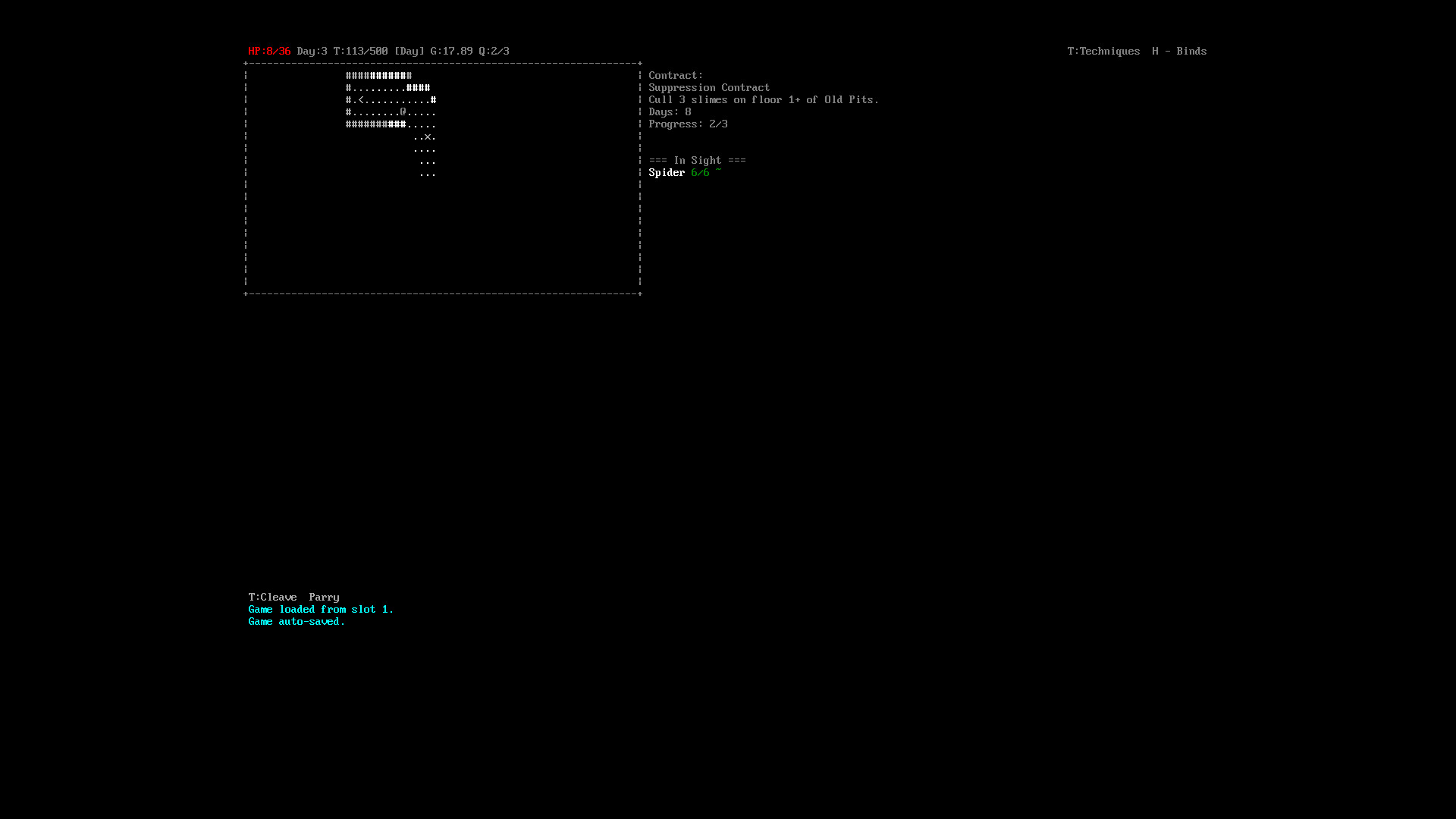
A Suppression Contract underway, tracking contract progress, HP and turn count while a spider lurks in viewImage: Ihor Filonenko via Steam -
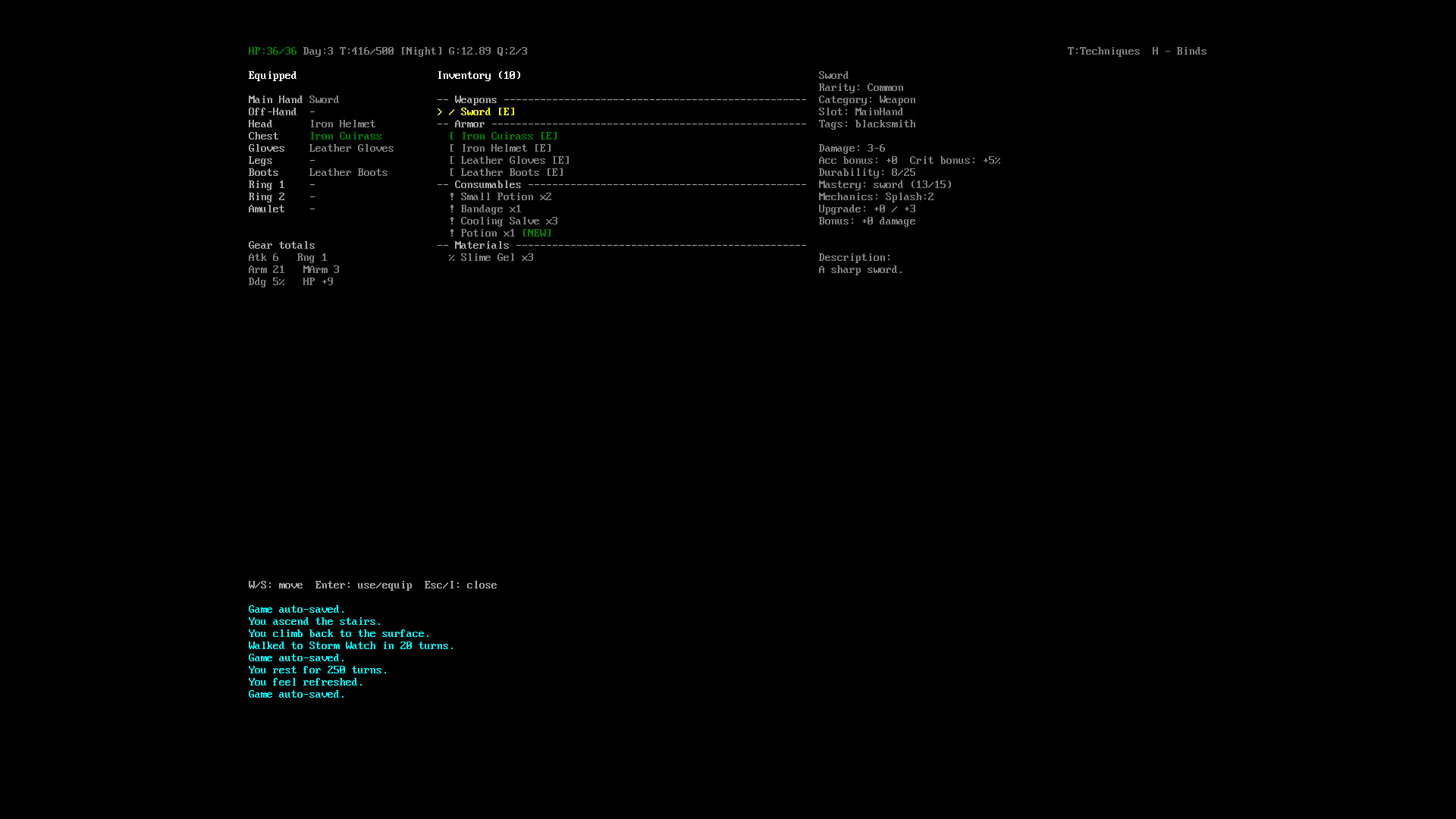
The equipment screen, breaking down a sword's damage, durability, weapon mastery progress and upgrade slotsImage: Ihor Filonenko via Steam -

The guild contract board at Storm Watch, offering suppression and scouting jobs toward the next guild rankImage: Ihor Filonenko via Steam