
Game review
The Last Faith
6.5 / 10
- Developer
- Kumi Souls Games
- Publisher
- Playstack
- Released
- 15 November 2023
- Platforms
- Windows, PlayStation, Xbox, Nintendo Switch
- Genre
- Gothic Metroidvania Soulslike
- Monetisation
- One-time premium purchase; a free DLC expansion, Awakened Ancients, released in 2026
- Players
- Single-player only; no online, co-op or PvP modes
The short version
The Last Faith casts you as a Curse Bearer navigating a gothic, plague-ravaged world clearly built in the shadow of Bloodborne and Blasphemous, and reviewers consistently praise its striking pixel art and genuinely deep build variety, with multiple weapon types, attribute scaling options and spell-melee hybrids supporting real replayability. One reviewer who completed the game twice with different builds specifically pushes back on the "just a Blasphemous clone" framing, arguing its RPG-style build depth exceeds that comparison significantly.
A substantial share of reviewers report real friction beneath that presentation, though. Combat is repeatedly described as sluggish, with input delay, animations that don't combo into each other, and notably weak aerial combat compared to genre peers. More seriously, this review's research turned up a specific, credible account of a progress-destroying softlock bug in the mirror shard area. What the patch record does contradict directly is a separate claim, made by at least one reviewer, that the developer abandoned the game — public patches and a free DLC expansion continued for more than two years after launch.
Biggest strengths
- Striking, richly detailed gothic pixel art that reviewers consistently rate on par with genre leader Blasphemous, with distinct, atmospheric area design throughout
- Genuinely deep build variety, with multiple weapon archetypes, attribute-based scaling, and spell-melee hybrid builds that reward replaying with a different approach
- An unusually long, still-active support record for a mid-sized indie release — 25 logged updates and a free DLC expansion released more than two years after launch, directly contradicting claims the developer abandoned the project
Biggest weaknesses
- Combat is repeatedly described as sluggish by a substantial share of reviewers, citing input delay, animations that fail to combo or transition into each other, and notably weak aerial combat with no air-combo options against airborne enemies
- This review's research surfaced a specific, credible account of a serious softlock bug in the mirror shard area capable of permanently blocking further progress, costing one reviewer over 13 hours of playtime
- A late-game design choice makes healing items non-refilling consumables purchased from an NPC, and several helpful NPCs despawn in the final stretch, which at least one reviewer reports left them stranded without healing resources during a boss attempt
Who it's for: Metroidvania and soulslike fans who value build variety and gothic pixel art over the most responsive possible combat feel. Less suited to anyone who needs fluid, combo-driven combat to be the genre's central draw, or who's especially risk-averse about progress-threatening bugs.
Our recommendation: Worth it for genre fans specifically, especially now that most bugs from launch have had two-plus years of patches to address, but go in aware that the combat feel draws real, consistent criticism relative to its clearest genre inspirations.
6.5 / 10
The Last Faith wears its inspirations openly — Bloodborne's gothic dread and Blasphemous's pixel-art grimdark aesthetic are the two reference points nearly every reviewer reaches for first — but reviewers who spend real time with it consistently push back on dismissing it as a simple clone. Cast as a Curse Bearer navigating a plague-ravaged world, players build toward wildly different playstyles across multiple weapon archetypes, attribute scaling paths and spell-melee hybrids, and at least one detailed review who finished the game twice with different builds argues that depth alone sets it meaningfully apart from its most obvious comparison points.
Genuine style and build depth
The pixel art draws essentially unanimous praise, with reviewers rating its gothic, richly detailed area design on par with genre leader Blasphemous — striking given how directly the two invite comparison. Beneath that presentation, the build system draws equally strong praise from reviewers willing to dig into it: dexterity-and-mind spell-blade hybrids, strength-and-instinct melee builds, and gunslinger-leaning firearms builds are all described as genuinely viable, distinct playstyles rather than cosmetic variations on the same underlying strategy. A free DLC expansion, Awakened Ancients, released more than two years after the base game's launch, adds further lore and content for players who return to it. Useful navigation quality-of-life features, including the ability to mark items and doors on the map for later backtracking, draw specific praise for easing exploration across a large, genuinely non-linear world.
Combat that a substantial share of reviewers find sluggish
Set against that praise, this review's research turned up a consistent, specific complaint about how combat actually feels moment to moment. Multiple reviewers describe real input delay and turn-delay issues that make quickly repositioning and attacking in the right direction feel unreliable, and note that attack animations don't transition or combo into each other the way genre peers allow. Aerial combat draws particularly pointed criticism, with reviewers describing the lack of any real air-combo options as forcing repetitive single-hit-and-retreat patterns against airborne enemies. This isn't a universal complaint — reviewers who prioritize build variety and atmosphere over combat fluidity report a much more positive experience — but it recurs across enough independent, detailed accounts to treat as a genuine weak point relative to the game's clearest inspirations rather than a one-off gripe.
A serious bug, and a claim the patch record contradicts
More seriously, this review's research surfaced a specific, credible account of a softlock bug in the mirror shard area: one detailed reviewer reports the game crashing after activating a mirror transport point, and being unable to reactivate it on reload, permanently losing access to the air dash ability needed for further progress after 13 hours of accumulated playtime. That's a real, serious problem for anyone who encounters it, though this review found no indication of how common it is across the wider player base.
Separately, at least one reviewer goes further, accusing the developer of abandoning the game entirely without delivering promised features, including Kickstarter-pledged New Game Plus support. Checking that claim against the public patch record tells a different story: 25 logged updates span from launch through early 2026, including a substantial PC Patch 1.5 adding controller remapping and a full stat respec system, and the free Awakened Ancients DLC released in January 2026, more than two years after launch. Whatever the merits of any individual unmet feature promise — which this review can't verify feature-by-feature — the broad claim of abandonment is directly contradicted by a patch and content-support record longer than most games this lane has covered.
What the completion data suggests
Global achievement figures back up the shape of real friction driving some players away before the end: the achievement most consistent with story completion sits at only about 9.5% of the playerbase, a notably low figure for a metroidvania with this much reviewer praise for its core concept. That's consistent with the combat-feel and bug complaints above contributing to real player drop-off, rather than pointing to any single specific cause on its own.
Weighing the "derivative" complaint fairly
A separate, more subjective criticism recurs across a handful of reviews: the sense that The Last Faith doesn't have "a single idea of its own," borrowing so heavily and specifically from Bloodborne and Blasphemous that its individual contributions feel thin by comparison. This is a fair aesthetic judgment for reviewers who hold genre-defining originality as a top priority, but it sits in direct tension with the build-variety praise covered above — reviewers who dug deeply into the character progression system describe genuinely distinct playstyles that exceed what either inspiration offers individually, even while acknowledging the visual and tonal debt is obvious and undisguised. Both reactions are reasonable responses to the same game; which one lands harder likely depends on whether a player weighs visual and atmospheric originality or mechanical depth more heavily when judging a genre homage.
Where it lands
The Last Faith earns real, substantial praise for its gothic art direction and build depth, and its sustained, multi-year post-launch support — including a 2026 free DLC — reflects a developer genuinely still invested in the project rather than one that walked away, directly contradicting the more inflammatory claims some reviewers make. The combat-feel complaints are real, specific and consistent enough to weigh seriously, and the softlock bug this review found documented is a legitimate risk worth knowing about even if far from universal. For metroidvania and soulslike fans willing to accept combat that trades some fluidity for build variety, this remains a worthwhile, visually striking pickup.
Pros and cons
Pros
- Striking, richly detailed gothic pixel art that reviewers consistently rate on par with genre leader Blasphemous, with distinct, atmospheric area design throughout
- Genuinely deep build variety, with multiple weapon archetypes, attribute-based scaling, and spell-melee hybrid builds that reward replaying with a different approach
- An unusually long, still-active support record for a mid-sized indie release — 25 logged updates and a free DLC expansion released more than two years after launch, directly contradicting claims the developer abandoned the project
- Useful navigation quality-of-life features, including map markers for backtrack-worthy items and doors, praised by multiple reviewers as easing exploration in a large, non-linear world
- Strong voice acting and creepy, well-written NPC questlines that reviewers single out as genuine highlights independent of the combat debate
Cons
- Combat is repeatedly described as sluggish by a substantial share of reviewers, citing input delay, animations that fail to combo or transition into each other, and notably weak aerial combat with no air-combo options against airborne enemies
- This review's research surfaced a specific, credible account of a serious softlock bug in the mirror shard area capable of permanently blocking further progress, costing one reviewer over 13 hours of playtime
- A late-game design choice makes healing items non-refilling consumables purchased from an NPC, and several helpful NPCs despawn in the final stretch, which at least one reviewer reports left them stranded without healing resources during a boss attempt
- Some enemy encounters are criticized for reused enemy types with only increased stats rather than genuinely new challenges, and status effects are reported as occasionally bugged
- Achievement data shows only about 9.5% of the playerbase has completed the story, a notably low completion rate consistent with reviewer accounts of combat friction and bugs driving players away before the end
Screenshots
-

The Last FaithImage: Playstack via Steam -

The Last FaithImage: Playstack via Steam -

The Last FaithImage: Playstack via Steam -
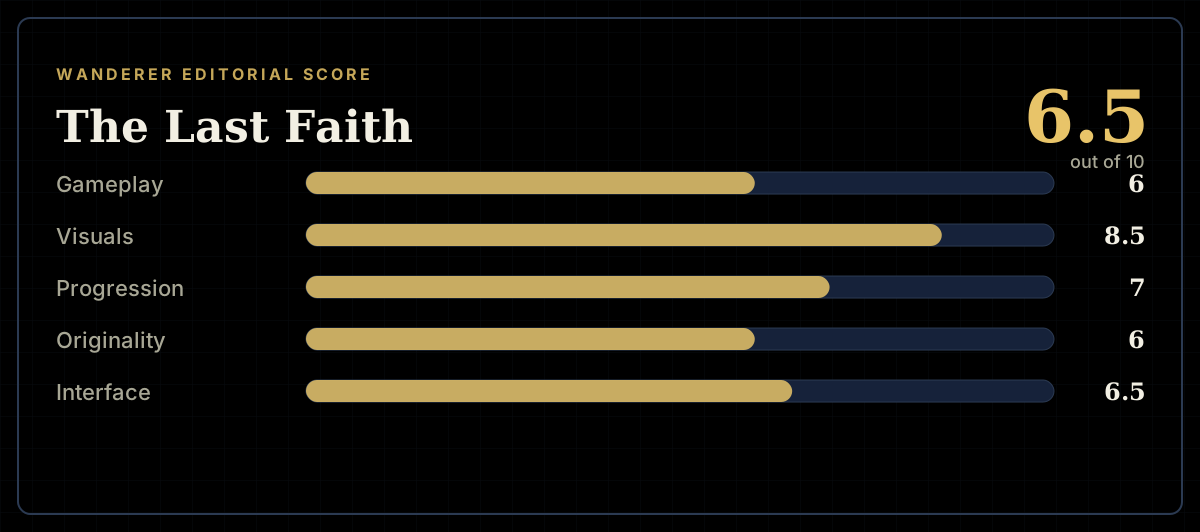
How the review scores each part of the gameWanderer Editorial -
The short versionWanderer Editorial