
Game review
The Hushed Ledger Review
6.5 / 10
- Developer
- Morass
- Publisher
- Morass
- Released
- 13 September 2026
- Platforms
- ["Windows", "Mac", "Linux"]
- Genre
- RPG
An Eighteenth Consecutive Launch Without a Single Review
The Hushed Ledger released on Steam on 13 September 2026 and currently has zero Steam user reviews, extending an unbroken run of unreviewed launches covered in this stretch of the schedule to eighteen. That's a genuine shame for a premise this specific — a deduction game that explicitly promises no randomness and no unsolvable cases is exactly the kind of design claim that a community of mystery-genre fans would normally be eager to stress-test within days of release. This review is built entirely from the developer's own store page description, not from verified play.
A Detective Game Built Around the Absence of Combat
The pitch opens with an unusual declaration for an RPG-tagged release: "there is no combat. Not as a restriction — as the design." Instead, the player investigates a mill fire in the river town of Dreskmark, where "every door in this game opens with a question, a noticed detail, or a name you were not supposed to know yet." That framing places The Hushed Ledger closer to a hand-authored mystery adventure than to a conventional RPG, and it's a deliberate, interesting bet: rather than gating progress behind stat checks or combat encounters, the entire game is staked on whether its writing and clue design can carry the tension that mechanics usually provide. Whether the game earns its RPG billing through eight distinct playable detectives and meaningful character-driven choice, or whether the tag is doing more marketing work than description, is worth keeping in mind going in.
Fair-Play Deduction, No Excuses
The store page is unusually specific about its design philosophy: every case is "fair-play," meaning "the evidence that convicts is evidence you can find, and no accusation is possible that the town did not give you grounds for." Crucially, "the game will not solve a case for you and will not quietly withhold the answer either," and naming a suspect means "staking your own reading of what you saw" with the explicit possibility of being wrong. That's a meaningfully harder design commitment than most mystery games attempt, since a fair-play structure requires every one of the 28 hand-authored cases to hide its solution in plain, findable evidence rather than a twist the player couldn't reasonably have anticipated — a much higher writing bar than a mystery that reveals a culprit the player had no real way to identify. The store page also separates "proving what happened" from "deciding what to do about it" as two distinct acts, describing the second as "harder," which suggests moral or social consequences layered on top of simply solving the case correctly.
No Dice, No Excuses Either
Beyond the writing, the mechanical promise is equally deliberate: "no randomness anywhere in the simulation. The same question asked twice gets the same answer, every clue sits where it was placed, and no case can become unsolvable through bad luck." Talk-gated discovery — "you cannot ask about a crime nobody has mentioned to you," since "rumour travels before you do" — adds a structural layer to information-gathering, meaning a player's investigative path is shaped by what the town chooses to reveal rather than a simple checklist of every possible topic being available from the start. A persistent, self-assembling casebook that collects "facts, leads and contradictions... as you earn them, not as the plot needs them" reinforces that same commitment to player-driven discovery over scripted revelation. Eight playable detectives, each of whom reportedly "notices different things," suggest replay value built around genuinely different investigative perspectives on the same cases rather than a purely cosmetic character-select screen — though the store page doesn't specify how mechanically distinct each detective's noticing actually is.
A Fully Voiced River Town, Priced to Try
Seven interconnected districts — "from the mill yard to the bond house to the docks after dark" — are described as "one continuous place rather than a menu of levels," and the townsfolk are "fully voiced" with dialogue that repeats "the way real people do — differently the second time," a small but telling detail suggesting attention to how repeated conversations avoid feeling robotic. The game is explicitly set in "the world of Orenvalt," the same shared fantasy setting behind this developer's other recent, similarly distinctive release. At NZ$1.59 with no discount at the time of writing, that's a negligible price for 28 cases' worth of hand-authored mystery content, making it close to a no-risk way to sample a genuinely unusual pitch. There's no mention on the store page of any monetisation beyond the base purchase, and English is the only listed supported language with full audio.
Verdict
The Hushed Ledger makes an unusually specific and ambitious design promise — a combat-free, fair-play detective RPG with zero randomness, 28 hand-authored cases, and eight distinct investigators, all set in a fully voiced river town built as one continuous space. Like every other title covered in this stretch, it remains completely unreviewed by Steam's user base at the time of writing, so whether its fair-play writing genuinely holds up across all 28 cases, and whether the eight detectives offer meaningfully different investigative experiences rather than a cosmetic choice, are unverified claims rather than confirmed strengths. Its negligible price and unusually confident, specific pitch make it one of the more interesting picks in this entire zero-review stretch for mystery fans willing to take a chance, with the standing caveat that this assessment rests entirely on the developer's own description rather than anyone's actual playthrough.
Screenshots
-
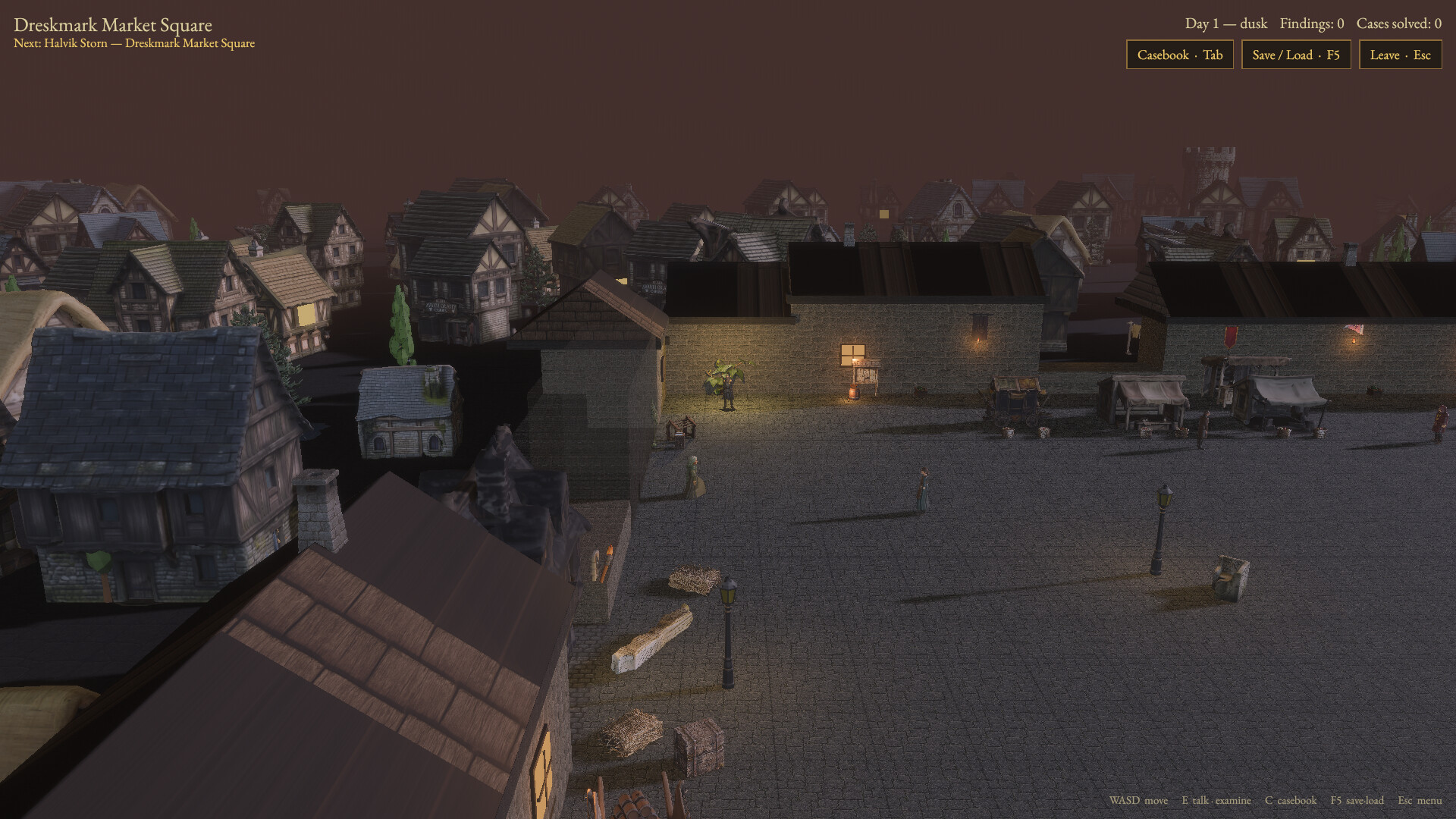
Dreskmark Market Square at dusk, one of the game's seven connected districts, tracked by an in-world day and findings counter rather than a level-select menuImage: Morass via Steam -
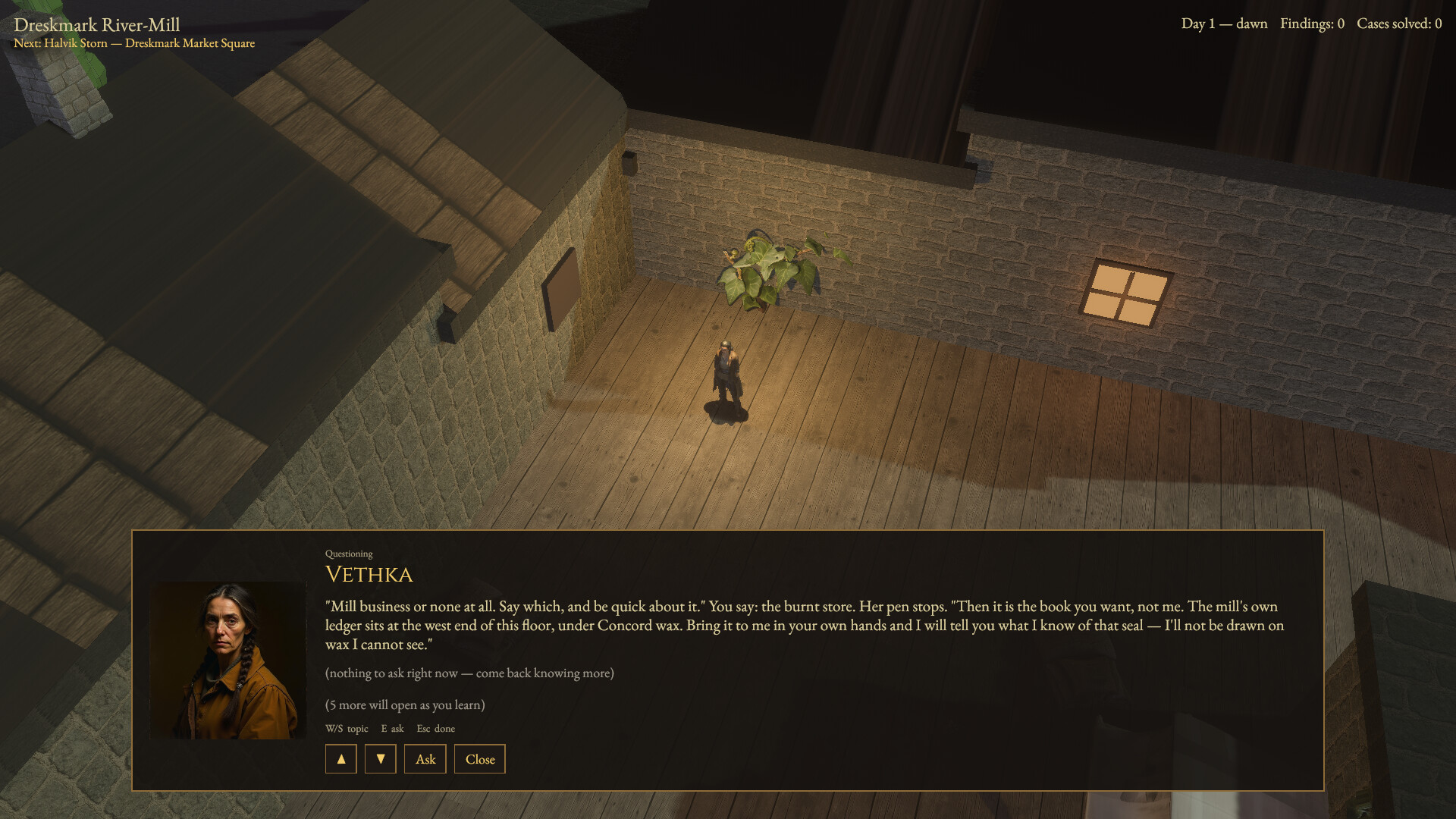
Questioning a suspect surfaces only the topics the detective has already earned the right to ask about, with more unlocking as new information comes inImage: Morass via Steam -
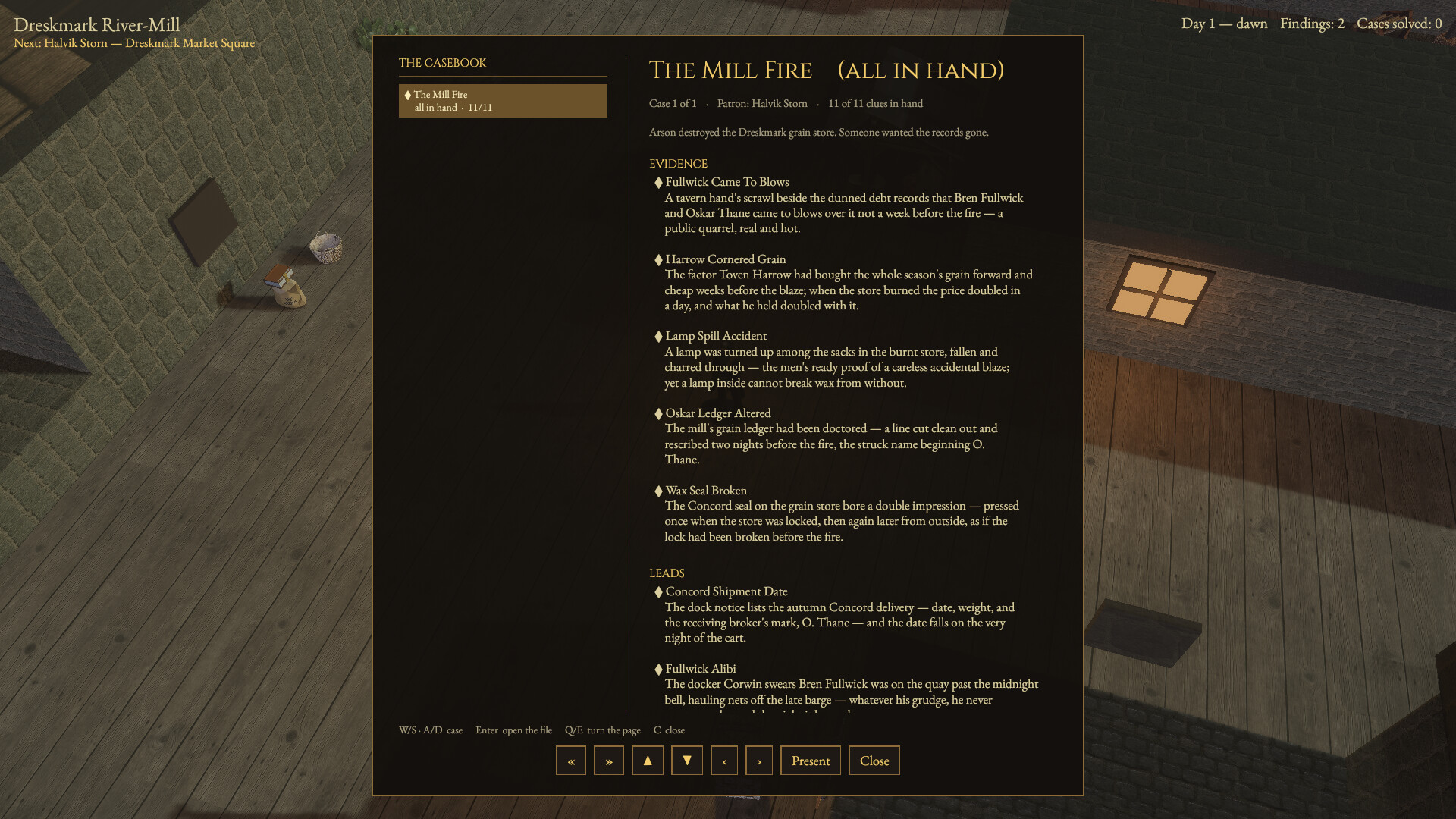
The self-assembling Casebook lays out every clue gathered so far under Evidence and Leads, ready to be weighed before naming a suspectImage: Morass via Steam