Game review
Task Bar of Ragnalis
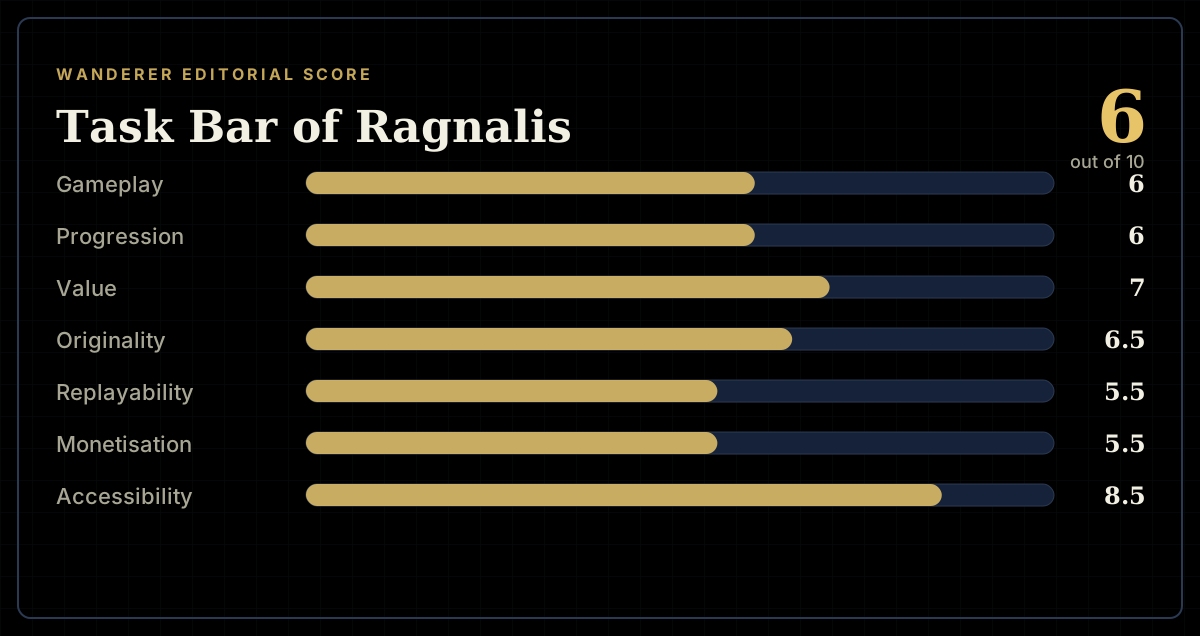
6 / 10
- Developer
- Jagernaut Games
- Publisher
- Jagernaut Games
- Released
- 30 July 2026
- Platforms
- Windows
- Genre
- Idle Auto-Battler RPG
- Monetisation
- Free to play. The base game and six of its eight hero classes are free to unlock through play; two additional classes (Pirate, Overlord) and extra inventory space are sold separately as DLC, individually or bundled
- Players
- Single-player only
The short version
Task Bar of Ragnalis commits fully to a genuinely unusual pitch: an RPG small enough to sit as an icon-sized window next to your clock, quietly fighting, looting and levelling while you do literally anything else. The base game is a real one — six hero classes, a proper stat sheet, equipment synthesis and an item-stacking system that rewards checking in rather than staring — and it costs nothing. What keeps this from being an easy recommendation is that "free" comes with two of its eight possible classes and extra storage tabs sitting behind a store link before you've finished your first afternoon with it, in a game whose own loot design is built around running out of space.
Biggest strengths
- A real-time auto-battler that runs as a small pinned window rather than demanding a maximised screen is a genuinely distinctive form factor, not a gimmick bolted onto a normal game
- Six full hero classes, each with their own stat block, equipment slots and skill tree, ship in the free base game before any DLC purchase is involved
- Accessibility support is unusually deep for the genre — adjustable text size, full keyboard-only and mouse-only play, custom volume controls and no timed inputs anywhere in the design
Biggest weaknesses
- The Pirate DLC's own store description promises boosted Gold and Drop rewards on top of its combat kit, which is a progression-speed advantage being sold, not just a new look
- The Storage Expansion Pack sells the inventory space a stack-nine-to-rank-up loot system is designed to fill, and the base game's own screenshots show locked storage tabs sitting in the inventory panel from the very first level
- The store page's own pitch namechecks "the Pirate" as its example of the game's "unique classes," advertising a paid class inside the free game's own marketing copy
Who it's for: Idle RPG fans who like the genre's mechanical bones — stats, gear tiers, party composition — and who don't mind a game that asks to be glanced at rather than sat with; less suited to anyone who wants every class in a "free" game to actually be free.
Our recommendation: Worth installing for the novelty of the format and the six-class free roster alone — just don't expect the Pirate or Overlord classes, or a second storage tab, without a further purchase, and go in aware that almost nobody has weighed in on how it holds up past week one.
6 / 10
Most idle games ask for a browser tab or a phone left face-up on a desk. Task Bar of Ragnalis asks for less than that — a sliver of window docked beside your clock, quietly running a full hack-and-slash RPG while you do your actual job on top of it. That's the hook, and it's a good one: a real auto-battler, with a real stat sheet and a real loot system, shrunk down to something you check the way you check a Slack badge. It's also, three days after release, a free game whose own marketing already leans on a class it doesn't include for free.
A battlefield the size of a taskbar icon
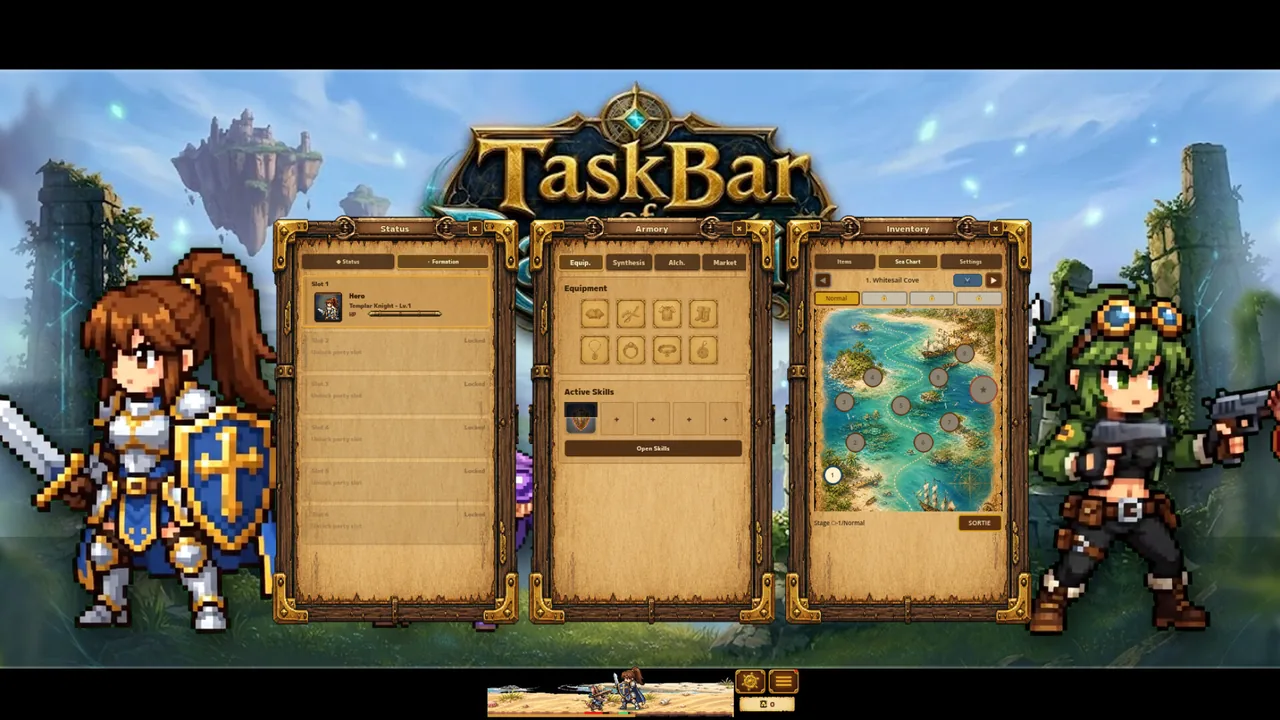
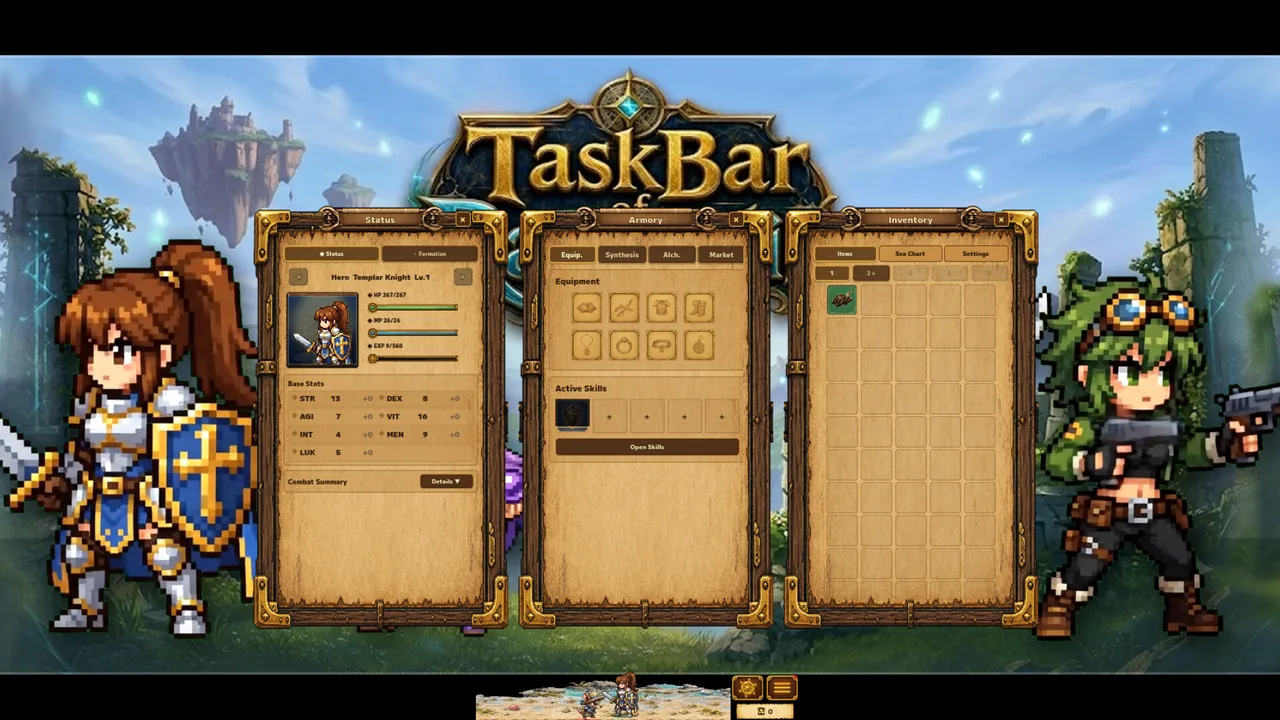
The idea only works if the compressed format doesn't feel like a compromise, and on the evidence of the game's own screenshots, it mostly doesn't. Menus for status, armory and inventory stack as parchment-styled panels that take up almost the entire frame, each one legible enough to actually read at a glance — equipment slots, active skill icons, a stage map broken into numbered nodes. The actual battle, tellingly, is relegated to a thin strip along the bottom of the screen: two sprites trading blows in a sliver of space beneath everything else. That's not an oversight, it's the entire design thesis made visible. Task Bar of Ragnalis isn't trying to be a game you watch fight; it's trying to be a management screen you occasionally open, with the fighting happening whether or not you're looking at it. Judged on those terms — as ambient software rather than appointment gaming — the format earns its premise. Judged as something you'd sit down and actively play for an evening, there's very little screen real estate here to reward the attention.
Six classes, one formation of three
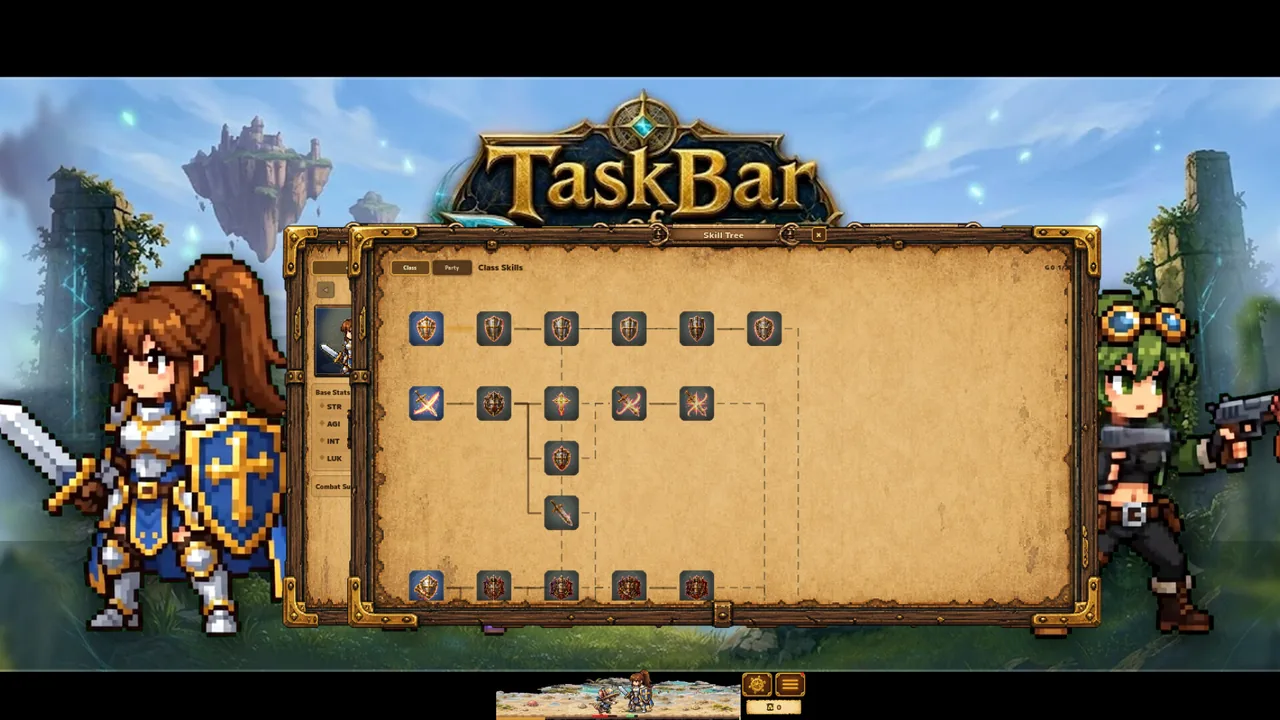
The free game's actual content is more substantial than "idle timer with a coat of pixel art" would suggest. The developer's own pre-launch posts describe six classes available from the start, each built around its own stat block — strength, dexterity, agility, vitality, intelligence, mental, luck — and its own equipment and skill-tree progression. In-game, party slots unlock one at a time rather than all at once, and only three heroes fight in an active formation, which gives party composition a genuine decision to make rather than treating six classes as six equally viable options to slot in blindly. Layered on top is the loot hook: gather nine copies of the same weapon, card or item and it tiers up, which turns even a duplicate drop most idle games would treat as clutter into forward progress. It's a familiar shape if you've played a mobile gacha RPG, but it's rare to see it built into a genuinely free PC release with this much of its structure — classes, stat sheets, equipment synthesis, an alchemy system, a market — present before a single purchase.
What "the Pirate" is actually worth
Here's where the free pitch gets complicated. Two more classes, Pirate and Overlord, exist only as paid DLC, at NZ$6.31 each or NZ$11.40 bundled together. That's two classes out of eight total — a real but not overwhelming slice of the roster, and importantly not a case of the free game holding back half its content to force a purchase. The two classes aren't interchangeable in what they're selling, either. The Overlord's own description — Dominion Marks, decrees, enemy debuffs, party-wide support — reads as a genuine alternate playstyle, the kind of build option a completionist wants rather than one anybody strictly needs. The Pirate is a sharper case: its listing promises it will "boost Gold and Drop rewards" on top of its dodge-and-counter combat kit, which is a direct accelerant on the game's own core progression currencies, not just a different silhouette in the formation screen. Because Task Bar of Ragnalis has no PvP, no leaderboard and no multiplayer mode of any kind, that boost doesn't let anyone beat another player — it just lets Pirate owners generate gold and loot faster than everyone still grinding with the free six. That's a real advantage, and calling it merely cosmetic would be generous, but it's also not a wall: nothing here suggests the free roster is locked out of any dungeon, boss or ending, only that reaching it takes longer without a class explicitly designed to shorten the trip. It's worth noting, too, that the free game's own store description name-drops "the Pirate" as its example of "unique classes" — using a class it doesn't include to sell the classes it does.
Selling back the space the loot system demands
The second DLC purchase is more straightforward, and less flattering. The Storage Expansion Pack adds two inventory tabs for NZ$3.83, in a game whose central loot mechanic is explicitly about accumulating stacks of nine identical items across weapons, cards and materials. Official screenshots of the early game show exactly the tension this creates: a nearly empty second inventory tab sits open next to a row of additional tabs, greyed out and locked, visible from the very first level before the player has come close to filling the space they already have. Selling storage isn't a new trick — plenty of free idle RPGs do it — but doing it in a game built around hoarding duplicates for a rank-up system is a pointed choice, and having the locked tabs visible before the pressure is even real reads less like a natural mid-game upsell and more like a storefront the game was built to point at from minute one.
Three days of data, read carefully
Steam's public achievement statistics offer the only independent read available this early, and they're worth treating cautiously given how young the release is. The earliest unlocks clear at a healthy clip — over half of players earn their first skill, roughly forty percent qualify for a late-night "Night Owl"-style achievement, about a fifth reach level 10 — before the curve drops hard: assembling the base three-hero formation sits at just 7% of players, and everything past that, including simply hoarding a full inventory, sits under 3.2%. Three days after launch that's not necessarily damning; most owners haven't had time to reach the midgame regardless of how good it is. But it does mean nobody should mistake "free to play" for "free of friction" here — completing even the game's own headline feature, a three-hero party, is currently a minority experience. Steam shows a single user review at the time of writing, too few for the platform to generate a score, and it happens to be a complaint about the DLC directly — not enough data to call a pattern, but not nothing, either.
Accessibility done right
One area where Task Bar of Ragnalis clearly outperforms its genre is accessibility, and it deserves a mention on its own rather than a footnote. The store listing carries adjustable text size, keyboard-only and mouse-only control options, custom volume controls, and a "Playable without Timed Input" designation — a meaningful commitment in a combat game, confirming nothing here demands split-second reflexes to progress. For a free auto-battler whose core appeal is supposed to be low friction, that list of options actually delivers on the promise in a way a lot of premium RPGs don't bother with.
Final verdict
Task Bar of Ragnalis earns real credit for committing to its format: this is a legitimate RPG, with a legitimate six-class roster, shrunk down to something that genuinely respects a desktop the way its pitch claims to. The accessibility work is better than almost anything else in the genre, and giving away that much of the class roster for free is a fairer starting position than most free-to-play RPGs bother with. What holds it to a 6 rather than higher is the part the brief for this review exists to interrogate: a free game that sells two playable classes — one of them an explicit progression accelerant — and sells back the storage space its own item design is engineered to strain, all inside the first few days anyone could have owned it. None of that makes it predatory in the way a timer-gated gacha grind is predatory; there's no PvP to lose, no wall blocking free players from content, and nothing here demands a purchase to keep playing. It does mean "free to play" is doing some quiet reputational work for a game that would rather be described that way than as "free, with the interesting bits behind a storefront." Judge it in a few months, once there's enough playtime on the clock to know if six classes and a stacking loot system hold attention the way the format wants to claim they will.
Anyone weighing this against other free idle RPGs with a paywall attached should look at Legends of Idleon, whose gem shop sells storage space and convenience the same way, or Archmage Idle, where a five-tier VIP ladder gates progress far more aggressively than anything sold here. Players who'd rather pay once and own everything the game has to offer might prefer 10-Man Idle's flat one-time price with no DLC at all. And anyone who likes the idea of a party that keeps working while they're away, in a world that keeps existing around them rather than a closed save file, might also enjoy Wanderer.
Pros and cons
Pros
- A real-time auto-battler that runs as a small pinned window rather than demanding a maximised screen is a genuinely distinctive form factor, not a gimmick bolted onto a normal game
- Six full hero classes, each with their own stat block, equipment slots and skill tree, ship in the free base game before any DLC purchase is involved
- Accessibility support is unusually deep for the genre — adjustable text size, full keyboard-only and mouse-only play, custom volume controls and no timed inputs anywhere in the design
- Steam Achievements and Steam Cloud saves are both present despite the game costing nothing to install
- The Overlord DLC class reads as a genuine build option — battlefield debuffs and party-wide support — rather than a reskin of an existing role
Cons
- The Pirate DLC's own store description promises boosted Gold and Drop rewards on top of its combat kit, which is a progression-speed advantage being sold, not just a new look
- The Storage Expansion Pack sells the inventory space a stack-nine-to-rank-up loot system is designed to fill, and the base game's own screenshots show locked storage tabs sitting in the inventory panel from the very first level
- The store page's own pitch namechecks "the Pirate" as its example of the game's "unique classes," advertising a paid class inside the free game's own marketing copy
- Steam shows effectively no review history three days after launch, so there is no independent account yet of whether the loop holds up past the opening hours
- Public achievement data already shows a steep drop-off after the earliest unlocks — assembling even the base three-hero formation is a minority achievement this early
Screenshots
-
Task Bar of RagnalisImage: Jagernaut Games via Steam -
Task Bar of RagnalisImage: Jagernaut Games via Steam -
Task Bar of RagnalisImage: Jagernaut Games via Steam -
How the review scores each part of the gameWanderer Editorial -
The short versionWanderer Editorial