
Game review
Tales of Immortal Cultivation
6.5 / 10
- Developer
- MountainPeople
- Publisher
- MountainPeople
- Released
- 9 September 2026
- Platforms
- Windows
- Genre
- RPG
A Forty-Seventh Consecutive Launch Without a Single Review
Tales of Immortal Cultivation launched on Steam on 9 September 2026 as a full release for Windows, and at the time of writing has zero user reviews. That's a meaningful silence for a genre where reader trust usually rides entirely on word of mouth — Xianxia cultivation sims live and die on whether their text-based progression loop actually stays engaging across dozens of hours, and that's exactly the kind of judgment normally settled by players comparing notes on how far they got before the grind stopped feeling rewarding.
Six Realms of Cultivation, From Mortal to Immortal
The core premise is a classic Xianxia structure: the player begins as an ordinary mortal and climbs through six named cultivation realms — Qi Refining, Foundation Establishment, Golden Core, Nascent Soul, Spirit Transformation, and Ascension — on the way to uncovering the truth behind the protagonist's family's destruction and eventually ascending to immortality. That's a genuinely well-defined long-term progression arc, borrowed directly from the web-novel tradition the genre is named after, and naming each realm explicitly rather than just implying a vague "power level" gives the climb a legible sense of milestones. The store page is explicit that this is "a slow-paced cultivation simulator," which sets different expectations from an action RPG — the appeal here is meant to be in the pacing and strategic planning of the climb itself, not in any real-time combat execution.
A Text-Based Strategy Loop Rather Than a Visual Spectacle
Calling this a "strategy text-based RPG" undersells how much of it is actually rendered: screenshots show a tabbed interface (Path, Cultivate, Adventure, Shop, Skills, Bag, Rest) built around a full numeric attribute sheet — HP, SP, ATK, DEF, SPD, and WIS — plus named five-element Spirit Root grades across Metal, Wood, Water, Fire, and Earth, and combat itself turns out to be a fully illustrated turn-based screen with HP bars, an Auto Battle toggle, and Attack-or-Flee choices against named enemies, rather than encounters resolved purely through text. That's a considerably more mechanically legible system than the "text-based" label suggests, and the numeric stat sheet gives the six-realm climb a concrete, comparable metric to track rather than leaving progression as an abstract narrative descriptor. What is concrete on the store page is the promise of a "vast world map" to explore alongside the progression track, plus unlockable romance companions and a personal cave manor to construct, both staples of the genre that give the player something to build toward beyond raw cultivation-realm numbers. The minimum system requirements — a Core i3, 4GB of RAM, and integrated graphics — are modest even by indie standards, consistent with a menu-and-portrait presentation rather than one leaning on explorable 3D environments to sell the fantasy.
Companions and a Cave Manor Give the Grind Somewhere to Point
The addition of romance companions and a buildable cave manor is a deliberate attempt to break up what could otherwise be a purely numerical climb through six realms with something more personal to invest in — a common and generally effective pattern in the cultivation genre, where the appeal of "power fantasy through patience" is balanced against relationship and homestead management to give idle stretches of the grind a secondary payoff. That these aren't just store-page promises is confirmed by the Cultivate tab's own sub-navigation, which lists Cultivate, Cave, Companion, and Craft as separate, seemingly functional menu screens sitting side by side, alongside a "Qi Condensation Lv.1 0/1000" progress bar that gives the current cultivation stage a concrete numeric target rather than an abstract sense of advancement. Whether the companion writing has enough depth to justify romancing over simply optimizing stats, and whether the cave manor offers meaningful mechanical benefits or is purely cosmetic, are the kind of texture-level questions that only extended play can answer, and with zero reviews so far nobody outside the studio has weighed in on either. The family-mystery hook driving the narrative — uncovering what destroyed the protagonist's family on the way up the cultivation ladder — gives the six-realm structure a reason to keep climbing beyond stat growth for its own sake, and a screenshot of the opening narrative log bears this out directly, with the protagonist waking in the ruins of their burned family estate and a wandering cultivator urging them to "survive, grow stronger, and find the truth," provided the mystery's pacing actually holds up across a full playthrough.
A Low Price for a Niche, Slow-Paced Genre
At NZ$8.01 with no discount, the price sits comfortably within budget-indie territory for a text-heavy simulation title, and there's no indication on the store page of any additional monetisation, DLC, or in-app purchases layered on top of the base price. Full audio support is listed for both English and Simplified Chinese, which suggests a reasonably serious production effort behind the localisation for a solo or small-team release, rather than a purely text-only budget product. That flat, one-time price is also worth noting against the genre's broader reputation: a large share of Xianxia-themed games on mobile and browser platforms lean on gacha pulls, energy timers, or premium currencies to monetise the same slow-climb structure, so a fixed-price Steam release with no stated live-service layer is a meaningfully different commercial pitch even before judging the writing or pacing on their own merits. The category listing is minimal — single-player and Family Sharing only, with no controller support, achievements, or cloud saves mentioned — which fits a slow-paced, keyboard-and-mouse strategy sim more than a game built for broader platform reach, though it does mean less of a safety net for players worried about losing progress on a long cultivation run.
Verdict
Tales of Immortal Cultivation pitches a clearly structured six-realm Xianxia progression arc, paired with companions, a buildable cave manor, and a family-mystery hook, and screenshots show it's built on more mechanical substance than its "text-based" label implies — a full numeric attribute sheet, five-element Spirit Root grades, working Cave/Companion/Craft menus, and an illustrated turn-based battle screen with an Auto Battle option. The genre's appeal has always depended on whether the numeric climb stays compelling over the long haul, and that's precisely the kind of judgment this game hasn't yet received from anyone. It launched on 9 September 2026 with zero user reviews so far, so how well the six realms are paced against each other, whether the strategic planning has enough real decision-making to reward patience, and whether the family mystery pays off, remain unverified by anyone outside the studio.
Screenshots
-
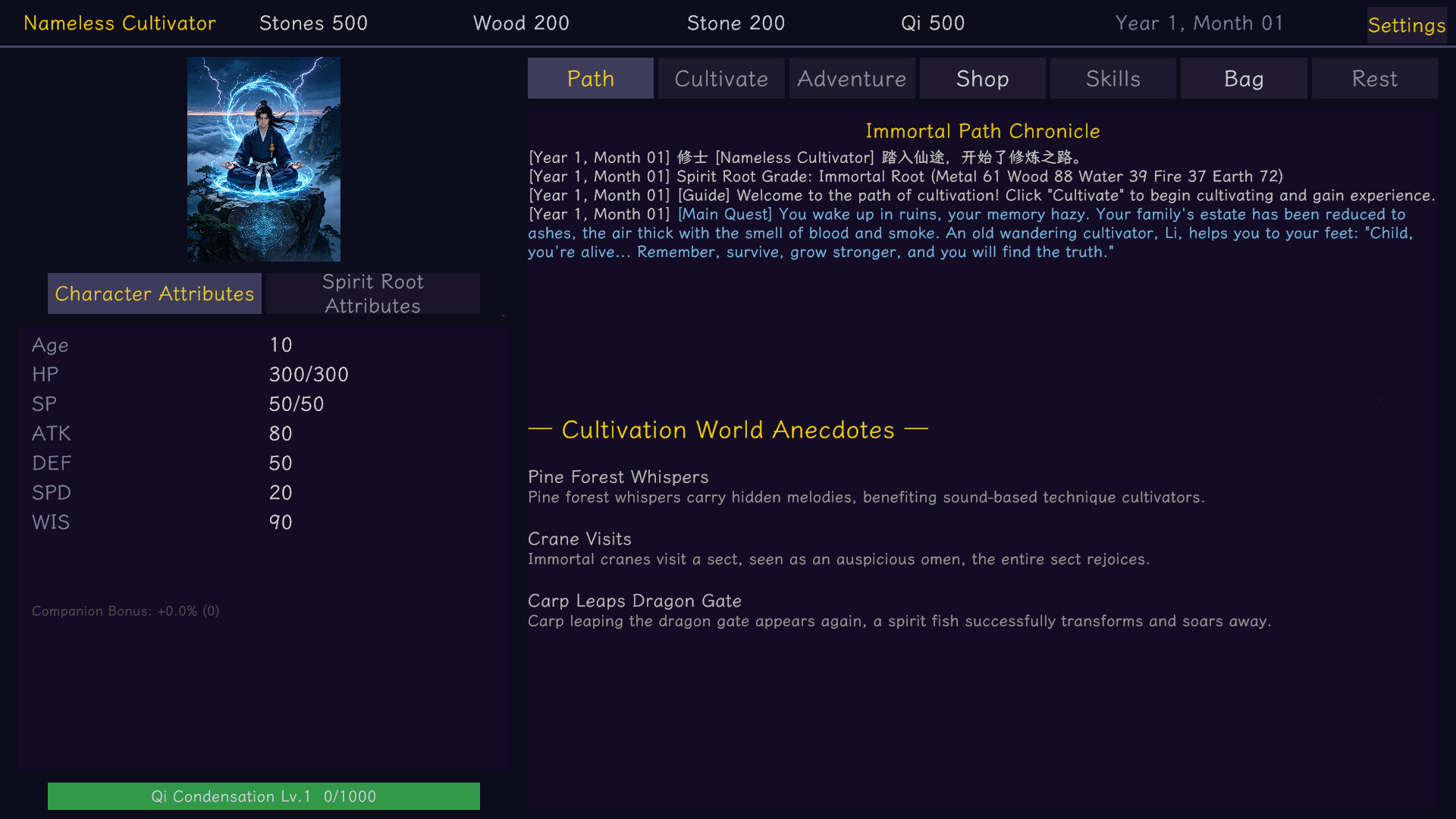
The Path tab pairs a numeric attribute sheet and named Spirit Root elemental grades with a running narrative log, confirming the family-mystery hook and stat-driven progression are both actually implemented, not just described.Steam store page -
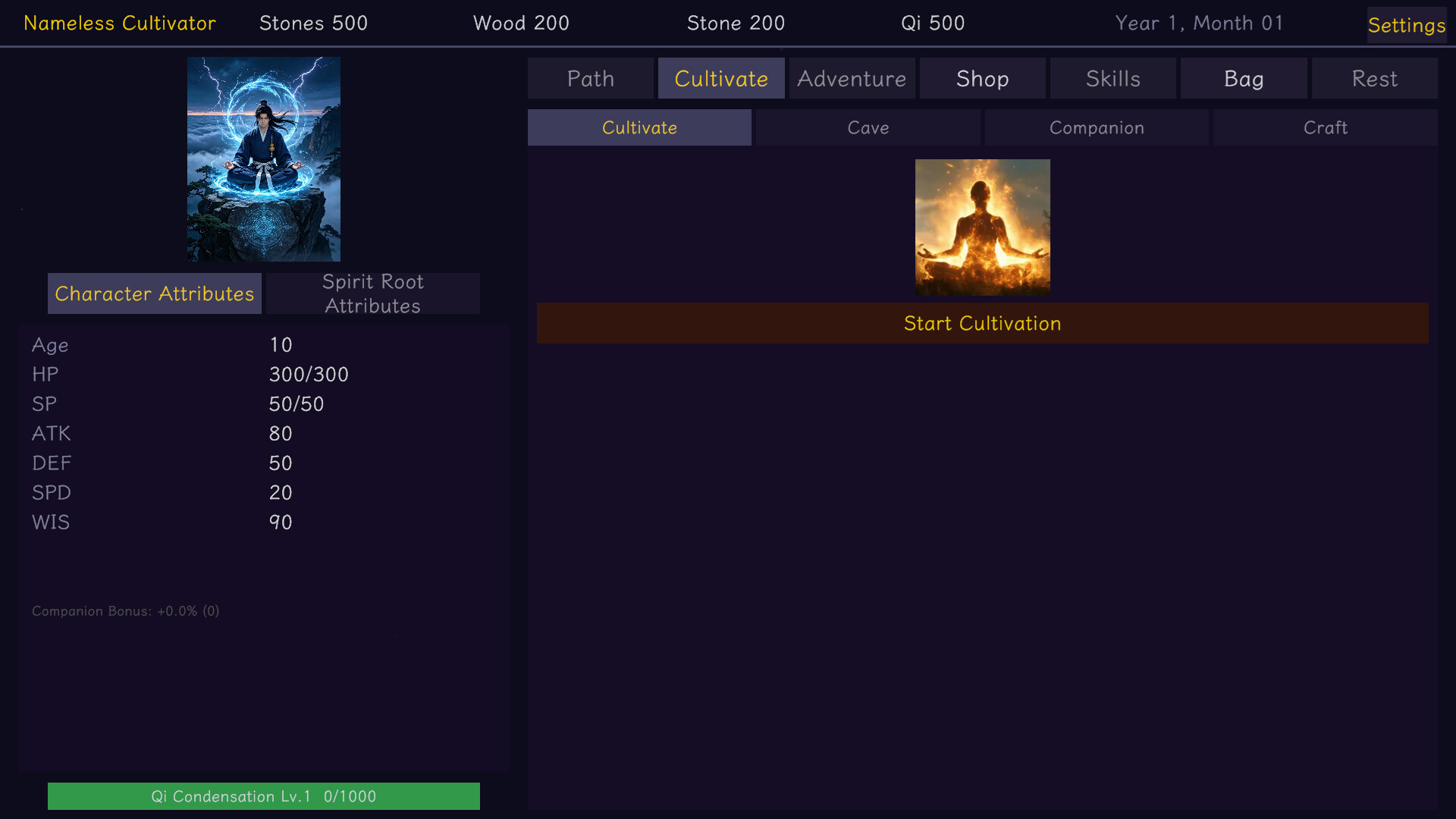
Separate Cave, Companion, and Craft sub-tabs sitting alongside the core Cultivate action confirm the cave-manor and companion systems are functioning menus rather than just marketing bullet points.Steam store page -

Combat turns out to be a fully rendered turn-based screen with HP bars and an Auto Battle option, not the purely text-resolved encounters the store page's \"text-based RPG\" label might suggest.Steam store page