
Game review
Stellar Odyssey
5.9 / 10
- Developer
- Stellar Games
- Publisher
- Stellar Games
- Released
- 7 August 2026
- Platforms
- PC
- Genre
- Idle Space MMORPG
Stellar Odyssey is a free-to-play idle space MMORPG from the small studio Stellar Games, released on Steam on 7 August 2026 after an extended run as a browser-based game — several reviewers describe having put hundreds of hours into that earlier web version before the Steam release brought a fresh-start server and a wider audience. The pitch is straightforward: set your character's actions, log off, and come back later to collect the results of battling, gathering, crafting and exploring across a galaxy the store page claims holds nearly 50 million procedurally generated star systems. What separates it from a typical solo idle clicker is the persistent, player-driven world underneath — squadrons, a tax-free player market, PvP, and cooperative dungeon raids all sit on top of the idle core.
Four skill tracks, one very dense fitting screen
Progress is split across four parallel tracks — Battling, Gathering, Crafting and Exploring — each with its own level, experience bar and action-point pool that refills over time. The ship-management screen alone stacks dozens of percentage bonuses (block chance, lifesteal, gathering yield, fuel efficiency, catalyst drop chance and more) on top of four core stats and six equippable module slots for weapons, shields, engines, sensors and probes. This is clearly meant to reward theory-crafting rather than passive number-watching, and reviewers who've stuck with it describe a game that "becomes a very active incremental game" once the early systems click, with progression that "rewards smart planning and figuring out the game systems." Others found the same density alienating at the start, citing a thin tutorial and a slow opening stretch before a squadron becomes available to help make sense of things.
Exploration is the game's most distinctive layer. The galaxy map presents a dense grid of individually named star systems, most locked behind fuel costs and level requirements, radiating out from a starting cluster toward that headline-scale 50-million-system galaxy. One reviewer likened the loop to "old space web games when I was a kid," while another compared the scale and open-ended systems to Elite Dangerous rendered in idle-incremental form. A recurring complaint, though, is that meaningful exploration is gated behind expensive fuel and travel costs that favour players who are already established, with one reviewer specifically calling out that "the means to travel and explore is insanely expensive and tends to cater to only the very richest players in the game."
Squadrons carry the multiplayer weight
Stellar Odyssey's social layer is where it distinguishes itself most clearly from single-player idlers. Squadrons pool resources to raise shared space stations and take on dungeon raids where a boss's health bar is chipped down by many players' ships simultaneously, tracked with individual per-player damage contributions — a structure that genuinely rewards showing up with a coordinated group rather than idling in isolation. Reviewers consistently single out the community as a strength: multiple describe the playerbase as "wholesome," "helpful" and welcoming to newcomers still learning the systems, and several credit the developer directly for being active on Discord, fixing reported bugs within minutes, and banning players caught using clicker scripts or multi-accounting. That level of hands-on moderation and support is unusual to see called out so consistently across a review pool this size.
The monetisation debate dominates the discourse
No topic generates more disagreement in the review pool than money. The game runs a roughly $10/month subscription that grants modest percentage boosts to nearly every system, alongside cosmetic ship skins and backgrounds priced individually as high as $25-50, plus a premium currency that can also be earned and traded in-game through a tax-free player market. Reviewers split sharply on what this amounts to. Detractors call it a "cash grab" and argue the free experience is deliberately throttled — one described paying players gaining "a huge advantage" through exploration income specifically because non-paying players can't compete on distance travelled. Defenders push back just as hard, repeatedly insisting the "P2W allegations are total crap" and pointing out that premium currency can be bought with in-game credits earned by playing, meaning a patient free player can access the same features without spending real money, just more slowly. Both positions show up with real specificity and vote counts in the review pool rather than reading as drive-by dismissals, which suggests this is a genuine, ongoing point of friction in the community rather than a settled question. Several reviews also flag that some art assets are AI-generated, a detail the developer discloses rather than hides, though it adds another layer to the "cash grab" framing from critics who object to paying for AI-produced cosmetics specifically.
A slow burn, deliberately
Pacing complaints cluster around the length of individual action ticks — one reviewer specifically singled out 60-second ticks as "dumb" and unsatisfying compared to faster-paced idlers, arguing progress felt imperceptible day to day. Others frame the same slowness as the entire point: a deliberately unhurried game meant to be checked in on rather than actively played, with generous catch-up mechanics for players who can't log in constantly. Given how differently these two camps describe the identical pacing, this seems to be less a bug than a genre-fit issue — players expecting a punchier idle-clicker rhythm are likely to bounce off a system built around day-to-day patience.
Verdict
Stellar Odyssey delivers a genuinely distinctive take on the idle-MMORPG hybrid, with a dense four-track progression system, a real player-driven economy, and a squadron structure that makes the multiplayer feel substantive rather than bolted on — backed by a small, visibly engaged development team with a track record stretching back through the game's browser-based origins. Its monetisation model is the clearest liability: whether it reads as fair freemium design or a P2W cash grab depends heavily on how much weight a given player puts on optional percentage boosts and $25 cosmetics, and the review pool itself hasn't settled the question. Prospective players who enjoy slow-burn, community-driven idlers and don't mind an opinionated premium-currency debate will likely find more here than the monetisation controversy alone would suggest.
Screenshots
-
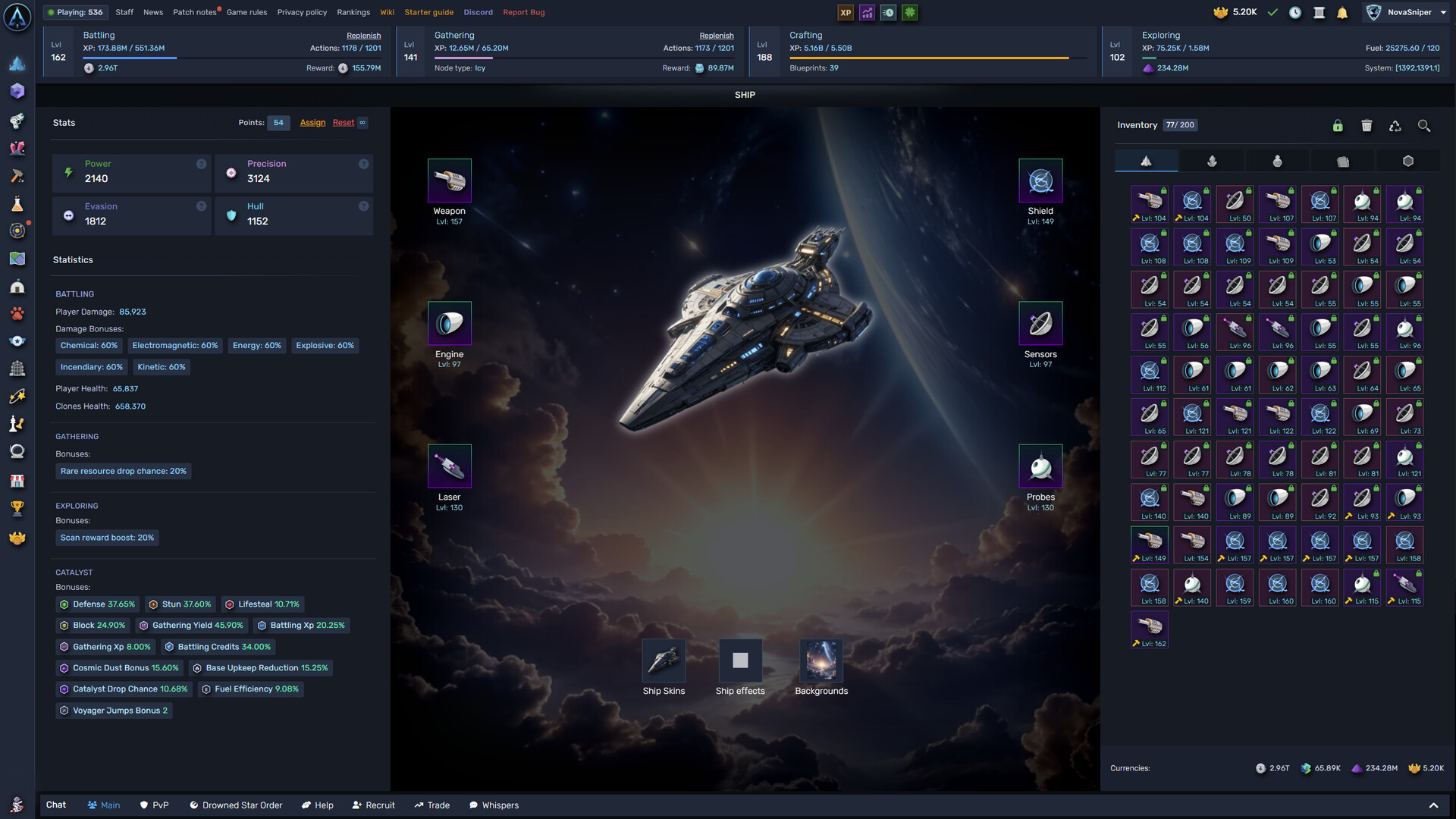
The ship-fitting screen stacks dozens of percentage-based bonuses across four separate skill tracks, reflecting the theory-crafting depth reviewers describe.Image: Stellar Games via Steam -
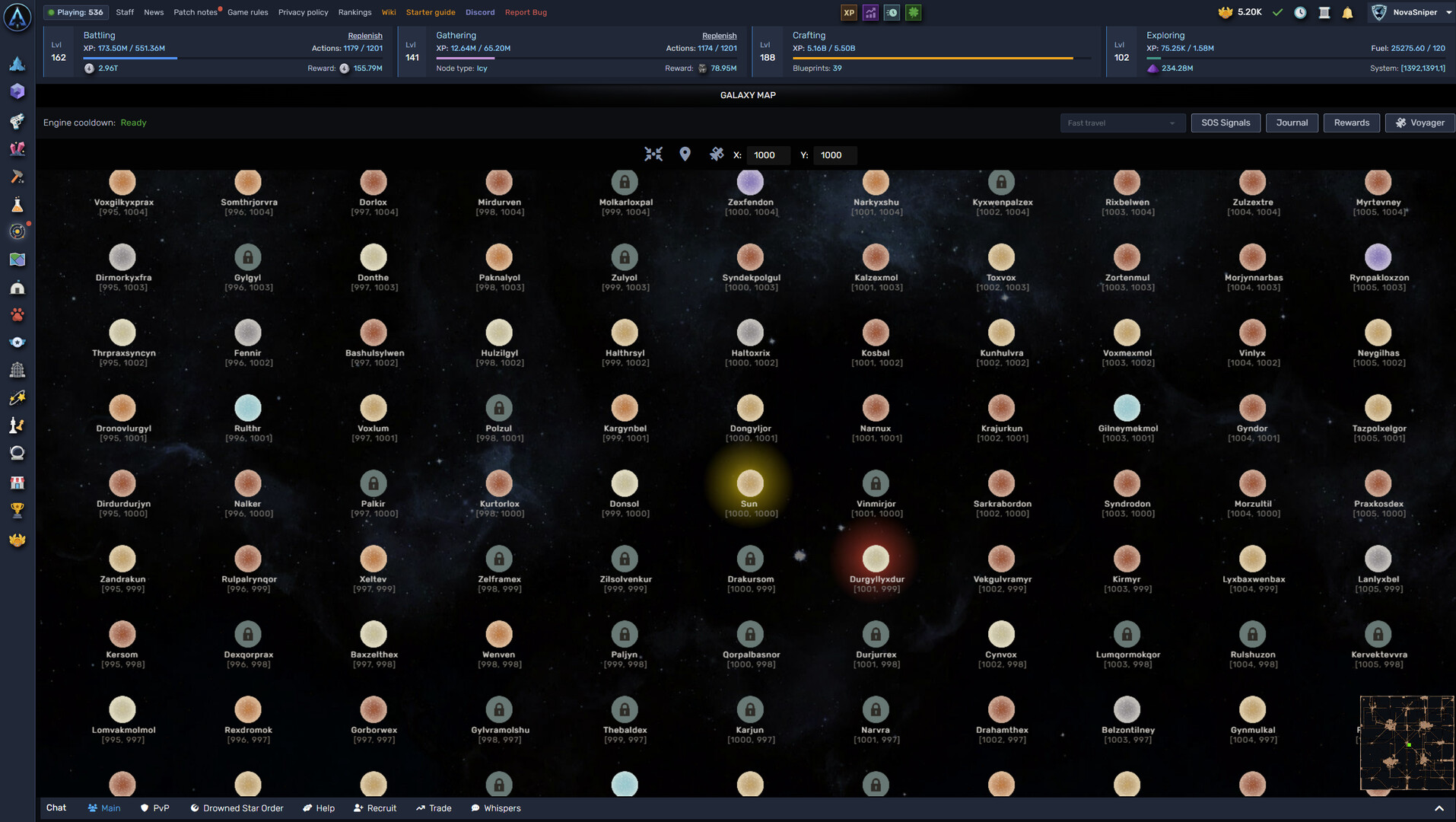
The galaxy map hints at the game's headline claim of nearly 50 million procedurally generated star systems, of which only a small local cluster is unlocked early on.Image: Stellar Games via Steam -
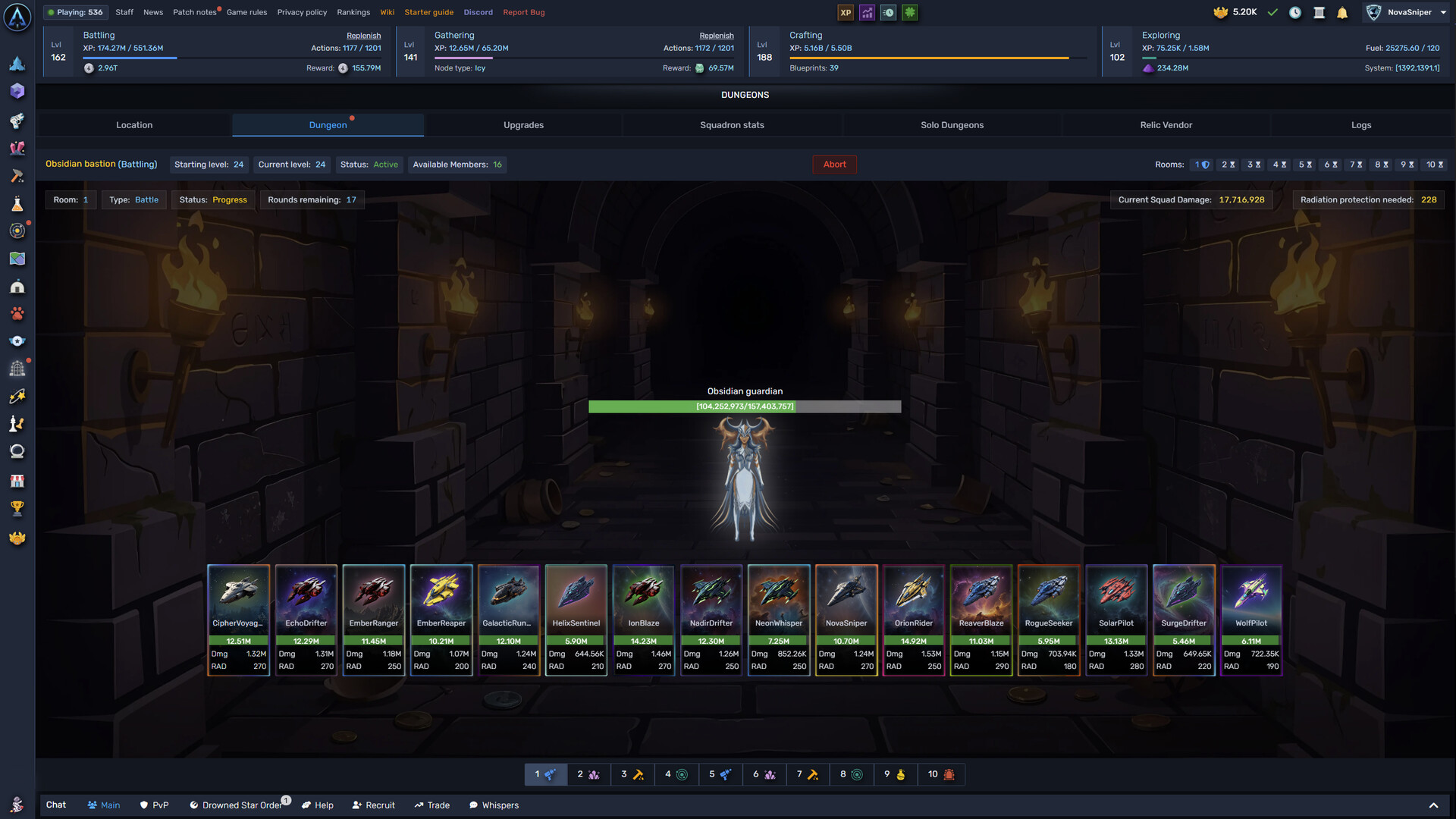
Squadron dungeons scale combat into a genuine team effort, with per-player damage and a shared boss health pool tracked in real time.Image: Stellar Games via Steam