
Game review
Xiuzhen Idle
5.9 / 10
- Developer
- 游戏养家工作室
- Publisher
- 游戏养家工作室
- Released
- 4 February 2025
- Platforms
- PC
- Genre
- Idle Cultivation RPG
Xiuzhen Idle is a solo-developer idle cultivation simulator built around the xianxia genre, the Chinese fantasy tradition of cultivators refining their qi, breaking through realms, and eventually ascending to godhood. Released on Steam on 4 February 2025 by 游戏养家工作室, who develop and publish it alone, it has no official built-in English translation; instead, the store page directs players to opt into an "english" beta branch carrying a community-made translation mod, with the developer candidly admitting in the store description that "due to lack of experience, skills, and language in developing the game for the first time, I am unable to implement the official built-in version of the translation." Despite that rough edge, it has built a strong and unusually vocal following: 188 English-language Steam reviews sit at 90% positive, and several of the most-read reviews describe hundred-plus-hour playtimes.
A genuinely deep cultivation loop, once you push past the interface
The core premise, refine qi, build a cultivation foundation, and climb through five successive realms (Mortal, Spirit, Xuan, Immortal, Divine, all visible as unlockable banners in the game's Travel tab) is standard for the genre, but reviewers consistently single out how much is layered on top of it. One reviewer put it bluntly: "Thought I was buying a single idle game, apparently I was buying an Idle game, an rpg, a tower defense game, a sect management game, and also factorio." Gathering, Mining, Alchemy, Forging, Taming, Planting, and Talismans all level up as independent skill tracks, and a Rebirth/Reincarnation system lets players reset their realm, cultivation, and skills for permanent talent points, a system captured directly in one of the screenshots gathered for this review, where a character with a Reincarnation Realm of Lv2199 is mid-way through allocating tens of thousands of banked talent points across five separate stats. Another long-time player wrote: "Once you ascend past the last realm, there's basically a brand new game that unlocks. 100+ hours in the game, and I've got an entirely new factory logistics micromanagement game to deal with. I absolutely love it." That density is echoed almost unanimously by the game's most positive reviews, several of which call it the best idle cultivation game on Steam by name, with one simply writing: "if you like cultivation novels or games, and you like semi-active idle games, this is the best there is!"
Not as idle as the name suggests
The title promises an idle game, but a recurring, cross-cutting theme in the review sample is that Xiuzhen Idle asks for far more active attention than the genre label implies, and doesn't run while the Steam client is closed. One reviewer with over 3,100 hours logged wrote plainly: "It's very hands off but unfortunately does not have an offline idle so the game does need to be running in the background. This is made especially more annoying by the frequent crashes I experience." Another, shorter review made the same point from a different angle: "This game is definitely pretty 'active'. There are a ton of mechanics to engage with, and until the mid/late game, you can effectively progress in the game while only idling for 10-20 minutes." A third reviewer summarised the mismatch as a design tension rather than a flaw outright: "This actually wants your attention a lot, usually if you're actually idling then you should instead be focusing your effort elsewhere to keep advancing." The planting system shown in one of this review's screenshots is a good illustration of the game's actual pacing philosophy: individual fruit types track maturity across thousands of in-game years on an internal clock, real progress that keeps accumulating, but the surrounding menus, crafting queues, and resource caps mean a player checking in only occasionally will find plenty of manual upkeep waiting for them.
A persistent, unresolved memory leak
Multiple reviewers independently report a memory leak that worsens the longer a session runs, a real cost given the lack of offline progress described above. One wrote: "There are small memory leak, it accumulate over time. That become problem because game need to run to progress," while the player with over 3,100 hours confirmed "frequent crashes" as a direct consequence of needing the game open constantly. This review cannot verify the leak's technical cause, but it is reported by more than one player independently rather than a single isolated account, and it directly undercuts the "hands off" pitch: a game that needs to be left running indefinitely is only as reliable as its long-session stability, and by multiple accounts that stability degrades over time.
Late-game systems that stall or feel pointless
The review sample's negative half converges on a specific and consistent complaint: several systems that feel meaningful early on stop mattering, or stop progressing altogether, once a player reaches the back half of the game. One reviewer wrote: "when we reach level 75 of the skills, there's no reason to keep gaining levels, since you can already make all the items," while another described the split more starkly: "It was a very fun little idle cultivation simulator in the first half, then became a micro-managing spreadsheet after reaching max cultivation." A third reviewer with just over 300 hours went further, describing outright progression stalls: "the game went downhill at the 40-50% mark, stats became capped, progression stopped, the sect and hidden realm stopped progressing and all the caps just brought the game to a halt." Set against the game's genuine depth, this is the clearest throughline in the criticism: the systems are numerous and the early-to-mid game is widely praised, but the back half doesn't uniformly deliver on the promise the front half sets up.
Fair monetisation, rough documentation
On value, the picture is more one-sided. Beyond the base price, an optional Talisman DLC is described by multiple reviewers as substantially useful without being predatory, one wrote it's "nearly a necessity for how much it helps in the early game," while a cosmetic-only DLC drew no complaints about its price precisely because it changes nothing mechanical. Another reviewer specifically praised the absence of pay-to-speed-up mechanics: "quite lovely and impressively lacking in microtransactions and little pay-2-speed up kind of buffs that you can acquire with money." The recurring soft spot instead is documentation and translation quality: several reviewers note the community English patch is incomplete or inconsistent in places, and one wrote plainly that "the game needs more documentation," a fair assessment for a game this systemically dense being run through a fan translation rather than a professional localisation pass.
Verdict
Xiuzhen Idle is a genuinely ambitious solo-developed cultivation sim whose sprawling, interlocking systems, gathering, planting, taming, sect-building, reincarnation, and more, have earned it a loyal following willing to overlook a rough fan translation and a real, still-unresolved memory leak. The core loop across the early and mid game is widely and specifically praised, but a consistent minority of reviewers report the back half stalling out, with capped stats and halted progression replacing the earlier sense of forward motion. At a low asking price with fair, non-predatory DLC, this is an easy recommendation for cultivation-fiction fans willing to run a community translation and tolerate some late-game rough edges; players who want a genre entry that lives up to a literal "idle" label, one that keeps progressing while the client is closed, should look elsewhere.
Screenshots
-
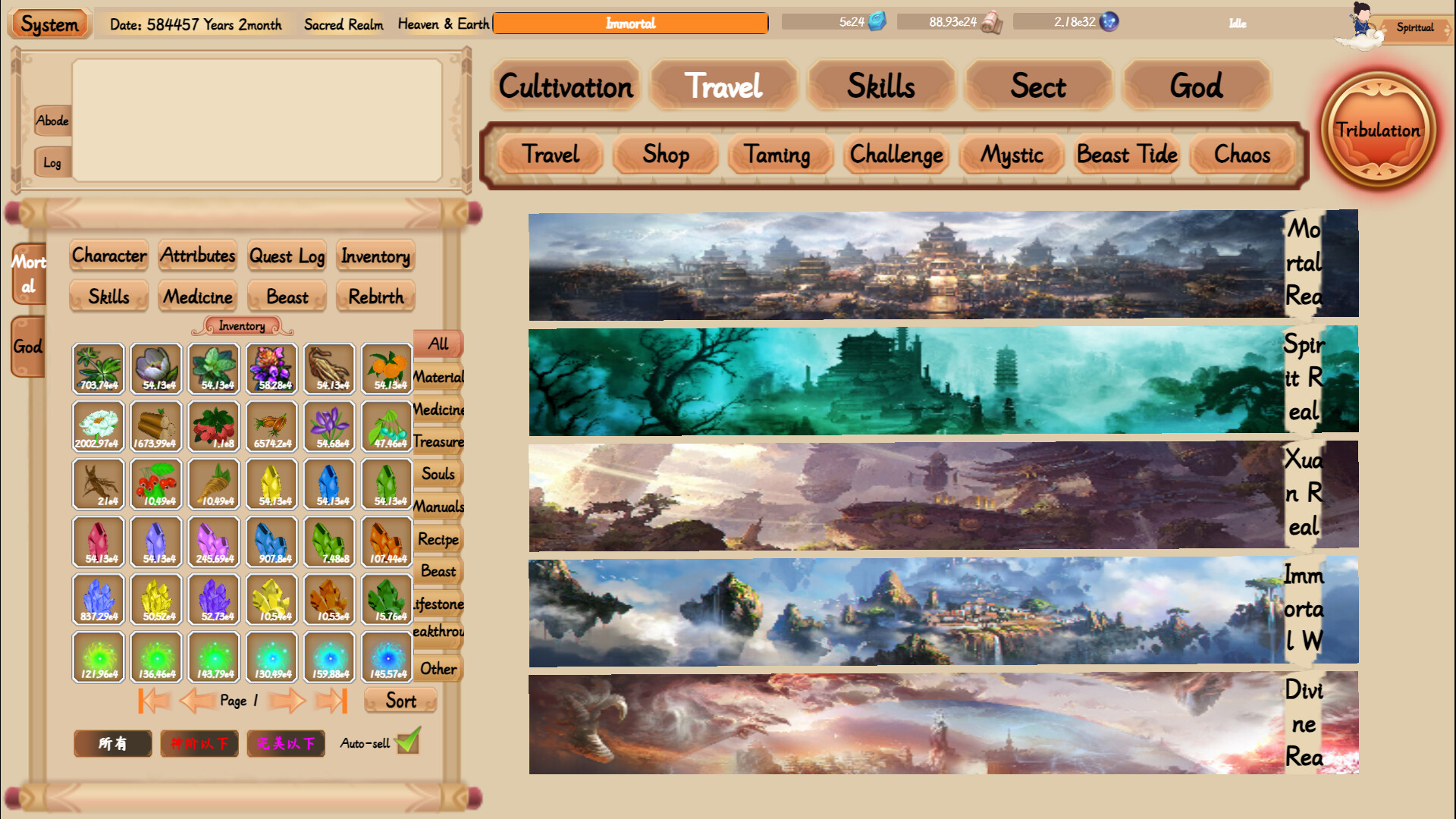
Five successive realms gate access to new content, each one visibly more elaborate than the last on the world-travel banner.Image: 游戏养家工作室 via Steam -

A reincarnation system resets realm, cultivation and skills in exchange for permanent talent points, one of several parallel long-term progression tracks.Image: 游戏养家工作室 via Steam -
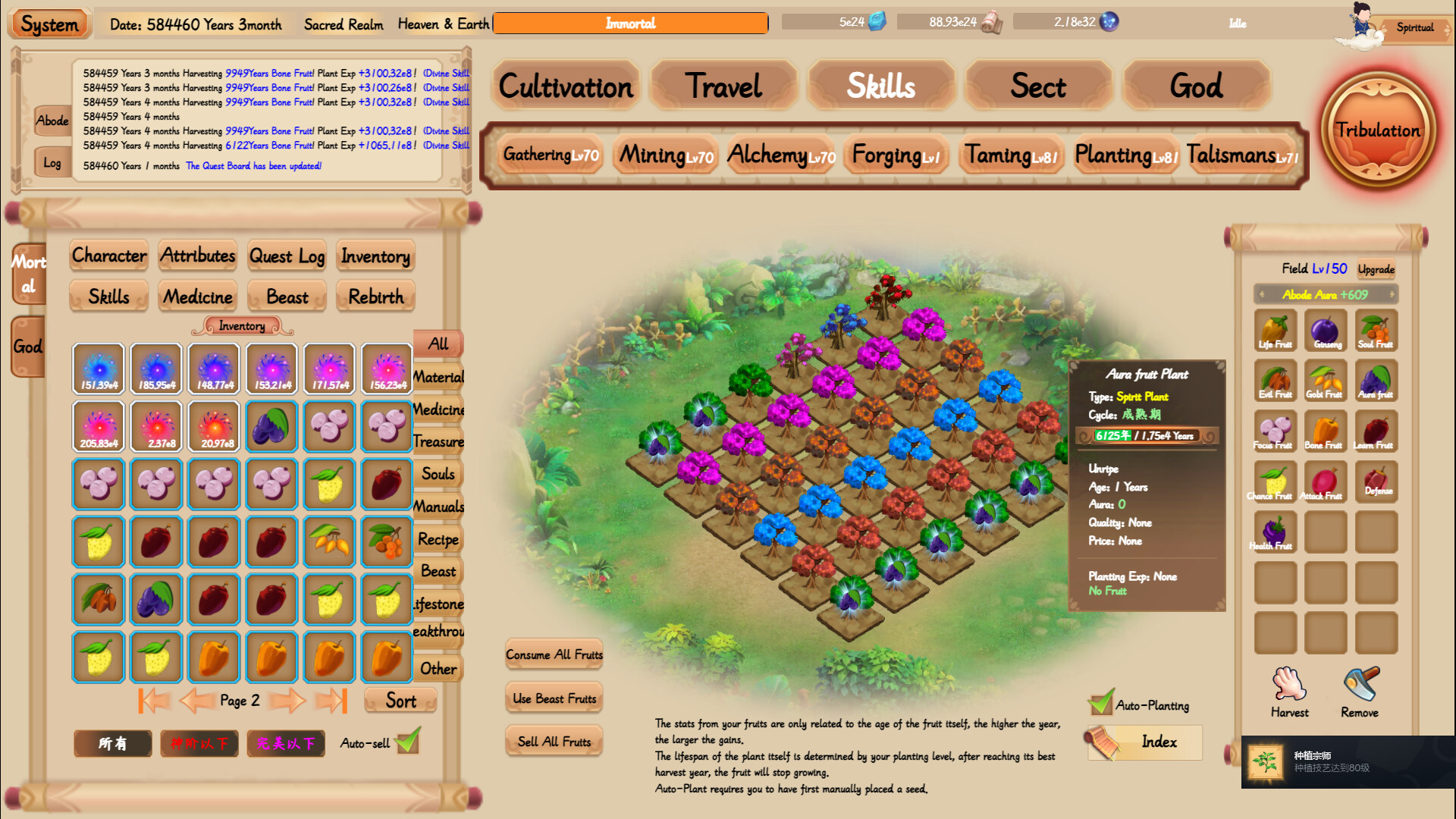
The planting system alone tracks fruit maturity in thousands of in-game years, one of more than half a dozen interlocking systems layered on top of core cultivation.Image: 游戏养家工作室 via Steam