
Game review
LazyLegions
6.2 / 10
- Developer
- SteelWindGames
- Publisher
- SteelWindGames
- Released
- 14 July 2026
- Platforms
- Windows, macOS
- Genre
- RPG
A Mixed 12 Reviews, With a Difficulty Wall Around Stage 4-3 the Loudest Complaint
LazyLegions launched on Steam on 14 July 2026 from solo-scale developer SteelWindGames, and at the time of writing it has 12 user reviews split seven positive to five negative, landing it a "Mixed" rating. The pitch is a straightforward one for the idle-RPG crowd: five auto-battling classes — Archer, Swordsman, Spearman, Healer, and Spellcaster — fight along the bottom edge of the player's desktop while gear rains down to sort, salvage, and re-equip with one click. The most detailed negative review, a Simplified Chinese player with 225 minutes logged, describes a specific and checkable progression wall: enemies at stage 4-3 reportedly jump from a few hundred HP in the first wave to tens of thousands in the second, while the player's own character caps out around 3,000 HP even with equipment factored in, and this same reviewer says their Archer had already been leveled to 90 while still being stuck farming level-20 gear at that same stage — a specific, first-hand account of a difficulty spike rather than a vague "it's too hard" complaint. That reviewer also flags a UI glitch where a Knight class stands idle doing nothing after using its skill and a Healer that visibly floats in the air rather than staying grounded, and, more seriously, that losing a fight triggers a jarring white flash "you might as well gouge your eyes out over." Encouragingly, the same reviewer returned two days later with a follow-up noting the developer had already fixed the Knight's stall and the white-flash bug, though they note the underlying difficulty-curve problem was still unresolved as of that update.
Auto-Battle, Loot Rarity Tiers, and a One-Click Upgrade Loop
The core loop follows the well-worn idle-RPG shape: a squad auto-fights along a lane, loot spills out in Common, Rare, Epic, Legendary, and Mythic tiers, and the player periodically checks in to salvage weaker drops into fuel for a smaller set of core gear rather than manually managing every individual item. The store page frames some weapons as teaching heroes new signature skills once equipped, which — if it holds up in practice — would give gearing decisions a build-shaping role beyond simple stat upgrades, though nothing in the available player reviews specifically confirms or complicates that claim, so it should be taken as a store-page promise rather than a verified mechanic. A screenshot of a Legendary-rarity "Winterpiercer Bow +6" equipped on a level-33 Archer shows the itemisation system runs deeper than a flat rarity-tier label: the tooltip separately tracks base stats, additional "crafted" affixes layered on through enhancement, and a distinct "Auto-processing protected" flag guarding the item from being accidentally salvaged — a safeguard mechanic not mentioned anywhere in the store page's description of the salvage-and-sacrifice loop, and a reassuring one given how central bulk-salvaging weaker drops is to the core gearing loop. A separate combat screenshot backs up the game's own "always something nastier one more run away" pitch with a concrete number: a boss-tier enemy with a large red health bar takes a five-digit hit in the middle of a meteor-shower night battle, while the full five-character party — Healer, Spellcaster, Swordsman, and Spearman all visible fighting alongside an Archer — works the lane simultaneously, matching the long-session reviewers' accounts of numbers climbing well into the tens of thousands over extended play. One of the two highest-playtime reviews available, a Simplified Chinese player who logged over 12,600 minutes (roughly 211 hours), calls the game "quite good quality" and specifically credits the developer with fixing bugs very quickly — a notable data point given how many of the negative reviews are bug reports rather than complaints about the core concept, suggesting the loop itself holds up well enough to sustain over 200 hours of play once the rough edges are worked around. A second long-session player, logging over 3,300 minutes (about 55 hours), similarly reports the developer actively making changes and updated their review accordingly, reinforcing a pattern of a developer who responds to specific, itemized feedback rather than one who's gone quiet after launch.
Bugs That Blocked Progress Entirely for Some Early Players
Several of the negative reviews describe bugs serious enough to have stopped play outright rather than just being cosmetic annoyances. One Simplified Chinese reviewer with 72 minutes logged reports that clicking the exploration map on the right side of the screen simply didn't open, leaving the materials-farming map stuck showing the main city instead, and separately says they couldn't figure out how to recruit more than one of the five playable classes. A second reviewer, with over 600 minutes logged, asks bluntly whether the game can even be left running unattended at all, questioning whether level selection was broken for them. A third reviewer, with zero minutes of stated progress described, says the game froze completely after the very first level with no guidance offered, calling the lack of onboarding into question directly. Separately, a Korean-language reviewer with over 1,270 minutes logged reports unspecified but repeated flaws in the character-growth systems specifically, a notably high playtime figure that suggests this reviewer stuck with the game a long time before deciding its progression systems weren't working as intended. Combined with a Simplified Chinese reviewer's report of frame rates dropping to single digits during combat, and a Japanese-language reviewer's specific complaint that multiplayer didn't work and that equipment disappeared entirely after closing the game, these add up to a real cluster of stability and save-reliability concerns rather than one-off complaints — though it's worth noting the multiplayer and equipment-loss reports date from just two days after launch, and it isn't possible to confirm from the available review data whether those specific issues persist in the current build.
A Newly-Added Co-op Layer Riding Alongside a Rocky Cloud-Save Track Record
LazyLegions' store page highlights online co-op as a headline "NEW" feature: up to eight players can share a lounge, watch each other's squads grow, chat without leaving the game, and roll dice against each other for rare loot drops in shared sessions, with the odds of higher-rarity gear appearing said to improve as more players join a room. That's an unusually social pitch for a genre that's normally solitary by design, and if it works as described it would be a genuine differentiator versus most desktop idle-loot games. But it's launched against a backdrop of reported reliability problems that specifically undercut trust in a system like this: one Simplified Chinese reviewer with nearly 500 minutes logged reports that Steam Cloud saves showed as corrupted and couldn't be recovered, initially recommending against buying the game at all, though the same reviewer posted a follow-up the next day noting the developer had already reached out about fixing the issue they'd raised. For a feature built around trusting shared, persistent state across up to eight simultaneous players, a documented history of cloud-save corruption on the single-player side is a reasonable thing for a prospective buyer to weigh before counting on the co-op loot-rolling as reliable.
Price, Platform Reach, and Localisation Gaps
At NZ$2.69 during a 40%-off promotion (NZ$4.49 at full price), LazyLegions is priced as a genuinely low-commitment idle pickup, and it supports both Windows and macOS with no Linux build listed. It ships with 13 supported languages including English, Simplified and Traditional Chinese, Japanese, Korean, Russian, French, German, and several others, and includes 63 Steam achievements plus Steam Cloud and Leaderboards support, categories that suggest a reasonably ambitious feature scope for a desktop-idle title at this price point. That broad language list comes with at least one specific gap flagged directly by a player: a Simplified Chinese reviewer notes the game has achievements but no Chinese localisation for them specifically, even though the base game's interface is in Chinese, a small but concrete inconsistency worth knowing about for players who care about fully localised achievement lists. There's no DLC listed on the store page, and the pricing structure appears to be a single upfront purchase rather than an ongoing monetisation model layered on top, which for a genre that frequently leans on gacha-style purchases or energy timers is a genuinely consumer-friendly structure worth crediting directly. The store page's marketing copy also undersells the amount of meta-progression on offer: a screenshot of a separate "Rune Path" menu shows a full skill tree branching into five distinct categories — Offense, Economy, Support, Survival, and Automation — layered on top of, and entirely separate from, the gear-based progression the store page focuses on, with at least one node gated behind an "Ascend 3000" requirement that implies a substantial long-term currency sink. The same screenshot's background carries on-screen text reading "the town is slowly coming back to life," a small but concrete hint of a settlement-rebuilding narrative frame around the numbers that isn't mentioned in the store description at all, and one that gives the otherwise generic fantasy setting a bit more shape than "auto-battle for loot" alone suggests.
Verdict
LazyLegions delivers a competent, if unremarkable, take on the desktop idle-loot RPG formula — five auto-battling classes, a familiar Common-to-Mythic rarity ladder, and a newly-added social co-op layer that's an interesting differentiator on paper. What holds it back at review time is a real, documented cluster of launch-window problems: a specific and checkable difficulty wall around stage 4-3, reports of broken exploration-map navigation, frozen progression with no onboarding for at least one player, single-digit frame rates in combat for another, and a cloud-save corruption report that undercuts confidence in the new co-op feature's shared, persistent state. The genuinely encouraging counterweight is a developer who multiple reviewers independently describe as fixing reported issues quickly, including two players who updated their reviews after seeing fixes land and one who logged over 200 hours despite the rough start. At NZ$2.69, it's a reasonable low-risk pickup for idle-RPG fans willing to tolerate some early rough edges while SteelWindGames continues patching, but not yet a confident recommendation for anyone who wants a smooth, bug-free experience out of the gate.
Screenshots
-
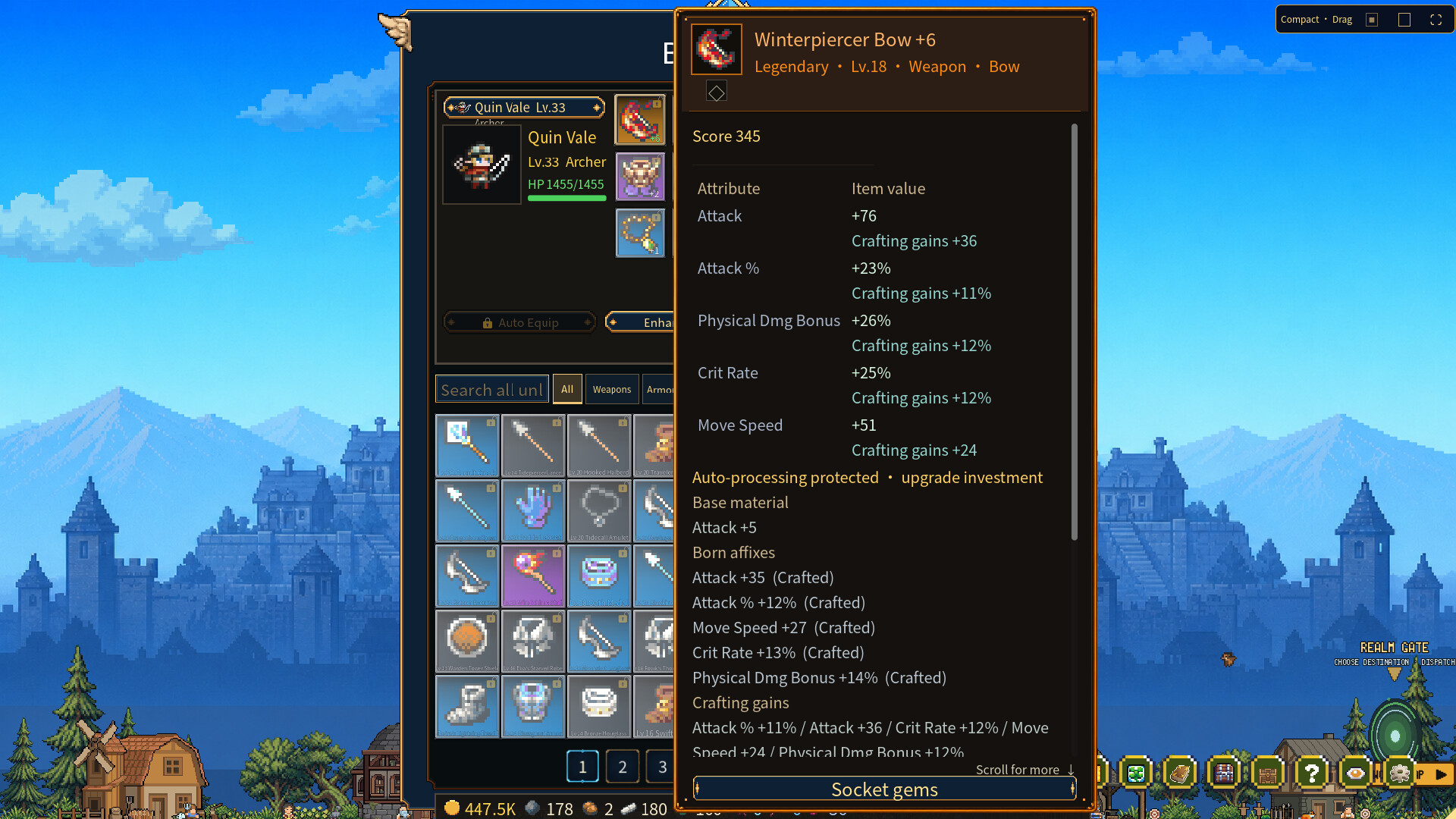
A Legendary bow's full item panel, showing separately tracked base stats, crafted affixes, and a salvage-protection flag not mentioned anywhere on the store page.Steam store page -
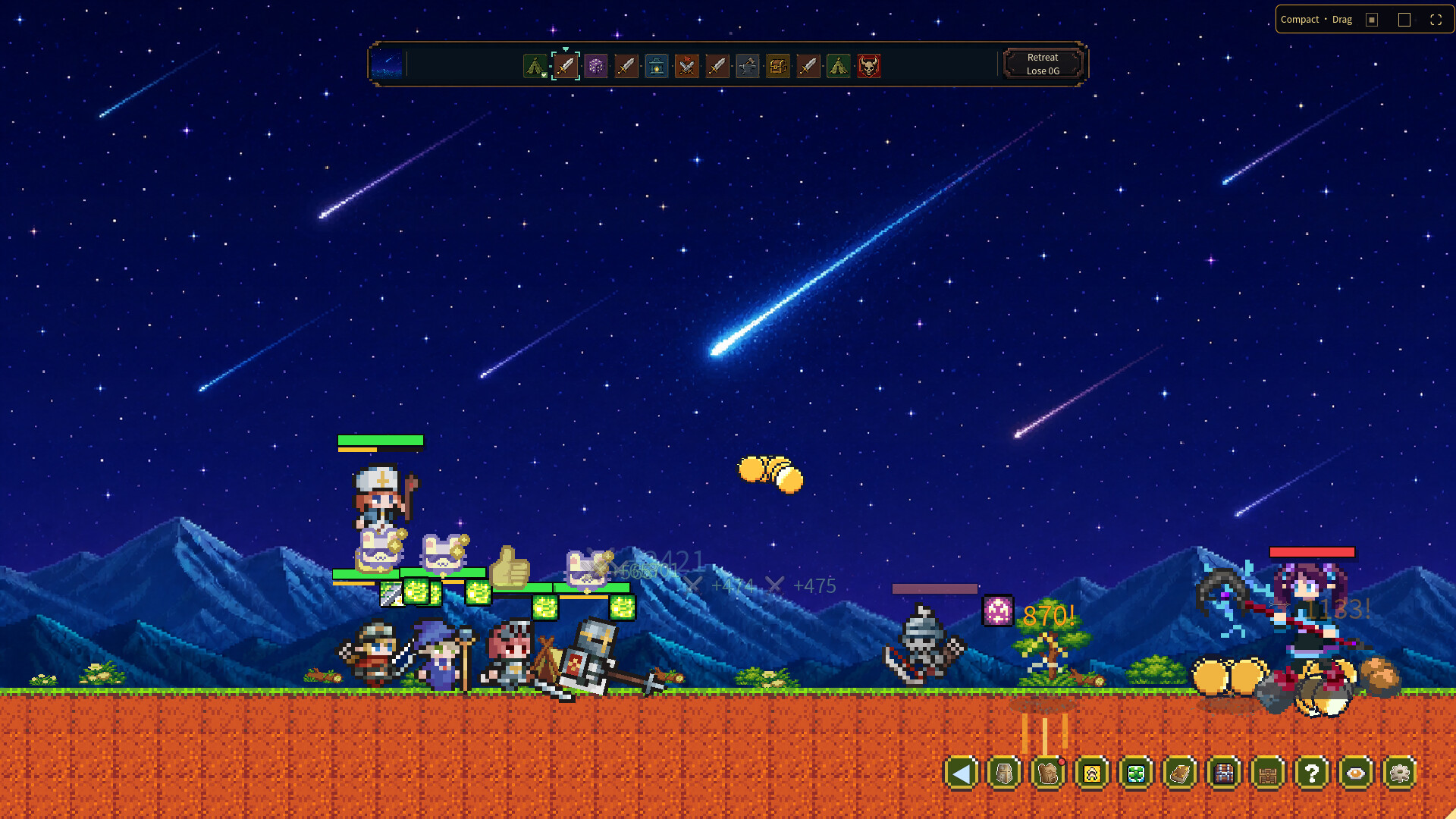
A live lane battle at night, with the party's Healer, Spellcaster, Swordsman, and Spearman engaging a boss-tier enemy for a five-digit hit.Steam store page -
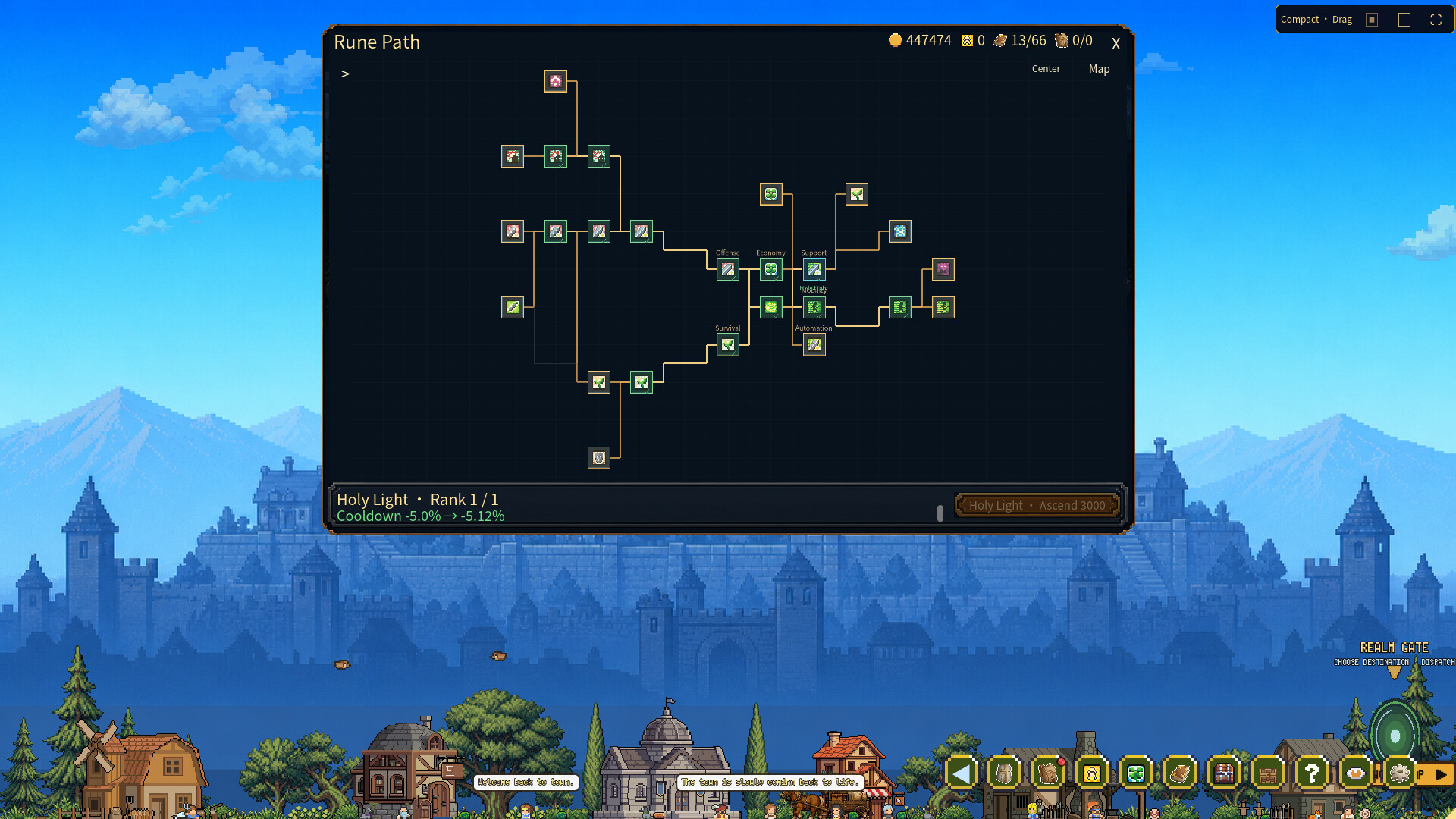
The Rune Path meta-progression tree, branching into five categories including Automation, layered over a town-rebuilding narrative not mentioned on the store page.Steam store page