
Game review
Gambit Loop
6.8 / 10
- Developer
- Delirium Tremens Games
- Publisher
- Delirium Tremens Games
- Released
- 10 September 2026
- Platforms
- Windows, Linux
- Genre
- RPG
Five Reviews, Split Three-to-Two, With Specific Complaints on Both Sides
Gambit Loop launched out of what its in-game splash screen calls a "V1.0.0 release" on 10 September 2026 from developer Delirium Tremens Games, and at the time of writing it has only five user reviews — three positive, two negative — too small a sample for Steam to assign one of its usual descriptive score tiers. The positive reviews are cautiously so: one German-language player with over 44 hours logged writes (translated) "you can buy it for 4.41 euros, but you don't have to... I give it a thumbs up for the price," while an English reviewer with 467 minutes logged calls their first impressions "decently positive" despite "a lot of little clean-up that could be done," and a third, with almost 21 hours logged, says the game is "what I've been looking for in a semi-idle game" even though it's "rough around the edges right now." The negative reviews are considerably more specific: an English-language player with over 47 hours logged details several gambit-system limitations that block builds they wanted to make, while a Simplified Chinese reviewer with over 56 hours logged sums up a core frustration in one line (translated): "You can't idle on this floor, everything requires manual input — and this is called an idle game?" Read together, the five reviews describe a real, promising mechanical hook that a meaningful share of its very small early audience feels isn't yet fully backed up by its execution.
Program Your Hero's Brain: A Genuine FFXII-Gambit System Applied to Idle Combat
The store page pitches Gambit Loop directly as an answer to "what if Final Fantasy XII's gambit system had its own game," and a screenshot of the Gambit Setup screen shows real structural depth behind that pitch: each numbered rule pairs an input condition (a boss's HP crossing a threshold, an enemy having a specific status, a random-chance roll) with an output action (Heal, Final Judgment, a targeted attack), an optional target (Self, Most Wounded), and an optional equippable rune, with three separate build slots plus export and import options for saving and sharing entire gambit setups. A boss-battle screenshot shows those rules executing live: a "Blade Dance" attack fires and chains across the battlefield for over 2,000 crit damage against a boss named "Fallen Seraph," while a running battle log confirms in plain text exactly which gambit rule triggered each action, turning what could be an opaque black box into something a player can audit and iteratively refine. A second boss encounter, against "Chaos Void, Abyssal Priest," shows the system's more punishing side: a "Silence" status effect lands on the player's mage mid-fight, a specific counter-condition a well-built gambit list needs to plan around rather than simply react to.
Three Classes, Nine Subclasses, 300+ Skills, and a Genuinely Deep Talent Constellation
Character building is split across three base classes — Warrior, Mage, and Thief — each branching into three named subclasses (Paladin, Berzerker, and Hunter for Warrior; Fire, Ice, and Thunder for Mage; Assassin, Archer, and Dancer for Thief), with the store page citing more than 300 active and passive skills spread across what a screenshot shows as a genuinely sprawling talent web, styled as a star-chart "Skill Constellation." That screenshot shows 26 nodes already unlocked, 9 currently available, and 25 unspent skill points still banked, radiating out toward dozens of further locked nodes in the distance — a visibly large tree rather than a small skill list dressed up as one. Progression runs across more than 100 floors spanning over 20 distinct biomes, with a total of 193 enemies including elite variants carrying their own dangerous affixes, and the store page notes that bosses are specifically designed to "force you to rethink your gambit setup mid-run" — a claim the two boss-battle screenshots, each showing a different disruptive status effect in play, back up directly. One negative review pushes back on how much of that depth is reachable in practice, though, reporting that with a single active unit and one skill tree, a build "quickly max[es] out the tree and only need[s] maybe 3 gambits" to run efficiently — a genuine tension between the system's apparent scale and how much of it any one playthrough actually uses.
Legendary Gear With Real Affix Rolls, a Black Market, and a Pay-to-Test Oracle
Gear runs from Common up to Legendary rarity, and the store page's own screenshot gallery shows a genuinely granular itemisation system underneath that rarity label: an equipped Legendary "Brutal Arcane Staff" has separate base stats (ATK, DEF, Max MP, ATB Speed) sitting alongside a distinct affix section (MAG, Crit Dmg) and individually-rolled prefixes and suffixes (Poison Dmg, Crit Rate, Armor Pen, Leech) each tracked against a visible roll-quality bar, plus a named "Brutal" unique trait adding a flat +20% Crit Damage on top of everything else. A Black Market panel sells mystery gear in six equipment slots for a rising gold cost, with a reroll option to refresh those offers, and a separate Forge screen lets the player drop an item in for further enhancement, though this review can't independently confirm exactly what upgrading there does beyond what the store page shows. Most distinctive is an "Oracle" system shown in that same broader gallery: for a rising gold cost, the player can pay to have the Oracle simulate a chosen gambit line against roughly 80 test fights drawn from bosses and regular enemies at their current floor, returning an estimated win-rate and a verdict — one captured consultation reports "your current line: 0.0% winrate... 8 alternatives tested — none beat it by +10 winrate points," a genuinely unusual, statistics-driven theorycrafting tool for validating a build before committing it to a real run, even if this outlet's own three chosen screenshots happen to focus on live combat and gambit setup rather than that particular gear and Oracle screen.
Specific Interface Friction, Alongside a Clean Single-Purchase Structure
Beyond the promising core loop, several reviews raise concrete, specific interface complaints rather than vague polish gripes. One player reports that selling items puts the confirmation button "nowhere near the item you right-clicked," that a string of tooltips "appear to be in French" despite the game being played in English, and that the Thief subclass's "Combo" mechanic is referenced repeatedly in tooltips without ever showing the player its current value or how it's gained. A second, more critical reviewer describes deeper gambit-configuration limits: a rule meant to punish an enemy's Reflect status can't be set to specifically target that enemy, a debuff-triggered gambit can't be locked to the Freeze debuff specifically and instead defaults to matching any debuff, and Unique-rarity items arrive automatically locked and can't be sold in bulk, requiring each one to be individually unlocked first — described as "incredibly tedious" for a system that otherwise encourages picking through drops quickly. None of these are reported as crashes or performance failures; they read as a young, single-developer release still working through real rough edges in a genuinely ambitious system rather than a fundamentally broken one. Set against that friction, Gambit Loop is priced at NZ$7.89 on Steam, currently discounted 15% to NZ$6.70, runs on Windows and Linux with support for English, French, German, Simplified Chinese, and Russian, and lists only a free demo as its sole "DLC" rather than any paid add-on — nothing on the store page or in any of its five reviews suggests monetisation beyond that single upfront price. It ships with 50 Steam achievements carrying genuinely varied, class-flavoured names like "First Blood," "Pack Hunter," "The Reaper," "Crow's Eye," and "Blade Echo" rather than flat numbered tiers, plus Steam Cloud support and an unusually thorough set of accessibility options for a small indie release, including adjustable text size, colour alternatives, custom volume controls, a mouse-only play option, and full playability without timed input.
Verdict
Gambit Loop takes a genuinely distinctive idea — Final Fantasy XII's gambit system, rebuilt as the entire core loop of an idle auto-battler RPG — and backs it with real structural ambition: three classes branching into nine subclasses, 300-plus skills across a sprawling talent constellation, more than 100 floors across 20-plus biomes, granular Legendary-tier itemisation, and an unusually clever pay-to-simulate Oracle system for validating a build before committing to it. But its five-review sample, however small, points at real growing pains: specific gambit-configuration limits that block certain build ideas, tedious unique-item handling, misplaced interface elements, and stray wrong-language tooltips, alongside at least one player's complaint that its "idle" framing oversells how hands-off the moment-to-moment floor progression actually is. At NZ$7.89 (currently NZ$6.70) with a clean single-purchase structure and a free demo available to try first, this looks like a promising, if still rough, pickup specifically for players drawn to deep, systems-driven theorycrafting over reflex-based combat — trying the free demo first is a genuinely sound way to judge whether its execution has caught up to its ambition.
Screenshots
-

A boss fight in progress, with a live gambit list and battle log confirming exactly which programmed rule triggered each action.Steam store page -
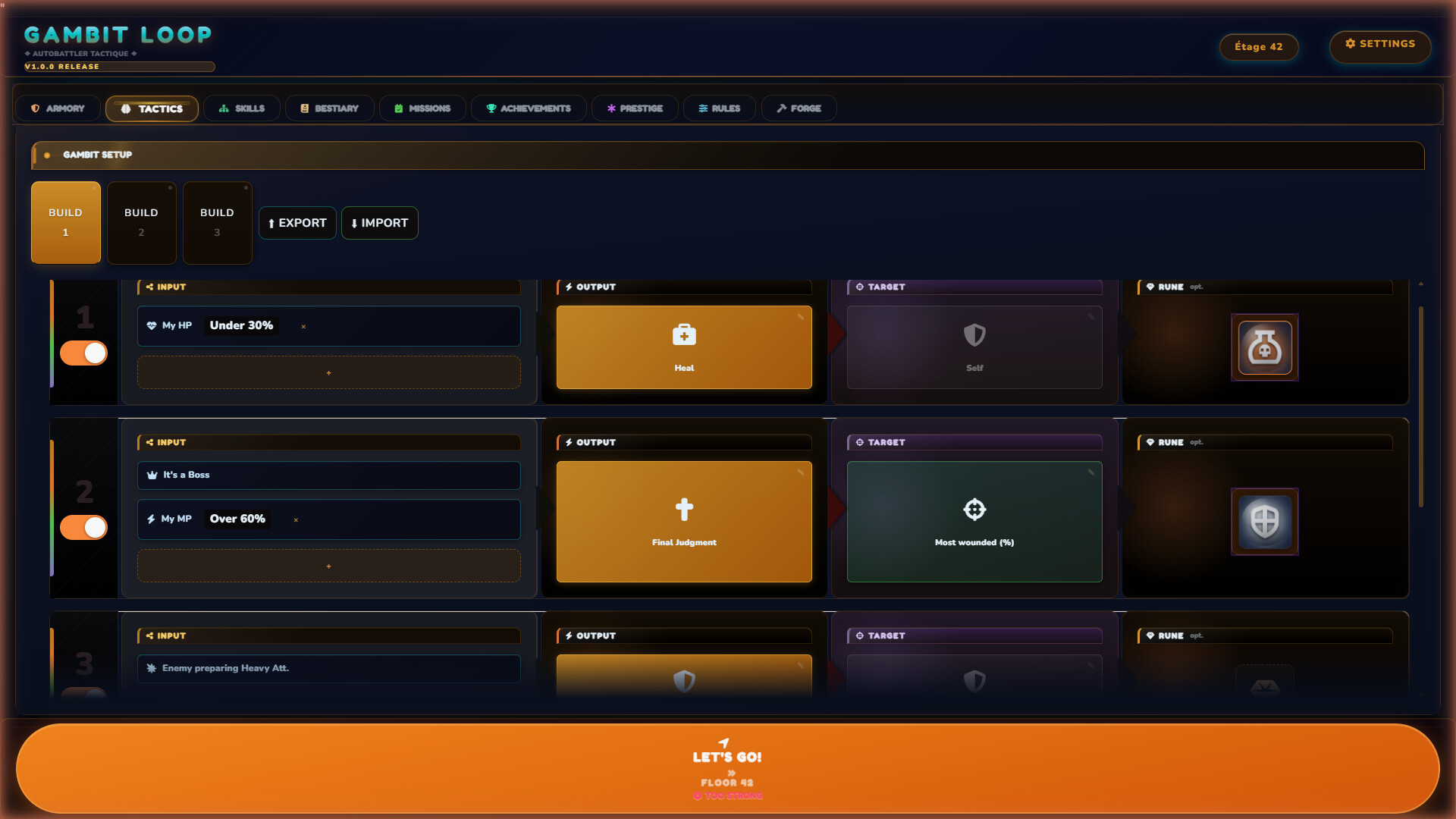
The Gambit Setup screen, where every combat rule is built from a condition, an action, a target, and an optional rune, then saved to one of three swappable builds.Steam store page -

A second boss fight, this one landing a Silence status effect on the player's mage mid-battle.Steam store page