
Game review
SHRIMP GAME: OVERKRILL
6.7 / 10
- Developer
- GasGod Games, GLUE MAN
- Publisher
- GIGATANK 3000
- Released
- 27 August 2026
- Platforms
- Windows
- Genre
- Looter-Shooter RPG
- Monetisation
- Premium
- Players
- Single-player, online co-op (up to 6), online PvP
The short version
SHRIMP GAME: OVERKRILL commits fully to its absurd premise — piloting a Submersible Hydrodynamic Research Integrated Marine Platform through a sunken, Lovecraftian world — and backs the joke with genuinely satisfying third-person combat, six elemental classes that combine into dozens of fusion builds, and co-op for up to six pilots. Reviewers who played through the campaign describe a game that earns its years of playtesting, but a meaningful minority flag that weapons and abilities don't carry over between stages, leaving progression feeling thinner than the build variety promises, alongside a confusing early hub layout and some reports of poor performance on capable hardware.
Biggest strengths
- Genuinely satisfying third-person combat that multiple reviewers compare favourably to games like Risk of Rain and Kirby Air Ride, of all things
- Deep elemental build system — six base classes combining into roughly two dozen fusion types across 11 distinct SHRIMP platforms
- Well-implemented co-op for up to six players spanning the full campaign, plus dedicated PvP modes (Shrimp Royale, Shrimp Tag, Boss Mode)
Biggest weaknesses
- Weapons and abilities reset between stages, with only base shrimp stats carrying over, which several reviewers say makes progression feel largely absent
- Weapon rarity and stat comparisons are hard to read in the middle of combat, forcing players to grab drops blind and test them afterwards
- The early hub and overworld structure is confusing to navigate, with unclear boundaries between story missions and open exploration
Who it's for: Fans of looter-shooters and co-op arena combat who don't mind a system that resets its builds between runs
Our recommendation: Recommend
6.7 / 10
An Absurd Premise, Played Completely Straight
SHRIMP GAME: OVERKRILL wears its silliness on its sleeve — you pilot a "Submersible Hydrodynamic Research Integrated Marine Platform," which is to say a shrimp-shaped mech, through a decaying underwater realm full of Lovecraftian bosses and hostile sea life. But reviewers who reached the campaign's end describe a game that treats that premise with real design ambition rather than leaning on the joke alone. One reviewer, who says they playtested the game for over three years before release, calls the eventual campaign payoff "crazy good," while another compares the loop to a mix of Kirby Air Ride, Risk of Rain, and an arena shooter. The pun-heavy writing ("Shrimply fantastic," "One in a krillion," "the yogurt effect") runs through nearly every corner of the review sample, and it's clear the tone is a deliberate, consistent choice rather than a gimmick that wears thin.
Combat Built on Elemental Fusion
The core loop is a third-person looter-shooter: explore an open hub and story missions, fight increasingly large bosses (the review sample name-checks a "volcano-bound hermit crab" and a "kaiju-sized electric eel"), and build out a shrimp platform from six base elemental classes that combine into roughly two dozen fusion types, with names like Magma, Smog, Moon, Demon, and Bone. Layered on top are 11 distinct SHRIMP platforms, each with its own base stats and playstyle, and a weapon system built around heavy cannons, shotgun blasts, and machine-gun-style projectiles with stacking rarities. Reviewers consistently praise how experimenting with element and weapon combinations changes the feel of a run, and the co-op implementation — up to six players through the entire campaign — draws specific praise for working smoothly rather than feeling bolted on. The dedicated PvP modes, Shrimp Royale, Shrimp Tag, and Boss Mode, are mentioned less often in the sample but read as a genuine second pillar rather than an afterthought.
Where Progression Falls Short
The clearest fault line in the review sample is progression. More than one reviewer notes that weapons and abilities collected during a stage don't carry over to the next — only a chosen shrimp's base stats persist — which leaves the sense of building toward something feeling weaker than the elemental-fusion system promises on paper. One detailed critical review specifically calls out the lack of persistent build progress, and separately argues the pool of pickup weapons leans too heavily on bullet-type projectiles, wishing for more variety in weapon archetypes like beams, pulse lasers, or grenade launchers. A related complaint is that weapon and rarity comparisons are difficult to read mid-fight, forcing players to grab a drop under fire and only judge it once the dust settles — a small but real friction point in a game that otherwise wants players experimenting freely.
A Confusing First Few Hours
Several reviewers who otherwise enjoyed the game single out the early hub and world structure as disorienting. The line between the central "backwaters" overworld, its own enemies and bosses, and the individual story missions branching off it isn't always clear, and one reviewer describes needing real trial and error to understand which areas were open exploration versus gated story content. This settles down as players get their bearings, according to the sample, but it's a rough patch specifically in the opening hours that a clearer onboarding pass could likely smooth out.
Technical Notes
The review sample is mostly quiet on technical issues, which is itself a reasonably good sign for a co-op-heavy indie release, but it isn't spotless. One reviewer running a 9700X3D and RTX 5070 Ti reports the game performing poorly enough to cause headaches from stutter, despite hardware well above what the game's visual scope would suggest it needs. That's a single data point rather than a pattern in this sample, but it's worth flagging for players on less mainstream hardware configurations, particularly given the game's online co-op and PvP focus, where smooth performance matters more than in a purely offline game.
Years in the Making
Several reviewers mention a history with the game that predates its full release, and it shows. One reviewer says they playtested the build for over three years before launch, and others specifically reference the earlier free prototype, SHRIMP GAME: KRILL CONFIRMED, as a point of comparison — one writes that the finished game is "THIS much better than the demo," a sentiment echoed by players who tried the free version first before deciding to buy in. That long lead time seems to have paid off in the areas the sample praises most: the co-op implementation across a full six-player campaign feels genuinely tested rather than tacked on, and the PvP suite ships with three distinct modes (Shrimp Royale, Shrimp Tag, and Boss Mode) rather than a single reused arena mode, giving the multiplayer side real variety alongside the solo campaign.
Worth Diving In At Full Price
At NZ$18.75, reviewers broadly treat SHRIMP GAME: OVERKRILL as good value, with one player logging 46.7 hours and calling it a game-of-the-year contender, and others specifically noting they got well beyond what they expected for the price after trying the free demo first. For players drawn to co-op looter-shooters with a genuine sense of humour and a willingness to experiment with elemental builds, OVERKRILL delivers a confident, well-tested campaign. Players who specifically want a strong sense of moment-to-moment progression and build permanence between stages should go in aware that several reviewers found that particular itch unscratched.
Pros and cons
Pros
- Genuinely satisfying third-person combat that multiple reviewers compare favourably to games like Risk of Rain and Kirby Air Ride, of all things
- Deep elemental build system — six base classes combining into roughly two dozen fusion types across 11 distinct SHRIMP platforms
- Well-implemented co-op for up to six players spanning the full campaign, plus dedicated PvP modes (Shrimp Royale, Shrimp Tag, Boss Mode)
- A strong, committed sense of humour that runs through the writing, boss design, and soundtrack without undermining the game's ambition
Cons
- Weapons and abilities reset between stages, with only base shrimp stats carrying over, which several reviewers say makes progression feel largely absent
- Weapon rarity and stat comparisons are hard to read in the middle of combat, forcing players to grab drops blind and test them afterwards
- The early hub and overworld structure is confusing to navigate, with unclear boundaries between story missions and open exploration
- Reports of poor performance on capable modern hardware for at least one reviewer, despite the game's relatively modest visual scope
Screenshots
-
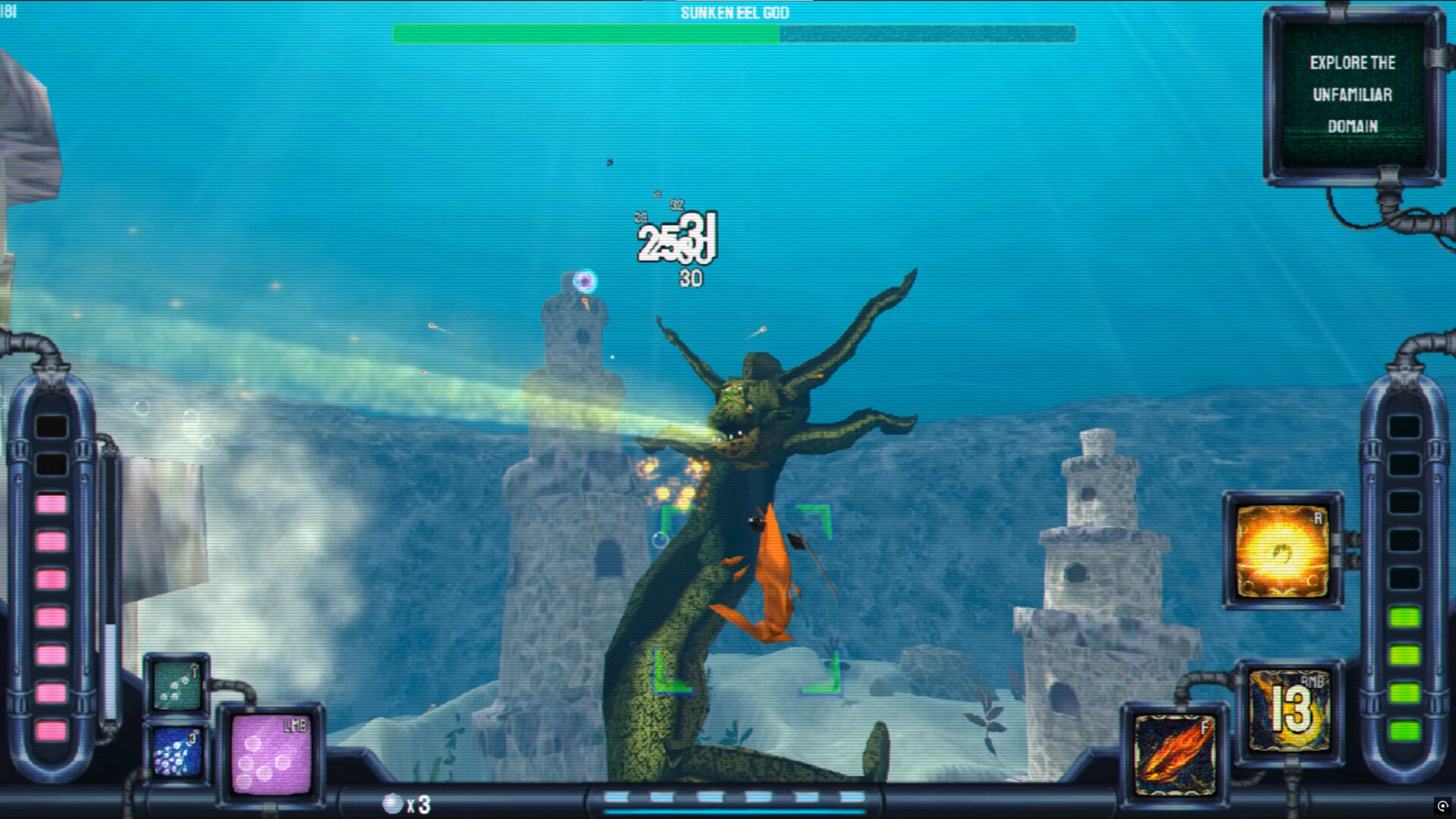
The Sunken Eel God, one of the campaign's Lovecraftian bosses that reviewers say the game's years of playtesting help it earnGIGATANK 3000 -
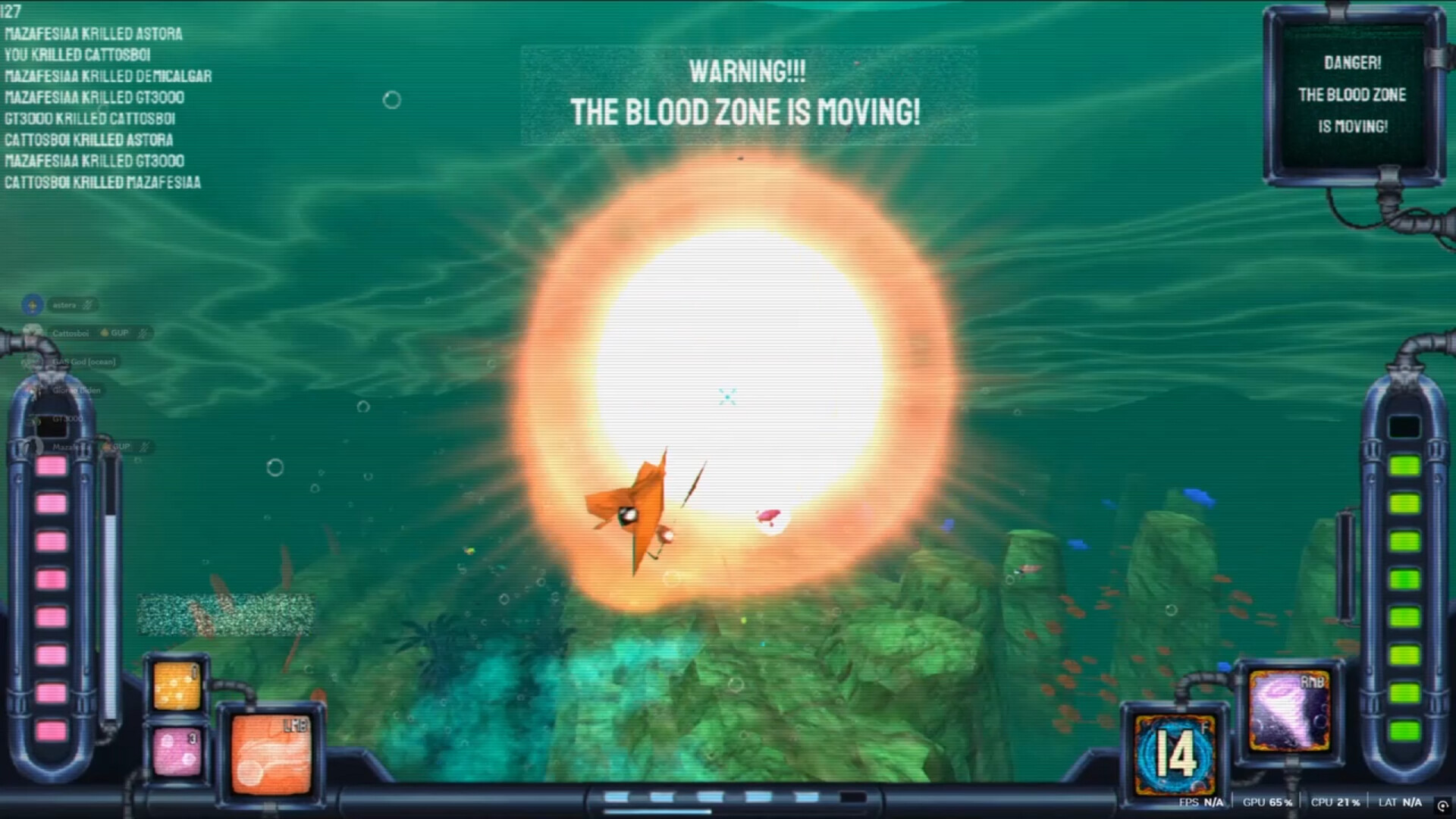
Shrimp Royale, one of the three dedicated PvP modes alongside the campaignGIGATANK 3000 -
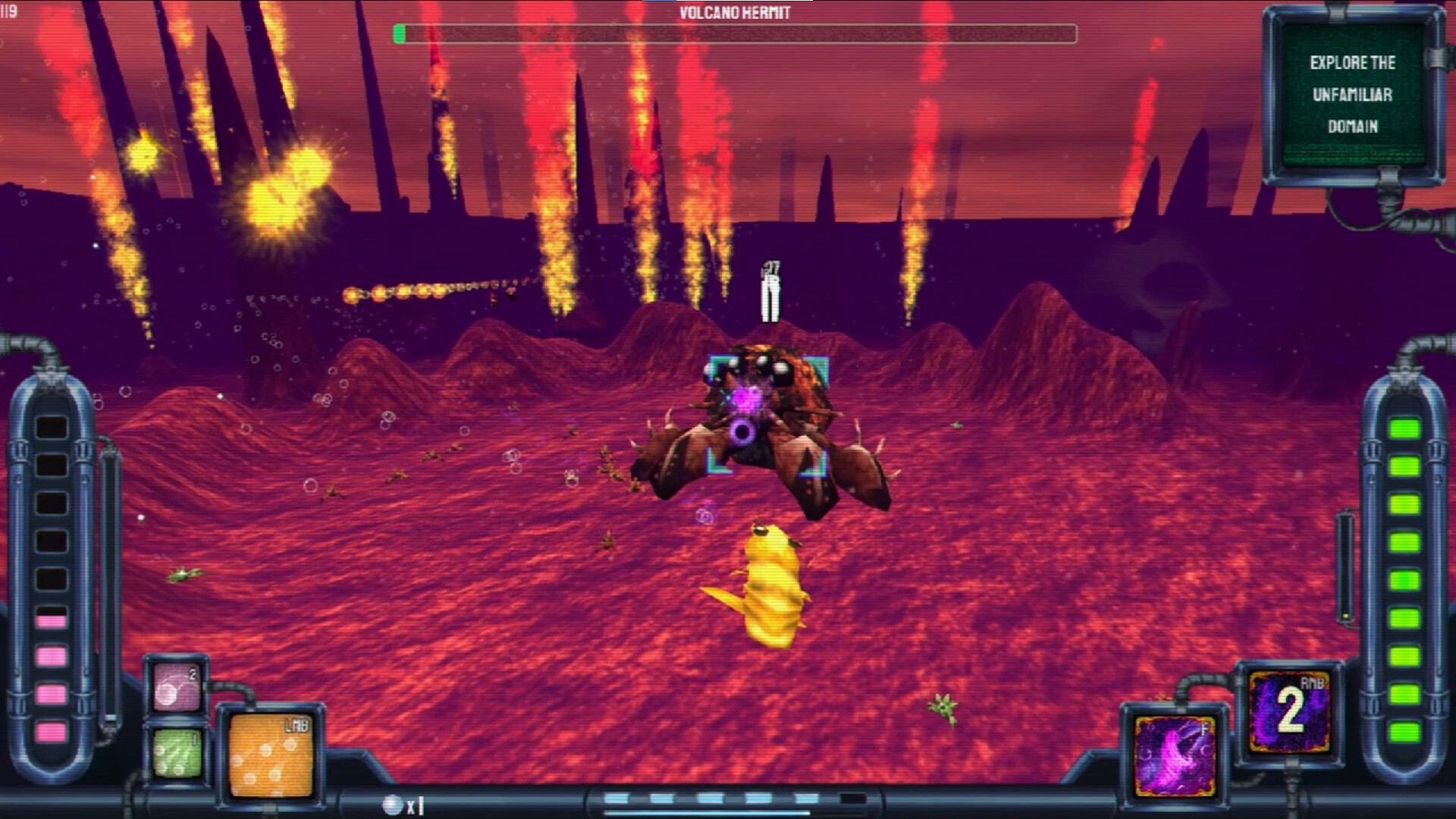
The volcano-bound Volcano Hermit boss, fought across a lava-streaked seabedGIGATANK 3000 -
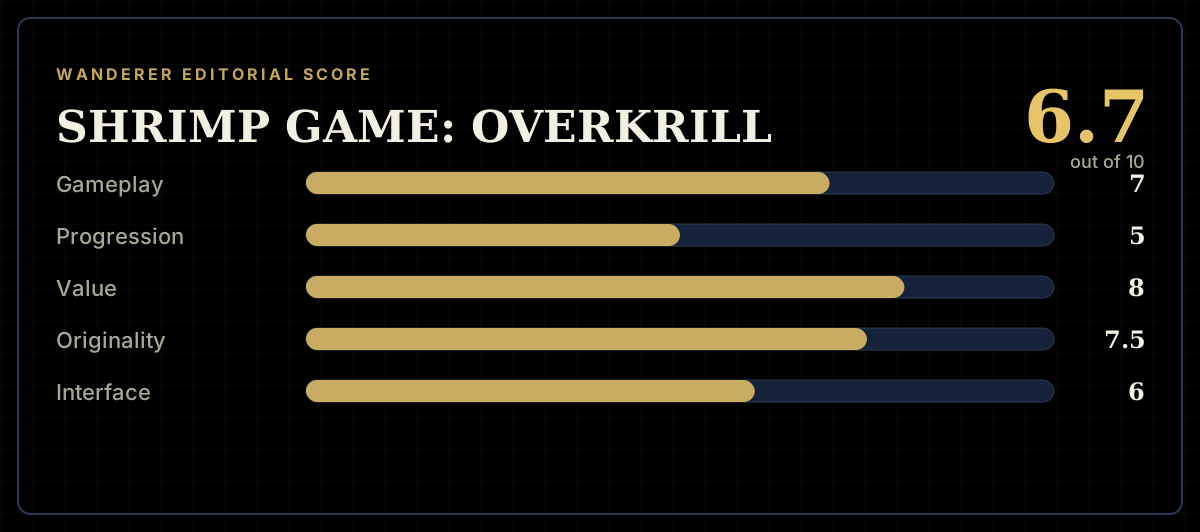
How the review scores each part of the gameWanderer Editorial -
The short versionWanderer Editorial